Egypt: Tourism megaproject in St. Catherine displaces Bedouin people and damages ecosystems and heritage

Construction of the Great Transfiguration Project – a mega tourism development n the St. Catherine area comprising luxury hotels, villas, chalets, visitors centre, shopping bazaars, housing and roads is linked to expansion of St. Catherine Airport.

Great Transfiguration Project (GTP), Egypt
Great Transfiguration Project (GTP) area, Egypt. Aerial imagery: 2nd July 2023

The Great Transfiguration Project (GTP), a mega tourism development project including hotels, villas, chalets, private housing, shopping bazaars, other facilities and roads in and around the St. Catherine area – a designated UNESCO World Heritage Site which includes St. Catherine’s Monastery and Mount Sinai – was announced by the Egyptian government in March 2021. Within weeks demolitions and construction works by private companies began. An August 2022 statement by the Egyptian Human Rights Forum (EHRF) detailed the project components, situation on the ground, impacts on and response from local communities and NGOs and comments from experts. Many contributors confirmed that GTP implementation had already caused serious, irreversible damage of nature, ecosystems, heritage and negative impacts on local people. EHRF’s statement said authorities had not included the local Jebeleya Bedouin tribe or the wider local community and that local organisations, community representatives, experts and representatives of St. Catherine’s Monastery (one of the oldest continuously inhabited monasteries in the world) and its inhabitants had not been consulted. A St. Catherine’s expert said homes were being demolished without compensation, part of the mosque had been demolished and the cemetery dug up. An eyewitness said many old olive and pistachio trees had been removed and some locals had worked together to replant them in different gardens. Construction of a 70km highway connecting St. Catherine with Al-Tur, on the Gulf of Suez, raised concerns over the environmental impacts. An expert on St. Catherine’s natural environment said, “This highway destroys an area designated by Egypt’s government as a nature protectorate, it cuts through the protected area and splits it in two, causing environmental ruin.”

In March 2022 a Middle East Eye correspondent gathered testimony from several local people concerned about the impacts of the GTP. One resident spoke of concern for the future of the heritage site, saying, “What is sold to us as development is in fact ruining this ancient and beautiful city.” A tourism worker, one of several people commenting on social media and posting photos of demolished buildings, said, “The view to most of the ancient sites of the city will be blockade by the concrete buildings now constructed in it”. One resident spoke of bulldozers tearing down important buildings, replacing them with blocks of concrete. Another resident said, “We wake up every day to discover that some buildings have been demolished and other made of cement constructed instead of them.” Mada Masr reported that two anonymous sources said the government began implementation of the project before submitting environmental impact assessments. A resident raised concerns over the project’s water consumption in a city reliant on wells and tanker trucks from Al-Tur saying, “Where will you get water for those employed in hotels, chalets and homes? They’re building swimming pools while people still wait for the water trucks once a week.” Accommodation built for relocation of residents, apartments in multi-storey buildings, some of which were already housing displaced residents, were very different from Bedouin’s traditional single-floor dwellings with gardens. One resident said, “These do not look like our homes nor do they align with our customs. We would not know how to live comfortably. But when they relocate us, we will have no other choice.”

Concluding a 10th March 2024 inspection tour in St. Catherine to assess the development projects Prime Minister Mostafa Madbouli said the GTP would be Egypt’s gift to the entire world. He said the state had made significant efforts to implement the project, beginning with development of St. Catherine International Airport, located 20km northeast of the city, into an international airport. A World Heritage Watch press release entitled ‘Mount Sinai: A Sacred Landscape Disfigured by a Megatourism Project’, issued on 18th December 2024 stated, “A new urban world is being built around a people of nomadic heritage,” It stated that the site surrounding St. Catherine’s monastery had been transformed. Landscapes had been damaged, the rights of indigenous people violated, houses demolished, important cultural sites destroyed and Bedouins had lost tribal territories. Heritage groups around the world had raised the alarm about the scale of commercial and infrastructure development in St. Catherine. Fourteen plots of land confiscated from the monastery by the Court of Appeals included agricultural land, gardens and buildings protected as antiquities including Saint Panteleimon Church on Mount Sinai which dates back to the 6th-7th centuries. In 2023, UNESCO had asked the Egyptian government to halt further development projects, evaluate the impacts and prepare a conservation plan for the area. The requests were ignored and construction of concrete buildings including luxury hotels, new roads and development of St. Catherine’s Airport into an international facility with a 3km runway, enlarged terminal and VIP lounge continued. Speaking to New Lines Magazine in June 2025 an anonymous resident said, “the fate of personal property that falls in the way of this construction remains unclear. Assurances and fake promises change day by day.” An anonymous expert said Jebeleya people’s homes were being demolished with no compensation. The aforementioned bulldozed cemetery had been paved over to create a parking lot. Plans for 700 new housing units caused worries that Bedouins might be displaced. An anonymous expert said, “Many fear they could be compensated with an apartment, which does not suit their way of life. They need outdoor space – for their livestock and to plant.”

For more information including references for all source material see the case study on EJAtlas, the world’s largest, most comprehensive online database of social conflict around environmental issues – Great Transfiguration Project, Egypt

‘Mindfulness City’ megaproject begins with expansion of Gelephu Airport

Gelephu Airport, one of only four airports in Bhutan, is a domestic airport located in the southern Himalayan foothills, close to the Indian border. In August 2023, as formulation of the master plan for expansion of Gelephu Airport neared completion and groundwork preparations began, there was growing speculation among landowners with properties in the proposed site regarding replacement land and compensation. Acquisition of land was to be determined by the government. The groundbreaking ceremony for Gelephu International Airport took place on 23rd December 2023. Satelite imagery dated 1st January 2024 reveals a large area of low-lying scrub land has been cleared for the airport expansion.

Satellite imagery shows clearance of a large area of low-lying scrubland for expansion of Gelephu Airport, including the new runway, and construction of a dry port south of the existing runway.

Expansion of Gelephu Airport is a key component of an even larger megaproject, a new city, and some residents are concered about losing land to the project. On 15th December 2023 Forbes reported that King Jigme Khesar Namgyel Wangchuck would be announcing development of a new ‘megacity’ in Gelephu, called Bhutan Mindfulness City, on Bhutan’s National Day, the 17th December. Initially there were plans for the announcement to take place in Gelephu, but the town, with just 10,000 residents, lacked the requisite infrastructure such as accommodation for international guests so the event was relocated to the capital city, Thimpu. Ahead of the official announcement the article cautioned that the new city project might be met with ‘strong opposition from Bhutan’s nearly 800,000 citizens’ and that ‘fears of government land grabs and the displacement of farmers in Gelephu have already taken root, according to several Bhutanese residents’. Sources with knowledge of Mindfulness City said the King was ‘trying to avoid the preception that families will be forcibly transferred to make way for the project’.

Mindfulness City was indeed the focus of the King’s 116th National Day address. The Bhutanese reported the King’s description of the new city, explaining that it will cover 1,000 square kilometres, about 2.5% of Bhutan’s total land area. Major public investment in roads, bridges and airports is planned, with an inflow of foreign investment anticipated for construction of offices, residencies, schools, hospitals, shops, hotels and restaurants. The new city was also referred to as Gelephu Special Administrative Region (SAR), an ‘economic hub’ that will have ‘autonomy to formulate laws and policies’. Ten of the twelve gewogs (groups of villages) in the Sarpang Dzongkhag (District) – Tareythang, Umling, Chhuzagang, Serzhong, Gelephu, Samtenling, Dekiling, Shompangkha, Gakiling, and Singye – were designated for the Gelephu Mindfulness City project. Kuensel Online reported that residents and landlords were ‘excited about the the upcoming development initiative’, attributing some landlords’ anxiety and fear of losing all of their land to the project to ‘lack of awareness regarding private properties’. There was reassurance of compensation following international practices and provision of replacement land in the city area. It appeared that acquisition of private land would be limited to areas allocated for road and airport construction.

Danish architecture firm BIG, known as a masterplanner for other megaprojects such as Neom, a glass-walled linear city in Saudi Arabia, duly unveiled its masterplan for Mindfulness City, including an international airport. Connectivity was a recurring theme of BIG founder Bjarke Ingels’ description of the new city; he said “Gelephu becomes a land of bridges, connecting nature and people, past and future, local and global”. Apparently, the project will ‘be shaped by 35 rivers and streams that run through the site’. Neighbourhoods will be connected by several ‘inhabitable bridges’ hosting facilities including a university, a healthcare centre and a spiritual centre. Connectivity claims extended to the airport, its timber terminal to act as a bridge. But its runway, crossing over several rivers, while facilitating connectivity for global air travellers, will cause major disruption to hydrological systems. And how does a new city highly dependent on fossil-fuel dependent international air travel square with the Gelephu Mindfulness City website claim of ‘Sustainability as a carbon negative country’? Buildings will incorporate local materials and be ‘informed by Bhutanese architecture‘. But will techniques and structures resonating with local cultural identity be integral to the function of new buildings, or merely aesthetically pleasing adornments? Perhaps the most striking showpiece feature of Mindulness City is the plan for a hydro-electric dam containing a temple. Will the new city be, as Ingels said, “founded on Bhutanese nature and culture”, or merely garnished with it?

A 6th January 2024 Kuensel Online article stated that that Gelephu Mindfulness City would commence with expansion of Gelephu Airport and landowners with land in the area earmarked for the airport had been given replacement land or compensation. Landlords confused about the future of their holdings had been told that they had ‘nothing to worry about’ as the project would include everyone and leave nobody behind, indeed ‘the entire Bhutanese citizenry would be part of the historic project’. This claim of inclusivity is at odds with the Gelephu Mindfulness City website promotion of new city aiming to ‘attract global top talents who are global and creative’ and ‘serve as a hub of global top minds’, i.e. for an international elite. By February 2024 six JCBs had cleared about 1,800 acres of land, working towards the goal of clearing 2,500 acres. Just south of the airport, a dry port was under construction. After considering three models for the airport expansion officials had selected the Asian Development Bank (ADB) masterplan. A new runway next to the existing runway will be 3km in length; possible extension of the runway to 3.5km to accommodate the Airbus A380 would cross over two rivers. Building a new runway will allow continuation of airport operations using the existing runway, enabling visitors involved in the development of Mindfulness City to fly in and out. The initial cost estimate of the ADB masterplan was Nu 8 billion (USD96 million) but a more recent estimate by the Airport Authority of India indicated a far higher figure, possibly as high as Nu 20 billion (USD240 million).

Polish government plans mega-airport and aerotropolis

The Polish government has approved a plan for a mega-airport and ‘airport city’ on a 3,000 hectare site. An area of farmland has been identified as a suitable location for the project.

On 7th November, the second day of the UN Climate Change Conference (COP23) in Bonn, the Polish government approved a plan to build a new mega-airport, called Poland Central Airport or New Central Polish Airport, handling as many as 100 million passengers per year. The project would result in a a major increase in Poland’s greenhouse gas emissions. Poland, host of the next climate summit, COP24, in December 2018, is already widely regarded as a climate renegade for its continued investment in coal plants, and had the dubious honour of being awarded Fossil of the Day award in Bonn, for its relentless efforts to siphon European Union (EU) funds for clean energy into subsidizing its ageing coal plants. Announcement of a major airport project makes a further mockery of the country’s commitments to address climate change.

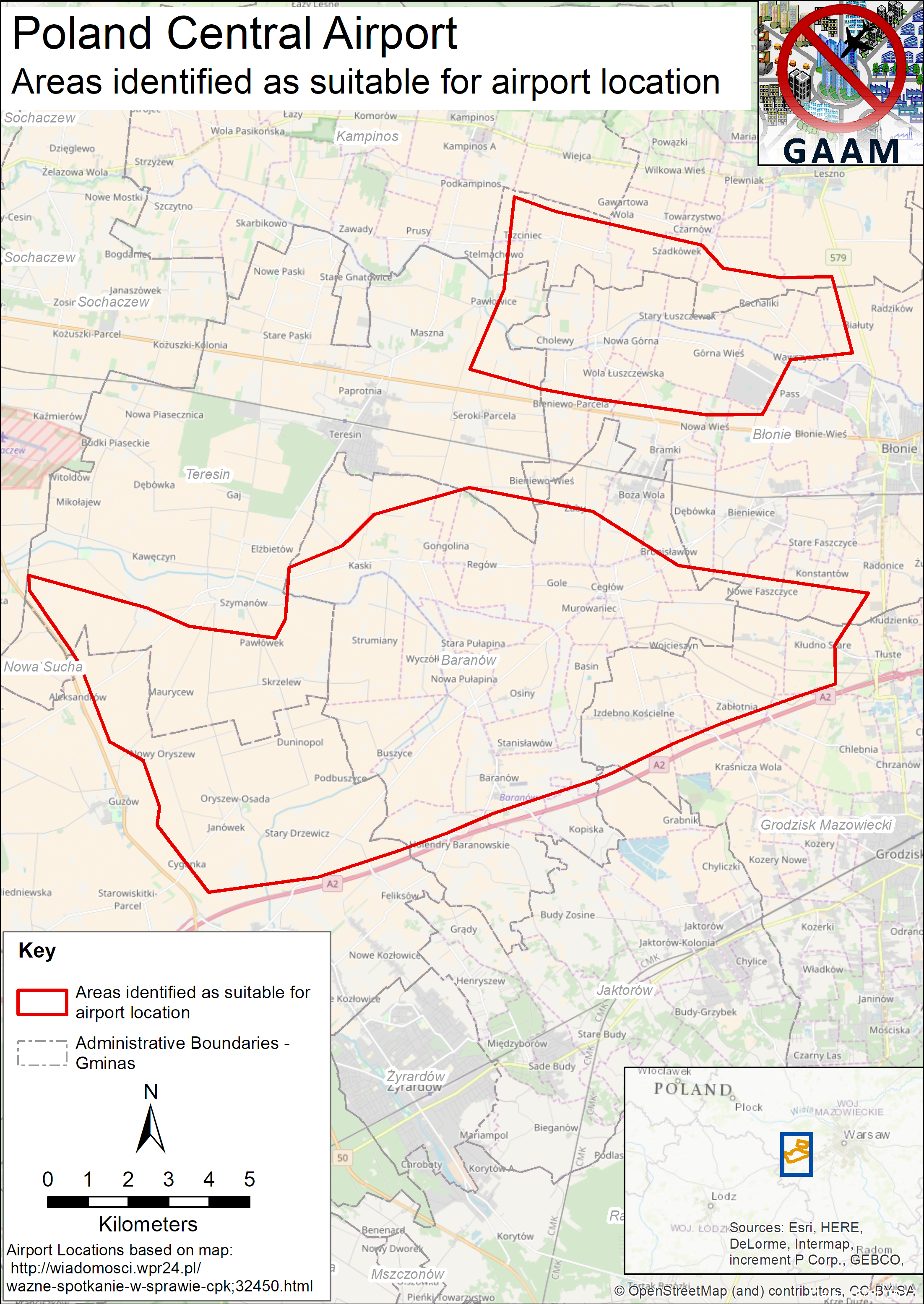
The proposed airport site is in Baranów, a rural gmina (administrative district) 40 kilometres to the west of Warsaw, Poland’s capital city. The map below, commissioned by Polski Fundusz Rozwoju (PFR) in 2008 and included in an article published on 8th October 2017, about a meeting on the airport between representatives of the government and Baranów municipality, shows two areas identified as suitable for the airport project: a 3,421 hectare area to the north of the map and a larger 11,338 hectare area to the south. Another variant of this map was included in a 100 page document discussed at the government meeting  which adopted the airport plan, Poland’s biggest infrastructure project in recent years, on 7th November. At this meeting it was confirmed that the planned location of the airport is the Stanisławów village area, near the southern boundary of the area identified as suitable for the project.

Poland Central Airport
Map commissioned by PFR showing areas suitable for Poland Central Airport

A map produced by GAAM shows the villages within the boundaries of the two areas identified as suitable for the airport project and the existing road and rail links.

PolandAirport

A satellite image of the Stanisławów village area, confirmed as the planned location for the new central airport, shows the villages and small parcels of cultivated land that characterize the wider area.

A mega-airport, multi-modal transportation hub and an aerotropolis

The schedule for the new airport is for preparatory works to be complete by the end of 2019, then for construction to be complete and operations to commence by mid-2027. A mega-airport is planned, one of the largest in the world with four runways, initially serving 45 million passengers per year, rising to 100 million, a passenger throughput as high as the world’s busiest airports, almost as high as Atlanta in the US and higher than the current traffic levels at Dubai Airport and Beijing Capital Airport. A multi-modal transportation hub is planned, integrating the new mega-airport with existing and new road and rail infrastructure. Plans for the airport include a rail station and the project is also referred to as Centralny Port Komunikacyjny (CPK), which translates as Central Communication Port. The proposed airport site is between Warsaw and Łódź, Poland’s third largest city, and a high-speed rail line connecting the two cities is planned. The A2 motorway running between Poland’s western and eastern borders is immediately south of the proposed site. Immediately north of the airport site is the rail line between Berlin and Moscow, via Warsaw,  providing a high-speed service that commenced operations in December 2016.

The 3,000 hectare land area for the new airport is far larger than would be required even if the number of passengers meets the projection of 100 million per annum. A 3,000 hectare site is more than 50 per cent larger than the world’s busiest airport, Atlanta in the US which handles 104 million passengers per year. Atlanta Airport’s site covers 1,900 hectares and encompasses substantial commercial development including more than 200 concession outlets such as retail, food and beverages. The oversized proposed land area for Poland Central Airport could be linked to plans for an ‘airport city‘ or aerotropolis. A 1,200 hectare new city is envisaged, with hotels and showrooms. Under the government resolution outlining plans for the new airport legal and infrastructural changes to Baranów would allow for construction of business parks, conference centres, an exhibition centre and office complexes.

A government financed megaproject

The budget for the airport project, combined with the road and rail infrastructure, is estimated at between €7 – 8 billion. Polish citizens will bear the brunt of the enormous cost of the project; the main investor is the government. The 7th November 2017 resolution announcing construction of the airport approved the financing structure as well as the location. An article in the second 2017 edition of Airport Development News, an industry newsletter published by Airports Council International, stated that two state-owned financial institutions, Polish Development Fund (Polski Fundusz Rozwoju – PFR) and Bank Gospodarstwa Krajowego (BGK), Poland’s national development bank, would be ‘heavily involved’ in financing the project.

Possibilities for European funding have been considered. The Airport Development News article states that between 75 and 80 per cent of airport construction will be financed by international institutions such as the EIB (European Investment Bank) and EBRD (European Bank for Reconstruction and Development). Such investment by the EIB and EBRD is doubtful as state aid rules preclude allocation of EU funds for construction of the airport. But a June 2017 article published by legal analyst firm Lexology stated that EU funds could be tapped for the road and rail elements of the project. The total cost of the rail infrastructure elements of the megaproject complex is estimated to be between €1.89 billion and €2.1 billion, the total cost of roads and highways between €424,000 and €1.6 billion.

Uncertainty over accessing EU funds has led to attempts to secure financing from Chinese sources. The airport was one of the vast transportation and energy infrastructure projects discussed at the May 2017 Summit of the Belt and Road in China, where the President of China repeated assurances about new credit lines by China Development Bank and China Exim Bank, and one of the outcomes was signing of a contract between Polish and Chinese state railways on facilitating container transport. The Asian Infrastructure Investment Bank (AIIB), a multilateral financial institution supporting construction of infrastructure in the Asia-Pacific region, is reported to have expressed an interest in co-financing the Poland Central Airport project, if it is in line with the bank’s policy of promoting ‘interconnectivity’ between continents, which would mean that the airport would have to promote passenger traffic with Asia. Potential benefits to Chinese exporters from the airport are evident. The project would support the Polish government’s intention to establish the country as a port of entry for Chinese goods into the EU single market.

Industry experts doubt feasibility of the new airport

Some industry experts are critical of the new airport, doubtful that a new global hub could compete with established European hub airports such as Schiphol and Frankfurt and saying that it would struggle to meet its traffic projections and fail to make a profit. And adoption of Poland Central Airport as a government priority reverses many years of sloughing huge sums of public money into several new small regional airports. A major new hub airport would compete with these regional airports, many of which are already struggling with low passenger levels and unprofitable. Some industry experts warn that opening a new hub airport would be likely to lead to the closure of several existing Polish airports.

Expenditure on a new airport that results in closure of established regional airports would be an astonishing waste of public funds. Between 2007 and 2015 Poland sank at least US$1.58 billion into building and expanding 14 regional airports, with 40 per cent of this funding coming from the European Union (EU). This was highlighted in a report Flights of fancy: A case study on aviation and EU funds in Poland published in 2012 by CEE Bankwatch Network which critiqued the development and operation of small regional airports which were not financially viable, placing a strain on regional and local government budgets, along with allocation of EU funds for rail connections to airports, arguing it should be redirected to serving mobility needs within regions.

Aviation industry consultancy CAPA (Centre for Aviation) reports that Poland Central Airport would replace Warsaw Chopin Airport, the city’s main airport located south of the city with limited room for expansion. Bloomberg also reports that, under the government plan for the new airport, Warsaw Chopin Airport would eventually be shut down. Closing Warsaw Chopin Airport would be a woeful example of enormous waste of public funds and short-sighted planning. A major, multi-million Euro programme of upgrades to Warsaw Chopin Airport, increasing its capacity to 10.4 million passengers per annum, was completed less than a year ago, in December 2016. The terminal was modernized including installation of new check-in desks and an observation deck, a new long-range fuel pipeline constructed and the runways, taxiways and apron have been upgraded. The airport upgrade programme cost €166,760,000 with the EU Cohesion Fund contributing €32,900,000.

Rafal Milczarski, CEO of Poland’s state-owned carrier, LOT Polish Airlines, has said that Warsaw Chopin Airport should be closed down and the land sold to real estate developers to help finance the new airport. This would certainly benefit LOT, a leading proponent of the central airport. Indeed, supporting growth of the national airline is part of the rationale for the project. But the role of LOT in the new airport is a factor in skepticism regarding its viability. LOT is a relatively small carrier with fewer than ten wide-bodied aircraft. A high level of investment would be required for LOT to become one of Central Europe’s main carriers, one of the goals of the the airport project. Critics are of the opinion that the LOT lacks the scale and financial capacity necessary for commercial viability of the new airport project. LOT Polish Airlines also has a history of government intervention to support ailing finances. The carrier was a direct beneficiary of state funds in 2012-2014 when it was rescued from bankruptcy with a €200 million state bailout.

There are serious doubts over the viability of the Poland Central Airport project. The only certainties are vast public expenditure on infrastructure and loss of a large area of farmland.

Nijgadh aerotropolis – 2.4 million trees could be felled, and 7,380 people displaced

An 80 square kilometre aerotropolis is planned in Nijgadh, Nepal. The projects entails displacement of 7,380 people and felling of 2.4 million trees.

A major aerotropolis is planned in Nijgadh, in the Bara District in southeastern Nepal, 175 kilometers south of Kathmandu. If the megaproject proceeds as planned as many as 2.4 million trees will be felled, and 7,380 people living in the Tangiya Basti settlement within the site will be displaced. The government has repeatedly stated that Nijgadh Airport with a 80 square kilometer site, will be the largest, by area, in South Asia. An airport city adjoining the airport is planned. The map below shows the proposed Nijgadh Airport boundary as reported in the Nepal Gazette on 5th June 2015. The site is between two braided rivers, Pashah to the west and Bakiya to the east. The northern boundary is the Mahendra Highway between the two rivers. Most of the site, about 90 per cent, is densely forested land, predominantly consisting of Shorea robusta trees, which are also known as Sal or Sakhua. The settlement in the middle of the airport site, where about 7,380 residents living in 1,476 households face eviction, is called Tangiya Basti.

Nepal - proposed boundary of Nijgadh Airport, an 80 square kilometre aerotropolis
Nijgadh Airport site boundary , as described in Nepal Gazette, 5th June 2015

A series of government announcements underlined determination to pursue the project. In June 2014 the government emphasized determination to attract investors, reportedly ‘preparing to complete the pre-construction works to spare the investors all the hassles whether the government, private sector or foreign investors invest on the project’ as preparations were being made to fence off the land. January 2016 saw another high level push to commence construction of Nijgadh airport. The Ministry of Culture, Tourism and Civil Aviation (MoCTCA) was instructed to begin land acquisition, site clearance and resettlement of affected people and the Ministry of Soil Conservation was directed to fell trees and clear the site for the construction of primary and access roads to the airport site within two months.

It appears that a confirmed investor in the airport has proved elusive. Public funds will be used to develop the project. On 24th May 2016 the government allocated US$46.4 million for the construction of Nijgadh Airport, for land acquisition, resettlement of displaced people, environmental impact assessment and preparation of a detailed project report. The Tourism Minister said the project would be developed in phases, beginning with a single runway facility with capacity for 20 million passengers annually, with the accompanying airport city to be constructed at a later stage. In January 2017 the government assigned preparatory work on Nijgadh Airport to the Nepal Army, tasking it with building a perimeter road and an access road to the area earmarked for the runway, and clearing trees to make way for construction.

600,000 trees could be felled to fund Nijgadh Airport construction

By May 2017 forest earmarked for Nijgadh Airport remained unfelled, but vast numbers of trees could be transformed from an obstacle to airport construction into a source of funding for it. A news article entitled ‘Money grows on trees for Nijgadh airport project‘ reported a statement by officials that a vast swathe of the forest, about 600,000 trees, will be felled for the airport. The market value of the lumber was estimated at nearly US$581 million, which would be sufficient to pay for half of the US$1.172 billion construction costs for the first phase of the airport. The Forest Ministry permitted the Tourism Ministry to conduct an EIA (environmental impact assessment) on the condition that 25 trees are planted for every tree that is cut down.

Tourism Ministry officials pointed out that tree planting on this scale this would be difficult to implement, as felling 600,000 trees would require the planting of more than 15 million saplings. The suggestion that 15 million trees could be planted is more than merely ‘difficult’; it is completely unfeasible. Any such mega tree plantation could not replace the rich biodiversity of an long-established forest ecosystem and an enormous land area would be required, inevitably entailing the wholesale obliteration of an existing ecosystem in order to plant such a huge number of trees.

2.4 million trees could be felled for 80 square kilometre aerotropolis

Subsequent announcements in July and August 2017 threaten the felling of even more trees for Nijgadh Airport, over 2.4 million, to make way for the full 80 square kilometer aerotropolis. The first phase of the airport will spread over between 1,000 and 2,000 hectares, and CAAN has assigned the Nepal Army to clear trees at the airport construction site and to build access and perimeter roads. The government has allocated US$14.6 million for the project this fiscal year with CAAN setting aside an additional US$29.2 million to pay for initial works, if required.

A short video of the forest at risk of being destroyed for Nijgadh airport was posted on Twitter, by Milan Dhungana, who commented: “It’s very hard to believe that this beautiful dense forest is soon to be vanished to give way to a new airport.”

Photos of the forest that is at risk of being felled were also posted on Twitter:

7,380 people face displacement

Residents of Tangiya Basti, 7,380 people living in the settlement in the midst of the forest land earmarked for Nijgadh aerotropolis, face displacement. In June 2014 MoCTCA was attempting to settle disputes over compensation for land acquisition and people’s demands for resettlement arrangements. By March 2016 the task of collecting land details had been completed, with land valuation about to commence, along with issuing public notices for land acquisition. Land had been categorized as under individual ownership, public land and ‘unidentified ownership’, the majority belonging in the latter category. A video shows the Civil Aviation Authority of Nepal (CAAN) sign erected at the Nijgadh Airport site.

A 35-day notice was published for landowners to apply for compensation in March 2017. The amount of compensation for land acquired for the airport had been confirmed and the notice required landowners to harvest their crops within a month, prohibiting them from cutting any trees or plants. But compensation is only available to a minority of residents who have recognized land ownership. A September 2016 project report by Tourism Secretary Prem Kumar Rai stated that 110 households were eligible for compensation, with between 80 and 85 of these households agreeing to the compensation and the remainder reluctant to accept the government’s offer. The majority of residents facing eviction, about 1,400 households, have been categorized as ‘squatters’. Chief of the airport project, Hari Adhikari, said that nothing had been done to resettle the ‘squatters’ living on the construction site. In July 2017 the Himalayan News Service reported that the government’s preparations to acquire land for Nijgadh Airport had left residents of the Tangiya settlement, about 7,380 people, fearing their displacement and in a state of panic over their resettlement.

Tangiya Basti residents are struggling for new homes and livelihood opportunities. The Tangiyabasti Stakeholders Committee stated that construction of the airport had made their future uncertain and held a press conference where they demanded rehabilitation. Residents facing eviction are insisting upon replacement land and food supplies, provision of water, electricity and education in the place where they will be relocated, and one job for each of the affected families. Chair of the Tangiyabasti Stakeholders Committee, Ramesh Kumar Sapotka, said that they would refuse to vacate the area unless their demands were addressed.

Tangiya Basti residents have been living in limbo for years, knowing they face eviction for the long delayed airport, which was proposed 20 years ago. The settlement was established by the government for flood victims in 1975 and the majority of people living there are from the marginalized Tamang ethnic group. For more than 40 years the government has failed to fund essential services for their established settlement, or to support their own efforts to develop these services. Tangiya Basti residents lack electricity, a reliable drinking water supply, electricity and roads. Construction of schools has been cancelled leaving pupils with a dangerous seven kilometer walk through dense forest to get to classes, with the risk of being trampled on by wild elephants that roam freely in the area. Many locals have to go to a neighboring town to make telephone calls and walk for several hours to reach healthcare facilities.

Fast-track to destruction

A 76 kilometer road, a ‘fast-track highway’, linking Nijgadh Airport with Kathmandu, has been on the drawing board since 1996. Reducing the travel time to the capital city to one-hour, is considered essential for the feasibility of the airport, but the road megaproject has also been plagued with delays. A Detailed Project Report (DPR) for the ‘fast-track’, a four-lane mega-highway, crossed by seven bridges and expanding to six lanes, was completed in August 2015.

Preparatory work for construction of the road was fraught with technical problems. The Nepal Army began excavation works without regard to the specifications for a four-lane expressway and the challenges of construction works on steeply sloping terrain, which could cause landslides. After years of delays the foundation stone for the expressway was laid on 28th May 2017, and the project handed over to the Nepal Army which will oversee construction. In the interim the road has fallen prey to the cost escalation common to megaprojects around the world. Over a seven year period the estimated construction cost of the expressway has doubled to over US$1 billion.

Megaproject mania, misplaced priorities

The Nepal government’s relentless pursuit of Nijgadh Airport and the fast-track continues in the face of criticism that the projects are draining funds from other regions of the country.  Meanwhile, other megaprojects languish incomplete and have fallen far behind schedule, such as a 28 kilometer tunnel to bring water from Melamchi to Kathmandu and transmission lines. Massive deforestation looms to clear the designated site for the airport even though funding for construction has not been secured. Successive administrations have put forward different plans for financing Nijgadh Airport. As late as August 2017 no decision has been made on funding. Two financial models have been put forward. BOOT public-private partnership (PPP) would involve foreign investment or private financing. Alternatively, the government would develop the project under the engineering, procurement, construction and finance (EPCF) model.

Megaproject mania, in particular massive government expenditure on a gigantic airport, multilane highway and aerotropolis, is a serious case of misplaced priorities in one of the world’s poorest countries. Nepal is still reeling from a devastating earthquake on 25th April 2015 which killed nearly 9,000 people and destroyed over 700,000 homes. Political infighting has delayed reconstruction and, in spite of billions of dollars pledged in aid, outside of Kathmandu the majority of affected families are still living in desperate conditions, in tents or makeshift shelters, enduring harsh winter weather and heavy monsoons. In these circumstances, spending vast amounts of public money on a mega-airport that would displace over 7,000 people is nonsensical.

International communique against the New Mexico City Airport

dorsetchiapassolidarity's avatardorset chiapas solidarity

.

International communique against the New Mexico City Airport

EMERGENCE OF A BROAD NON-PARTY FRONT AGAINST THE NEW AIRPORT AND OTHER MEGAPROJECTS IN THE VALLEY OF MEXICO BASIN

Mexico City, 4 February 2016

11838528_862071437210246_4183637250175690279_o

In response to the announcement by the government of Enrique Peña Nieto to reactivate the construction of a new airport for Mexico City, more than 70 organizations of organized society in the East of the State of Mexico, Hidalgo state, the Federal District and the rest of the country during the Forum “All Voices against New Airport” and the Constituent Assembly on 10 and 11 November 2015 at the Ché Guevara Auditorium located next to the Faculty of Philosophy and Letters of the UNAM, agreed to the creation of a Broad Front with a horizontal and inclusive structure, with an autonomous and self-managed character, whose main objectives are to defend the territory and to prevent the construction…

View original post 953 more words

Jeju Islanders resist airport megaproject – Ecologist article

An article about resistance to plans for a second airport on the South Korean island of Jeju has been published on The Ecologist website – Jeju Islanders resist airport megaproject. A plan for an airport and an accompanying ‘Air City’, i.e. an aerotropolis, was announced without even consulting residents of five villages who would be seriously affected. Hailed by its proponents as the biggest project in the history of Jeju island the airport scheme is linked with other looming megaprojects such as tourism resorts, casinos and surface transportation networks.

Since announcement of the airport, in November 2015, there has been a series of protests and the campaign is being compared to long standing resistance to a Naval Base on the island, an affront to many citizens of the ‘Island of Peace’, which is destroying a large area of coastline and marine wildlife habitat. The mainstream media has misrepresented the community response to the airport plan as divided; in fact the majority of people living in and near to the proposed site are opposed to it. The photos accompanying the Ecologist article were originally published on the blog Pagansweare (one of few sources of information about opposition to the second airport) and used with kind permission. The additional photos below, also from Pagansweare, give more insight into the communities affected by the airport plan and their reaction.

This slideshow requires JavaScript.


Video of Istanbul third airport – an ecocide megaproject

GAAM has published a video showing the ecocide underway for Istanbul’s third airport – an ecocide megaproject. The project site is north of the city on the Black Sea coast. A vast area of forests, lakes, farmland and coastline is being systematically destroyed as the site is prepared for construction. The plan is to build an aerotropolis covering 76 square kilometres. Trees are being felled, lakes filled in and land reclamation damages coastal ecosystems. The aerotropolis plan is linked with other destructive megaprojects including a third bridge across the Bosphorus Strait. Resistance against the megaprojects is led by Kuzey Ormanları Savunması (Northern Forest Defence).


The video was taken on a visit to the site on 7th May 2016, photos can be viewed on Fickr. Istanbul third airport
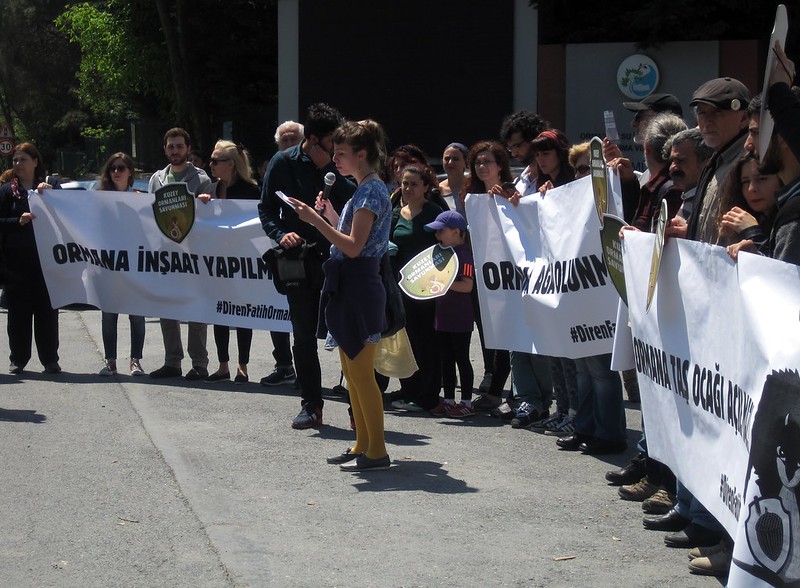
Earlier that day Kuzey Ormanları Savunması held a protest outside the forest directorate.
Protesting to save Istanbul forests

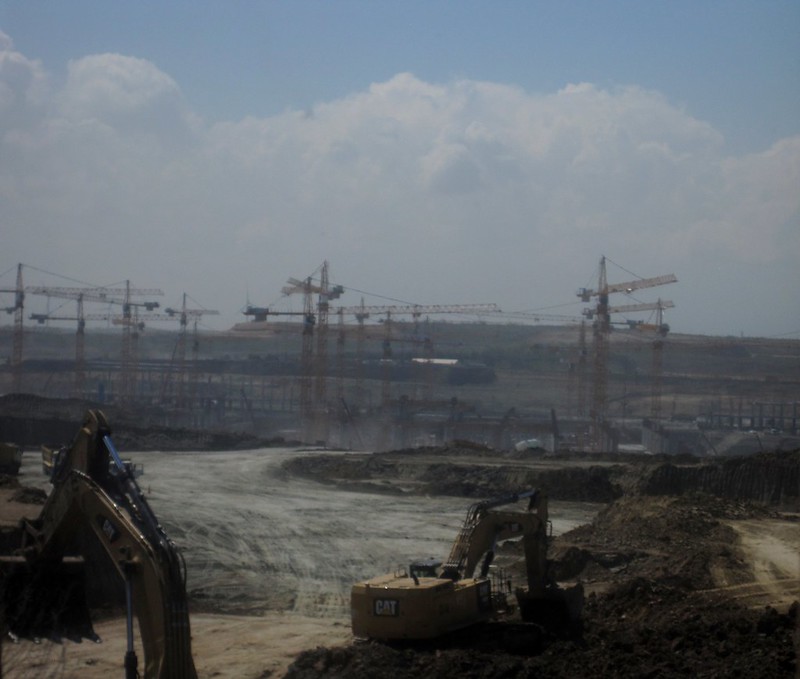
Industry videos of construction of Istanbul’s third airport are available online – giving an indication of the severity and extent of the destruction of ecosystems. The video below, made by Caterpillar shows bulldozing underway.

This video of construction of the airport – on land that used to be forest, lakes and farmland – was filmed from above.

Defending the zad: A new little book about the struggle against an airport and its world.

A book written by some of the occupants of the ZAD (Zone a Défendre) – a site in Western France which has been occupied for over 9 years – in resistance against the construction of the planned Notre-Dame-des-Landes airport. Over 5,000 acres of farmland and wetladns would be destroyed. Evictions and mass protests are documented, and the sustained solidarity which has held the ZAD together for so many years. The ZAD is a ray of hope in the resistance against destructive megaprojects.

Parasitic Urbanization: The Transformation of Istanbul

There are a lot of internet videos promoting aerotropolis projects – here is one that is critical. ‘Parasitic Urbanization: The Transformation of Istanbul’, a talk by Cihan Uzunçarşılı Baysal

The presentation highlights Istanbul’s airport, currently under construction, and other mega infrastructure projects in the region, which are symptomatic of the phenomenon of “planetary urbanisation”. What is happening with this wave of urban development is not new cities, it is not settlements that are contained within boundaries. A new type of urbanisation is extending its influence over the entire surface of the earth, even encroaching into the atmosphere and into the oceans and underground. A key characteristic of this new wave of urbanisation is that it is “parasitic” – it depends on nutrition from its host – sucking in water and other resources from a large hinterland area.

Baysal describes Istanbul’s third airport as an “ecocide” project. Forest is being felled and lakes filled, on a massive scale, and not just for an airport; land is being prepared for an ‘aerotropolis’ extending over a much larger area. An aerotropolis is the opposite of traditional airports, built to serve an established city. An aerotropolis is an airport-centric development, commercial development around an airport that is designed to serve aviation growth.

The talk explains that Istanbul’s third airport is one of the largest of no less than 43 megaprojects underway and planned in the region – most notably a third Bridge across the Bosphorus Strait and a canal alongside it. There is no democratic process whatsoever for deciding to embark on the megaprojects; they are imposed by the government and the firms awarded contracts. Citizens simply do now know what “insane” scheme is going to be announced next.

Campaigners against the Istanbul megaprojects make use of satellite images to reveal the reality of the ecological destruction. These images reflect a global phenomenon. They are examples of the 21st century iconic image of urbanisation, an aerial photograph of excavated and bulldozed area of land, a site being prepared for construction, an image of destruction that is similar to the tar sands in Alberta. This is a marked contrast with the exciting iconic image of 20th century urbanisation: the skyscraper.

Ecologically destructive urban development in Istanbul also exacts a human cost. People are being displaced for the airport and other megaprojects – forced out of their homes by eminent domain, then dumped in new settlements on the periphery, far away from their livelihoods and social life in Istanbul, having to undertake long commutes for work and leisure.

The underlying agenda for the orgy of construction is opening up land for plunder, turning it into a financial and speculative asset, which facilitates the accumulation of capital. The megaprojects are in the process of “privatising and commercialising each and every urban space” and must be halted.

Major investigation of eco-destruction for Istanbul’s third airport

In March, Kuzey Ormanları Savunması​ (the ‘North Forest Defence’) which campaigns to protect the forests to the north of Istanbul from industrialization and urbanization, published a 100 page comprehensive report into Istanbul’s third airport, currently under construction. Entitled The Third Airport Project: Vis-a-Vis Life, Nature, Environment, People and Law, this report has been translated into English. It exposes the ecological destruction of the project, and examines the drive for economic growth and corporate profits that is the real reason it is being so relentlessly pursued by the government and firms that stand to benefit.Istanbul 3rd Airport report, North Forest Defence, cover

The site is gigantic, over 76 square kilometres. About 80 per cent of this area is forested, the remainder consists of 70 large and small lakes, meadows, farmland and coastline. All are being destroyed as airport construction progresses.

The reason for the gigantic site is that the plan is not for an airport. Land is being expropriated for an ‘aerotropolis’, an airport surrounded by commercial development that is designed to be aviation dependent and support growth of the airport.

Istanbul’s last large area of green space is being sacrificed for a vast urbanisation incorporating the world’s biggest duty-free shopping centre, hotels, a convention centre, sports centre, business space, a clinic and other facilities. Ostensibly, the land is allocated for an airport with the incredibly ambitious goal of handling 90 million passengers annually, ultimately becoming the world’s busiest airport with 150 million passengers passing through.

But even if the airport does indeed grow to handle this number of passengers, an eventuality regarded as unlikely within the aviation industry as well as by its critics, there will be plenty of space for commercial activity. North Forest Defence estimates the area surplus to requirements for aeronautical activities at 57 square kilometres. This is illustrated by comparison with the world’s busiest passenger airport, Atlanta in the USA, which, with a a far smaller land area of 1,625 hectares, handles about 95 million passengers per year.

Preparation of the site for construction commenced on approval of an Environmental Impact Analysis (EIA) that North Forest Defence’s work exposes as utterly inadequate, full of serious omissions and trivialising the impacts of the project. Lakes are described as ‘ponds’, the number of species at risk is under-reported and the bizarre claim is made that, of the 2.5 million trees earmarked for felling, over 1.8 million would be moved to another place, a mass replanting that is technically impossible. The reality is that the habitat of animal and plant species is being obliterated. Endangered bird species whose habitat is imperilled include the greater spotted eagle and the pygmy cormorant. Istanbul’s northern forests are one of the world’s major bird migration routes with hundreds of thousands flying over every spring and autumn. This means that the airport will endanger human life as well as birds, as there will be a considerably higher flight safety risk from bird strikes – collisions between birds and aircraft that can cause fatal air accidents.

Istanbul’s third airport has proceeded in the face of vigorous opposition from a broad coalition of environmental, community and civil organisations, plus professional associations of engineers, architects, scientists and economists. There have been endless campaign meetings and protests, in the centre of Istanbul and in villages affected by the project. The two photos below are of the protest to mark the groundbreaking ceremony for the airport, on 7th June 2014. A slideshow with more photos of this lively protest can be viewed here.

Protest agaisnt ISanbul 3rd airport, 7th June 2014
Protest against Istanbul’s third airport, 7th June 2014. Photo: MURAT DELIKLITAS/ISTANBUL-DHA

 Istanbul 3rd airport protesters met with riot police, June 7 2014
Forest defending protesters meet with a wall of riot police, 7th June 2014

North Forest Defence’s report is also a powerful critique of the financing of the airport, and the economic implications. The tender to construct the airport and operate it for 25 years, the biggest in the history of Turkey, was awarded to a consortium of five firms, all with close ties to the government. These firms stand to profit from operating the airport, regardless of the actual level of traffic, because of a state guarantee of liabilities that may be incurred. The consortium’s economic benefit from the airport is also assured because of revenue guarantee of €6.3 billion over 12 years, from a fee levied on the projected 342 million international passengers over this period. There is a precedent for state payment to airport operators when the projected number of passengers fail to materialise; €27 million has been paid to reimburse the operator of three of Turkeys’ airports to compensate for a shortfall. Treasury guarantees mean that the economic risks of the project fall onto citizens.

Every Turkish citizen will incur debt due to the cost of the project, which has already escalated from $16 billion to $20 billion. The airport project is part of a construction and real estate speculation frenzy that serves as Turkey’s main economic stimulus, keeping up a flow of ‘hot money’ – international capital seeking short term profits from interest rate differences and anticipated shifts in currency exchange rates – that buoys up capital markets and keeps the plates spinning.

The campaign to stop construction of Istanbul’s third airport is bolstered by an extraordinary visual record of the ecological destruction that is underway – photographs and videos. It is highly unusual for a megaproject to be documented in this way and it is extremely effective in raising the alarm over the scale and severity of the ecocide that is happening. The site is crawling with hundreds of trucks excavating and dumping earth, the level of infill required to raise and level the site is estimated at 2.5 billion square metres, and compacting the soil is on the swampy site is proving problematic.

earth excavating trucks on the Istanbul third airport site
Trucks in the Istanbul third airport excavation area, the number of trucks in the project area is expected escalate from 1,200 to 2,000

A video shows destruction of forests and meadows and filled in lakes, swathes of bare earth being worked by bulldozers, and piles of felled trees. There is nowhere left for the wild animals or for farmers to tend their sheep.

The 3rd Airport Project in İstanbul Against Life, Nature, Environment, Humanity and Law from Kuzey Ormanları Savunması .

Video of storks, one of the 300 species of birds whose habitat is being destroyed for Istanbul’s third airport, flying around bewildered and traumatised in the immediate aftermath of their habitat being bulldozed.

3. havalimanı leylek travma from Kuzey Ormanları Savunması .

This video, published in May 2015, shows the impact of airport construction on the coastal village of Yenikoy. It begins with a farmer explaining the ‘airport city’ plans, shows the farmland that is at risk as bulldozers move ever closer, then reveals the destruction of forest, lakes, farmland and coastline that is already underway.

İstanbul 3rd Airport Construction – Yeniköy – May 2015 (Eng Subtitled) from Imre Azem.

Istanbul’s third airport is integrated with other ecologically destructive megaprojects – a multi-lane third bridge over the Bosphorus Strait and a canal running alongside it. Highways to provide surface access mean the loss of yet more green space. All these projects open up the virgin forests for further plunder and feed each others growth. Campaigners have stepped up their efforts to tackle these megaprojects as a package. North Forest Defence has joined forces with Istanbul Kent Suvanmasi (Istanbul City Defence) and on 5th July 2015 a new campaign was launched. The slogan is: ‘Stop the Killer Projects! Be the Breath of Istanbul‘. The forests north of Istanbul are depicted as the lungs of the city, providing oxygen for people and all life to breathe. As well as resisting the megaprojects the campaign is about envisioning and creating a future city which lives in harmony with nature rather than destroying it, taking forward the optimism that concludes North Forest Defence’s report into the third airport, the conviction that ‘it is in our hands to write another story’.

from the campaign meeting - july 5 victory will be the resistant paws
5th July 2015 – campaign meeting, ‘Stop the Killer Projects! Be the Breath of Istanbul!’. Photo: North Forest Defence

Banner 'Stop the killer mega projects, defend 250 million trees, be the breath of Istanbul'
A banner is unfurled from the top of a building, it reads:  ‘Stop the killer mega projects, defend 250 million trees, be the breath of Istanbul’: Photo: North Forest Defence

be the breath of istanbul
“Stop the Killer Projects! Be the Breath Of Istanbul!” campaign ribbon, slogan translates as ‘Be the Breath’. Photo: North Forest Defence

Further information: