Kenya: Trees felled in protected Imenti forest for airstrip, State Lodge and golf course

Plans for construction of an airstrip, State Lodge and golf course in the protected Imenti forest, an important elephant habitat and water catchment area, are opposed by many residents and conservation organisations. Felling of mature trees for airstrip construction continued despite conservatory orders to protect the forest and halt the projects.

Construction of an airstrip in the Kithoka area of the protected Imenti Forest began in June 2026
Construction of an airstrip in the Kithoka area of the protected Imenti Forest began in June 2026. Satellite imagery: 16/09/2025

Reports that allocation of 50 acres of Imenti forest, near Mount Kenya, for an airstrip, State Lodge (regional presidential residence and official venue for state functions and meetings) and golf course, was under consideration emerged in September 2025. Imenti forest, a protected public forest, is a habitat for elephants and many other species, an important water catchment for rivers and streams and is a source of income from agriculture and honey harvesting. Greenpeace Africa immediately opposed allocation of part of the forest ‘for luxury projects’, arguing that it would violate the Forest Conservation and Management Act, the Constitution and be a ‘betrayal of public trust’. The Green Belt Movement called for an immediate halt to the projects, saying the developments would be a misuse of a conservation area, stating, “How does an airstrip qualify as conservation? How does a golf course protect water catchments? How does a State Lodge restore degraded ecosystems? These projects are not necessary. They are luxuries. They are symbols of privilege. They have no place in a protected public forest.” Project proponents claimed that the developments would attract investors, create employment and enable hosting of high-level government events and international visitors but environmentalists warned that a reduction in forest cover would cause soil erosion, disrupt of water flows, reduce biodiversity and facilitate further forest encroachment and ecosystem fragmentation.

The Imenti Development Forum (IDF), a group of professionals involved in conservation and establishing ICT hubs in schools, issued a press statement opposing the plans, stating, “The Imenti forest is not simply trees. It is one of the region’s most significant repositories of biological diversity- a living library accumulated over millennia that, once destroyed, cannot be rebuilt in any human timescale.” Representatives of two political parties also opposed the projects: Party of National Unity leader Peter Munya and Jubilee Party deputy leader Dr. Fred Matlang’l who said another state lodge was unnecessary as the president already has access to high-speed aircraft and safe, modern hotels. North Imenti MP Rahim Dawood had initially favoured the projects but opposed locating a State Lodge in the forest taking up more than 20 acres of land and suggested locating a golf course elsewhere.

The Meru Environment and Land Court intervened to protect Imenti forest, issuing interim preservation orders pending hearing of a constitutional petition challenging the plans. On 11th June Justice Oguttu Mboya directed maintaining the forest in its current state until a court decision, barring activities that might impact on forest before issuance of further orders. The case was filed by Francis Awino who argued that the projects could cause irreversible damage. He also asked for preservation and disclosure of records connected to the proposed development such as environmental impacts assessments, maps, correspondence, license applications and approvals and planning documentation. The petition stated. “Public forests are held in trust for both present and future generations, and the State bears a constitutional obligation to conserve and protect them.” On that same day machinery entered the Kithoka section of the forest and, protected by security, began felling mature trees. Forestry Principal Secretary Gitonga Mugambi said construction of an airstrip would be completed within a week, by 18th June, with the first plane expected to land on that day. Kenya Forest Service (KFS) rangers had been deployed to guard all entrances to the site and local people entering the forest were frisked to check for smartphones, presumably to prevent recording of activities in the forest.

Conservation charity Rhino Ark issued a statement strongly opposing airstrip construction in the Upper Imenti Forest Reserve and calling on the National Environment Management Authority (NEMA) to suspend works pending assurance of compliance with environmental laws and criticised lack of the public participation, Environmental and Social Impact Assessment ESIA) and a NEMA license authorising the project. Surveys had found that, during the dry season, the Upper Imenti Forest has the highest concentration of elephants in the Mount Kenya area. The airstrip was being constructed within this elephant habitat, close to an elephant maternity area where pregnant mothers migrate to give birth. Greenpeace Africa pointed out that Imenti forest forms part of a wildlife corridor linking Mount Kenya to conservation areas in the north of the country, along which elephants migrate for food, water and mating. Greenpeace Africa said the National Land Commission should “Stop the bulldozers. Respect the court order. Let the elephants keep their dry season home. And prove, for once, that development in Kenya does not have to cost us the things we cannot get back.” The Mount Kenya Trust (MKT) made a statement condemning destruction of part of Imenti forest for an airstrip, maintaining that the project is in violation of Articles 42, 69 and 70 of the Constitution and the 2016 Forest Conservation and Management Act and could undermine Kenya’s commitments to increase tree cover, protect biodiversity and restore degraded landscapes. MKT stated, “We stand with those defending the protection of Imenti Forest and all protected areas for future generations.”

On 24th June Meru Environment and Land Court issued another interim conservatory order to halt construction of the airstrip, in response to a petition filed by five Meru residents. Petitioners said to the court, “The Respondents have failed to disclose Environmental Impact Assessment reports, feasibility studies, approvals, maps, acreage surveys and other statutory documents relating to the project. The proposed development threatens to cause irreversible degradation and destruction of forest resources.” The following day Meru Environment and Land Court certified an application, filed by Francis Awino, seeking to cite senior officials for contempt of court over allegations of continuing destruction of Imenti forest. In the Notice of Motion, Awino stated “Unless the contemnors are immediately summoned to answer for their actions, the authority and dignity of this Honourable Court shall be undermined…The continued and wilful acts of disobedience are causing and/or threaten to cause irreparable prejudice to the Petitioner’s constitutional rights, public interest and adversely desecrate designated forest.” A supporting affidavit alleged that, in defiance of court orders, prohibited activities continued including: granting commercial contractors, earth moving machinery and workers access to the Kithoka section of Imenti forest; felling mature trees, removing forest vegetation and clearing undergrowth to open up a corridor for a runway; bulldozing, grading and levelling works to prepare the forest floor for runway construction; and surveying forest areas for a proposed State Lodge and golf course. Geotagged satellite images, photographs and videos provided evidence of continued forest clearance. A petition filed by Meru Forest Conservation Forum and Pan-African Climate Justice Alliance resulted in a further conservatory order to halt developments in Imenti forest.

Belatedly, a public participation forum on the projects in Imenti forest was held, but it descended into chaos. The Meru Environment and Land Court had suspended the exercise as a change of venue with just 24 hours notice failed to meet the constitutional threshold for meaningful engagement. Defying a court order KFS proceeded with the forum and a group of stakeholders endorsed the airstrip, State Lodge and golf course projects. A lawyer attempting to serve a valid court order was denied access to the microphone and people presenting a petition opposing the projects that had been signed by more than 7,000 people were jeered at, threatened and removed by security officers. The Standard described the forum as ‘not public participation, but more of a staged exercise to endorse a decision that had already been made’. By 15th July 2026 the online petition, Hands Off Nkunga Forest! Stop the Destruction of Meru’s water catchment area, calling for an immediate halt to plans, surveys and budget allocation for the State Lodge, airstrip and golf course, had garnered 7,114 signatures.[17]

For more information including references for all source material, videos and photos see the case study on EJAtlas, the world’s largest, most comprehensive online database of social conflict around environmental issues – Airstrip, State Lodge and golf course in Imenti forest, Kenya
Vietnam: Development of dual-use (civilian and military) airport on Tho Chu Island

Conversion of 270 hectares of forest land has been approved for construction of Tho Chi Airport, classified by the Ministry of National Defence as an ‘urgent public investment project’ with an estimated total investment of VND28.8 trillion (USD1.1 billion).

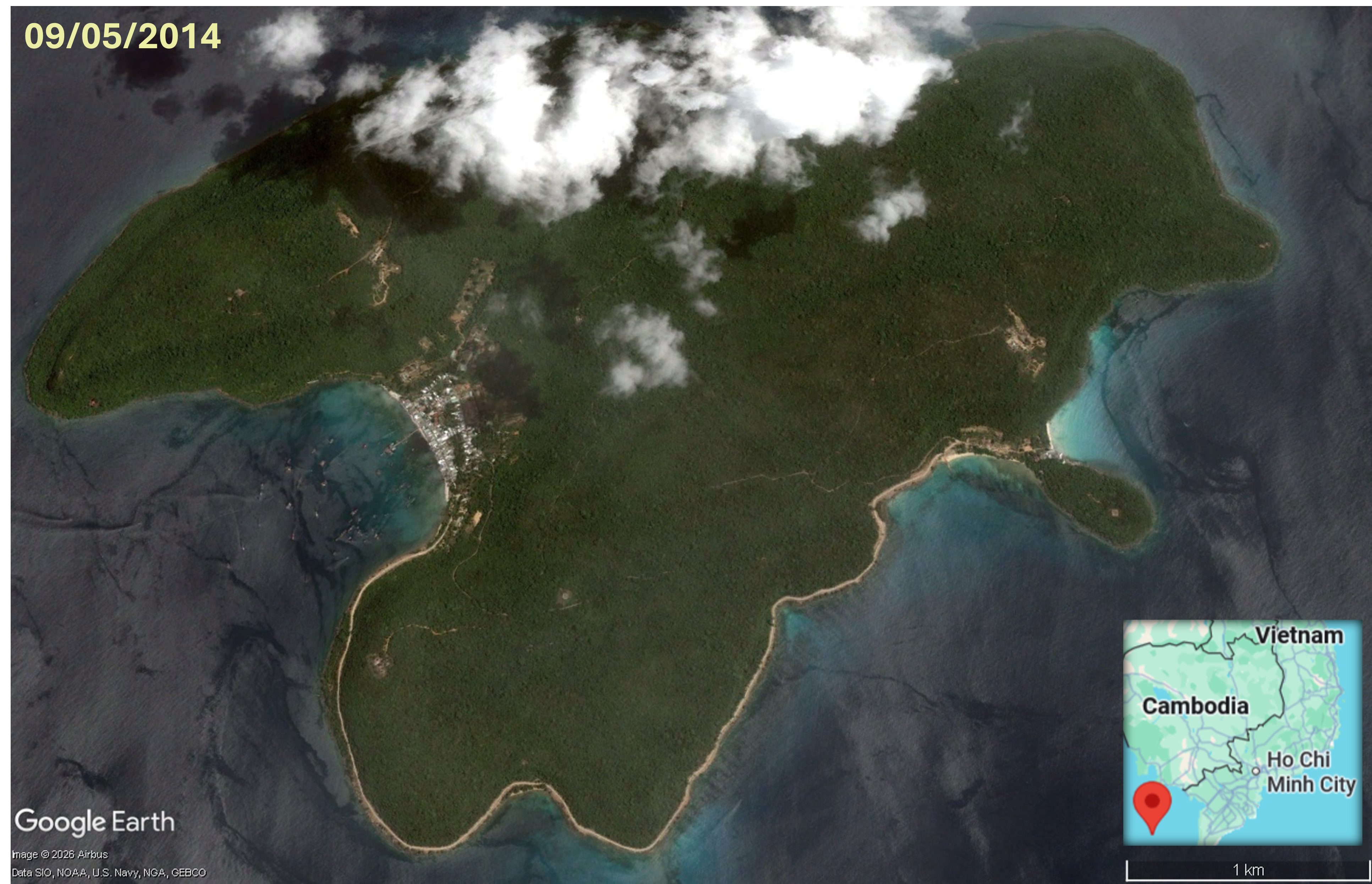
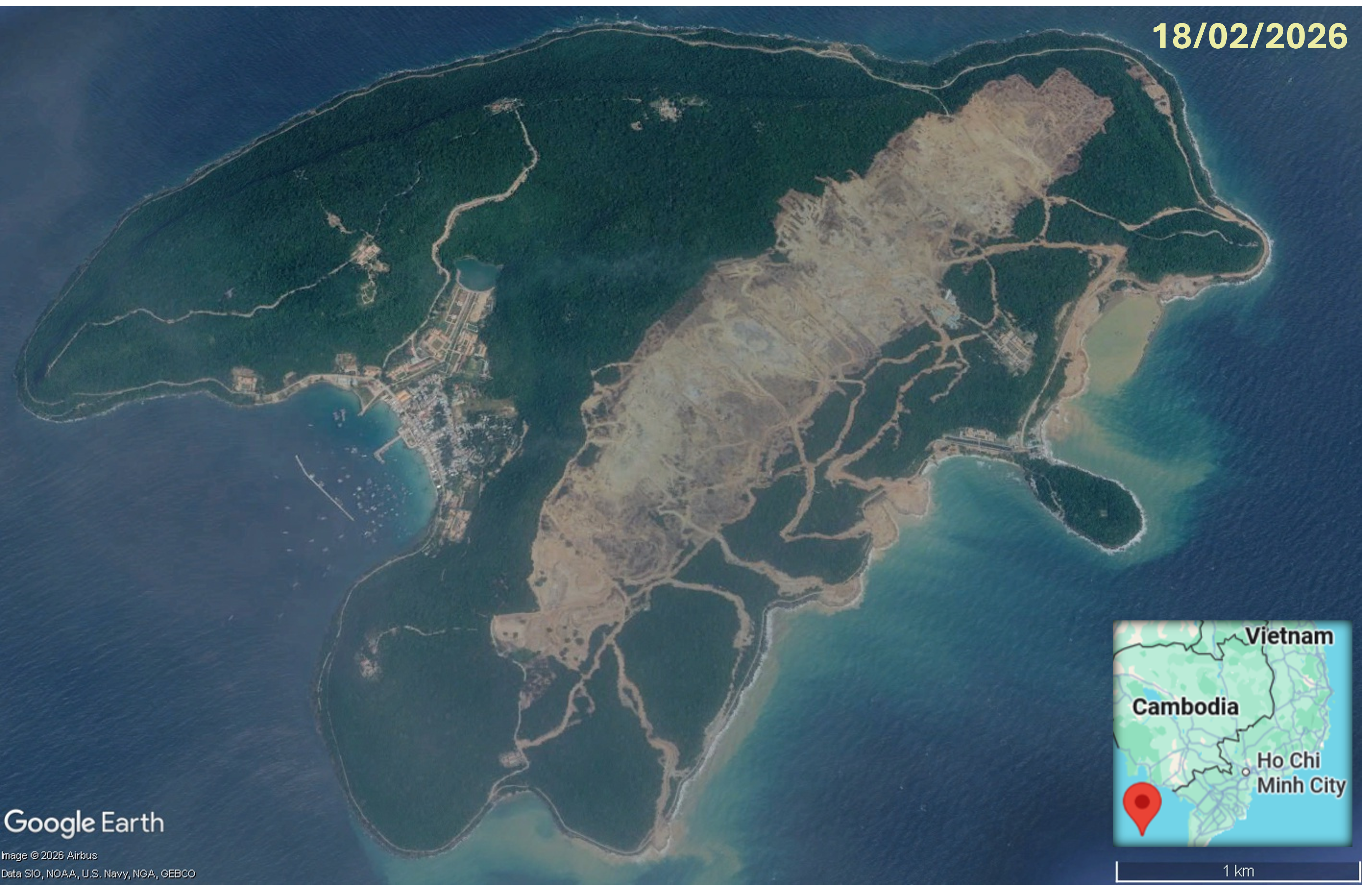
Tho Chu Island, aerial imagery 9th May 2014Tho Chu Island, aerial imagery 18th Feb 2026
Aerial imagery of Tho Chu Island.shows forest clearance, road network development and land reclamation that occurred between 9th May 2014 and 18th February 2026.

Geographically remote from the Vietnam mainland, and home to only 1,800 people, Tho Chu is located about 110km southwest of Phú Quốc Island in the Gulf of Thailand and is part of the An Giang province. Tho Chu is the largest and the administrative centre of eight islands comprising the Tho Chu Special Economic Zone and the archipelago is only accessible be sea. On a November 2025 visit, Party General Secretary and Secretary of the Central Military Commission, To Lam, called for transformation of the newly established zone into a ‘strong and sustainable maritime zone’, directing the Ministry of National Defence and other agencies to develop a master plan with feasibility studies for housing, upgrade of coastal road and other transport infrastructure, water and energy projects, and large seafood logistics and processing facilities. He spoke of the Tho Chu islands’ pristine ecosystems with clean seas, high-yielding fishing grounds, forest cover of 80-90%, sunny weather for seven months of the year and unique landscapes being ideally suited for ‘eco-tourism’. He also urged the Ministry of National Defence to consider construction of a dual-use (civilian and military) airport on Tho Chu Island, initially a 4C airport with capacity to handle narrow-bodied aircraft such as the Airbus A320 and A321 with potential future expansion to a 4E airport handling wide-bodied aircraft including the Airbus A350 and Boeing 787.

Plans for an airport on Tho Chu Island moved forward in December 2025 when Vietnam’s Ministry of Defence submitted a dossier for high-level review. The Tho Chu Airport master plan, for a dual-use airport, serving socio-economic development and transforming Tho Chu into a defence centre for the southwestern sea region, was added to the national airport network in May 2026. With an estimated total investment is VND28.8 trillion (USD1.1 billion) and land requirement of approximately 234 hectares the new airport is anticipated to reach capacity for approximately 20,000 passengers annually by 2030, rising to about 1 million passengers per year by 2050. The approved Tho Chu Airport plan is classified by the Ministry of National Defence as an ‘urgent public investment project’, exempt from investment policy approval and environmental impact assessment processes. The airport project aligns with the An Giang Province 2021-2030 development plan and on 21st May 2026 An Giang Province authorities approved conversion of 270 hectares of forest land for building Tho Chi Airport. The investor committed to pay for planting replacement forest. But newly planted forest is not a replacement for the biodiversity that builds up over time in long-established forest. And aerial imagery, in the timelapse graphic above, shows that, between April 2014 and February 2026, approximately 243 hectares of forest on Tho Chu Island was cleared. Grading works, levelling the site for construction, are underway, along with smaller scale forest clearance for coastal and access road development.

Nijgadh aerotropolis – 2.4 million trees could be felled, and 7,380 people displaced

An 80 square kilometre aerotropolis is planned in Nijgadh, Nepal. The projects entails displacement of 7,380 people and felling of 2.4 million trees.

A major aerotropolis is planned in Nijgadh, in the Bara District in southeastern Nepal, 175 kilometers south of Kathmandu. If the megaproject proceeds as planned as many as 2.4 million trees will be felled, and 7,380 people living in the Tangiya Basti settlement within the site will be displaced. The government has repeatedly stated that Nijgadh Airport with a 80 square kilometer site, will be the largest, by area, in South Asia. An airport city adjoining the airport is planned. The map below shows the proposed Nijgadh Airport boundary as reported in the Nepal Gazette on 5th June 2015. The site is between two braided rivers, Pashah to the west and Bakiya to the east. The northern boundary is the Mahendra Highway between the two rivers. Most of the site, about 90 per cent, is densely forested land, predominantly consisting of Shorea robusta trees, which are also known as Sal or Sakhua. The settlement in the middle of the airport site, where about 7,380 residents living in 1,476 households face eviction, is called Tangiya Basti.

Nepal - proposed boundary of Nijgadh Airport, an 80 square kilometre aerotropolis
Nijgadh Airport site boundary , as described in Nepal Gazette, 5th June 2015

A series of government announcements underlined determination to pursue the project. In June 2014 the government emphasized determination to attract investors, reportedly ‘preparing to complete the pre-construction works to spare the investors all the hassles whether the government, private sector or foreign investors invest on the project’ as preparations were being made to fence off the land. January 2016 saw another high level push to commence construction of Nijgadh airport. The Ministry of Culture, Tourism and Civil Aviation (MoCTCA) was instructed to begin land acquisition, site clearance and resettlement of affected people and the Ministry of Soil Conservation was directed to fell trees and clear the site for the construction of primary and access roads to the airport site within two months.

It appears that a confirmed investor in the airport has proved elusive. Public funds will be used to develop the project. On 24th May 2016 the government allocated US$46.4 million for the construction of Nijgadh Airport, for land acquisition, resettlement of displaced people, environmental impact assessment and preparation of a detailed project report. The Tourism Minister said the project would be developed in phases, beginning with a single runway facility with capacity for 20 million passengers annually, with the accompanying airport city to be constructed at a later stage. In January 2017 the government assigned preparatory work on Nijgadh Airport to the Nepal Army, tasking it with building a perimeter road and an access road to the area earmarked for the runway, and clearing trees to make way for construction.

600,000 trees could be felled to fund Nijgadh Airport construction

By May 2017 forest earmarked for Nijgadh Airport remained unfelled, but vast numbers of trees could be transformed from an obstacle to airport construction into a source of funding for it. A news article entitled ‘Money grows on trees for Nijgadh airport project‘ reported a statement by officials that a vast swathe of the forest, about 600,000 trees, will be felled for the airport. The market value of the lumber was estimated at nearly US$581 million, which would be sufficient to pay for half of the US$1.172 billion construction costs for the first phase of the airport. The Forest Ministry permitted the Tourism Ministry to conduct an EIA (environmental impact assessment) on the condition that 25 trees are planted for every tree that is cut down.

Tourism Ministry officials pointed out that tree planting on this scale this would be difficult to implement, as felling 600,000 trees would require the planting of more than 15 million saplings. The suggestion that 15 million trees could be planted is more than merely ‘difficult’; it is completely unfeasible. Any such mega tree plantation could not replace the rich biodiversity of an long-established forest ecosystem and an enormous land area would be required, inevitably entailing the wholesale obliteration of an existing ecosystem in order to plant such a huge number of trees.

2.4 million trees could be felled for 80 square kilometre aerotropolis

Subsequent announcements in July and August 2017 threaten the felling of even more trees for Nijgadh Airport, over 2.4 million, to make way for the full 80 square kilometer aerotropolis. The first phase of the airport will spread over between 1,000 and 2,000 hectares, and CAAN has assigned the Nepal Army to clear trees at the airport construction site and to build access and perimeter roads. The government has allocated US$14.6 million for the project this fiscal year with CAAN setting aside an additional US$29.2 million to pay for initial works, if required.

A short video of the forest at risk of being destroyed for Nijgadh airport was posted on Twitter, by Milan Dhungana, who commented: “It’s very hard to believe that this beautiful dense forest is soon to be vanished to give way to a new airport.”

Photos of the forest that is at risk of being felled were also posted on Twitter:

7,380 people face displacement

Residents of Tangiya Basti, 7,380 people living in the settlement in the midst of the forest land earmarked for Nijgadh aerotropolis, face displacement. In June 2014 MoCTCA was attempting to settle disputes over compensation for land acquisition and people’s demands for resettlement arrangements. By March 2016 the task of collecting land details had been completed, with land valuation about to commence, along with issuing public notices for land acquisition. Land had been categorized as under individual ownership, public land and ‘unidentified ownership’, the majority belonging in the latter category. A video shows the Civil Aviation Authority of Nepal (CAAN) sign erected at the Nijgadh Airport site.

A 35-day notice was published for landowners to apply for compensation in March 2017. The amount of compensation for land acquired for the airport had been confirmed and the notice required landowners to harvest their crops within a month, prohibiting them from cutting any trees or plants. But compensation is only available to a minority of residents who have recognized land ownership. A September 2016 project report by Tourism Secretary Prem Kumar Rai stated that 110 households were eligible for compensation, with between 80 and 85 of these households agreeing to the compensation and the remainder reluctant to accept the government’s offer. The majority of residents facing eviction, about 1,400 households, have been categorized as ‘squatters’. Chief of the airport project, Hari Adhikari, said that nothing had been done to resettle the ‘squatters’ living on the construction site. In July 2017 the Himalayan News Service reported that the government’s preparations to acquire land for Nijgadh Airport had left residents of the Tangiya settlement, about 7,380 people, fearing their displacement and in a state of panic over their resettlement.

Tangiya Basti residents are struggling for new homes and livelihood opportunities. The Tangiyabasti Stakeholders Committee stated that construction of the airport had made their future uncertain and held a press conference where they demanded rehabilitation. Residents facing eviction are insisting upon replacement land and food supplies, provision of water, electricity and education in the place where they will be relocated, and one job for each of the affected families. Chair of the Tangiyabasti Stakeholders Committee, Ramesh Kumar Sapotka, said that they would refuse to vacate the area unless their demands were addressed.

Tangiya Basti residents have been living in limbo for years, knowing they face eviction for the long delayed airport, which was proposed 20 years ago. The settlement was established by the government for flood victims in 1975 and the majority of people living there are from the marginalized Tamang ethnic group. For more than 40 years the government has failed to fund essential services for their established settlement, or to support their own efforts to develop these services. Tangiya Basti residents lack electricity, a reliable drinking water supply, electricity and roads. Construction of schools has been cancelled leaving pupils with a dangerous seven kilometer walk through dense forest to get to classes, with the risk of being trampled on by wild elephants that roam freely in the area. Many locals have to go to a neighboring town to make telephone calls and walk for several hours to reach healthcare facilities.

Fast-track to destruction

A 76 kilometer road, a ‘fast-track highway’, linking Nijgadh Airport with Kathmandu, has been on the drawing board since 1996. Reducing the travel time to the capital city to one-hour, is considered essential for the feasibility of the airport, but the road megaproject has also been plagued with delays. A Detailed Project Report (DPR) for the ‘fast-track’, a four-lane mega-highway, crossed by seven bridges and expanding to six lanes, was completed in August 2015.

Preparatory work for construction of the road was fraught with technical problems. The Nepal Army began excavation works without regard to the specifications for a four-lane expressway and the challenges of construction works on steeply sloping terrain, which could cause landslides. After years of delays the foundation stone for the expressway was laid on 28th May 2017, and the project handed over to the Nepal Army which will oversee construction. In the interim the road has fallen prey to the cost escalation common to megaprojects around the world. Over a seven year period the estimated construction cost of the expressway has doubled to over US$1 billion.

Megaproject mania, misplaced priorities

The Nepal government’s relentless pursuit of Nijgadh Airport and the fast-track continues in the face of criticism that the projects are draining funds from other regions of the country.  Meanwhile, other megaprojects languish incomplete and have fallen far behind schedule, such as a 28 kilometer tunnel to bring water from Melamchi to Kathmandu and transmission lines. Massive deforestation looms to clear the designated site for the airport even though funding for construction has not been secured. Successive administrations have put forward different plans for financing Nijgadh Airport. As late as August 2017 no decision has been made on funding. Two financial models have been put forward. BOOT public-private partnership (PPP) would involve foreign investment or private financing. Alternatively, the government would develop the project under the engineering, procurement, construction and finance (EPCF) model.

Megaproject mania, in particular massive government expenditure on a gigantic airport, multilane highway and aerotropolis, is a serious case of misplaced priorities in one of the world’s poorest countries. Nepal is still reeling from a devastating earthquake on 25th April 2015 which killed nearly 9,000 people and destroyed over 700,000 homes. Political infighting has delayed reconstruction and, in spite of billions of dollars pledged in aid, outside of Kathmandu the majority of affected families are still living in desperate conditions, in tents or makeshift shelters, enduring harsh winter weather and heavy monsoons. In these circumstances, spending vast amounts of public money on a mega-airport that would displace over 7,000 people is nonsensical.