A new report ‘Solidarity Calls for Kulon Progo Farmers against Airport and Airport City‘ about farmers’ resistance against eviction for New Yogyakarta International Airport (NYIA) gives many insights into one of Indonesia’s key land rights struggles. Opposition to the airport dates back to 2011. The site, on the south coast of Java, comprises six villages which, before eviction commenced, hosted 11,501 residents. Farmers worked for many generations to increase the fertility of the land, establishing successful farms and thriving communities. Eviction from farmland means many thousands of agricultural labourers also lose their livelihoods and excavation of coastal areas has destroyed fishing farmers’ ponds.
The megaproject was approved without the requisite Environmental Impact Assessment (EIA) even though there are serious ecological concerns, including the destruction of sand dunes which act as a bulwark protecting from coastal erosion and tsunamis and prevention salinization of groundwater. The report includes a map of the tsunami hazard area. Cultural heritage, such as the Glagah Stupa historical Buddhist site and Mount Lanang prayer monument, is also being obliterated.
The report is filled with striking photographs showing the progress of the airport and the resistance: bulldozers at work clearing land for the airport and the devastation that is left behind, evictions and protest actions including roadside banners, marches, blocking bulldozers, a road block and a hunger strike. Infographics show the projected development of NYIA not just as airport infrastructure but as an airport city, the affected areas of construction and inhabitants, and the food crops (approximately 450 tonnes annually per hectare including melons, eggplant and chilies) and livelihoods being displaced by the airport.
The airport project has divided the community. Many citizens have refused to sell their land for the airport, whilst some are willing to sell their land for compensation. Supporters of the airport worked to widen the social, economic and political rifts, facilitating the project. Resistance to land acquisition has met with state intimidation, repression and criminalization. Four farmers were imprisoned for four months. The report contains a chronology of violence against local residents resisting eviction and their supporters. Most recently, beginning on 28th November 2017, as another phase of eviction took place, police blocked road access to a group of residents’ homes, cut off their electricity supply, destroyed plants in their gardens and intimidated them. Police attacked a woman causing bruising on her neck and a number of citizens supporting the residents experienced violence at the hands of police, one person suffered a head injury and another suffered injuries from being dragged along the road.
An ‘airport city’ or aerotropolis – comprising shopping malls, offices, hotels, golf resort, tourism village, leisure town, industrial park and residential areas – is planned around the new airport, increasing the land area to 2,000 hectares and potentially leading to eviction of even more citizens. A new solidarity organization Paguyuban Warga Penolak Penggusuran Kulon Progo (PWPP-KP), has been formed to oppose the airport and airport city, allied with an organization of neighbouring farmers resisting sand mining, and supported by many citizens and environmental groups, including Jogja Darurat Agraria.
Construction of an airport on the island of Barbuda began without residents’ approval. A larger land grab looms; moves are afoot to revoke residents’ collective tenure and allocate land to private investors.
On the night of 6th September Hurricane Irma, the most powerful hurricane ever recorded over the Atlantic Ocean, an unprecedented Category 5, made landfall on the small Caribbean island of Barbuda. 185 miles-per-hour winds wreaked havoc. A two-year old child was killed, land was flooded and shorn of trees, homes were left without roofs and walls or completely flattened and the island’s road, energy and communications infrastructure were destroyed. An estimated 90 per cent of buildings were damaged. Two days later all of Barbuda’s 1,800 residents were forcibly evacuated, ferried to Antigua which only suffered minor damage.
Two and a half months after the catastrophic storm most Barbudan residents remained with relatives and friends or in impromptu shelters such as a cricket stadium in Antigua, or abroad. Only a small number of islanders were allowed to return, for a few hours at a time. Efforts to rebuild houses were piecemeal. People were patching up roofs using plywood and corrugated iron salvaged from the wreckage. Hardly anything had been done to re-establish essential services. Water and electricity supplies had not yet been restored; returned residents relied on generators and desalinated water provided by humanitarian aid organizations. Schools and the hospital remained closed. But bulldozers had been working day and night for weeks, flattening land in preparation for construction of an international airport.
In a Channel 4 report Leslie Thomas QC said development of the airport is unlawful as it had not been approved by the Barbuda Council and consultation with the Barbudan people had not taken place. Work on the airport, which will have serious negative ecological impacts on the coral fringed island renowned for its seabird colonies, had commenced without the requisite Environmental Impact Assessment (EIA). Already, forest, wildlife habitats and land used for livestock grazing had been destroyed for the runway.
Bulldozing land in preparation for construction of the new airport is evidently so highly prioritized by the government that it began even before Barbuda’s existing small airport had been re-fenced and resumed operations. Prime Minister of Antigua and Barbuda Gaston Browne dismissed residents’ legitimate concerns that the new airport is evidence of a land grab. His text message to Channel 4 in response to coverage of the issue directed a string of insults at citizens: “The deracinated Imbeciles, Ignorant elements, say that by building Barbudans an airport, we are stealing their land. 😂😂😂 These are what we call dunce elements.”
A land grab paving the way for privately-owned resorts
Prime Minister Gaston Browne is exploiting the chaotic after-effects of Hurricane Irma to attempt to erode Barbudans’ land rights. Within days of the disaster he proposed that Barbudans returning to their homes buy freehold title deeds to their land for $1, which could be used as collateral for bank loans to get mortgages to rebuild their homes, claiming that creating an “ownership class” would be “empowering”. Barbudans objected that this would force them to buy land they have owned collectively for nearly two centuries, since 1834, when Britain abolished slavery in its colonies.
Post-Irma disarray is being used to launch the latest in a series of attempts to undermine the 2007 Barbuda Land Act, which confirms that Barbudans share common title to the land and requires their consent for commercial development. The entire island is owned collectively and managed by an elected council. As co-owners citizens have rights to utilize the island’s resources, including for grazing animals, hunting and fishing. Individual citizens, whether resident on the island or not, have the right to a plot of land for a house, to farm and for commercial enterprise. Browne refuses to recognize Barbudan’s communal land rights. He refers to islanders as “squatters” in a New York Times mini-documentary showing how people’s difficulties in retaining shared land rights are compounded by relentless struggles to retain community cohesion and rebuild their own lives.
Barbuda resident and marine biologist John Mussington maintains that the line being put out, that Barbudans do not have the means to rebuild their homes, is a myth that is being perpetuated to justify a land grab. People managed to rebuild after a hurricane in 1995. Under the current land tenure system residents are not burdened with mortgages and high land prices, so they are able to channel their resources directly into rebuilding their homes. Furthermore, there have been generous donations from international aid agencies and there will be a substantial payout from an OECD insurance scheme that Barbuda is a member of.
Collective tenure is not a barrier to recovery
Liz Alden Wily, an independent land tenure specialist, maintains that if the government succeeds in forcing Barbudans to buy title deeds to their land this will result in many citizens losing their property. Without a sufficient and steady income – difficult for people to secure when their lives have been severely disrupted by the hurricane – people may not be able to secure loans or will not be able to afford the repayments, a plight that would force them into distress sale of their plots. She refutes Browne’s insistence that individual, private land ownership is a precondition of post-Irma recovery and the only way for Barbudans to secure bank loans for reconstructing their houses. Collective title is not a barrier to securing a mortgage. Another option would be for the government to follow successful examples of establishing forms of credit, such as a credit union, which would not place people’s homes, often their main or only asset, at risk.
The privatization agenda being pushed by Browne’s government will enable developers to acquire land, in particular lucrative beach-front parcels, at low prices. In marked contrast with many Caribbean islands, including Antigua, where tourism revolves around all-inclusive beach resorts and cruise ship ports, tourism on Barbuda is small-scale. The vast majority of the coastline remains undeveloped, the beaches remain unspoiled. Residents have approved some tourism projects, maintaining a high degree of community ownership and control. Weakening the Barbuda Land Act would enable land purchase by Antiguan and foreign interests, to establish privately owned resorts. Browne admits that the airport will open up Barbuda for investors and is pushing for a cruise ship port on the island as well as an airport, to support tourism growth.
Dispossession and disaster capitalism
A land grab is looming in Barbuda, and it is bigger than the new airport and citizens’ plots of land. Imposition of individual freehold title would result in Barbudans losing their rights to most of the island. Only a minority of the land is designated as housing, farming and commercial plots; the majority of the land is long established as a communal resource which is of particular importance to poorer islanders’ livelihoods. Removal of Barbudans’ rights to this land would convert it to easy pickings for investors. Furthermore, Barbudans without land would no longer have rights to acquire plots, and nor will islanders’ descendants. Alden Wily said “The government is asking Barbudans to surrender collective ownership of the whole island for just a few parcels of land in (the capital) Codrington”. Back in October she had warned that:
“Repeal of the Barbuda Land Act would free up most of the island for allocation to investors. Overall, it is difficult to see this move as other than a classical land grab by the stronger elite, and the end result of which could well turn the island principally into foreign-owned resorts.”
Kendra Beazer, featured in the New York Times film and a member of Barbuda Council and the Barbudan People’s Movement, slammed the government’s opportunistic moves to change land tenure laws, while its people are traumatized, scattered and scrambling to rebuild their lives, as an example of ‘disaster capitalism‘: the exploitation of citizens’ vulnerability in the wake of crises – including extreme weather, war and terrorist attacks – to consolidate state and corporate power in order to drive through neoliberal policies of privatization, austerity and deregulation. Naomi Klein explores the imposition of these so-called ‘free market’ policies over the course of four decades, in the aftermath of catastrophic events including Hurricane Katrina and the 2004 tsunami in the Indian Ocean, in her book The Shock Doctrine: The rise of disaster capitalism, published in 2007. She commented on the post-Irma construction of Barbuda airport on Twitter:
On 12th December, in a brazen attempt to subvert democracy, the first reading of the Barbuda Land (Amendment) Act took place in parliament. The Bill, seeking to repeal and replace the Barbuda Land Act and dismantle the communal tenure system, did not appear on parliament’s agenda until moments before its introduction under an accelerated review process. Leslie Thomas said the act was tabled with no consultation whatsoever. Many Barbudans – returners to the island, the disapora, and their supporters – moved to resist the land grab enabling legislation. A petition against the Act has already garnered over 2,500 signatures and dozens of people joined a picket outside parliament.
An injunction seeking permission for a judicial review of the government’s attempt to expedite amendments to the Barbuda Land Act has been heard by the Antigua and Barbuda High Court of Justice, presented by Leslie Thomas. Broader resistance is gathering momentum with formation of the Barbuda Silent No More movement, working to strengthening Barbudans’ voices as they work to protect communal land rights, determine their own future and conserve Barbuda’s heritage, culture and environment.
But the airport land grab is progressing. John Mussington, who refused to leave the island after Hurricane Irma struck because he suspected underhand motives for the evacuation, and filmed bulldozing of land for the new airport that was used in the Channel 4 report, now reports that a huge area of land is being cleared and parceled up. The government claims that the land clearance is for an airport, but it is clear that what is taking shape is not just an airport. Water and electricity services have still not been restored, schools and the hospital remain closed. He says the “attack on our land tenure system is unconscionable” and it is clear that “powers that be” want Barbudans out of the way with the intention of a creating a “private island” for the enrichment of real estate speculators.
Regulation to pave the way for a mega-resort
Erosion of Barbudan’s land rights, and imposition of major tourism developments, already looms with government support for a mega-resort called ‘Paradise Found‘. On the site of an abandoned hotel project, islanders had cautiously welcomed proposals for redevelopment, but became concerned when the government approved extension of the 251 acre footprint of the resort by granting a lease for an additional 140 acres. Funded by famous film actor Robert de Niro and Australian billionaire businessman and investor James Packer, the plan for the $250 million luxury beachfront resort features upmarket cottages each with a private pool and a yacht marina, along with an airport.
A referendum approved the Paradise Found project, but only by a narrow majority, and the Barbuda People’s Movement challenged the result as unlawful on the basis that non-Barbudans were permitted to vote. The government pushed through laws to facilitate the resort project. In 2015 the Antigua and Barbuda parliament passed the Paradise Found (Project) Act, the provisions of which specifically support development of the resort, exempting the De Niro-Packer project from time limits on development and granting a 198 year lease along with the right to freehold tenure should this become instantiated in law. The debate on the bill attracted 400 protesters; critics warned that it stripped away the rights of the elected Barbuda Council to consider and approve large-scale property deals on the island. The Paradise Found Act also doled out a cluster of tax breaks for the two business partners; on corporate income, dividends, stamp duty and property.
The future of the Paradise Found project is uncertain, protest and litigation have bogged it down. Barbudans may well succeed in fending off the Barbuda Land (Amendment) Act which threatens to open the gate to a multitude of privately-owned resorts. The drive to revoke collective tenure goes against the grain of a positive global trend. Around the world thousands of communities have secured legal rights to shared land tenure, controlling, regulating and leasing commonly held property as they see fit. In 2018 a global declaration on the rights of the world’s rural communities, making collective ownership and governance a founding right, will be presented to the United Nations Assembly.
On the morning of 27th November 400 officials – police, army and representatives of Indonesia’s state-owned airport developer PT Angkasa Pura I – arrived to survey land for New Yogyakarta International Airport (NYIA) in the Temon District in the Kulonprogo Regency, on the south coast of central Java. An attempted land grab for the airport, and the courageous resistance of residents resisting forced eviction is documented in a video by Jogja Darurat Agraria. In the space of just two days bulldozers have wreaked devastation reminiscent of a powerful earthquake that struck the island of Java in 2006. Parts of some houses have been destroyed and trees and plants uprooted leaving bare earth.
The land does not belong to PT Angkasa Pura I and residents are refusing to leave or to sell their property. Officials, some of them armed with guns, inform the residents that they will register their houses and instruct them to vacate, and that they have been instructed to clear the land, to tear down everything, by 4th December. But 300 residents are refusing to sell the land passed on to them by their ancestors. Their livelihoods depend upon the farming that they are determined to continue, their values embedded in the culture and nature of the southern coast area.
Women play a prominent role in resisting the forced eviction for the new airport, they stand their ground against the intimidation of large numbers of male officials, facing down heavy verbal aggression, refusing to obey commands, refuting claims that the airport is for their economic benefit and asserting their right to remain in their homes. A crowd of officials confront another woman on her doorstep, try to push the door down, shout at her to get out and try to force their way into her house. She shouts out to the officials that their role is to protect civilians. Then some men begin to wrench open the door. Another woman, also confronted by officials at her door, says that they told her that received three warnings of the impending eviction, she denies this and insists that she did not receive any warning.
Officials are shown cutting off the electricity supply to some of the houses. This move is intended to amplify the threat of destruction and make other residents give up their resistance to eviction, dismantle their homes to salvage whatever they can, and vacate the area. Jogja Darurat Agraria posted photos on Facebook showing villagers gathering to witness and resist the bulldozers at work and the severing of electrical supplies.
The Indonesian government’s attempt to evict Kulon Progo villagers from their homes and farmland at this particular time, beginning on 27th November 2017, adds irony to insult and intimidation; 29th November is designated by the United Nations as the International Day of Women Human Rights Defenders. A video posted on 28th November shows distressed residents – women, men and children – bravely standing and lying in the path of the bulldozers as roofs are ripped off houses and trees uprooted. They are dragged away by officials. Cutting off electricity supplies continues.
The new airport is a key project of the Indonesian government, led by President Joko Widodo, which is pushing for accelerated infrastructure development. PT Angkasa Pura I claims that the process of land acquisition and clearance for NYIA is under control. In reality a land grab is taking place. Forcible eviction for the airport is a shameful and serious abuse of human rights and the very opposite of the government’s stated commitment to achieving the United Nations Sustainable Development Goals (SDGS), specifically SDG 11: Make cities and human settlements inclusive, safe, resilient and sustainable.
The struggle against eviction for New Yogyakarta International Airport dates back to 2011. The site comprises six villages, 2,875 households with 11,501 residents, most of whom sustain agricultural livelihoods cultivating many crops in the fertile soil, including watermelons, chillie peppers and eggplant. Construction of the mega-project commenced and continues without approval of an Environmental Impact Assessment (EIA) and there are serious concerns that destruction of sand dunes will make the coastline more vulnerable to erosion and flooding. An aerotropolis around the airport is planned, a 2,000 hectare ‘airport city’ containing hotels and other tourism facilities, shopping malls and industrial zones.
Authorities have perpetrated repeated acts of repression and violence against villagers resisting displacement for NYIA, which, in its pre-construction phase, was referred to as Kulon Progo Airport. The worst incidence occurred on 16th February 2016. Police and army officers overseeing a boundary-marking procedure subjected a number of residents who had gathered to voice their objections to a vicious and brutal attack. People were choked, kicked and trampled on. The case was taken up by the Asian Human Rights Commission which condemned the excessive use of force and called for prosecution of the officers who were in charge of the exercise.
An 80 square kilometre aerotropolis is planned in Nijgadh, Nepal. The projects entails displacement of 7,380 people and felling of 2.4 million trees.
A major aerotropolis is planned in Nijgadh, in the Bara District in southeastern Nepal, 175 kilometers south of Kathmandu. If the megaproject proceeds as planned as many as 2.4 million trees will be felled, and 7,380 people living in the Tangiya Basti settlement within the site will be displaced. The government has repeatedly stated that Nijgadh Airport with a 80 square kilometer site, will be the largest, by area, in South Asia. An airport city adjoining the airport is planned. The map below shows the proposed Nijgadh Airport boundary as reported in the Nepal Gazette on 5th June 2015. The site is between two braided rivers, Pashah to the west and Bakiya to the east. The northern boundary is the Mahendra Highway between the two rivers. Most of the site, about 90 per cent, is densely forested land, predominantly consisting of Shorea robusta trees, which are also known as Sal or Sakhua. The settlement in the middle of the airport site, where about 7,380 residents living in 1,476 households face eviction, is called Tangiya Basti.
Nijgadh Airport site boundary , as described in Nepal Gazette, 5th June 2015
A series of government announcements underlined determination to pursue the project. In June 2014 the government emphasized determination to attract investors, reportedly ‘preparing to complete the pre-construction works to spare the investors all the hassles whether the government, private sector or foreign investors invest on the project’ as preparations were being made to fence off the land. January 2016 saw another high level push to commence construction of Nijgadh airport. The Ministry of Culture, Tourism and Civil Aviation (MoCTCA) was instructed to begin land acquisition, site clearance and resettlement of affected people and the Ministry of Soil Conservation was directed to fell trees and clear the site for the construction of primary and access roads to the airport site within two months.
It appears that a confirmed investor in the airport has proved elusive. Public funds will be used to develop the project. On 24th May 2016 the government allocated US$46.4 million for the construction of Nijgadh Airport, for land acquisition, resettlement of displaced people, environmental impact assessment and preparation of a detailed project report. The Tourism Minister said the project would be developed in phases, beginning with a single runway facility with capacity for 20 million passengers annually, with the accompanying airport city to be constructed at a later stage. In January 2017 the government assigned preparatory work on Nijgadh Airport to the Nepal Army, tasking it with building a perimeter road and an access road to the area earmarked for the runway, and clearing trees to make way for construction.
600,000 trees could be felled to fund Nijgadh Airport construction
By May 2017 forest earmarked for Nijgadh Airport remained unfelled, but vast numbers of trees could be transformed from an obstacle to airport construction into a source of funding for it. A news article entitled ‘Money grows on trees for Nijgadh airport project‘ reported a statement by officials that a vast swathe of the forest, about 600,000 trees, will be felled for the airport. The market value of the lumber was estimated at nearly US$581 million, which would be sufficient to pay for half of the US$1.172 billion construction costs for the first phase of the airport. The Forest Ministry permitted the Tourism Ministry to conduct an EIA (environmental impact assessment) on the condition that 25 trees are planted for every tree that is cut down.
Tourism Ministry officials pointed out that tree planting on this scale this would be difficult to implement, as felling 600,000 trees would require the planting of more than 15 million saplings. The suggestion that 15 million trees could be planted is more than merely ‘difficult’; it is completely unfeasible. Any such mega tree plantation could not replace the rich biodiversity of an long-established forest ecosystem and an enormous land area would be required, inevitably entailing the wholesale obliteration of an existing ecosystem in order to plant such a huge number of trees.
2.4 million trees could be felled for 80 square kilometre aerotropolis
Subsequent announcements in July and August 2017 threaten the felling of even more trees for Nijgadh Airport, over 2.4 million, to make way for the full 80 square kilometer aerotropolis. The first phase of the airport will spread over between 1,000 and 2,000 hectares, and CAAN has assigned the Nepal Army to clear trees at the airport construction site and to build access and perimeter roads. The government has allocated US$14.6 million for the project this fiscal year with CAAN setting aside an additional US$29.2 million to pay for initial works, if required.
A short video of the forest at risk of being destroyed for Nijgadh airport was posted on Twitter, by Milan Dhungana, who commented: “It’s very hard to believe that this beautiful dense forest is soon to be vanished to give way to a new airport.”
It’s very hard to believe that this beautiful dense #Sal forest is soon to be vanished to give way to a new airport. pic.twitter.com/6K8YVrnrRC
Residents of Tangiya Basti, 7,380 people living in the settlement in the midst of the forest land earmarked for Nijgadh aerotropolis, face displacement. In June 2014 MoCTCA was attempting to settle disputes over compensation for land acquisition and people’s demands for resettlement arrangements. By March 2016 the task of collecting land details had been completed, with land valuation about to commence, along with issuing public notices for land acquisition. Land had been categorized as under individual ownership, public land and ‘unidentified ownership’, the majority belonging in the latter category. A video shows the Civil Aviation Authority of Nepal (CAAN) sign erected at the Nijgadh Airport site.
A 35-day notice was published for landowners to apply for compensation in March 2017. The amount of compensation for land acquired for the airport had been confirmed and the notice required landowners to harvest their crops within a month, prohibiting them from cutting any trees or plants. But compensation is only available to a minority of residents who have recognized land ownership. A September 2016 project report by Tourism Secretary Prem Kumar Rai stated that 110 households were eligible for compensation, with between 80 and 85 of these households agreeing to the compensation and the remainder reluctant to accept the government’s offer. The majority of residents facing eviction, about 1,400 households, have been categorized as ‘squatters’. Chief of the airport project, Hari Adhikari, said that nothing had been done to resettle the ‘squatters’ living on the construction site. In July 2017 the Himalayan News Service reported that the government’s preparations to acquire land for Nijgadh Airport had left residents of the Tangiya settlement, about 7,380 people, fearing their displacement and in a state of panic over their resettlement.
Tangiya Basti residents are struggling for new homes and livelihood opportunities. The Tangiyabasti Stakeholders Committee stated that construction of the airport had made their future uncertain and held a press conference where they demanded rehabilitation. Residents facing eviction are insisting upon replacement land and food supplies, provision of water, electricity and education in the place where they will be relocated, and one job for each of the affected families. Chair of the Tangiyabasti Stakeholders Committee, Ramesh Kumar Sapotka, said that they would refuse to vacate the area unless their demands were addressed.
Tangiya Basti residents have been living in limbo for years, knowing they face eviction for the long delayed airport, which was proposed 20 years ago. The settlement was established by the government for flood victims in 1975 and the majority of people living there are from the marginalized Tamang ethnic group. For more than 40 years the government has failed to fund essential services for their established settlement, or to support their own efforts to develop these services. Tangiya Basti residents lack electricity, a reliable drinking water supply, electricity and roads. Construction of schools has been cancelled leaving pupils with a dangerous seven kilometer walk through dense forest to get to classes, with the risk of being trampled on by wild elephants that roam freely in the area. Many locals have to go to a neighboring town to make telephone calls and walk for several hours to reach healthcare facilities.
Fast-track to destruction
A 76 kilometer road, a ‘fast-track highway’, linking Nijgadh Airport with Kathmandu, has been on the drawing board since 1996. Reducing the travel time to the capital city to one-hour, is considered essential for the feasibility of the airport, but the road megaproject has also been plagued with delays. A Detailed Project Report (DPR) for the ‘fast-track’, a four-lane mega-highway, crossed by seven bridges and expanding to six lanes, was completed in August 2015.
Preparatory work for construction of the road was fraught with technical problems. The Nepal Army began excavation works without regard to the specifications for a four-lane expressway and the challenges of construction works on steeply sloping terrain, which could cause landslides. After years of delays the foundation stone for the expressway was laid on 28th May 2017, and the project handed over to the Nepal Army which will oversee construction. In the interim the road has fallen prey to the cost escalation common to megaprojects around the world. Over a seven year period the estimated construction cost of the expressway has doubled to over US$1 billion.
Megaproject mania, misplaced priorities
The Nepal government’s relentless pursuit of Nijgadh Airport and the fast-track continues in the face of criticism that the projects are draining funds from other regions of the country. Meanwhile, other megaprojects languish incomplete and have fallen far behind schedule, such as a 28 kilometer tunnel to bring water from Melamchi to Kathmandu and transmission lines. Massive deforestation looms to clear the designated site for the airport even though funding for construction has not been secured. Successive administrations have put forward different plans for financing Nijgadh Airport. As late as August 2017 no decision has been made on funding. Two financial models have been put forward. BOOT public-private partnership (PPP) would involve foreign investment or private financing. Alternatively, the government would develop the project under the engineering, procurement, construction and finance (EPCF) model.
Megaproject mania, in particular massive government expenditure on a gigantic airport, multilane highway and aerotropolis, is a serious case of misplaced priorities in one of the world’s poorest countries. Nepal is still reeling from a devastating earthquake on 25th April 2015 which killed nearly 9,000 people and destroyed over 700,000 homes. Political infighting has delayed reconstruction and, in spite of billions of dollars pledged in aid, outside of Kathmandu the majority of affected families are still living in desperate conditions, in tents or makeshift shelters, enduring harsh winter weather and heavy monsoons. In these circumstances, spending vast amounts of public money on a mega-airport that would displace over 7,000 people is nonsensical.
This paper for the 2016 HDCA (Human Development and Capability Association) conference documents the public hearings for land expropriation for Taoyuan Aerotropolis. The 4,771 hectare aerotropolis is the biggest megaproject planned by the Taiwan government, threatening to displace 46,000 people from their homes and farmland. It is part of wider picture of ‘Development-Induced Displacement’ – eviction, often forcible, for infrastructure projects. Following revision of the Land Acquisition Act in 2012, the Taoyuan Aerotropolis case is the first in Taiwan history to hold public hearings on land expropriation.
The paper argues that land expropriation must serve the community – evaluated on social, economic, cultural and ecological aspects – and be fully compensated, and considers the potential for these public hearings to bring deliberative democracy to the land expropriation policy and ensure that people who are, actually or potentially, displaced genuinely own development rights in the process. With the interpretation of public interest still controlled by the state and its allies, the authors conclude that, in their current form, the public hearings cannot achieve these goals.
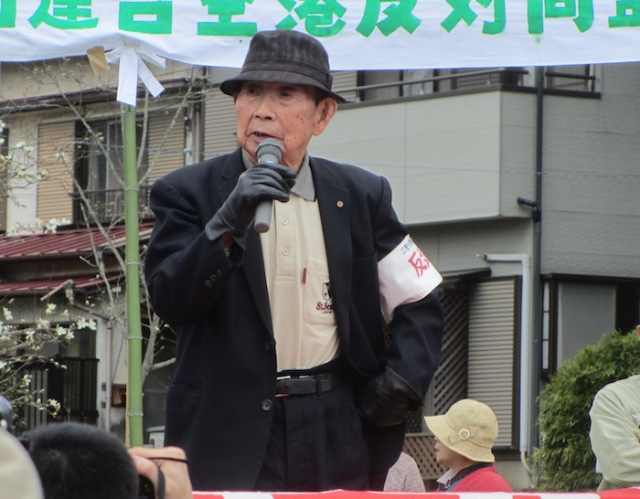
He passed away in the afternoon of August 9th in a hospital in Tomisato, Chiba. A farmer and landowner, Kitahara was the official head of the Sanrizuka-Shibayama United Opposition League Against the Construction of Narita Airport (also known as the Farmers League Against the [sic] Narita Airport, or more colloquially known in Japanese as Hantai Dōmei, or the Opposition League), which campaigns against the expansion of Japan’s premier airport.
After Issaku Tomura, who initially led the protest movement until his death in 1979, Kitahara was the most prominent figure in the Hantai Dōmei. Though increasingly frail in recent times, Kitahara’s fervour was boundless. I met Kitahara once and heard him at rallies on a few occasions. He remained a passionate public speaker despite his advancing age and he was still participating in rallies until last year.
The scale of forced evictions is shocking, threatening more than 70 million people worldwide. Eviction for tourism projects – including hotels, theme parks, resorts, cruise ship ports and airports – is a growing problem that is gaining recognition. Individuals and communities who are affected are invited to submit cases to an important international event which will make recommendations for effective actions and help build solidarity across the globe.
The International Tribunal on Evictions (ITE) has issued an International Call for Cases of Evictions due to Tourism. Any individual or community that has been evicted or is facing the threat of eviction for tourism development is invited to submit their case of eviction or displacement. The deadline for submissions is 15th July 2017. To submit a case of eviction please complete the online form. The selected cases will be examined at the sixth session of the ITE, which will specifically focus on cases of eviction and displacement for tourism development, to be held in Venice, Italy, from 28 to 30 September 2017.
The ITE is a peoples’ and opinion tribunal established in 2011 by the International Alliance of Inhabitants and civil society organizations to practically and interactively end forced evictions around the world, is calling on the international community to report cases of evictions and displacement in the context of tourism development. The ITE’s call for action reads:
“Is your home threatened with destruction because developers want to build a hotel? Do they want to clear your community, your neighbourhood, and your land for a resort, a golf course, a stadium, a port, or an airport for tourism? Are you and your community threatened by the precariousness of rental contracts resulting from AirBnB? Tourism development is attacking your rights where you have chosen to live in peace and dignity!”
Photo: International Tribunal on Evictions (ITE)
At the ITE a jury consisting of representatives of civil society, international organizations and academics will select the cases and evaluate the claims in the light of international legal instruments relating to enforcement of economic, social and cultural rights, with particular regard to the right to housing and land security. The ITE verdict will take the form of recommendations drafted by a jury of international experts, and will serve as a road map for the cases judged and as a reference point for building international solidarity. Recommendations will be made to stakeholders, including the United Nations, governments, the economic and institutional actors responsible for the evictions, and will be monitored on regular basis.
An article on the ITE website, Why the ITE Session on Tourism? Growing human rights violations caused by over-tourism, provides useful background information on the problems host communities have contend with due to the current trajectory of rapid tourism growth. Globally, tourist numbers reached 1,235 billion in 2016 and the the number of forced evictions for this industry is growing. Entire communities are evicted for infrastructure to support mobility for tourism – ports, roads and airports. Indigenous communities are evicted from forests and coastal ecosystems under the pretext of environmental preservation or preventing natural disasters. Urban residents are displaced for gentrification schemes and escalation of rentals of private homes for tourism pushes up rental costs for residents. Authorities often view tourism as an engine of development and disregard human rights.
It is fitting that the ITE is to be held in Venice; this unique city has been dubbed the ‘global capital of resistance to tourism evictions‘. Massive tourism development has been the key factor in reducing the number of inhabitants from 175,000 in 1953 down to just 54,000 in 2017. Meanwhile, Venice is undergoing continued tourism pressure, with 9 million overnight tourists and 24 million commuter visitors in 2016. The fishing island of Pellestrina is a particularly striking example, where landlords no longer rent to residents but only to tourists. It is encouraging that, countering this negative trend, determined and vibrant civil society movement has emerged thoughout the city, organizing daily activities to support resistance against evictions for tourism projects. The ITE session will include visits to a number of islands and districts of “resistance Venice”.
If you are lucky, as your plane touches down you may be able to catch a glimpse from your window of a large homemade sign declaring, in Japanese, “Against Narita Airport”. Omotenashi indeed.
The protest movement against Narita Airport is almost moribund for two obvious reasons: despite fierce opposition and mammoth delays and even fatalities, the airport was eventually finished and opened, and isn’t going anywhere; and the inevitable process of mortality is setting in and the original activists and farmers are slowly disappearing.
Instead, the remains of the protest movement, which is often referred to as the Sanrizuka movement after the area where many of the affected villages were located, continues on with a primary focus on stopping further expansion of the airport in the form of the long-anticipated third runway. Much of this manifests as petitions, various suits and trials, and regular rallies and marches. In particular, the…
An article about resistance to eviction from their homes and productive agricultural land for a new airport in Java, Indonesia, has been published by The Ecologist online magazine: Indonesia: Villagers resist eviction for 50 sq.km ‘aeropolis’ / Airport city on their land. Ten villages, and a vast area of farmland, have already been wiped from the map for Kertajati Airport, which is currently under construction. But Sukamulya village remains. Residents have sustained their resistance to displacement for the airport for over 12 years, since the project was first mooted in 2004. The Front Perjuangan Rakyat Sukamulya (FPRS) was formed to resist eviction for the airport.
Sukamulya villagers have blocked officials from measuring land for Kertajati Airport on many occasions. Starting in August 2016 a series of attempts to measure the land were successful blocked by residents. But on 17th November 2016, when people had gathered yet again to protect their farmland, 2,000 police rushed onto the fields to disperse them and enforce the land measurement. Twelve protesters were injured and the barbaric eviction attempt has been widely condemned by Indonesian human rights organizations and NGOs. Land rights and agrarian reform NGO Konsorsium Pembaruan Agraria (KPA) highlighted resistance against Kertajati Airport as one of Indonesia’s key land rights struggles.
This slideshow requires JavaScript.
A video by AGRA Indonesia Alliance of Agrarian Reform Movement/Aliansi Gerakan Reforma Agraria shows the firing of teargas at Sukamulya residents attempting to defend their land and resist eviction.
If development of the project goes ahead as planned Kertajati Airport will be the starting point for an even larger development, an aerotropolis. An Aerocity adjoining the airport site is planned. In total, 50 square kilometres of land, predominantly productive farmland, has been earmarked for Kertajati aerotropolis: 1,800 hectares for the airport and 3,200 hectares for the Aerocity.
“The project of the NAICM will lead to water shortage” Vandana Shiva in Atenco
Desinformémonos
Mexico City. 14 August 2016. “At some point it will lead to a water shortage” said Vandana Shiva and Sebastiao Pinheiro during their visit to Atenco yesterday. With members of the Peoples Front in Defence of Land (FPDT) they toured the lands of Atenco that the government intends to dispossess in order to be part of the new airport in Mexico City (NAICM). They arrived early in the camp that is located in the area where they intend to build one of the access roads.
Vandana, winner of the alternative Nobel prize for the environment, asked Mexicans not to allow life to be exterminated and to come to support the movement of the FPDT and all those who oppose the construction of the airport in these lands.
Meanwhile, members of the FPDT told the environmentalists that in these lands they grow crops of pumpkins, olives, corn…