DR Congo: Evictions and demolitions for Mbuji-Mayi Airport rehabilitation and expansion

About 800 houses were demolished to make way for rehabilitation and expansion of Mbuji-Mayi Airport. Many affected people said compensation did not match the real value of their land plots.

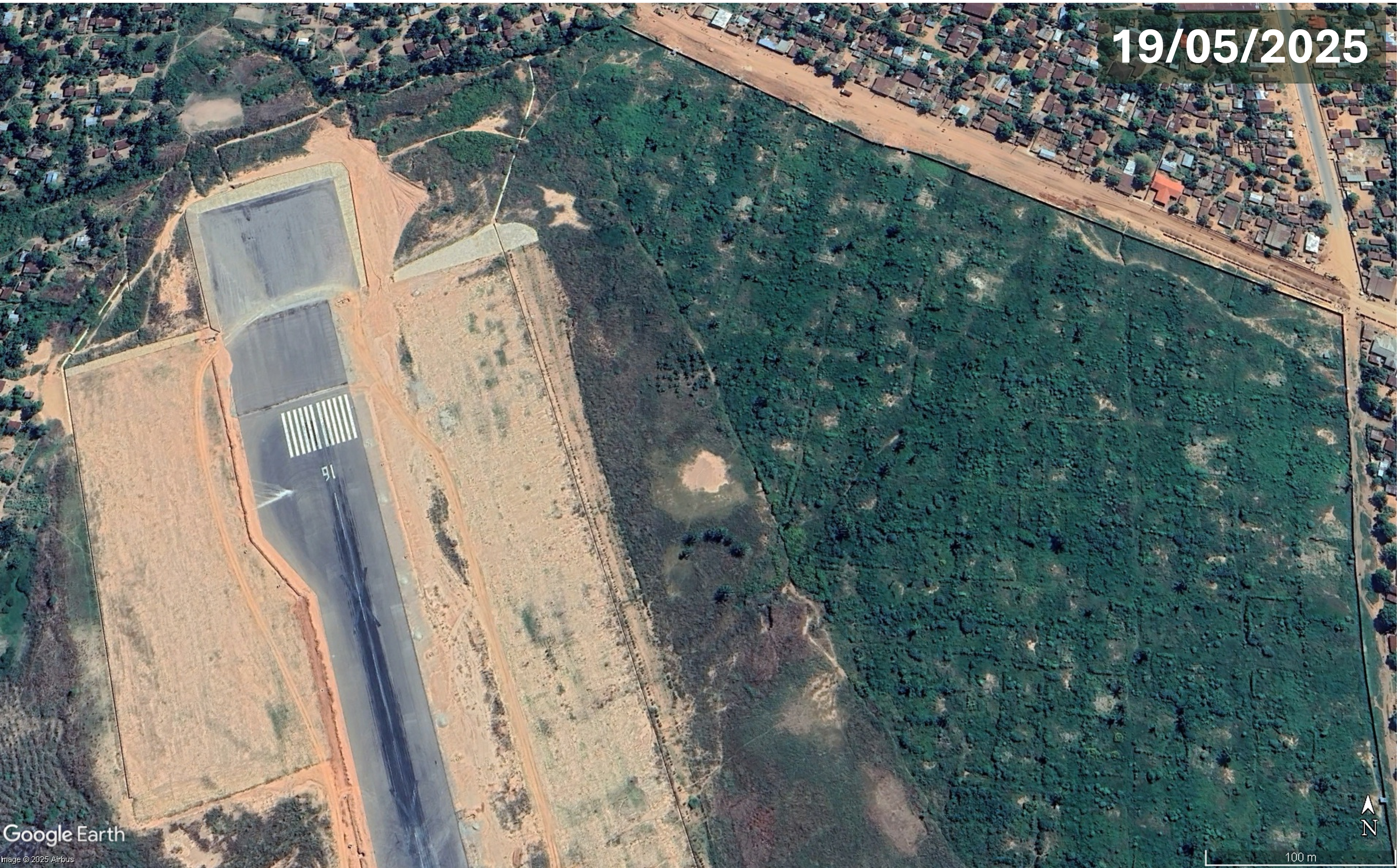
Aerial imagery of Mbuji-Mayi Airport, 17th June 2023Aerial imagery of Mbuji-Mayi Airport, 19th May 2025
Aerial imagery shows changes to the northern section of Mbuji-Mayi Airport between June 2023 and May 2025. In addition to runway works, roads have been widened and buildings next to the airport demolished and replaced with fast-growing vegetation.

Rehabilitation of Mbuji-Mayi Airport, located in the northeast of the city of Mbuji-Mayi, the capital of the Kasai-Oriental Province in south central DR Congo, is part of the Priority Air Safety Project – Phase 2 (PPSA 2) project financed by the African Development Bank (AfDB). Project components include runway extension, construction of aircraft parking aprons, control tower and works to improve aviation safety. AfDB’s 2018 Summary Environmental and Social Management Plans (ESMP) noted that the project area consists of neighbourhoods situated near the airport with dwellings and agricultural plots on the site; some activities including runway extension were postponed to enable studies and mobilisation of funding for involuntary resettlement. In February 2021 the mayor of Mbuji-Mayi set up a commission to identify all affected people who would be evicted, then in March he made reassurances that state obligations for the eviction of people who had built and rented houses would be followed.

Bulldozing of unauthorised buildings around Mbuji-Mayi Airport began on 7th November 2022. The airport project necessitated displacement of approximately 800 households but compensation of affected people was suspended in October 2023 because the census was inadequate and the process had not been accepted by all the residents with some continuing to resist. People whose land was expropriated began receiving compensation cheques on 13th October yet some voiced concerns about finding a new site, the compensation amount and demanded more transparency and guarantees regarding their property rights.

On 21st October 2023 residents whose land was expropriated for the airport project demonstrated in the street denouncing insufficient compensation, burning tyres at two road junctions before police attempted, unsuccessfully, to disperse them. An emergency meeting failed to reach an agreement satisfactory to plot owners who were given a 15-day ultimatum to relocate after receipt of compensation. In February 2024, as works at Mbuji-Mayi Airport were underway, owners of nearly 800 houses on the site were given two weeks’ notice to dismantle their homes. Occupants maintained that the compensation offer did not match the value of their assets.

On 17th July 2024 the mayor of Mbuji-Mayi announced imminent demolition of houses built on the airport site, in the name of expropriation for public purposes. Plot owners had been given tokens for replacement land on the outskirts of Mbuji-Mayi but had not vacated or demolished their houses; 800 families still contested expropriation due to lack of recognition of the market value of their plots. A delegation of residents living around the airport requested protection and support from the provincial authority and respect for expropriation law as recognised in the constitution.

Early on the morning of 29th October 2024 demolition of houses east of Mbuji-Mayi Airport, between Zaire and Dodoma avenues, began. Heavy machinery was escorted by police, as owners of the buildings demanded compensation matching the real value of their property. All their efforts, including marches, sit-in protest and suicide threats, had not dissuaded the government from expropriating the land plots. On the instructions of the president of DRC, Félix Tshisekedi, Minister of Social Affairs, Humanitarian Action and Solidarity, Nathalie Aziza Munana, visited Mbuji-Mayi on 10th November to investigate the demolition of 800 houses near the airport, collect information about evictions and meet with victims and civil society organisations. Minister of Justice, Constant Mutamba, said he had been contacted by several citizens who had not yet received the compensation they were promised, raising suspicions of misappropriation of funds allocated for this purpose.

For more information including references for all source material and photos see the case study on EJAtlas, the world’s largest, most comprehensive online database of social conflict around environmental issues – Mbuji-Mayi Airport rehabilitation, DRC

Puerto Rico: Resisting Esencia, a luxury tourism and residential development with a private airport

Many local and diaspora organisations are opposing Esencia, a luxury tourism and residential megaproject with a private airport, in Cabo Rojo. The development has been granted generous tax credits and would require vast volumes of water.

In May 2024 two real estate firms, Reuben Brothers and Three Rules Capital, filed a master plan for Esencia, a USD2billion development in Boquerón Bay, Cabo Rojo on the west coast of Puerto Rico. Anchored by international hotel operators Mandarin Oriental Hotel Group, Aman Group and Rosewood Hotels and Resorts and containing up to 500 luxury hotel rooms and 900 tourist residences the complex would have a private airport. The Esencia website says the new ‘residential and hospitality community’ will have 3 miles (4.8km) of ‘pristine beachfront’. Plans also included two golf courses, spa, wellnesses centre, health clubs, equestrian centre, hiking and biking trails and a school.

Project Esencia proposed plan
The proposed Esencia plan, with sea views and a private airport, includes luxury hotels and residences and two golf courses. Image source: Reuben Brothers

The Esencia project was granted more than USD497 million in tax credits and in August 2024 four new tax exemptions of between 90 and 100 per cent were approved. A new decree granting 100 per cent fuel tax exemption for tourism-related activities was criticised for incentivising high levels of fossil fuel usage. Comité por la Verdadera Esencia del Suroeste sent statements to multimedia platform Marea Ecologista concerning the proximity of the project site to protected ecologically sensitive areas providing habitats for endangered birds such as the Puerto Rican nightjar. Responding to the absence of public hearings on permits and boundary demarcation for the Esencia project a town hall was convened by local community, environmental and cultural groups on 28th September 2024 where further detail of Esencia project components, including shopping malls and renovation of an airstrip to accommodate small aircraft, was shared.

The land within the site is rural and falls under two classifications. One category is rural land protected because of its ecological importance as it is located between two nature reserves and serves as a corridor for many species and also for its recreational value. The second category is rural land where there is more flexibility regarding development and in recent years mechanisms to evade compliance with the land use plan have been deployed such as declaring projects to be strategic or of critical importance. The project area contains at least 24 archaeological sites from the colonial and pre-colonial eras, many of which have not yet been explored.

On the first day of public hearings in March 2025 Cabo Rojo’s streets were filled with protesters holding posters and banners, many declaring ‘No to Esencia’ and calling the project an enclave for a small number of billionaires. The hall was not big enough to accommodate all the people opposing the project so many watched the proceedings on a screen in a tent outside. Puerto Rican groups opposing the project joined forces under the slogans ‘Defend Cabo Rojo’ and ‘No to Esencia’. The anti-Esencia movement gained support from Puerto Rican diaspora and pro-independence organisations, amplifying locals’ calls for cancellation of the project and holding protests throughout New York. For example, protesters occupied the lobby of the Mandarin Oriental Hotel and unfurled banners in the luxurious Columbus Circle shopping mall.

Officials said the project’s environmental impact statement (EIS) did not address the impacts on infrastructure and ecosystems and lacked hydrological studies. Esencia would place additional strain on water supplies, consuming more than 1.25 million gallons per day, a volume equal to more than a third of current consumption in the Cabo Rojo Municipality. This is a low estimate as it does not include the project proposal’s two golf courses which would increase the volume of water consumed per day to 2 million gallons. The development would require extraction from aquifers or connection to the existing drinking water system but neither of these options are feasible. Local fishers expressed concerns over the risk of damage to oyster beds and disruption of freshwater and saltwater flows that are essential to the health of the estuarine environment.

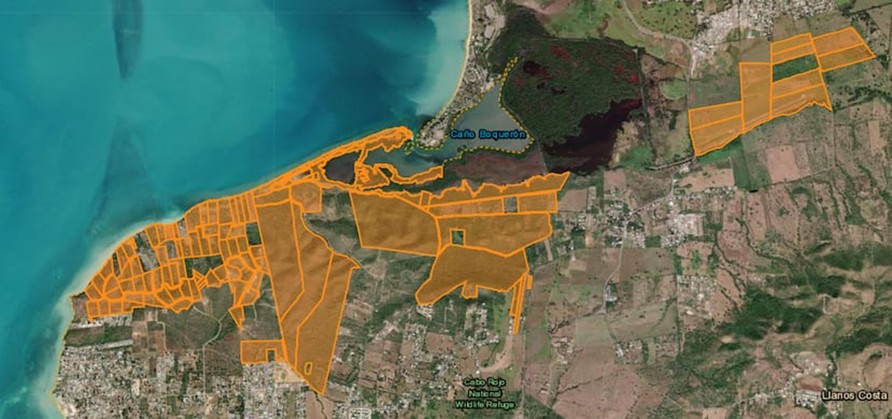
Properties in Cabo Rojo purchased for Esencia
Many of the properties purchased for the Esencia project are shown in orange, agricultural land purchased in August 2025 is shown to the right. El Nuevo Día, 20/09/2025

By September 2025 project investors had spent approximately USD147 million on properties for Esencia and were on track to acquire the target of 809 hectares of land. Recent land parcel purchases were part of the Reserva Agrícola del Valle de Lajas (Lajas Valley Agricultural Reserve) and an airstrip. On 12th September the Department of Natural and Environmental Resources (DNRA) published a 29-page report firmly reiterating its opposition to the Esencia project and concluding that the plans did not comply with environmental laws. Significant findings included fragmentation of habitats hosting endangered bird species, severe impacts on Catesbaea melanocarpa, a rare, endangered lily and threats to the habitat of Anolis poncensis, a rare lizard species. The project’s so-called ‘ecological corridors’ lacked the connectivity of existing ecosystems and golf courses, artificial ponds and landscaping claimed to be mitigations would be part of the project’s negative impacts.

For more information including references for all source material and photos see the case study on EJAtlas, the world’s largest, most comprehensive online database of social conflict around environmental issues – Esencia project, Puerto Rico

By 3rd November 2025 a petition – STOP THE LUXURY MEGAPROJECT “ESENCIA” IN CABO ROJO, PUERTO RICO NOW – calling on the Puerto Rican government and its agencies to stop the permit granting process, protect the land, study submitted material and conduct a transparent investigation prioritizing affected communities and experts, had attracted 36,327 signatures: Detengan ahora el megaproyecto de lujo “Esencia” en Cabo Rojo, Puerto Rico (STOP THE LUXURY MEGAPROJECT “ESENCIA” IN CABO ROJO, PUERTO RICO NOW)

Cabo Rojo International Airport will serve a new luxury tourism complex and private jets

A new international airport under construction in the Pedernales province in the southwest of the Dominican Republic, for commercial and private flights, is integral to development of a high-end coastal tourism complex.

Cabo Rojo International Airport site
Cabo Rojo International Airport construction site. Satellite image 09/09/2024

In January 2024 the government of the Dominican Republic announced construction of a new international airport in the Pedernales province in the southwest of the country. The site is in the Manuel Goya community, part of the Oviedo municipality. A Spanish firm, Acciona Construction SA, was awarded the contract to build Cabo Rojo International Airport, even though its bid was the most expensive. The RD$3,961 million (€62 million) contract, awarded in June 2024, included construction of a 3.1 kilometre runway, taxiway, aprons for Boeing 777 aircraft (the world’s largest twin-jet aircraft accommodating up to 368 passengers) and drainage works. The new airport will serve luxury tourism and private aircraft (private jets). Director of the Airport Department, Víctor Pichardo, highlighted the new airport’s potential to transform tourism in Pedernales by attracting both commercial flights and private aviation, noting that each year more than 40,000 private aircraft fly over the Carribean. He said the new airport would position the Dominican Republic as a hub for high-end tourism. Construction of the new Cabo Rojo Airport (also known as Pedernales Airport) is scheduled to be complete by the end of 2025; it is anticipated to handle up to 1 million passengers annually within 17 years, making it the third busiest airport in the country.

Luxiry tourism development adjoining Cabo Rojo Airport
Artist rendering of development of planned luxury tourism development near the new Cabo Rojo International Airport and expansion of Port Cabo Rojo. Image: Dominican Today

The new Cabo Rojo International Airport, will form the basis for a new coastal tourism complex with 12,000 rooms located just 15 minutes away (about 25 km). The two locations are already connected by a major highway: DR Route 44. The tourism complex site is near the existing Cabo Rojo Domestic Airport, a civic/military airport currently receiving a few small aircraft, carrying 2-30 passengers, per week and serving operations of the Dominican Air Force. Tourists will also be delivered to new resorts via Port Cabo Rojo, which is expanding into a facility capable of receiving two large cruise ships carrying up to 15,000 visitors. Large volumes of fresh water will be diverted to the tourist area via a new aqueduct which will supply 8,000 tourism rooms. As of July 2024 the ProPedernales tourism development trust, a Public-Private Partnership (PPP) with the government holding a 52% stake and the private sector holding 48%, reported a total investment of USD130 million on Cabo Rojo tourism, focused on the first three hotels and the airport runway. In addition, the Dominican Government had spent nearly USD30 million on water projects, site conditioning, planning and design to prepare for and support the initiative.

Six major international hotel chains, ‘a who’s who of luxury and all-inclusive resorts’, are building new properties in Cabo Rojo: Hilton, Marriott International, therostar Group, Karisma Hotels & Resorts, Amresorts (part of World of Hyatt) and Sunwing. Luxury tourism development just 15 kilometres away from the border with Haiti, gripped by gang violence and a humanitarian crisis, might seem incongruous. But the Dominican Republic has reinforced the border with Haiti with more than 13,000 troops and the first phase of a high-tech ‘smart’ border wall with drone patrols, surveillance towers and night vision cameras is nearing completion. The exclusivity and high security requirements of luxury tourism can go hand in hand with militarisation; the established Cabo Rojo Airport nearby already serves the Dominican Air Force.

At a June 2025 National System of Protected Areas (SNAP) conference a number of environmental experts stressed the importance of responsible tourism development in Cabo Rojo, avoiding repeating the mistakes of some other Dominican tourist destinations by protecting the region’s ecology and directly benefitting local communities. But problems have been reported in the earliest stages of Cabo Rojo’s tourism development. In August 2024 environmental organisation Grupo Jaragua said the project was proceeding without clear compensation plans for affected residents of the Oviedo municipality, where the airport is being constructed. A community leader reported that tractors had destroyed land. Two months later a truck drivers’ union took strike action protesting non-payment for tranport of fill materials used for airport construction, saying the amount being paid per kilometre was not even sufficient to cover their fuel costs. The government is providing a high level of financial and infrastructural support to tourism and airport megaprojects that will primarily benefit airlines, major international hotel chains and cruise ship lines, not local businesses, and only wealthy visitors will be able to afford to stay in the luxury hotels. And the new high-end tourism complex may well boost the number of private aircraft flights, only affordable to a small number of very wealthy people, at Cabo Rojo Domestic Airport.

Climate refugees face displacement to make way for Cox’s Bazar Airport and Air Force Base expansion

Up to 70,000 climate refugees face displacement to make way for Cox’s Bazar Airport and Air Force Base expansion and more than 20,000 could be ineligible for replacement flats in the Khurushkul Ashrayan Project. On 7th January 2025 thousands of people protested against eviction.

Map of Cox's Bazar Airport and Bangladesh Air Force (BAF) base.
Map of Cox’s Bazar Airport, Bangladesh Air Force (BAF) base and Khurushkul Ashrayan Project. Satellite imagery 25th March 2025

Since 1981 climate refugees – people displaced by cyclones, river erosion and tidal surges from many of Bangladesh’s coastal areas – have resettled in Ward 1, Cox’s Bazar Municipality. The area is government-owned ‘khas’ land between the Bay of Bengal and Cox’s Bazar Airport and the adjoining Bangladesh Air Force (BAF) base. The largest influx of climate refugees occurred in the aftermath of a cyclone and tidal wave on 29th April 1991 when about 40,000 people displaced from Kutubdia Island settled in the area. In February 2011 several local leaders demanded cancellation of a project to expand Cox’s Bazar Airport. Officials had moved to acquire 16 areas in Ward 1 – including Kutubdiapara, Samitypara, Fadnerdail, Bandarpara and Naziraratek – and 40,000 people would become homeless. In 2012 the Civil Aviation Authority of Bangladesh (CAAB) began a project to extend Cox’s Bazar Airport runway. In 2021 an agreement for another runway extension, lengthening it northwards into the Maheshkhali Channel through land reclamation, was signed.

Climate refugees face eviction

An in-depth investigation of the climate refugees from Kutubdia Island who had settled in Ward 1 was published in December 2024. They were still vulnerable to extreme weather; storms would leave many homes flooded with seawater and the area lacked cyclone shelters. Neither Cox’s Bazar Municipality nor the Chittagong District had precise data on the number of people living in Ward 1 but Akter Kamal, elected three times to represent Ward 1 and now a former councillor, said at least 52,000 people resided there. The investigation found that ‘Every household in the climate refugee camp lives inconstant fear of eviction. All the khas land in the area has been acquired for the expansion of Cox’s Bazar Airport’s runway and the construction of an air force base’.

Resettlement in the Khurushkal Ashrayan Project

The Khurushkal Ashrayan Project, located 3 kilometres east of Cox’s Bazar Airport, was described as ‘the world’s biggest climate refugee rehabilitation project’ when the then Prime Minister Sheikh Hasina inaugurated the first phase, housing 600 families, on 23rd July 2020. It was stated that upon completion 139 five-storey blocks would rehabilitate 4,409 families, the majority living in the Cox’s Bazar Airport area since being displaced by the 1991 cyclone. By December 2024 another 85 buildings had been completed which would accommodate 2,270 families. But former councillor Akter Kamal said that at least 20,000 climate refugees living in Ward 1 were ineligible for flats. Changes to the list of project beneficiaries had caused anxiety to between 20,000 and 22,000 climate refugees who were excluded from the resettlement plan.

Thousands protest eviction plan

On 7th January 2025 thousands of climate refugees, including residents of Samitypara and Kutubdiapara, held a protest demanding cancellation of the eviction plan linked to Cox’s Bazar Airport expansion. Demonstrators blocked roads causing traffic disruption with several thousand people blocking the main city road for 2½ hours, protesting eviction and calling for long-term settlement and holding a rally in front of the Deputy Commissioner’s office. They had lived in their settlements in Ward 1 for 20-30 years but instead of rehabilitating them plans were being made to evict them. Former councillor Akter Kamal told Prothom Alo that between 60,000 and 70,000 climate refugees were living in the area and land had been acquired for Cox’s Bazar Airport runway expansion and air force base construction. He estimated the number of families not entitled to flats in the Khurushkal housing project as approximately 4,000. Protestors said they would bring the city to a standstill if the government did not reverse its decision to evict them.

Clash between locals and BAF personnel

On 24th February 2025 Shihab Kabir Nahid, a 30-year-old local trader, was killed in a clash between locals and BAF presonnel. His mother said he was standing in the doorway of their house and died after being shot in the head. The Inter Services Public Relation Directorate (ISPR) stated that Cox’s Bazar Air Base had come under a “sudden attack” by unidentified people from the neighbouring Samitypara area. But local residents alleged that the clash was triggered by altercations over BAF’s attempts to acquire land and relocate residents for expansion of Cox’s Bazar Airport and the air base. A Samitypara resident said the clash began as local representatives were on their way to a scheduled meeting with BAF officials about relocation for airport expansion. The Borderlens published an account of the violent incident and the circumstances leading up to it. Climate refugees in Ward 1 had lived in fear for many years, their homes on land earmarked for air base expansion and denied land ownership rights or resettlement. In recent months the eviction drive for air base expansion had intensified. Families’ appeals to the district administration went unanswered and BAF personnel were making threats. Gunfire began after a scuffle and social media footage showed air force personnel firing at unarmed protesters throwing bricks and stones.

Runway expansion impacts on waterway navigability

By March 2025 the runway expansion was 84% complete and aircraft navigation aid lights had been installed on concrete piles extending across the mouth of the Maheshkhali Channel. On multiple occasions the Bangladesh Inland Water Transport Authority (BIWTA) had raised concerns about lack of approvals, consultation and surveys pertaining to the risk of loss of navigability for waterway traffic, but the warnings had been ignored. A report by a committee of experts stated that the pillars in the river obstructed water flow and caused accumulation of sediment at the base of the pillars, narrowing the mouth of the Maheshkhali Channel and reducing navigability. An alternative channel that had been dug out was expanding westwards, posing risks to residents of Sonadia Island. The BIWTA report warned that sediment build-up could affect water routes along the coast from Chattogram to Cox’s Bazar along with the southward route to Saint Martin’s. The report recommended removal of the piling in the Maheshkhali Channel.

For more information, including references for source material, see the case study on EJAtlas, the world’s largest, most comprehensive online database of social conflict around environmental issues – Cox’s Bazar Airport and Air Force Base expansion

Lucknow Airport expansion, land acquisition, protest and Aerocity plans

Satellite image of Lucknow Airport (Chaudhary Charan Singh International Airport) dated 20/10/2024. Location of Terminal 3 and some of the villages affected by land acquisition for airport expansion are shown.

Lucknow Airport (also known as Chaudhary Charan Singh International Airport), located 14km southwest of the capital city of Uttar Pradesh, is already the 11th busiest airport in India and traffic will increase with recent and ongoing expansion. A third terminal began operations on 30th March 2024, with capacity for 8 million passengers per year, set to rise to about 13 million upon completion of phase two. Land from Bhaktikhera village was used for the third terminal and runway extension and in March 2018 the Airports Authority of India (AAI) agreed to pay Rs 32 crore for relocation of about 600 residents. Compensation for acquisition of 70 acres of land from Bhaktikhera, Gurera and Aurangabad Jagir villages, for runway extension and other facilities, was still being negotiated in June 2018. Airport expansion had been stalled for a decade due to difficulties with land acquisition. But in June 2019 the AAI announced that ‘decks are cleared for the construction of the wall around the airport and expansion of the runway’. The district administration committed to helping AAI build the wall to keep out people ‘trespassing the area’ and stray animals posing safety risks.

Demolition notices and farmers protest boundary wall construction

Construction of houses near Lucknow Airport also raised safety concerns. At the end of August 2024 authorities served demolition notices on 50 houses which had been built next to the airport boundary without authorization. A Lucknow Development Authority (LDA) official said a builder had posed as a contractor without obtaining the requisite No Objection Certificate (NOC) from the airport administration, acquired land directly from farmers and pocketed the money. A month later construction of the airport boundary wall led to a clash between a group of farmers and police. After commencement of excavations works, with two JCBs in the presence of police, a large number of farmers, between 150 and 200, gathered and began to protest, saying the airport administration was forcibly occupying their land. The farmers, from Rahimabad and Mohammadpur Bhakti Kheda villages, said a disputed land petition was pending adjudication in the Allahabad High Court.  The protest forced authorities to temporarily halt land reclamation operations for airport expansion. Farmers argued that the land had been cultivated for many generations and that land acquisition notification in the 1950s lacked important details including plot numbers, land area and the names of the landowners, thus raising questions about the legitimacy of the acquisition process.

In response to the protest the district administration postponed the land reclamation drive until 15th October. The owner and operator of Lucknow Airport, Adani, one of India’s largest multinational conglomerates, plans to reclaim approximately 260 acres on the southern edge of the airport for extension of the runway to 3,500 metres to accommodate large, wide-body aircraft and construction of two parallel taxiways. Speaking anonymously, an official stated that a total of about 400 acres owned by the airport for over 70 years would be reclaimed for airport expansion and a survey would be conducted to compensate farmers with crops growing on the land. The principal petitioner against the land reclamation said the farmland had not been legally acquired, farmers had not received any compensation and Adani was attempting to forcibly construct the airport boundary wall. 

Boundary wall construction continues and Aero City plans

On 25th October the Supreme Court dismissed the farmers’ plea against expansion of Lucknow Airport, allowing LDA to proceed with the project. Lucknow Development Index announced on X that, after deployment of a ‘heavy police force’ in response to resistance, ‘work is still progressing amid farmers clashes’. A ‘massive area’ was being reclaimed and construction of the boundary wall had re-commenced. An official source said a 400-acre area was being reclaimed and a fourth terminal and an Aero City was planned on the land.

 Few months previously, on 5th February 2024 Times of India had reported ‘ambitious plans’ for Lucknow Aerocity, a 1,500 acre development with ‘an array of upscale amenities, such as world-class convention centres, large parks and seven-star hotels’, announced by Uttar Pradesh finance minister Suresh Kharna. The LDA was tasked with identifying land for the project, likely to be located in Rahimabad and Gahru villages. In addition to Lucknow, Adani owns several airports in India including Mumbai, Mangaluru, Jaipur, Ahemedabad, Thiruvanthapuram and Guwahati. Plans for aero cities adjoining Adani’s airports were reported in July 2022. The Economic Times stated that Adani plans to develop ‘aero cities’ on more than 500 acres at all its airports, with hotels, convention centres, retail, entertainment, healthcare, logistics, offices and other real estate sectors.

Locals resisted eviction for Guwahati Airport expansion

At the beginning of September 2021, a month before operation of Guwahati Airport (the busiest airport in northeast India) was handed over to Adani, there were reports of locals resisting eviction to make way for expansion. An eviction notice was served to 54 households, outside the walled area of the airport in Koitasidhi village. An airport official said the land, adjacent to the runway, was to be developed as an approach area, especially for larger aircraft on international flights. Villagers said that several plots of land had been acquired for construction and expansion of the airport since 1962. Some villagers said, “We would rather give our blood than give up our land”. Continuing protest was reported on 8th September; a local person said “We heard that the Adani group which has been given charge of the Airport for 50 years under a lease agreement by the Government of India wants to do expansion work here. But we want to clarify that we will not leave our land even if we are given adequate compensation”. Some other locals said they would not give their land to Adani. On 15th September 2021 the Times of India reported that villagers were fiercely resisting giving up land for airport expansion. A tearful farmer in his late 70s said his family had been compelled to give up land for airport expansion in the 1960s, which if sold today would fetch a much higher price. His family was left with ownership of just one residential plot. More recently, in June 2024, announcing the schedule for opening of a new terminal at Guwahati Airport in April 2025, Chief Airport Officer Utpal Baruah said plans for subsequent expansion phases included a maintenance, repair and overhaul (MRO) facility, aerocity and helipad.

Construction of an ‘Eco-Tourism Airport’ on Koh Rong island

Earthworks for construction of an airport on Koh Rong island, 25 km from the city of Sihanoukville on Cambodia’s south-west coast, began in January 2024. Satellite imagery shows the airport site, located in a flat area in the centre of the island. The new airport with a 2.650 metre runway will have capacity to handle 138,000 passengers annually upon completion of the first phase and the MoU signed in January 2023 formalised a budget of $300 million. The necessity and viability of Koh Rong International Eco-Tourism Airport seems questionable with two major international airports nearby. Newly constructed Dara Sakor Airport, with capacity for 10 million passengers per annum and scheduled to begin operations in November 2024, is only 21km away. Sihanouk Airport is 45 km away. Also, Koh Rong is already well served by boat; the ferry journey from Sihanoukville only takes about 45 minutes.

Satellite imagery of Koh Rong dated 1st November 2023, showing location of the four coastal villages, Royal Sands resort, long beach, major roads and Koh Rong International Eco-Tourism Airport construction site.

The new airport will be named ‘Koh Rong International Eco-Tourism Airport’. While an airport enables people to visit and explore protected beaches, forests and native wildlife habitats, it does the very opposite of protecting ecosystems, concreting over a vast area for runways, terminals and access roads. Then there is the issue of climate disrupting greenhouse gas emissions from flights, with aviation being energy intensive and dependent upon fossil fuels. And tourism development on Koh Rong has damaged ecosystems and the people depending on them. In 2008, Royal Group, one of the largest investment and development companies in Cambodia, was granted a 99-year land concession to develop the 78 square kilometre island. Realisation of the masterplan – featuring resorts, casinos, marinas, golf courses, two fishing villages and an airport – was delayed but commenced in 2015 with clearance of sites along the southwestern coast including forests along with construction of a road. On 3rd July 2015 Koh Touch villagers held a sit-in protest, blocking construction crews, excavators and a bulldozer, in response to construction of a road which they said would cut through their village and affect their homes. Later that month opposition to development of Koh Rong became more vocal in response to construction equipment and workers appearing on the island. Hundreds of residents began to speak out on social media. As well as cutting trees cliffs and rocky outcrops had been flattened for development, including a new pier on Long Beach, on the southeast of the island.

In August 2015 a number of Koh Kong residents called on officials to review what they called “abusive activities” by Royal Group. Construction had accelerated in recent weeks and workers and machinery had been photographed clearing large areas of forest. Residents accused Royal Group of destroying farmland and crops, including cashew, jackfruit, coconut and mango trees. A village leader said destruction could impact the livelihoods of over 100 families, who had lived on the island since 1995. Villagers said the destruction of their livelihoods was illegal and authorities should monitor the situation. Human rights and environmental campaigners supported residents’ calls for improved oversight and local groups were preparing petitions and other documents to file with provincial and national authorities. Protest groups had been formed in response to a breakdown in communications between residents and Royal Group. One villager said, “They come in and do their work, take whatever they want, but there is no communication”. 

Controversy over land titles for Koh Rong villagers was reported in 2017. Some residents who had lived on the island since before 2008 had land titles, although it was uncertain whether these titles would be upheld amid disputes. Those arriving after 2008 did not have land titles. By 2018 over 1,000 land plots, belonging to 500 families, had been recognised by the government, but in April 2018, during the inauguration of the luxurious, five-star Royal Sands Koh Rong resort, about 50 people who had not yet received land titles attempted to join the event but were prohibited from doing so. Prime Minister Hun Sen ordered the Ministry of Land Management to bring an end to the Koh Rong land dispute. In June 2020 53 families protested land clearance; a 35-hectare site they believed rightfully belonged to them was being bulldozed. A Preah Sihanouk Provincial Administration spokesperson called on the protesting families to cooperate with authorities by providing relevant documents and warned them that if they caused chaos legal action would be taken against them. A member of one of the protesting families claimed they had lived in the area since 1992 and said: ”We won’t go anywhere. I will gather to protest at this site. We dare not enter the bulldozing site. I want Prime Minister Hun Sen to see and tackle this issue for us. We all have ownership documents.”

In June 2024 Mongabay reported that a new map of Royal Group’s plans for Koh Rong showed golf course zones, commercial zones, accommodation zones, casinos zones and an international airport. The latest plans did not appear to impact fishing villages but included clearing some of the Koh Rong’s protected forests to make way for golf courses. In total, project plans entail clearing more than 3,100 hectares of the island’s forests. A photo showed bulldozers and trucks working on the airport site. Sixteen years after the land was leased to Royal Group there was still no publicly available social or environmental impact assessment and islanders’ future was uncertain. Some Koh Rong residents hoped to sell their land to Royal Group while others feared that it would be taken from them.

For more information about the airport and tourism projects on Koh Rong island, including references for all source material, see the case study on EJAtlas, the world’s largest, most comprehensive online database of social conflict around environmental issues: Koh Rong island tourism development, Cambodia.

Dara Sakor Airport serves tourism zone taking up 1/5 of Cambodia’s coastline

In November 2023 Cambodia’s State Secretariat of Aviation (SSCA) announced that construction of Dara Sakor Airport (Cambodia’s fourth international airport after Phnom Penh Airport, Siem Reap Airport and Sihanouk Airport) was in its final stages. Dara Sakor Airport has been built to serve a gigantic tourism-oriented economic zone, the 451 square kilometre Dara Sakor project encompassing about one-fifth of Cambodia’s coastline. The Dara Sakor developer, Coastal City Development Group Ltd., calls the project ‘Coastal City’ and its website has pictorial maps indicating the many components of the project such as Dara Sakor Airport, a resort, tourism zone, golf courses and a port. The China-Global South Project reflected on the Dara Sakor project in 2023. Of all the anticipated infrastructure only the airport was completed. Yet the project continued with ‘considerable support from the government’. BBC reporters visiting Dara Sakor in September 2023 described unfinished roads and buildings as a stark contrast with ‘dazzling brochures for potential investors’.

Pictorial map of Dara Sakor project including tourism zone, resort, golf courses, development zone and Dara Sakor International Airport. Source: Coastal City Development Group Ltd.

Thousands of people have been forcibly displaced from their homes for the Dara Sakor project, losing their farming and fishing livelihoods. There have been many protests against eviction and inadequate compensation, in many instances met with repression. Unrest dates back to the inception of the project in 2008 when 360 sq km of land in the Botum Sakor and Kiri Sakor districts in the Koh Kong Province was reclassified as state-owned land. A 99-year lease contract was signed with Union Development Group (UDG) of China. Cambodian Human Rights and Development Association (Adhoc) reported that affected communities were not consulted about the project, some only becoming aware when officials arrived to measuring land. In 2011 the project site grew to 451 sq km when UDG was granted an additional 91 sq km land concession to develop a water reservoir and hydropower. During 2011 UDG began dismantling and burning down some villagers’ houses and destroying productive trees.

A key protest took place in February 2014 when about 140 people blocked the road to UDG’s offices leading to a clash with 40 UDG security guards and six soldiers carrying AK-47 rifles. Kiri Sakor District Governor said district authorities had ordered about 100 families to vacate their land for the Dara Sakor project’s hotels, golf courses and an airport. By September 2014 5,791 people had moved to a relocation site where they lacked access to former farming and fishing areas and suffered many problems including poor quality housing damaged by wind and rain, limited water that did not meet national standards, lack of electricity and health care facilities. Reports of destruction of houses and productive trees emerged again in 2018. In april April Koh Kong Provincial Court heard testimony from 13 families claiming that 60 UDG guards had burned their productive trees, seeking compensation for loss of cassava, jackfruit, mango, rubber and coconut crops.

On 27th May 2019 about 20 residents protested in front of the Chinese Embassy in Phnom Penh, calling for resolution of the 11-year land dispute. A report by the Community Legal Education Center stated that 1,143 families were forced to vacate about 100 sq km of land in the first five years fo the project but many families had resisted and fought for rights to the land. Four villagers were detained for 12 hours on 29th September 2020, after camping outside Koh Kong Provincial Hall calling for action over the 12-year land dispute with UDG. A year later 1,333 families rejected compensation offers of between 1 and 3.5 hectares and said they would fight to remain on their land. Protests against compensation offers continues into 2022; some declined the offer as it was insufficient and the village the government wanted to relocate people to was 100 km away and lacked infrastructure.

In June 2023, just four months before SSCA’s announcement about construction of Dara Sakor Airport entering its final stages, there was yet another protest by people affected by displacement for the Dara Sakor project. A group of villagers involved in a Dara Sakor related land dispute attempted to travel to Phnom Penh to submit a petition at the Ministry of Justice, but were met with a police roadblock. Eleven villagers were arrested, forced into a truck, returned to Koh Kong and charged with criminal incitement. Radio Free Asia reported that authorities threatened further arrests after about 20 villagers gathered outside the offices where the 11 people were being detained. Human rights organization Licadho said the protesters had not caused any social disorder and that police had been sent to the the area where many of them lived.

For more information including references for all source material see the case study on EJAtlas, the world’s largest, most comprehensive online database of social conflict around environmental issues – Dara Sakor project, Cambodia.

Over 1,000 residents protest Taoyuan Aerotropolis relocation policies

More than 1,000 residents, along with several legislators, gathered to voice their discontent over government relocation policies for the Taoyuan Aerotropolis project, the largest land expropriation case in Taiwan.

The protest took place on 13th October 2023, after continued public appeals over the high cost of resettlement housing had gone unheeded. Huang Shih-chieh, the Democratic Progressive Party legislator, said the government should adjust relocation compensation in line with the price index and that the high cost of resettlement housing should be absorbed by the government, not shifted onto the affected people. In response, the Taoyuan City Government stated that the compensation budget had been increased by 20% but affected households said they have never felt adequately compensated. Kuomintang (KMT) Councillor Hsu Chi-wan said the government had repeatedly given the same resonse to appeals from households whose property was expropriated and suggested that compensation measures executed by Taoyuan’s Land Administration Department should be expedited.

VVIP airport for Indonesia’s new capital city triggers land tensions

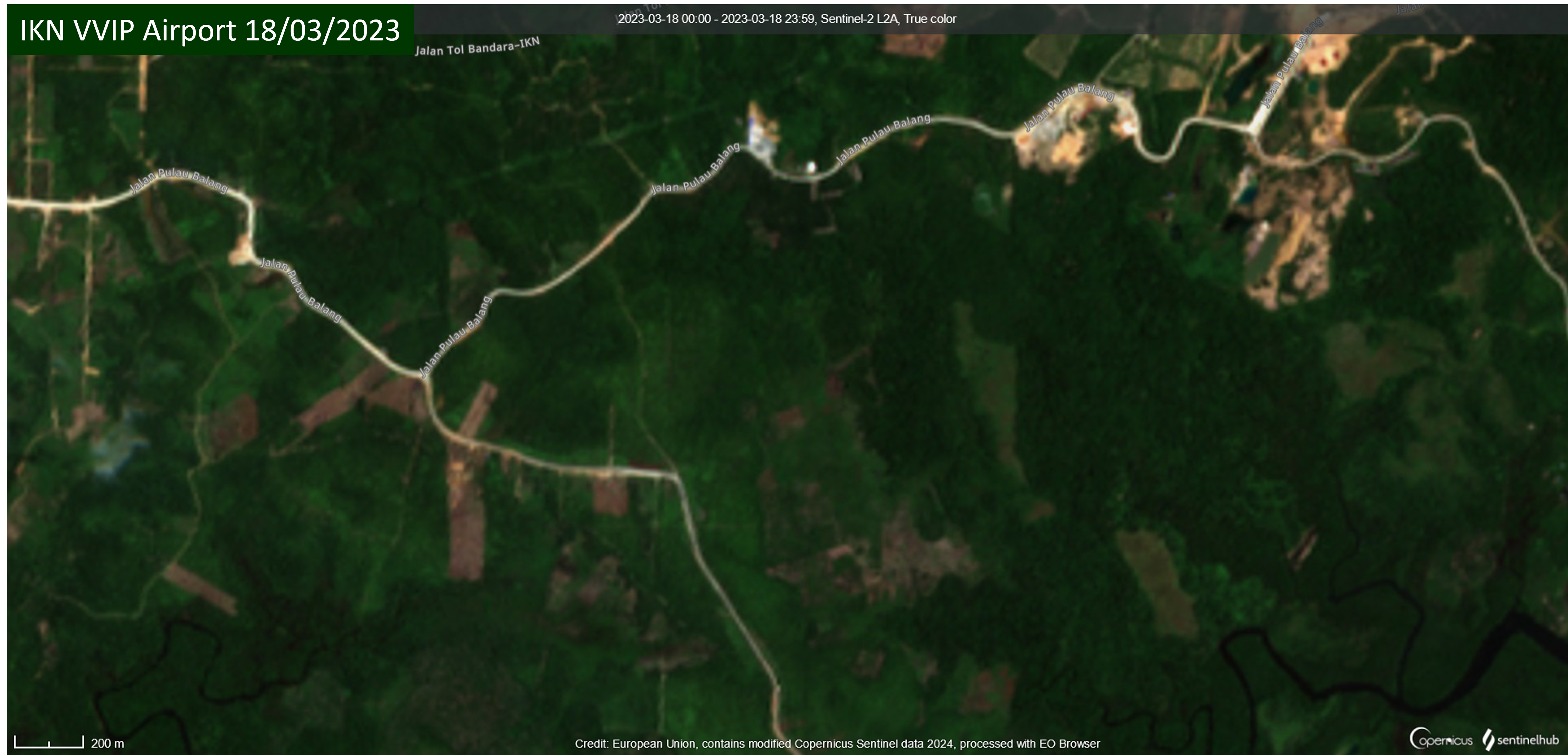
In East Kalimantan on the east coast of Borneo a new VVIP (Very Very Important Person) airport is being constructed to support development of Nusantara (IKN), the future capital city of Indonesia. With a VVIP and VIP terminal covering an area of 7,350 square metres and three helipads IKN VVIP Airport will support the mobility of the President, high-ranking officials, state guests and investors. The international airport will have a 3,000 metre runway to accommodate Airbus A400 military airaft and will be used in coordination with the Indonesian Air Force (IAF). Development of IKN VVIP Airport was accelerated by Presidential Regulation No. 31 on 6th June 2023.

Satellite imagery shows land clearance and earthworks. The image on the left is from 18th March 2023 before works began. On the right is an image from 16th February 2024 where development of the IKN VVIP Airport terminal, runway and access road are clearly visible.

Demarcation of a 360-hectare site began within a few days and triggered reaction from some affected residents. On 30th June Muslimah News reported that hundreds of residents from five sub-districts – Gersik, Jenebora, Pantai Lango, Kelurahan Riko and the Maridan village area in Sepaku – were protesting take-over of land they occupied by the Land Bank Agency for construction of the VVIP airport. They refused to hand over their land to the Land Bank Agency because stakes were installed without prior notice and the government’s promise, made the previous year, to provide land for agrarian reform had not yet been fulfilled. There was a lot of evidence that construction was consuming residents’ land and authorities were ignoring their protests. Protest was not just in response to construction of the airport; there was also some controversy over whether the land bank serves public interest or corporate projects. The Land Bank Agency made reassurances that residents’ rights to replacement land would be accelerated and that agrarian reform land was being prepared for this purpose.

On 3rd August 2023 many palm farmers gathered at their former plantation area where they unfurled banners and made speeches demanding compensation for land affected by the VVIP airport construction project. A lawyer representing some of the residents said that oil palm land previously managed by them was suddenly cleared with heavy equipment. Palm oil trees had been damaged and razed to the ground but the farmers said they had not received compensation and there had been no discussions or meetings with authorities.

Land clearance and installation of boundary markers continued and on 10th January 2024, during socialisation for communities impacted by construction of the VVIP airport and access toll road, it was announced that 400 hectares of replacement land had been prepared for them. Yet complaints about the land acquisition process continued. On 14th January 2024 TribunKaltim reported that some farmers whose land was used for construction of the VVIP airport were unable to farm the land and had no clarity regarding replacement land. The land declared for the airport was the only land they owned and they relied upon it for their livelihoods. Many affected farmers owned one or two hectares of land. Many residents who lost their land had still not received compensation.

On 9th February 2024 Acting Regent of North Penajam Paser, Makmur Marbun, said the number of people whose land was allocated for the VVIP airport but had not yet been acquired had reduced from 80 to 22, explaining that the land of these 22 people is in the area that will be the runway and vital for the airport project. The residents had brought a lawyer to the airport site where they met with officials but Makmur Marbun said he would continue to attempt to resolve the issue through discussions. Completion of IKN VVIP Airport and commencement of operations is targeted for early August 2024.

Demolitions for ‘airport zone’ (zone aéroportuaire Modibo Kéita), Mali

Mass evictions for an ‘airport zone’ next to Modibo Keita Airport, Mali’s main airport on the outskirts of Bamako, the capital city, began on 20th April 1995. Without warning, the government began bulldozing the Senou neighbourhood to make way for expansion of the zone. Demolitions continued for ten days and about 3,707 families, approximately 30,000 people, were forcibly evicted. Further waves of demolitions followed with many instances of land grabbing and speculation. Farmers were displaced for a fertilizer plant on the land in 2007-8 and in 2009 residents resisted instructions to leave the land. A drive to clear remaining communities began in 2021. Bulldozers arrived early in the morning of 14th January, in a major eviction drive covering 1,600 hectares; about 20,000 families in 11 neighbourhoods were impacted. About 800 evictees said they had permits to occupy the land and many affected people were left destitute without shelter.

zone aéroportuaire Modibo Kéita
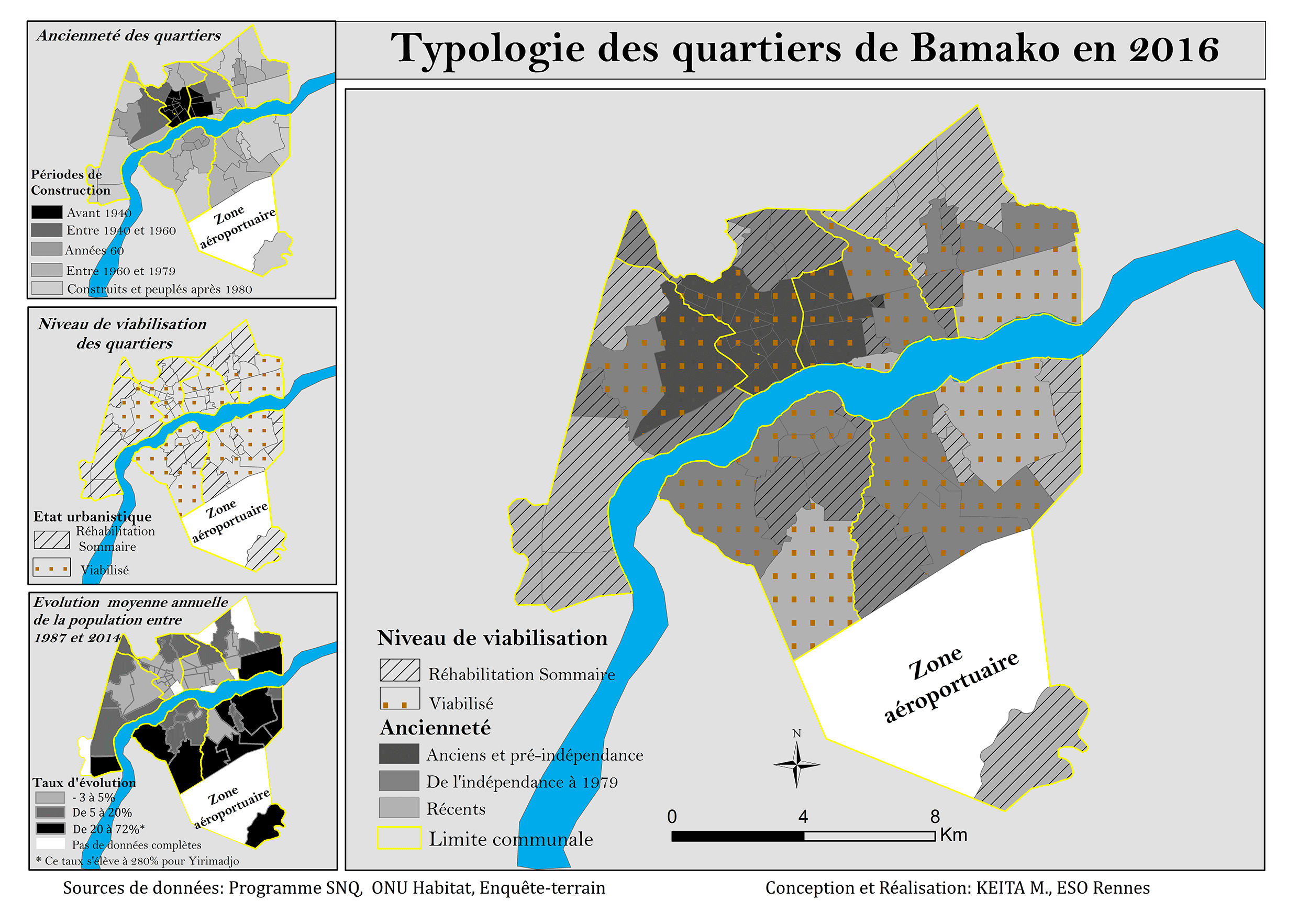
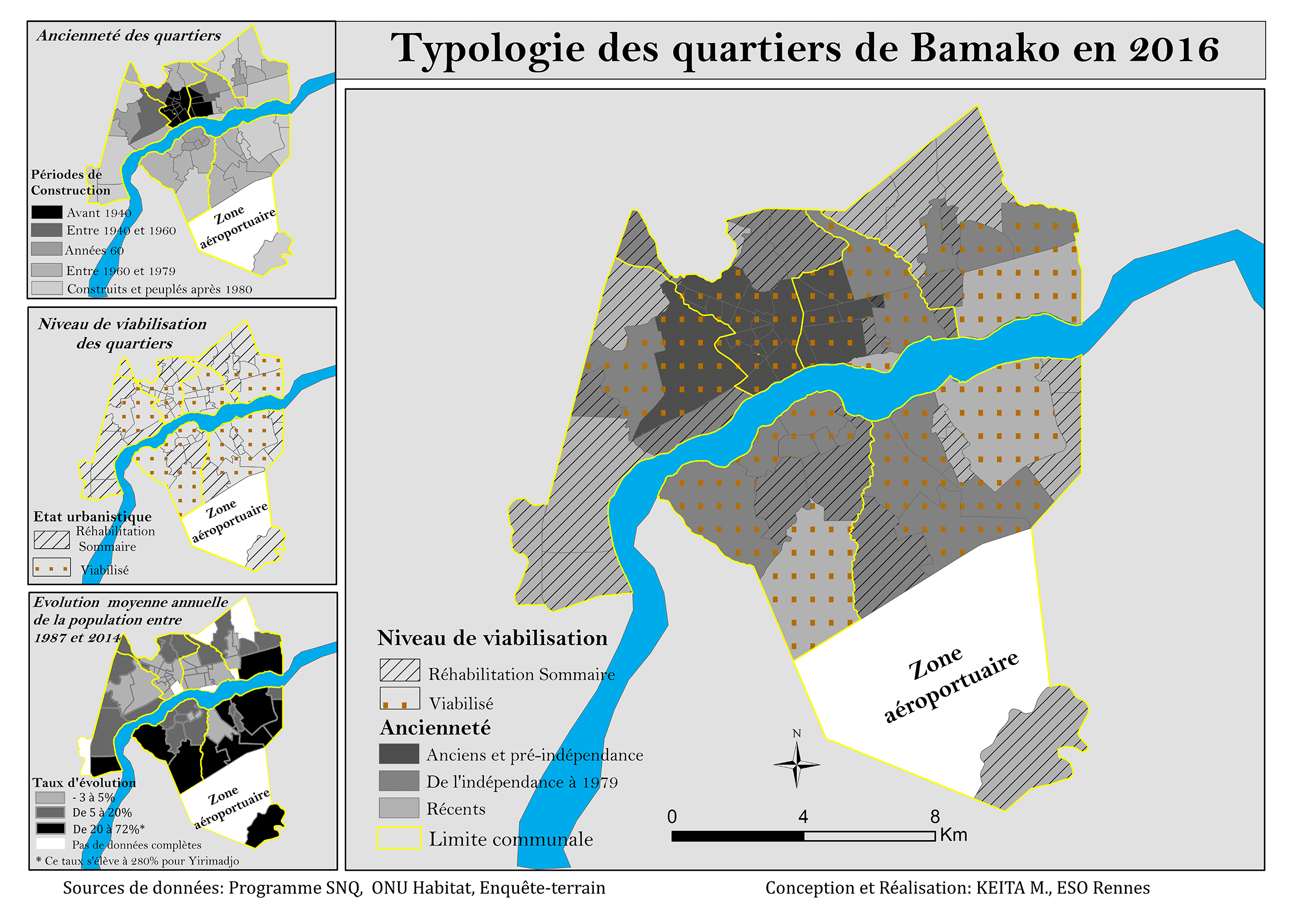
Map showing zone aéroportuaire Modibo Kéita. Source: https://journals.openedition.org/eps/docannexe/image/7707/img-3.png

The ‘airport zone’ – zone aéroportuaire Modibo Kéita – is vast, extending over 7,194 hectares northwest of the airport. It was classified as a plot of land for airport company use in 1999. Residents contest government claims that their occupation of the airport zone is illicit; they have lived on the land for several generations. An inhabitants’ organization – Plateforme deshabitants de la zone dite aéroportuaire (PHZA) – has been established with active groups, sometimes holding different views about land management, in many affected villages. Women, some of them elderly, play a prominent role in resistance against eviction from the ‘so-called airport zone’. The land struggle is supported by l’Union des Associations et Coordinations d’associations pour le Dévelopement et la Défense des Droits des Démunis (UACDDDD), a national federation fighting the injustices of dispossession. Demonstrations and meetings about the airport zone have been attended by hundreds of people. In November 2021 an independent national commission of inquiry to investigate demolitions in the airport area was established.

For more information about the Modibo Keita airport zone evictions see the case report on EJatlas, the world’s largest, most comprehensive online database of social conflict around environmental issues: Modibo Keith airport zone, Mali