Vietnam: Gia Binh Airport land clearance, construction and airport city plans

Land clearance for and construction of Gia Binh Airport, accelerated for APEC 2027, is displacing thousands of households. Delays in providing replacement housing or compensation have caused difficulties for many of the residents forced to leave their homes. An airport city development surrounding the new airport, the ‘southern Duong River urban area’, is planned.

Land clearance and construction of Gia Binh AIrport, about 40 kilometres east of Hanoi in a rural area of Vietnam’s Bac Ninh province, are underway. A mega-airport is planned with four runways arranged in two pairs, handling 30 million passengers and 1.6 million tonnes of cargo per year by 2030 increasing to 50 million passengers per year and 2.5 million tonnes of cargo by 2050. The total investment is estimated at VND196,378 trillion (USD7.5 billion). A vast swath of productive farmland is being sacrificed for the new airport. Land allocated for the Gia Binh Airport site, in the communes of Gia Ginh, Luong Tai, Nhan Thang and Lam Thao, encompasses about 1,184.78 hectares of agricultural land, including about 920 hectares of rice fields yielding two crops per year. The site also comprises 415 hectares of non-agricultural land, 159.4 hectares of residential land and 124.8 hectares of land utilised for defence and security purposes. Preparation of the airport project site has triggered one of the largest land clearances in Vietnam’s recent history, affecting approximately 7,100 households and individuals and 118 organisations; about 5,800 households and individuals are being relocated. By 25th December 2025 almost 600 hectares of land had been cleared and land registration for 6,309 households within the project area was complete. The Bac Ninh province had advanced over VND2,700 billion (USD102.5 million) to pay compensation to about 5,000 households. Plans for a second phase of compensation were progressing with a further VND1,102 billion (USD41.8 million) in payments for approximately 360 hectares of agricultural land. An inventory of religious structures and tombs had identified 17,800 graves within the project area to be relocated, but the process was complexified by the many unique buildings including churches, temples and communal houses with a higher value than the price framework and therefore requiring specific estimates.

Acceleration for APEC 2027

As well as a major passenger and cargo hub Gia Binh Airport is being built as strategic infrastructure to host major diplomatic events, beginning with the APEC (Asia-Pacific Economic Cooperation) 2027 Leaders’ Week gathering of high level officials, to be hosted by Vietnam and scheduled for November 2027. Construction of key components of Gia Binh Airport has been accelerated for APEC 2027, even though the primary event venues are on Phu Quoc island, 15 kilometres off the coast of Cambodia in the Gulf of Thailand. On 7th March 2026, nearing the end of his term, Prime Minister Pham Minh Chinh visited the Gia Binh Airport project and directed stakeholders to develop the site as an “airport economic ecosystem”. He stated that the airport will be a dual-use (civilian and military) facility, stressing the importance of completion in time for APEC 2027 Leaders’ Week, and was briefed on the progress of construction of the VIP terminal. By 19th March pile driving and removal of topsoil for the VIP area was complete and foundation works were underway. Authorities had handed over 1,259.45 hectares, 66.82% of the 1,883.93 hectare required land area, and relocation of 4,761 graves was expedited. But land clearance of about 1,260 households, scheduled to be complete by 30th April, was highlighted as the ‘most significant bottleneck’ impeding the expedited construction programme.

Land clearance for a road network

Development of road networks serving the airport, involving land clearance for wide corridors to accommodate multiple lanes, has been accelerated for APEC 2027. The total investment for a 41.3 kilometre road connecting Gia Binh Airport with Hanoi, linking directly with several major arterial roads, including intercity expressways, is estimated at VND83 trillion (USD3.165 billion). People in the Thuan Thanh, Tram Lo, Tri Qua and Mao Dien wards are being resettled to make way for the Gia Binh Airport – Hanoi road and a resettlement site is being urgently constructed in Lam Thao commune southwest of the airport site. By 24th July 2026 304 out of 412 hectares of land in Bac Ninh had been cleared for the 10-lane, 120 metres wide road which is expected to open in October 2026, in time to serve APEC 2027. Rapid advancement of the Bac Ninh segments of the Ring Road No. 4 project linking Hanoi with satellite urban centres and northern industrial zones, was reported in My 2026. Clearance of agricultural and residential land within the 90-metre corridor for one component of Ring Road No. 4 was complete along with most of the infrastructure for nine resettlement areas, with excavation and embankment filling works for another component ongoing. Clearance of over 82 hectares for the direct access road was complete and resettlement schemes had been expedited.

Villages and residential areas impacted by land clearance for Gia Binh Airport
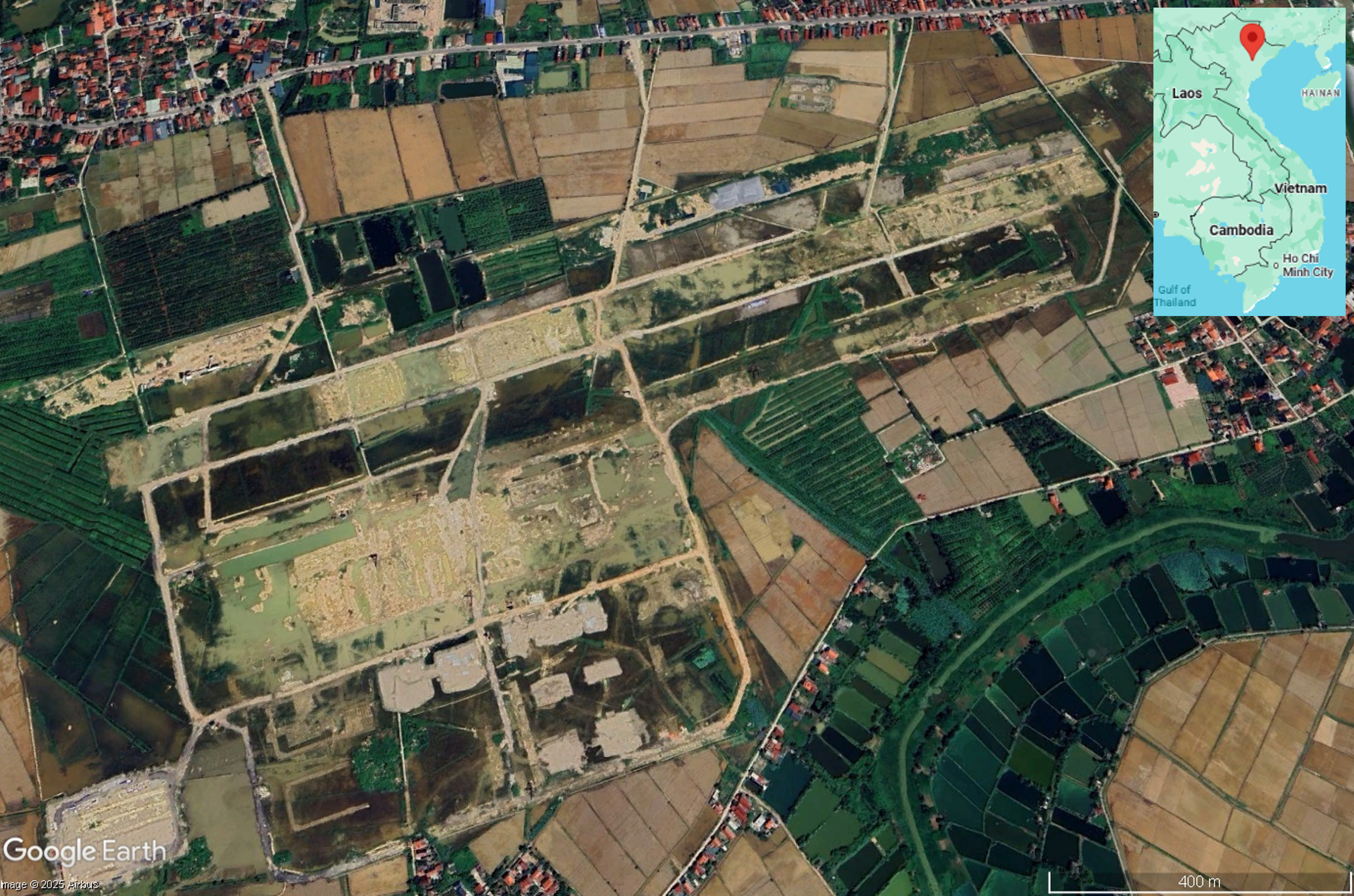
Some of the villages and residential areas impacted by land clearance for Gia Binh Airport, the area where site clearance for airport construction is visible is highlighted. Satellite imagery 17/07/2025 / 02/07/2023

Displacement difficulties

In early June Bac Ninh Catholic communities voiced concerns over displacement for Gia Binh Airport. Bishop Joseph Đỗ Quang Khang said he had seen “many families forced to live in temporary housing, facing compounded difficulties over shelter, work, schooling, faith life, and daily activities”. One affected resident wrote on the Diocese’s website “The image of excavators tearing down homes within the planning area of a major national project is striking. Walls collapse. Tiled roofs are stripped away. Belongings are loaded onto trucks. Trucks operate nonstop”. Another resident commented on the previous view of graves and crosses around the parish church abruptly replaced by ‘deep trenches gouged into the earth, overturned patches of land, and fresh marks left by excavators and bulldozers’. A woman representing the Sisters of Our Lady of Unity said their charity home was affected by low valuation of agricultural land and was uncertain where the sisters and 40 disabled children could relocate to. During land clearing operations on 13th June 2026 17 graves in Ngọc Xuyên village were illegally levelled and affected families were pressured to accept the compensation offer and sign a pledge not to file complaints.

Residents forced to dismantle homes

A 24th June 2026 communication from the Bac Ninh province required residents to dismantle their homes and relocate with just a few hours notice, by 4pm that same day. The notice stated that land in four villages – Ngô Thôn, Mỹ Thôn, Lương Pháp, and Thủ Pháp – had been officially handed over to the investor on 20th June but some residents were still dismantling their homes. The following day a preliminary review on land clearance for the airport reported that 1,400 households in the four villages had been relocated in just 38 days. Since late May hundreds of households had been forced to dismantle their homes and move into temporary housing but authorities had not yet constructed resettlement areas nor provided reasonable compensation for affected people. A Bac Ninh province announcement on Facebook met with more than 2,000 reactions, about half of which were ‘haha’ and ‘angry’, and over 600 comments expressing frustration. Residents also posted critical comments in response to Bac Ninh news outlet videos praising the relocation process and claiming it was a ‘high consensus’ exercise. Several residents expressed their difficulties related to the airport at a dialogue meeting held on 3rd July. Their families had received eviction notices instructing them to relocate before 30th August but temporary housing had not yet been organised for them.

Relocation and resettlement delays

One resident spoke of her loss of trust as she had been assured she would not be forced to move again before the resettlement area with permanent replacement housing was ready. Acting on this information she had not rented a house and the only places still available were very small and expensive. She was worried that being forced to vacate by 30th August would push her out onto the street. Another resident with three children had found temporary relocation “extremely difficult and exhausting” and said it would be impossible for more than 500 households in Tử Nê and nearby villages to relocate under the current process. A Phú Dưới village resident said there was not yet official notice of the date by which their family would be required to leave. The Gia Bình Commune Party Committee issued a document stating that relocation of assets must be completed by 20th July in the Đồng Lâm and Quỳnh Bội residential areas and by 20th August in the Đỗ Xá residential area.

‘High consensus’ claims

Interviews conducted by Luật Khoa Magazine contradicted government claims of ‘high consensus’ with the relocation process. A man from Quỳnh Bội village said, “People now have no voice. We have to follow along. How can we resist? If anyone refuses to move, they just impose it.” In the villages of Tử Nê, Bái Giang, and Hương La the relocation deadline was fast approaching but residents reported a lack of preparation. A woman from Tử Nê village said, “Officials say we have to move by Aug. 30, but there is no resettlement yet. We have not received anything.” On 3rd August 2026, for the second time, Gia Binh Commune authorities threatened to disconnect residents’ water, electricity and telecommunications if they did not comply with instructions to leave their homes and had over the site to the investor. A resident of Trại Quỳnh Bội, regretful at the loss of a house built by his family only three years previously, said “The government says electricity will be cut on Aug. 15 if we don’t move. Without moving, what would we live on?” He said he had not received compensation or been notified of land for resettlement and might need to ask friends or neighbours if they could provide land or shelter for temporary accommodation.

‘Fake news’ crackdown

Authorities reacted to increased scrutiny and criticism of the Gia Binh Airport project with a repressive crackdown, penalising people for spreading so-called ‘fake news’. According to research by Luật Khoa Magazine since works on the airport began in September 2025 dozens of people accused of disseminating ‘fake news’ have been warned, sanctioned or ‘educated’. Severe measures included police visiting people in their own homes to monitor their opinions and pressuring people to write pledges stating compliance with regulations. One of the key responsibilities of a committee tasked with ‘ensuring security’ and maintaining the airport project schedule is to prevent articles and comments deemed to be ‘negative’ or ‘affecting public opinion and communication efforts’ regarding land clearance for the airport.

Gia Binh Airport area, satellite imageryDigital rendering of Gia Binh Airport and surrounding area
Left image:17/07/2025 satellite imagery of the Gia Binh Airport area highlighting where construction works are visible. Right image: digital rendering of plan for Gia Binh Airport and the surrounding ‘southern Duong River urban area’., source: WE LOVE ASEAN_ASEAN urbanist, 04/09/2025

A 12,800 hectare airport city

Vast urban areas surrounding Gia Binh Airport runways and other aviation facilities have been approved. Planning at a scale of 1/2,000 for the ‘southern Duong River urban area’, a zone covering more than 12,800 hectares described as an ‘international-class airport city’ was approved by the Bac Ninh province in September 2025. On his 7th March 2026 airport site visit the then Prime Minister Pham Minh Chinh directed stakeholders to develop the site as an “airport economic ecosystem” and to plan surrounding areas as an aviation economy. The urban area is envisaged to include a free-trade zone, duty free zone, multimodal logistics zone, inland port, conference and exhibition centre, offices, hotels and housing. With a high-density layout a population of between 750,000 and 800,000 people – permanent residents, workers and tourists – is anticipated. Plans for segments of the airport-related urban area, in the Gia Binh, Nhan Thang and Dong Cuu communes, are advancing. The ‘Gia Binh Airport urban area 1’ project, a VND39.52 trillion (USD1.51 billion) urban development covering about 200.8 hectares of land and expected to accommodate about 35,637 residents has been approved along with detailed 1/500 scale planning for ‘Gia Binh Airport Urban Area 2‘, encompassing about 560.5 hectares with an expected population of 70,000-80,000 people. Plans for a 5,000 hectare free trade zone linked to Gia Binh Airport, intending to create a ‘new growth engine for the region’, a ‘gateway connecting Vietnam to global markets’ and a ‘regional trade hub’, were adopted in June 2026.

Vietnam: Clearing rice fields and relocating thousands of households for Gia Binh Airport

Land clearance and consutruction of Gia Binh Airport, on the largest airport site in North Vietnam. is underway. Since approval of the project the projected passenger capacity has risen to 50 million per year by 2050. A VIP terminal is scheduled for completion in time for APEC 27.

Aerial image of Gia Binh Airport site, 26/04/3024Aerial image of Gia Binh Airport site, 17/07/2025
Aerial imagery of Gia Binh Airport site. The image on the left shows the site on 26/04/2024 before construction works began. The image on the right, dated 17/07/2025, shows land cleared for runways and other airport infrastructure.

A major new airport in Gia Binh, about 40 kilometres east of Hanoi in a rural area of Vietnam’s Bac Ninh province, was approved by the Ministry of Transport in February 2025, with capacity for 1 million passengers annually by 2030, rising to 3 million by 2050. By April the planned capacity had been adjusted upwards to 5 million passengers annually by 2030 rising to 15 million by 2050. In July the size of the airport project was scaled upwards again, to handle 30 million passengers per year by 2030 then reaching 50 million by 2050. Since publication of the original plan the projected cargo volume had more than doubled, from 250,000 tons annually by 2030 growing to 1 million tons by 2050 to 1.6 million tons by 2030 growing to 2.5 million tons by 2050. With its site enlarged nearly fivefold, from an initial 408.5 hectares to 1,960 hectares, Gia Binh Airport is now set to be northern Vietnam’s largest airport, bigger than Noi Bai Airport and Tan Son Nhat Airport, exceeded only by the 5,000 hectare site of Long Thanh Airport in the southern Dong Nai province.

In August the government approved special mechanisms fast tracking investment and construction processes for the airport, related works, land clearance and resettlement, exempting projects from construction permit requirements and approving conversion of rice crop land. About 920 hectares of rice fields yielding two crops per year will be converted for the airport. Land allocated for the Gia Binh Airport site comprises about 1,184.78 hectares of agricultural land, 415 hectares of non-agricultural land, 159.4 hectares of residential land and 124.8 hectares of land utilized for defence and security purposes. Land acquisition will affect approximately 7,100 households and individuals and 118 organizations. About 5,800 households and individuals will have to relocate and resettle. The number of graves that will be moved is estimated at 18,800 but this does not include unidentified graves. Development of Gia Binh Airport is triggering one of the largest land clearances in recent history.

Schools and hospitals along with infrastructure such as irrigation systems, canals, pumping stations and power transmission lines will also have to be removed to make way for the airport and rebuilt elsewhere. About 25 historical and cultural sites must also be relocated as part of land clearance for the airport. By mid-November initial groundworks for construction of the airport and development of supporting infrastructure were underway. Heavy machinery was operating continuously to level the airport site and barriers and signs restricted access to construction zones. The provincial government had paid more than VND1,990 trillion (USD81 million) in compensation to 4,045 households in the Gia Binh, Nhan Thang and Luong Tai communes, accelerating clearance of more than 436 hectares of land. Clearance of agricultural plots of land was scheduled to be finished by 30th November with resettlement areas due for completion by 15th December.

Gia Binh Airport will accommodate large, wide-bodied aircraft including the Boeing 777 and Airbus A330 and plans specify four runways upon completion by 2050. The investment requirement is estimated at VND 196.37 trillion (USD7.5 billion). As well as becoming a major aviation hub the airport project will open up land surrounding it for development including hotels, airport-adjacent hospitality, and airport city projects. The Ministry of Construction had considered expanding Noi Bai Airport southwards, but this would have necessitated relocation of large communities and incur high land clearance costs. With larger land reserves and more space for development than Noi Bai Airport, the government expects Gia Binh Airport to accelerate growth of industry, logistics, e-commerce and tourism.

In addition to dual-use function as a civil and military facility with a strategic role in national defence Gia Binh Airport is designed to support major diplomatic events, in particular Vietnam’s hosting of the 2027 Asia-Pacific Economic Cooperation inter-governmental forum, APEC 2027. Elite APEC officials will be among the first passengers to arrive at Gia Binh Airport; a ‘soft opening‘ in time for APEC 2027 is planned, with one runway operational along with the air traffic control tower and a VIP terminal. Many key APEC 2027 events, most notably the annual Leaders’ Summit, will take place on Phu Quoc, Vietnam’s largest island located near the south coast of Cambodia, which is rapidly developing as a luxury tourism destination. Fast-paced expansion of Phu Quoc Airport to support APEC 27 Leaders’ Week is underway. One of the high-priority projects is a VIP terminal to welcome heads of state and high-ranking delegations to the APEC 27 leaders’ meeting. Longer term plans for Phu Quoc Airport expansion aim to increase passenger capacity from the current 4 million to 50 million by 2050.

Climate refugees face displacement to make way for Cox’s Bazar Airport and Air Force Base expansion

Up to 70,000 climate refugees face displacement to make way for Cox’s Bazar Airport and Air Force Base expansion and more than 20,000 could be ineligible for replacement flats in the Khurushkul Ashrayan Project. On 7th January 2025 thousands of people protested against eviction.

Map of Cox's Bazar Airport and Bangladesh Air Force (BAF) base.
Map of Cox’s Bazar Airport, Bangladesh Air Force (BAF) base and Khurushkul Ashrayan Project. Satellite imagery 25th March 2025

Since 1981 climate refugees – people displaced by cyclones, river erosion and tidal surges from many of Bangladesh’s coastal areas – have resettled in Ward 1, Cox’s Bazar Municipality. The area is government-owned ‘khas’ land between the Bay of Bengal and Cox’s Bazar Airport and the adjoining Bangladesh Air Force (BAF) base. The largest influx of climate refugees occurred in the aftermath of a cyclone and tidal wave on 29th April 1991 when about 40,000 people displaced from Kutubdia Island settled in the area. In February 2011 several local leaders demanded cancellation of a project to expand Cox’s Bazar Airport. Officials had moved to acquire 16 areas in Ward 1 – including Kutubdiapara, Samitypara, Fadnerdail, Bandarpara and Naziraratek – and 40,000 people would become homeless. In 2012 the Civil Aviation Authority of Bangladesh (CAAB) began a project to extend Cox’s Bazar Airport runway. In 2021 an agreement for another runway extension, lengthening it northwards into the Maheshkhali Channel through land reclamation, was signed.

Climate refugees face eviction

An in-depth investigation of the climate refugees from Kutubdia Island who had settled in Ward 1 was published in December 2024. They were still vulnerable to extreme weather; storms would leave many homes flooded with seawater and the area lacked cyclone shelters. Neither Cox’s Bazar Municipality nor the Chittagong District had precise data on the number of people living in Ward 1 but Akter Kamal, elected three times to represent Ward 1 and now a former councillor, said at least 52,000 people resided there. The investigation found that ‘Every household in the climate refugee camp lives inconstant fear of eviction. All the khas land in the area has been acquired for the expansion of Cox’s Bazar Airport’s runway and the construction of an air force base’.

Resettlement in the Khurushkal Ashrayan Project

The Khurushkal Ashrayan Project, located 3 kilometres east of Cox’s Bazar Airport, was described as ‘the world’s biggest climate refugee rehabilitation project’ when the then Prime Minister Sheikh Hasina inaugurated the first phase, housing 600 families, on 23rd July 2020. It was stated that upon completion 139 five-storey blocks would rehabilitate 4,409 families, the majority living in the Cox’s Bazar Airport area since being displaced by the 1991 cyclone. By December 2024 another 85 buildings had been completed which would accommodate 2,270 families. But former councillor Akter Kamal said that at least 20,000 climate refugees living in Ward 1 were ineligible for flats. Changes to the list of project beneficiaries had caused anxiety to between 20,000 and 22,000 climate refugees who were excluded from the resettlement plan.

Thousands protest eviction plan

On 7th January 2025 thousands of climate refugees, including residents of Samitypara and Kutubdiapara, held a protest demanding cancellation of the eviction plan linked to Cox’s Bazar Airport expansion. Demonstrators blocked roads causing traffic disruption with several thousand people blocking the main city road for 2½ hours, protesting eviction and calling for long-term settlement and holding a rally in front of the Deputy Commissioner’s office. They had lived in their settlements in Ward 1 for 20-30 years but instead of rehabilitating them plans were being made to evict them. Former councillor Akter Kamal told Prothom Alo that between 60,000 and 70,000 climate refugees were living in the area and land had been acquired for Cox’s Bazar Airport runway expansion and air force base construction. He estimated the number of families not entitled to flats in the Khurushkal housing project as approximately 4,000. Protestors said they would bring the city to a standstill if the government did not reverse its decision to evict them.

Clash between locals and BAF personnel

On 24th February 2025 Shihab Kabir Nahid, a 30-year-old local trader, was killed in a clash between locals and BAF presonnel. His mother said he was standing in the doorway of their house and died after being shot in the head. The Inter Services Public Relation Directorate (ISPR) stated that Cox’s Bazar Air Base had come under a “sudden attack” by unidentified people from the neighbouring Samitypara area. But local residents alleged that the clash was triggered by altercations over BAF’s attempts to acquire land and relocate residents for expansion of Cox’s Bazar Airport and the air base. A Samitypara resident said the clash began as local representatives were on their way to a scheduled meeting with BAF officials about relocation for airport expansion. The Borderlens published an account of the violent incident and the circumstances leading up to it. Climate refugees in Ward 1 had lived in fear for many years, their homes on land earmarked for air base expansion and denied land ownership rights or resettlement. In recent months the eviction drive for air base expansion had intensified. Families’ appeals to the district administration went unanswered and BAF personnel were making threats. Gunfire began after a scuffle and social media footage showed air force personnel firing at unarmed protesters throwing bricks and stones.

Runway expansion impacts on waterway navigability

By March 2025 the runway expansion was 84% complete and aircraft navigation aid lights had been installed on concrete piles extending across the mouth of the Maheshkhali Channel. On multiple occasions the Bangladesh Inland Water Transport Authority (BIWTA) had raised concerns about lack of approvals, consultation and surveys pertaining to the risk of loss of navigability for waterway traffic, but the warnings had been ignored. A report by a committee of experts stated that the pillars in the river obstructed water flow and caused accumulation of sediment at the base of the pillars, narrowing the mouth of the Maheshkhali Channel and reducing navigability. An alternative channel that had been dug out was expanding westwards, posing risks to residents of Sonadia Island. The BIWTA report warned that sediment build-up could affect water routes along the coast from Chattogram to Cox’s Bazar along with the southward route to Saint Martin’s. The report recommended removal of the piling in the Maheshkhali Channel.

For more information, including references for source material, see the case study on EJAtlas, the world’s largest, most comprehensive online database of social conflict around environmental issues – Cox’s Bazar Airport and Air Force Base expansion

Mega Airport City in Bishoftu, Ethiopia

Construction of Africa’s biggest airport, a Mega Airport City, in Bishoftu, Ethiopia, is set to take up a vast 35 square kilometre site and a budget of USD6 billion just for the first phase and has met with resistance from farmers impacted by the resettlement process.

Mega Airport City, Bishoftu, Ethiopia
Artist rendering of planned Mega Airport City in Bishoftu, Ethiopia. Photo: Ethiopian Airlines, September 2024

Ethiopian Airlines announced plans for an airport city in Abusera (in Bishoftu, part of central Ethiopia’s Oromia region, about 40 kilometres southeast of Addis Ababa) in September 2018. CEO Tewolde Gebremariam said the location was selected because of its elevation; at about 1,900 metres above sea level it is considerably lower than Addis Ababa at 2,400 metres. This would bring the advantage of improved fuel efficiency for flights in comparison with Ethiopia’s existing main airport, Addis Ababa Bole International Airport. French engineering firm ADP Ingénierie (ADPI) conducted a site selection study and in February 2019 the Council of Ministers was set to endorse the proposed site in Abusera. Gebremariam said the mega-hub would not just be an airport, costing USD4 billion with four runways and capacity to handle 80 million passengers per year; it would include other infrastructures making it an airport city with a large duty-free shopping area, entertainment centres, hotels, business centre, logistics centres and real estate development. By January 2020 the airport city plans had become even more ambitious; passenger capacity had increased to 100 million per year. The anticipated cost had also risen significantly. Gebremariam said “We have identified 35sqkm land to be developed as an airport and it is about a $5bn project – larger than the Grand Ethiopian Renaissance Dam (GERD). It is going to accommodate 100m passengers; larger than Dubai and more or less equal to the new Istanbul airport.”

In February 2024 Ethiopian Airlines announced that the designated land for the airport city had been secured and that the project would encompass an area of 38 to 40 square kilometres. A spokesperson said the Oromia Regional Government, in collaboration with the Federal Government, was evacuating residents from the site to make way for construction to begin. The estimated cost of the megaproject had escalated again. In August 2024 Ethiopian Airlines was searching for USD6 billion in financing just for the first phase of what was now called a ‘Mega Airport City’. Projected passenger capacity increased again, to 110 million per annum, and the Dar Al-Handasah consultancy was awarded the contract for design and supervision of the Mega Airport City. At the signing ceremony Ethiopian Airlines stated, ‘The architectural team will incorporate elements of Ethiopian heritage to establish a people-centric, intuitive airport characterised by sustainability, resilience, and future-readiness.’

The claim to be ‘intuitive airport’, ascribing sentience to infrastructure, is just meaningless corporate guff. And the claims to be ‘people-centric’ boasting the qualities of ‘sustainability’, ‘resilience’ and ‘future-readiness’ disregard the airport city’s impacts on the people most directly affected, those who are being displaced to make way for it. Simultaneous with the search for USD6 billion to finance the airport city it was announced that construction could only go ahead if up to 2,500 farmers currently residing on and surrounding the site were resettled. Mesfin Tassev, CEO of Dar Al-Handasah, said a 740-hectare plot had been allocated by the Oromia Regional Government for this purpose, along with 17 billion Birr (USD172.5 million) for resettlement and development works. Design work was anticipated to be complete by December 2025 followed by construction of housing and other basic facilities along with development of employment opportunities for relocated residents by the end of 2026. Mesfin told The Reporter, “The construction of the airport city depends on the resettlement of the farmers. It will commence as soon as they move.”

The resettlement process is not proceeding smoothly. By January 2025 it was reported that Africa’s biggest airport was under construction but ‘faced significant challenges’ regarding coordination of finances, geopolitical dynamics, environmental concerns and the complex task of relocating affected communities. The airport city has triggered local resistance. Affected farmers, many of whom depend upon their land for subsistence and farming livelihoods, are concerned about compensation and resettlement. Many of them feel inadequately compensated and there are reports that the compensation offer was far less than the land’s market value. Resettlement has also caused discontent. Some farmers claim that clear plans for relocation and support for finding new livelihoods have not been provided. During a local meeting held to discuss the project one farmer said, “I’ve cultivated this land for decades. It’s not just my home. It’s my history and my family’s future.”

Over 1,000 residents protest Taoyuan Aerotropolis relocation policies

More than 1,000 residents, along with several legislators, gathered to voice their discontent over government relocation policies for the Taoyuan Aerotropolis project, the largest land expropriation case in Taiwan.

The protest took place on 13th October 2023, after continued public appeals over the high cost of resettlement housing had gone unheeded. Huang Shih-chieh, the Democratic Progressive Party legislator, said the government should adjust relocation compensation in line with the price index and that the high cost of resettlement housing should be absorbed by the government, not shifted onto the affected people. In response, the Taoyuan City Government stated that the compensation budget had been increased by 20% but affected households said they have never felt adequately compensated. Kuomintang (KMT) Councillor Hsu Chi-wan said the government had repeatedly given the same resonse to appeals from households whose property was expropriated and suggested that compensation measures executed by Taoyuan’s Land Administration Department should be expedited.