USA: Farmland seized for new corporate/private jet airport in Spalding County, Georgia

Farmland has been seized for a new airport in Spalding County, Georgia. Griffin-Spalding Regional Airport will serve corporate/private jets, has received federal, state and local government funding and is intended to spur real estate development in a large ‘Airport Impact Area’.

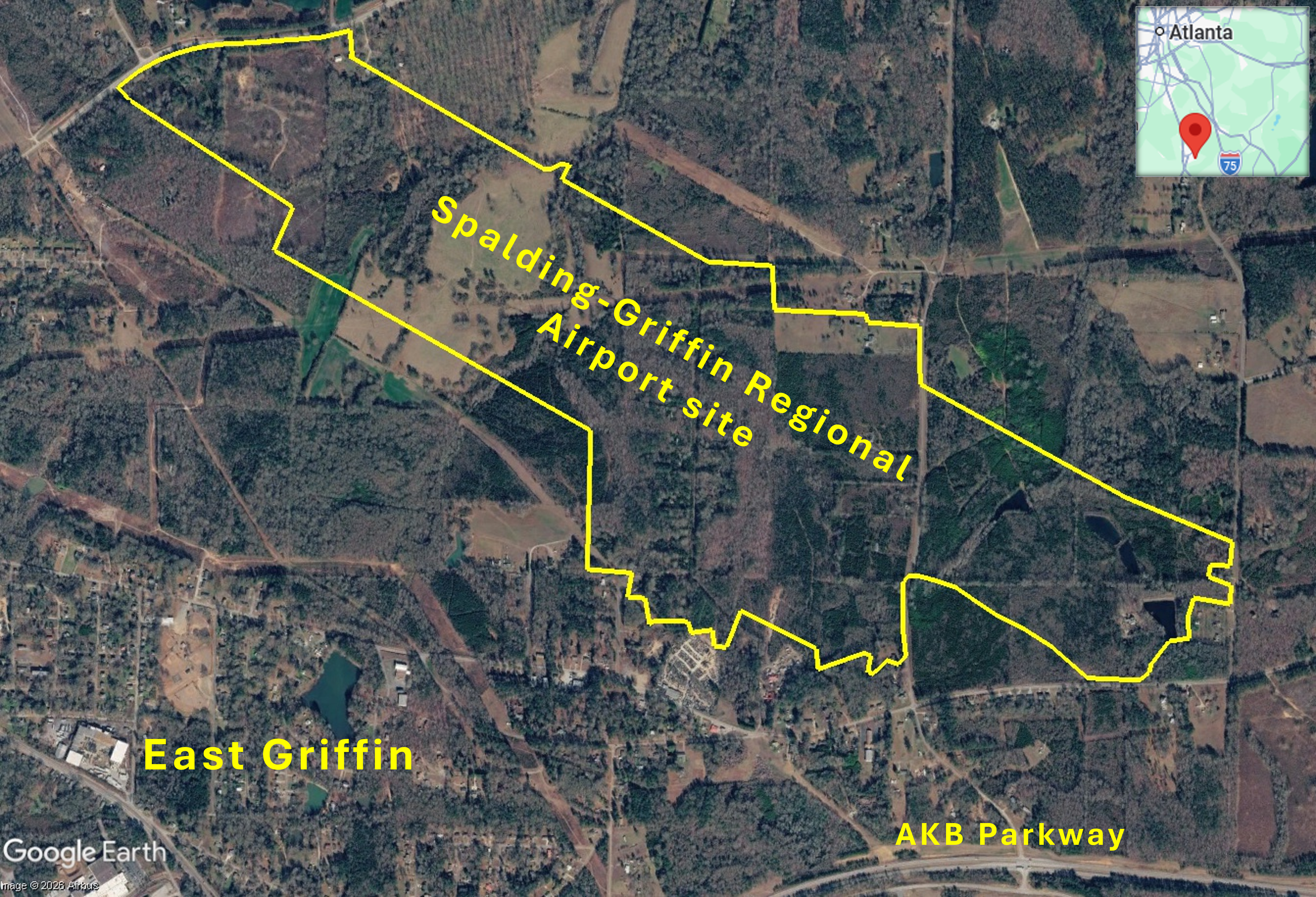
Griffin-Spalding Regional Airport site boundary
Boundary of the new Griffin-Spalding Regional Airport site, New Airport Location Map, Lamar County Commissioners, 13/01/2025, overlaid on aerial imagery dated 30/12/2025

Construction of a new airport for corporate/private jets, northeast of the City of Griffin in Spalding County, Georgia, USA has commenced. A Farm Journal article by Chris Bennett describes the seizure of a large area of Jeff Melin’s farm by eminent domain (government power to take land, with compensation, for public use such as infrastructure projects) for the new airport. The 225-acre middle section of his 450-acre farm, containing pasture, cattle, woodland, deer, dove field and a pecan tree grove, has been appropriated, which will leave his farmland on either side of the airport site landlocked. Trees, many more than a century old, at the edge of the pecan grove have already been felled to make way for airport construction and concrete poles for power lines are being erected. Melin first learned of the airport project in 2012, from a newspaper article showing his farm as one of four or five possible sites for a new airport with 124 hangars for corporate jets. He says authorities never communicated with him face to face and would not listen to him, just sending letters, making announcements and conducting ever more studies. Now Melin has been issued with an order to vacate within 90 days; he has to remove equipment and at least 65 cows and 30 calves. Melin say he is being forced to accept payment for the land which is far lower than what comparable property has been sold for. But he does not want to part with the land at any price. Melin said, “They force me to sell against my will and then pay a fraction of the value. And I’m not allowed to turn them down. My story will make you question what kind of country you’re living in” The farm has been in the family since they arrived in Griffin in 1951. Year after year Melin has worked to improve the farmland but none of this was factored into the evaluation.

Griffin-Spalding Regional Airport will be far larger than the existing Griffin-Spalding County Airport located south of the central business district of the City of Griffin, only 3 miles southwest of the new airport site, . The 5,500-6,000 foot runway will be nearly twice the length of the established airport’s 3,100-foot runway. The Griffin-Spalding Regional Airport site is significantly larger as well, encompassing 730 acres, over three and a half times the size of the existing airport’s 198-acre site. The airport site was among seven potential sites identified in the Griffin-Spalding County Airport; Airport Site Selection Study prepared for the City of Griffin and Spalding County by LPA Group Incorporated in 2008. The introduction to the study states that an ‘aeronautical industrial park adjacent to a new airport’ could help achieve industrial growth plans and that in ‘the process to find suitable land area for a new airport, this study considered an additional area for industrial development’. A map of Site 6, subsequently selected for the airport, shows a 320-acre Airport Area with a 5,500-foot runway. A second map of Site 6 shows a larger 392-acre Airport Area including a 500-foot runway extension plus an adjoining 351-acre Industrial Area, extending south of the runway with a smaller area on the other side. The combined area of the Airport Area and the Industrial Area is 743 acres.

In March 2013, the Federal Aviation Administration (FAA) issued a Finding of No Significant Impact, (FONSI) Record of Decision (ROD) determining that ‘the project as proposed would not significantly affect the quality of the human environment’ and deeming an Environmental Impact Assessment (EIA) unnecessary. The FONSI decision was based on information contained in a December 2011 Environmental Assessment (EA) for a replacement airport, prepared by LPA Group, and other applicable documents. Two potential alternative sites to replace the existing Griffin-Spalding County Airport, where expansion is constrained by a large amount of residential and commercial development surrounding it, were considered. A runway at least 5,500 feet in length and 100 feet wide with a parallel taxiway would enable the new airport to accommodate 75 per cent of large general aviation aircraft including Learjets, Cessna Citation 500s, Raytheon Hawkers, Dassault Falcons and the Bombardier Challenger 300.

The EA identified the site where the airport is now being constructed as the Preferred Build Alternative, requiring acquisition of 320 acres of land comprising 51 land parcels, many of which were uninhabited so relocation of residents would not be necessary. The EA notes that land acquisition would result in conversion of the land from agricultural and residential use to aviation use and clearance of approximately 260 acres of forest. Forest types identified within the site boundary and runway protection zones included bluff, slope and ravine forest along with pine and oak-hickory successional forests. The site includes approximately 37.1 acres of prime farmland and 55.6 acres of farmland categorised as of ‘statewide importance’. About 33.5 acres of floodplain and 7,368 feet of streams would be lost to airport construction. Maps of existing land use and future land use in and around the airport site show large areas of Agriculture/Forest converted to Medium and Low-Density Residential with narrow corridors of ‘Open Space Network’. A large commercial area is shown south of the airport site, with smaller industrial areas and a large industrial area to the south of AKB Parkway. An expanded ‘ultimate build-out of the Airport’ with a 6,500-foot runway is ‘reasonably foreseeable’. This would require conversion of 239 acres of federally protected farmland and relocation of 49 acres of residences.

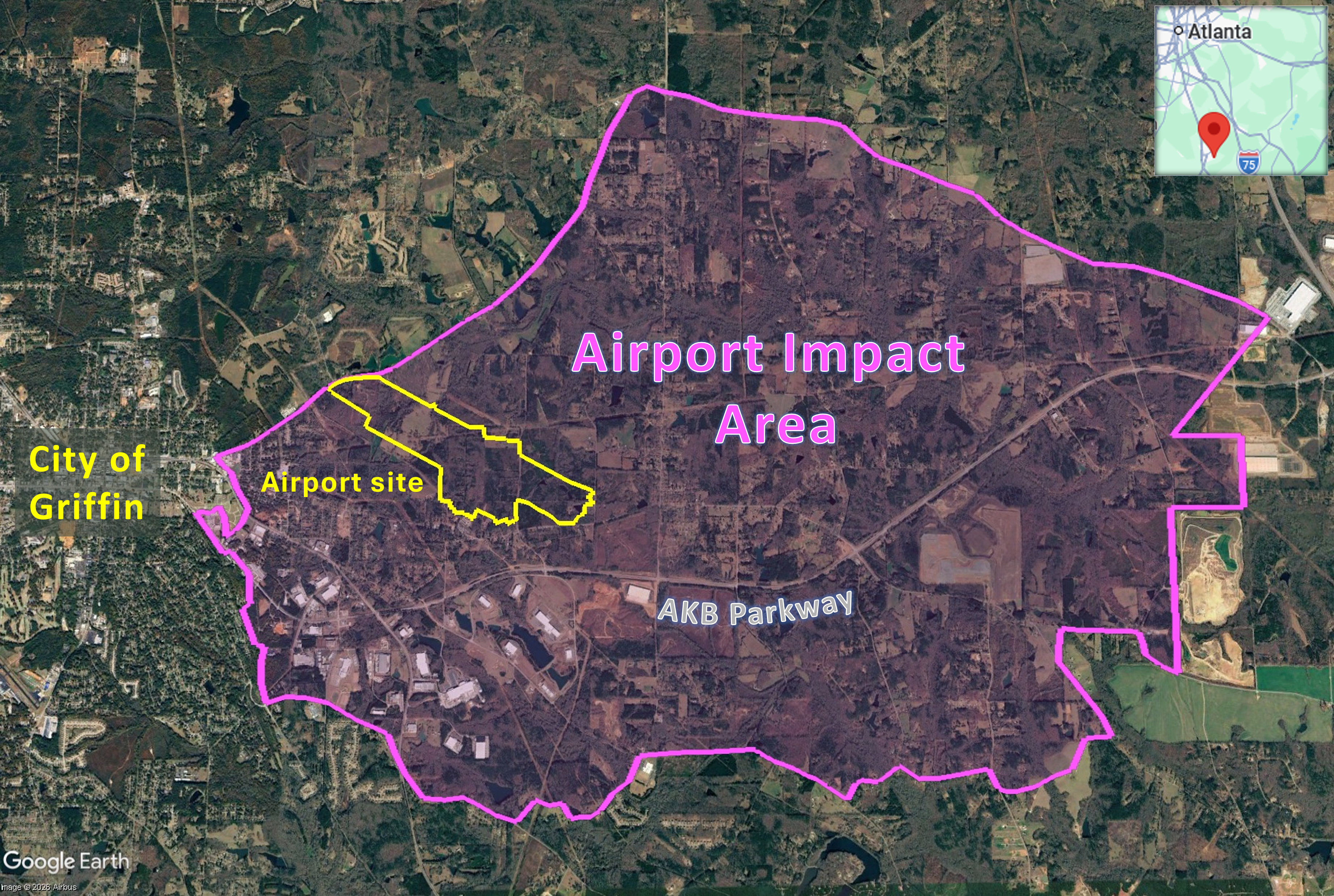
Griffin-Spalding Regional Airport, Airport Impact Area
Griffin-Spalding Regional Airport site and Airport Impact Area, as shown in Griffin-Spalding Regional Airport Strategic Development Plan, KB Advisory Group, page 5, overlaid on aerial imagery dated 30/12/2025

Georgia based Croy Engineering was selected as the prime consultant for development of the new airport in 2018, assisting with development of a financial plan and procurement of a USD8.5 million grant for the final design. The Griffin-Spalding Regional Airport Strategic Development Plan, prepared for Spalding County and the City of Griffin by KB Advisory Group based on data up to 2025, summarises the purpose of the project, ‘The new airport can serve as the driver for increased personal & business/corporate aviation traffic, expedite the corridor as a manufacturing and distribution hub, support technical training and research for the aerospace industry, and become a local destination for the community.’ Commercial and industrial corridor development is envisaged along the AKB Parkway which runs south of the airport site. The plan identifies an ‘Airport Impact Area‘ representing ‘potential real estate development capture’, forecasting future real estate demand for four key land use types: 29 million square feet of new industrial/flex (versatile property that can be utilised for a combination of warehouse, distribution, office and retail) space, 79,800-97,000 square feet of new retail space and 1,796 housing units by 2045, plus 180 additional hotel rooms by 2035. The Airport Impact Area, including the airport site, encompasses more than 18,500 acres of land. The report recommends infrastructure development to signal site readiness and reduce risks to developers, initially prioritising shovel ready sites to market the corridor. The Immediate Priority: Target Area 1 extends along both sides of the AKB. The Medium-Term: Impact Area is the entire Airport Impact Area.

The groundbreaking ceremony for Griffin-Spalding Regional Airport took place on 7th May 2026 with over 50 people in attendance, including Department of Transportation (DOT) Under Secretary Ryan McCormack who echoed President Donald Trump’s lauding of the One BIg Beautiful Bill Act with his description of the airport as “big and beautiful“, Congressman Brian Jack, Lieutenant Governor Burt Jones, GDOT Commissioner Russell McMurry and local leaders. Construction of the airport is scheduled to be completed by 2030. Griffin-Spalding Regional Airport, the first new airport to be constructed in Georgia since 2008, is supported by federal, state and local funding. Congressman Brian Jack stated that to date the project has secured a total of USD83.4 million including USD8.5 million from the Federal Aviation Administration (FAA) Airport Improvement Program, USD8.8 million from a Congressional Community Project Funding appropriation, USD47.2 million from the Georgia General Assembly, USD11.9 million from the Georgia Department of Transportation (GDOT) Airport Aid Development program and USD7 million from a local bond.

Cabo Rojo International Airport will serve a new luxury tourism complex and private jets

A new international airport under construction in the Pedernales province in the southwest of the Dominican Republic, for commercial and private flights, is integral to development of a high-end coastal tourism complex.

Cabo Rojo International Airport site
Cabo Rojo International Airport construction site. Satellite image 09/09/2024

In January 2024 the government of the Dominican Republic announced construction of a new international airport in the Pedernales province in the southwest of the country. The site is in the Manuel Goya community, part of the Oviedo municipality. A Spanish firm, Acciona Construction SA, was awarded the contract to build Cabo Rojo International Airport, even though its bid was the most expensive. The RD$3,961 million (€62 million) contract, awarded in June 2024, included construction of a 3.1 kilometre runway, taxiway, aprons for Boeing 777 aircraft (the world’s largest twin-jet aircraft accommodating up to 368 passengers) and drainage works. The new airport will serve luxury tourism and private aircraft (private jets). Director of the Airport Department, Víctor Pichardo, highlighted the new airport’s potential to transform tourism in Pedernales by attracting both commercial flights and private aviation, noting that each year more than 40,000 private aircraft fly over the Carribean. He said the new airport would position the Dominican Republic as a hub for high-end tourism. Construction of the new Cabo Rojo Airport (also known as Pedernales Airport) is scheduled to be complete by the end of 2025; it is anticipated to handle up to 1 million passengers annually within 17 years, making it the third busiest airport in the country.

Luxiry tourism development adjoining Cabo Rojo Airport
Artist rendering of development of planned luxury tourism development near the new Cabo Rojo International Airport and expansion of Port Cabo Rojo. Image: Dominican Today

The new Cabo Rojo International Airport, will form the basis for a new coastal tourism complex with 12,000 rooms located just 15 minutes away (about 25 km). The two locations are already connected by a major highway: DR Route 44. The tourism complex site is near the existing Cabo Rojo Domestic Airport, a civic/military airport currently receiving a few small aircraft, carrying 2-30 passengers, per week and serving operations of the Dominican Air Force. Tourists will also be delivered to new resorts via Port Cabo Rojo, which is expanding into a facility capable of receiving two large cruise ships carrying up to 15,000 visitors. Large volumes of fresh water will be diverted to the tourist area via a new aqueduct which will supply 8,000 tourism rooms. As of July 2024 the ProPedernales tourism development trust, a Public-Private Partnership (PPP) with the government holding a 52% stake and the private sector holding 48%, reported a total investment of USD130 million on Cabo Rojo tourism, focused on the first three hotels and the airport runway. In addition, the Dominican Government had spent nearly USD30 million on water projects, site conditioning, planning and design to prepare for and support the initiative.

Six major international hotel chains, ‘a who’s who of luxury and all-inclusive resorts’, are building new properties in Cabo Rojo: Hilton, Marriott International, therostar Group, Karisma Hotels & Resorts, Amresorts (part of World of Hyatt) and Sunwing. Luxury tourism development just 15 kilometres away from the border with Haiti, gripped by gang violence and a humanitarian crisis, might seem incongruous. But the Dominican Republic has reinforced the border with Haiti with more than 13,000 troops and the first phase of a high-tech ‘smart’ border wall with drone patrols, surveillance towers and night vision cameras is nearing completion. The exclusivity and high security requirements of luxury tourism can go hand in hand with militarisation; the established Cabo Rojo Airport nearby already serves the Dominican Air Force.

At a June 2025 National System of Protected Areas (SNAP) conference a number of environmental experts stressed the importance of responsible tourism development in Cabo Rojo, avoiding repeating the mistakes of some other Dominican tourist destinations by protecting the region’s ecology and directly benefitting local communities. But problems have been reported in the earliest stages of Cabo Rojo’s tourism development. In August 2024 environmental organisation Grupo Jaragua said the project was proceeding without clear compensation plans for affected residents of the Oviedo municipality, where the airport is being constructed. A community leader reported that tractors had destroyed land. Two months later a truck drivers’ union took strike action protesting non-payment for tranport of fill materials used for airport construction, saying the amount being paid per kilometre was not even sufficient to cover their fuel costs. The government is providing a high level of financial and infrastructural support to tourism and airport megaprojects that will primarily benefit airlines, major international hotel chains and cruise ship lines, not local businesses, and only wealthy visitors will be able to afford to stay in the luxury hotels. And the new high-end tourism complex may well boost the number of private aircraft flights, only affordable to a small number of very wealthy people, at Cabo Rojo Domestic Airport.

Aerocity catalyst for Little Andaman plan

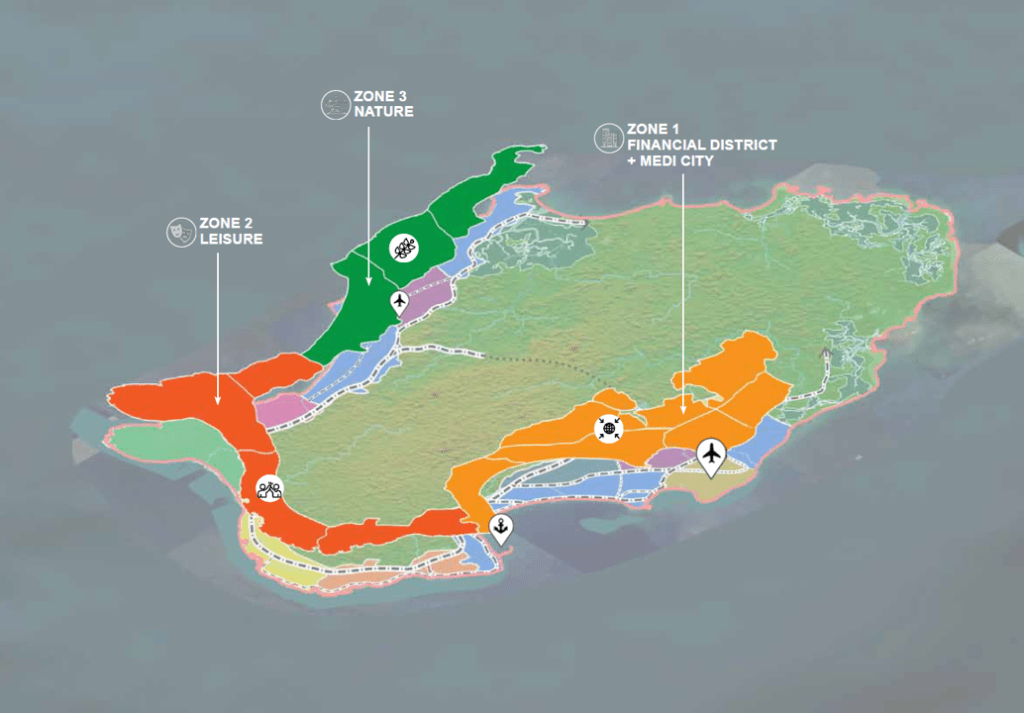
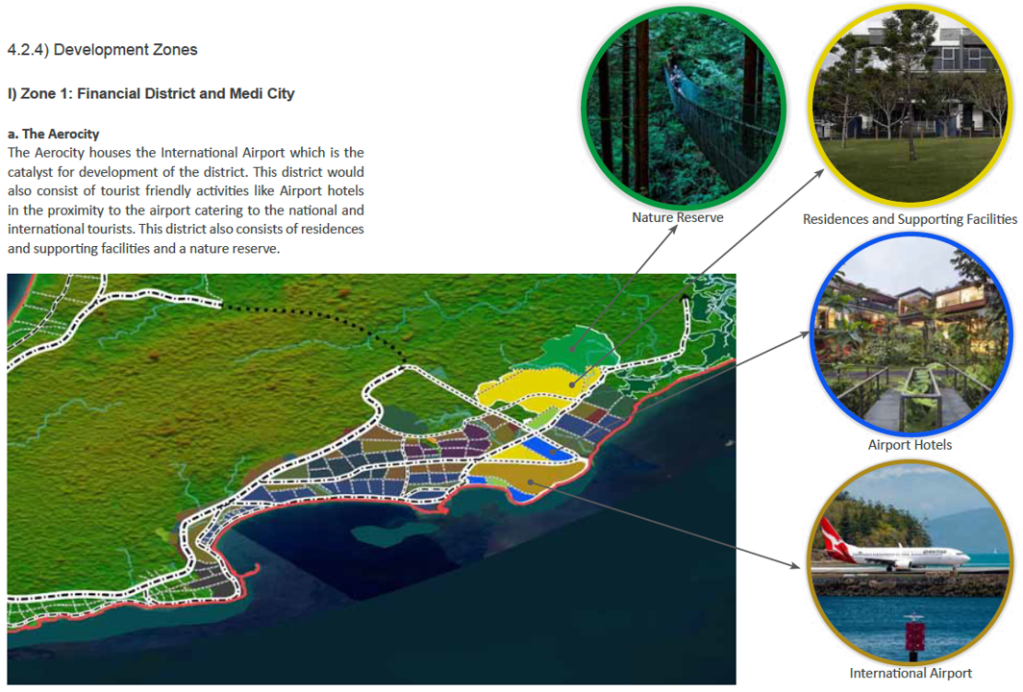
Airport development features heavily in a plan for tourism-oriented megaprojects on Little Andaman Island, the southernmost island of the Andaman archipelago. Graphics below, from the 58-page ‘Sustainable Development of Little Andaman Island – Vision Document’, show: Zone 1, on the eastern coast, featuring an Aerocity, housing an international airport, envisaged as ‘the catalyst for development of the district’; Zone 2, on the southern coast, including a Leisure Zone and Tourism SEZ (special economic zone) with casinos, theme park and beach hotels; Zone 3, on the western coast, a Nature Zone containing super-luxury resorts and hotels, with an airstrip for private charter flights.

  • Little Andaman plan
  • Little Andaman plan indicating 3 zones
  • Map of Zone 1 of Little Andaman plan. The Aerocity is the catalyst for developmen

Sudden news of the plan, in January 2021, alarmed conservationists. The ‘Vision Document’, thought to have been finalised a few months previously but not in the public domain, is included in ‘A MONUMENTAL FOLLY: NITI Aayog’s Development Plans for Great Nicobar Island (An evolving archive of reports, information and documents)’, compiled by Panjaj Sekhsaria and published by Kalvpavriksh Environmental Action Group. The total project area is nearly 240 sq km, 35% of the island; the three zones would take up 107 kilometres of the island’s coastline. Development of this scale would have major impacts on indigenous people and the island’s unique biodiversity and forests. Little Andaman is home to the Onge tribe, living on the island for more than 50,000 years, the population dwindling since 1900. Now numbering an estimated 125 people the Onge tribe is categorised as one of India’s Particularly Vulnerable Tribal Groups (PVTG). According to the plan the Onge Tribal Reserve would be reduced by 31%; the Vision Document states that steps would be taken to relocate and protect Onge people but no detail is given. An anthropologist pointed out that bringing areas where Onge, with nomadic origins, do not live into the proposed development would still impact them, saying “the Onges have a close attachment with their territory be it inhabited or not”.

The Divisional Forest Officer of Little Andaman raised concerns that the major diversion of forest land for the project would cause irreversible damage to the island’s forests, entailing the loss of more than 2 million trees. An official source said there are over 2.4 million trees in the “vast tract of forests” in the areas where development is proposed. Removal of trees would cause topsoil erosion and reduce rainfall, impacting on the small area of the island with cultivable soil. Uprooting more than 2 million trees for the Little Andaman plan would also result in carbon emissions and carbon stock losses. Carbon pools were calculated for the four forest types in the development areas: nearly 136 sq km of Evergreen/Semi Evergreen and smaller areas of Deciduous, Swamp/Mangrove and Plantation forests. A study estimated that implementation of the ‘Sustainable Development of Little Andaman – Vision Document’ would result in carbon stock loss of 2,996.286 tonnes from five categories of carbon pools: 55% from woody debris and soil organic matter, 32% from above ground living biomass, 9% from below ground biomass, 3% from dead mass of litter and 1% from dead wood.

Nesting sites of Giant Leatherback Turtles, the world’s largest turtles growing over 6 feet in length, with many populations in precipitous decline, are threatened by the Little Andaman plan. South Bay and West Bay on Little Andaman are both high-intensity nesting sites and among the most important in the entire island chain. Along with other nesting beaches on the islands, the two sites are specifically mentioned as ‘Important Marine Turtles Habitats in India’ in the National Marine Turtle Action Plan. There are fears that implementation of the ‘vision’ would push the leatherback turtles to the brink of extinction. A 2019 report on a long-term monitoring programme at Little Andaman island identified previously unknown migratory routes of Great Leatherback Turtle nesting in the region, highlighting their dependence upon foraging and nesting sites that are thousands of kilometres apart. Nine tracked turtles traversed much of the Indian Ocean, as far southeast as Western Australia and towards the eastern coast of Africa. The turtle travelling the furthest, close to the western coast of Mozambique, covered 13,237km in 266 days; it was also the fastest, travelling an average of 49.8km per day.

More information about the Little Andaman plan has been published on EJatlas, the world’s largest, most comprehensive online database of social conflict around environmental issues: Little Andaman Development Plan

Two aviation-dependent Red Sea resorts

Two tourism developments on the Red Sea coast, Amaala and the Red Sea Project, will not live up to claims of ecological sustainability. Both resorts will have dedicated airports, sending carbon emissions soaring and hardwiring fossil fuel dependency.

An aerotropolis of sorts, a tourism resort with its own dedicated airport, is emerging on the Red Sea coast of northwestern Saudi Arabia. Amaala is a planned tourism gigaproject covering 4,155 square kilometres of terrain on land and sea, with more than 2,500 hotel rooms and over 800 residential villas. On 26th June renderings for the terminal and control tower of a luxury airport to serve Amaala were unveiled by UK-based Foster + Partners.

Amaala Airport – ‘inspired by the optical illusion of a desert mirage’

Luxury and exclusivity characterise the three main components of Amaala: Triple Bay – a luxury wellness resort and sports facilities including golf, equestrian, polo and falconry; Coastal Development – a cultural district featuring a museum of contemporary arts, film and performance arts venue and a biennial park and The Island – one of the world’s ‘most exclusive enclaves’ featuring botanical gardens, artworks, sculptures and private residences surrounded by landscaping. Amaala aims to attract ultra-high net worth individuals (UHNWIs), specifically targetting the very wealthiest, ‘the top 2.5 million ultra-high net worth individual luxury travellers’. This really is high-end tourism; Amaala’s target market segment is the wealthiest 0.03 per cent of the world’s total population of more than 7.8 billion. The resort will have its own ‘special regulatory structure’ to attract the super-rich.

Taking premium tourism to new heights, Amaala’s own dedicated airport will be as luxurious as the resort. Chief executive of Amaala, Nicholas Naples said: the ‘gateway to Amaala…will be a unique space that personifies luxury and marks the start of memorable experiences for the world’s most discerning guests’. Scheduled to open in 2023, coinciding with opening of the first phase of the resort, Amaala airport will initially serve private jets and charter flights, before expanding to accommodate commercial airlines. When fully complete, by 2028, Amaala Airport terminal, a ‘spacious light filled courtyard’, will have capacity for 1 million passengers per year.

Zero carbon (but what about the flights?)

Listing a mutlitude of ecological features – including an organic farm, utilising biodegradable materials, preventing plastic pollution, protecting iconic species, renewable energy including solar fields, recycling, treating wastewater for use in agriculture – Amaala claims it will ‘set an example for sustainability and eco-conservation in the region’. CEO Nicholas Naples, said ‘energy requirements will be met by using renewable sources, with the entire Amaala development having a zero-carbon footprint’. All these laudable ecological measures will be undermined by the impacts of travel to and from the resort. Amaala will be heavily dependent on aviation; an estimated 80 per cent of visitors will arrive by air. Flying is the most carbon intensive mode of transport and the carbon footprint of travelling by private jet is far higher than comparable journeys by commercial airliner; some estimates quantify the differential at 10 times the amount of carbon per passenger.

Foster + Partners’ design for Amaala Airport, a ‘sleek mirrored edifice’ inspired by ‘the optical illusion of a desert mirage‘, received a lot of publicity. The angular, shiny roof is indeed striking but its just an ostentatious example of superficial architectural flourishes that are typical of airport design, a fancy veneer disguising a functional concrete box. Gerard Evenden of Foster + Partners said: “The passenger experience through the entire building will be akin to a private members club … The design seeks to establish a new model for private terminals that provides a seamless experience from resort to airplane”. Passengers will be enclosed in a bubble sealed off from the real world. Damaging environmental impacts of emissions from private jets will be externalised, inflicted on other people, predominantly the poorest, living elsewhere and in the future. As less privileged people contend with extreme weather private jets owned by UHNWI’s parked at Amaala will be protected from the slightest climactic variation, in climate-controlled hangars.

Architects criticise Amaala Airport

In Architects Journal, Greg Pitcher queried whether Foster + Partners’ involvement with the Amaala airport project aligned with the firm’s carbon reduction pledges, in particular commitment under the Architects Declare banner to ‘evaluate all new projects against the aspiration to contribute positively to mitigating climate breakdown’. Sustainability expert and consultant Simon Sturgis said: ‘These sort of projects suggest that Foster + Partners is still engaged with 20th rather than 21st century thinking … This represents a climate betrayal’. Another consultant, Robert Franklin, weighed in on the Architects Declare movement, describing it as ‘a calculated, cynical insult to anyone who understands the lease nuanced interpretation of sustainable’.

Architects Climate Action Network (ACAN) polled network members asking them about their thoughts on Foster + Partners’ involvement in Amaala Airport. A clear majority opposed the scheme and ACAN wrote an open letter to voice concerns, arguing that architecture practices working to expand aviation goes against pledges to ‘Evaluate all new projects against the aspiration to contribute positively to mitigating climate breakdown’. ACAN also questioned how the airport project could be reconciled with Foster + Partners being a signatory of Architects Declare commitments recognising rapid decarbonisation as a global imperative.

Superyachts and luxury cruises

For those arriving at Amaala by sea there will be facilities for yachts, specifically ‘luxury yachting’. Naples spoke to Superyacht News about Amaala. Explaining that Amaala is part of a ‘yachting strategy for the Red Sea’ whilst acknowledging that while ‘yachting and environmentalism often aren’t seen to go hand-in-hand’ he was ‘confident that the project will be considerate to its surroundings’. Such confidence is unwarranted as travellers on superyachts, luxury vessels with price tags upwards of $100 million, leave ‘oversized personal carbon footprints‘ in their wake. The carbon footprint of one Superyacht, Venus, the result of 51,796 kilometres travelled in 2018, was estimated at 4,571 tonnes. This astonishingly massive figure is 279 times the average Australian citizen’s annual carbon footprint – for all their activities, not just transportation – and 594 times the average Chinese citizen’s carbon footprint.

Amaala will also be a calling point for boutique luxury cruises. Each passenger on board these boats will wield an even larger carbon footprint than the thousands of people crammed on board cheaper vast cruise ships that resemble floating cities. And Amaala’s facilities for arrivals by sea, marinas to accommodate international races and regattas, are likely to have negative environmental impacts on the pristine Red Sea coastal ecosystems. Large concrete structures and air and water pollution from boats could compromise biodiverse ecosystems that provide havens for whales, turtles and healthy coral reefs.

Neom megacity and the Red Sea Project

Amaala is situated between two other developments on the Red Sea coast: Neom megacity to the north and the Red Sea Project to the south. Vivian Nereim and Donna Abu-Nasr reported for Bloomberg on their visit to Neom in July 2019. They explored an eminently desirable setting for development, an area blessed with ‘stunning untouched shorelines with waves rippling in the turquoise water’ against a backdrop of purple volcanic mountains. Residents were uncertain and divided over whether benefits from Neom megacity would accrue to them: ‘Many of the locals who have lived there for years are looking forward to some prosperity, while others are concerned they will be removed and their homes bulldozed.’ Rumours swirled of large-scale resettlement to make way for luxury villas and office complexes and Neom stated that under current estimates more than 20,000 people would be moved. Megaprojects including a ‘huge port’ and a causeway to Egypt were in the works. A small airport serving Neom opened in June 2019.

The massive Red Sea tourism project, comprising resorts on 22 islands and six inland sites, will, like Amaala, be served by its own dedicated airport. In July 2020 infrastructure contracts for Red Sea International Airport were awarded to two Saudi firms: Nesma & Partners Contracting and Almabani General Contractors. And Foster + Partners is also involved in the airport. In July 2019 the firm was awarded the design contract. As with Amaala airport a whimsical architectural facade will evoke the surroundings, ‘the form of the roof shells is inspired by the desert dunes’.

Red Sea International Airport, serving 1 million passengers per year. ‘Eco-friendly and sustainable design’.

Although not built for private jets the ‘design of the terminal aims to bring the experience of a private aircraft terminal to every traveller by providing smaller, intimate spaces that feel luxurious and personalised’. Visitors will be funnelled from the airport to the resort via ‘an immersive experience of the highlights at the resort’ in a Welcome Centre and ‘departure pods’ with spas and restaurants. Red Sea International Airport’s projected number of air passengers is identical to Amaala airport: 1 million per year. And the emphasis on environmental policies, such as zero waste-to-landfill and ban on single-use plastics, is similar to Amaala. Red Sea Project developers ‘want it to become one of the world’s most succussful sustainable tourist resorts’. Visitors will be given personal carbon footprint trackers to encourage them to think about sustainability. If these trackers were to include flights visitors would see their carbon emissions exceeding that of the majority of the worlds’ people who have never flown, before they even step off the plane into the luxury terminal.

A New Civil Engineer article, proclaiming the airport to be ‘eco-friendly‘, states that ‘the entire infrastructure of the Red Sea Project, including its transport network, will be powered by 100% renewable energy’. Conversion of transportation systems is one of the most difficult aspects of transition to renewable energy. Flights powered by renewable energy are not even remotely on the horizon. Much-hyped biofuels only provide a minute proportion of aviation fuel, just 0.01 per cent. Scaling up aviation biofuel production would destroy forests and other ecosystems and trigger land grabbing for plantations. Many airports have installed solar panels on unused land surrounding runways, providing a proportion of the power requirements for ground operations. But solar flight is a distant dream. The only solar-powered planes to successfully fly long distances, Solar Impulse 1 and 2, carry just one or two people at speeds rarely reaching 100 kilometres per hour.

Like Amaala, Neom and the Red Sea Project are supported by the Public Investment Fund KSA (PIF), Saudi Arabia’s sovereign fund, and all three projects are part of the Saudi Vision 2030 programme. Spanning various sectors including tourism, real estate and entertainment Saudi Vision 2030 aims to diversify the economy away from dependency upon oil. Tourism is a prominent sectoral focus, anticipated to increase from the current 3 per cent of gross domestic product to 10 per cent by 2030. Yet Amaala and the Red Sea Project, flagship tourism developments, are heading in the opposite direction from reducing dependency on oil. Dedicated airports serving these two resorts might not draw upon Saudi Arabia’s depleting oil deposits. But both facilities will require prodigious amounts of oil extracted from somewhere.