‘Mindfulness City’ megaproject begins with expansion of Gelephu Airport

Gelephu Airport, one of only four airports in Bhutan, is a domestic airport located in the southern Himalayan foothills, close to the Indian border. In August 2023, as formulation of the master plan for expansion of Gelephu Airport neared completion and groundwork preparations began, there was growing speculation among landowners with properties in the proposed site regarding replacement land and compensation. Acquisition of land was to be determined by the government. The groundbreaking ceremony for Gelephu International Airport took place on 23rd December 2023. Satelite imagery dated 1st January 2024 reveals a large area of low-lying scrub land has been cleared for the airport expansion.

Satellite imagery shows clearance of a large area of low-lying scrubland for expansion of Gelephu Airport, including the new runway, and construction of a dry port south of the existing runway.

Expansion of Gelephu Airport is a key component of an even larger megaproject, a new city, and some residents are concered about losing land to the project. On 15th December 2023 Forbes reported that King Jigme Khesar Namgyel Wangchuck would be announcing development of a new ‘megacity’ in Gelephu, called Bhutan Mindfulness City, on Bhutan’s National Day, the 17th December. Initially there were plans for the announcement to take place in Gelephu, but the town, with just 10,000 residents, lacked the requisite infrastructure such as accommodation for international guests so the event was relocated to the capital city, Thimpu. Ahead of the official announcement the article cautioned that the new city project might be met with ‘strong opposition from Bhutan’s nearly 800,000 citizens’ and that ‘fears of government land grabs and the displacement of farmers in Gelephu have already taken root, according to several Bhutanese residents’. Sources with knowledge of Mindfulness City said the King was ‘trying to avoid the preception that families will be forcibly transferred to make way for the project’.

Mindfulness City was indeed the focus of the King’s 116th National Day address. The Bhutanese reported the King’s description of the new city, explaining that it will cover 1,000 square kilometres, about 2.5% of Bhutan’s total land area. Major public investment in roads, bridges and airports is planned, with an inflow of foreign investment anticipated for construction of offices, residencies, schools, hospitals, shops, hotels and restaurants. The new city was also referred to as Gelephu Special Administrative Region (SAR), an ‘economic hub’ that will have ‘autonomy to formulate laws and policies’. Ten of the twelve gewogs (groups of villages) in the Sarpang Dzongkhag (District) – Tareythang, Umling, Chhuzagang, Serzhong, Gelephu, Samtenling, Dekiling, Shompangkha, Gakiling, and Singye – were designated for the Gelephu Mindfulness City project. Kuensel Online reported that residents and landlords were ‘excited about the the upcoming development initiative’, attributing some landlords’ anxiety and fear of losing all of their land to the project to ‘lack of awareness regarding private properties’. There was reassurance of compensation following international practices and provision of replacement land in the city area. It appeared that acquisition of private land would be limited to areas allocated for road and airport construction.

Danish architecture firm BIG, known as a masterplanner for other megaprojects such as Neom, a glass-walled linear city in Saudi Arabia, duly unveiled its masterplan for Mindfulness City, including an international airport. Connectivity was a recurring theme of BIG founder Bjarke Ingels’ description of the new city; he said “Gelephu becomes a land of bridges, connecting nature and people, past and future, local and global”. Apparently, the project will ‘be shaped by 35 rivers and streams that run through the site’. Neighbourhoods will be connected by several ‘inhabitable bridges’ hosting facilities including a university, a healthcare centre and a spiritual centre. Connectivity claims extended to the airport, its timber terminal to act as a bridge. But its runway, crossing over several rivers, while facilitating connectivity for global air travellers, will cause major disruption to hydrological systems. And how does a new city highly dependent on fossil-fuel dependent international air travel square with the Gelephu Mindfulness City website claim of ‘Sustainability as a carbon negative country’? Buildings will incorporate local materials and be ‘informed by Bhutanese architecture‘. But will techniques and structures resonating with local cultural identity be integral to the function of new buildings, or merely aesthetically pleasing adornments? Perhaps the most striking showpiece feature of Mindulness City is the plan for a hydro-electric dam containing a temple. Will the new city be, as Ingels said, “founded on Bhutanese nature and culture”, or merely garnished with it?

A 6th January 2024 Kuensel Online article stated that that Gelephu Mindfulness City would commence with expansion of Gelephu Airport and landowners with land in the area earmarked for the airport had been given replacement land or compensation. Landlords confused about the future of their holdings had been told that they had ‘nothing to worry about’ as the project would include everyone and leave nobody behind, indeed ‘the entire Bhutanese citizenry would be part of the historic project’. This claim of inclusivity is at odds with the Gelephu Mindfulness City website promotion of new city aiming to ‘attract global top talents who are global and creative’ and ‘serve as a hub of global top minds’, i.e. for an international elite. By February 2024 six JCBs had cleared about 1,800 acres of land, working towards the goal of clearing 2,500 acres. Just south of the airport, a dry port was under construction. After considering three models for the airport expansion officials had selected the Asian Development Bank (ADB) masterplan. A new runway next to the existing runway will be 3km in length; possible extension of the runway to 3.5km to accommodate the Airbus A380 would cross over two rivers. Building a new runway will allow continuation of airport operations using the existing runway, enabling visitors involved in the development of Mindfulness City to fly in and out. The initial cost estimate of the ADB masterplan was Nu 8 billion (USD96 million) but a more recent estimate by the Airport Authority of India indicated a far higher figure, possibly as high as Nu 20 billion (USD240 million).

Eviction of villages bordering Kilimanjaro Airport

In Tanzania state forces are forcefully evicting Maasai residents of eight villages bordering Kilimanjaro Airport. On 8th May 2024 it was reported that hundreds of homes have been demolished and cars with loudspeakers, escorted by armed police, warned residents to evacuate. Plans to expand the 460 hectare airport site to 11,447 hectares date back to 1985 and the government labels the lawful owners of the land as ‘trespassers’. For background information on the land dispute see EJAtlas: Kilimanjaro International Airport. Impacted communities and supporting organisations are calling for and immediate halt to demolition of homes, humanitarian aid including food and shelter to the hundreds of people rendered homeless and establishment of an independent enquiry into the land dispute.

Mohali Aero City expansion impacts on rural livelihoods

A study focussing on three villages affected by land acquisition for expansion Mohali Aero City, southwest of Shaheed Bhagat Singh International Airport, raised concerns over threats to rural livelihoods.

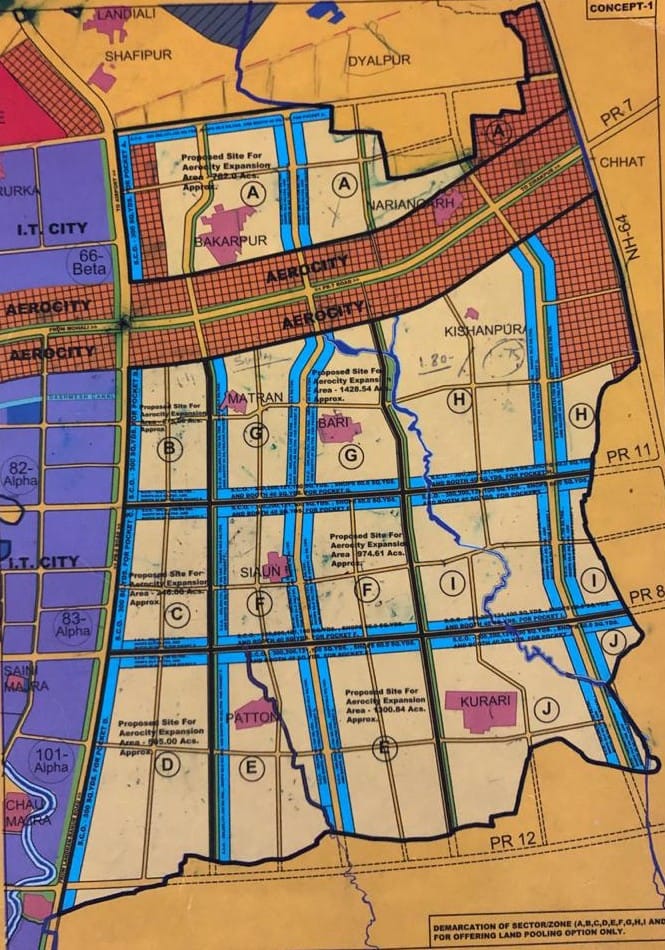
Proposed acquisition of 5,438 acres (2,200 hectares) of land from 14 villages – Bakarpur, Naraingarh, Kishanpura, Safipur, Rurka, Matran, Bari, Chatt, Saini Majra, Seon, Kurari, Chau Majra, Manauli and Paton – for AeroCity expansion, called ‘Aerotropolis’, was confirmed by Greater Mohali Area Development Authority (GMADA) in 2017. A 2021 article in the Journal of Land and Rural Studies by Thomas Reuter, Sarbjeet Singh, A.K. Sinha and Shalina Mehta, Land Grab Practices and a Threat to Livelihood and Food Security in India? A Case Study from Aerocity Expansion Project from S.A.S. Nagar, Punjab, analyses the project as an example of large-scale acquisition of highly fertile agricultural land. The authors describe ‘blatant land grab practices by the state authority in the name of development, which act as barriers to the food security and threaten the livelihoods of those whose land will be acquired’. The study focussed on three affected villages – Patton, Kurari and Seon. Fieldwork conducted in April 2019 included in-depth interviews with 50 displaced farmers.

Mohali Aerotropolis
GMADA location map of proposed sites for Aerocity expansion. Graphic: Aerotropolis Mohali, 23/11/2020 https://www.facebook.com/451195685303715/photos/pb.100064020934387.-2207520000/1041176552972289/

Impacts on marginal rural people

A consolidated demographic profile of Patton, Kurari and Seon from the 2011 census showed that the total number of affected people was 3,031. A significant number, 955, belonged to the scheduled caste population, the most marginal rural people, many of them landless labourers, some of whom farm on leased land and other providing menial services. Land acquisition renders them homeless and they receive no compensation. The scheduled caste community of Patton village were marginal farmers owning only 1-2 acres of land. Scheduled caste people of Kurari and Seon did not own any land and depended entirely on agricultural activities. The working population was divided into two categories. ‘Main workers’ included marginalised individuals regularly hired by affluent farmers to work in their fields and people engaged in pastoral activities in a more favourable economic situation. ‘Marginal workers’ comprised migrant workers primarily from Uttar Pradesh and Bihar along with seasonal workers from other states coming to the area for work harvesting paddy and wheat. Agriculture was the primary economic activity in the three villages. Several farmers had modern equipment such as tractors, tillers and adequate irrigation with tube wells for which free electricity was provided by the state. Farmers getting cash compensation for surrendered land tend to lose these subsidies, along with minimum price support for cereal crops.

Narratives from three affected farmers

The article includes narratives from three farmers affected by land acquisition for the Aero City Expansion. A 59-year old man from Kurari village grieved that the pace of urbanisation would convert lush green fields into a concrete jungle. He worried that wheat, rice, maize and other cereal crops would disappear. GMADA and private builders offered different compensation packages, causing friction among those surrendering prime agricultural land and also between farmers and the state, resulting in litigations and delays in land acquisition and launch of construction activities. A respondent from Patton said that a decade ago the land was unsuitable for farming and nobody wanted to settle in the village. Residents worked hard and within two years had made all the available land suitable for agriculture. Most farmers grew vegetables and cereals which they sold at nearby farmers’ markets. When GMADA notified the village for land acquisition for the Aero City Expansion project farmers feared compulsory acquisition and sold their land to private builders. He said that when the government acquires land compensation is inadequate and the payment process often gets trapped in legislation. He had worked hard on the land he was forced to sell and was unsure of the productive capacity of new land he had purchased. A Seon villager whose land was acquired by GMADA for the Aero City Expansion had not been paid adequate compensation. He retained six acres but there was a possibility this would also fall under the proposed land acquisition, leaving him without any means of livelihood.

Loss of pastoral activities and social stability

Livestock provided an important subsidiary source of income in the three villages. Cows and buffalo were reared mainly for milk and cows also for manure. Pastoral activities in the three villages were mainly pursued by women waking up early to milk cows and buffalo. Land acquisition can deprive women of this primary economic activity making them far more vulnerable, especially when they run single-parent households. The case studies suggested that animal rearing as a livelihood became unviable because land used for pasture was no longer in villagers’ possession. Loss of agricultural land can cause cessation of pastoral activities, as most displaced households are not compensated with sufficient land to accommodate dairy animals.

Residents of the villages were content with acquisition of small portions of land along roads as it brought them improved connectivity. But acquisition of their fertile land for development of housing for wealthy urbanites and creation of infrastructure in which they were not equal stakeholders left locals feeling cheated. Their lives were marked with upheavals and displacement threatened close-knit social networks. The authors conclude that the Aero City Expansion project was ‘an ambitious ideas but executed without due diligence and groundwork’. Land acquisition brought revenue to the state but measures to support the interests of local residents were inadequate. Urban planners failed to foresee the risks of social tensions and the Aero City epxansion led to social and political instability. The article warned of agricultural decline and the prospect of food insecurity.

Velana Airport expansion and designation of Funadhoo Island as an economic zone

Plans for expansion of Velana Airport, the main airport in the Maldives, and a linked Economic Zone on Funadhoo Island are certainly ambitious. A video outlines a blueprint for a 20-year, multi-billion dollar development.

The expanded airport will be designed to accommodate 25 million passengers per year (nearly a six-fold increase over 4.3 million passengers in 2022). A new cargo terminal is forecast to handle 100,000 tonnes by 2025, rising to 300,000 tonnes by 2050. Aviation fuel farm storage will be expanded fro 15 million litres to 100 million litres. The passenger processing capacity of the domstic terminal will be increased from 300 per hour to 2,000. A self contained jet terminal is described as ‘serving niche market segments of the airline industry, exploiting this market segment and investing in it is an essential part of the future airport infrastructure’. The airport footrpint will extend to other islands. Seaplane facilites operations will be relocated to another island and linked to passenger terminals via a new bridge. The ‘epitome of this futuristic vision’ is development of an Airport Economic Zone on the island of Funadhoo, linked to the rest of Velana Airport and ‘offering a plethora of shopping opportunities’ along with hotels, convention centres and entertainment facilities.

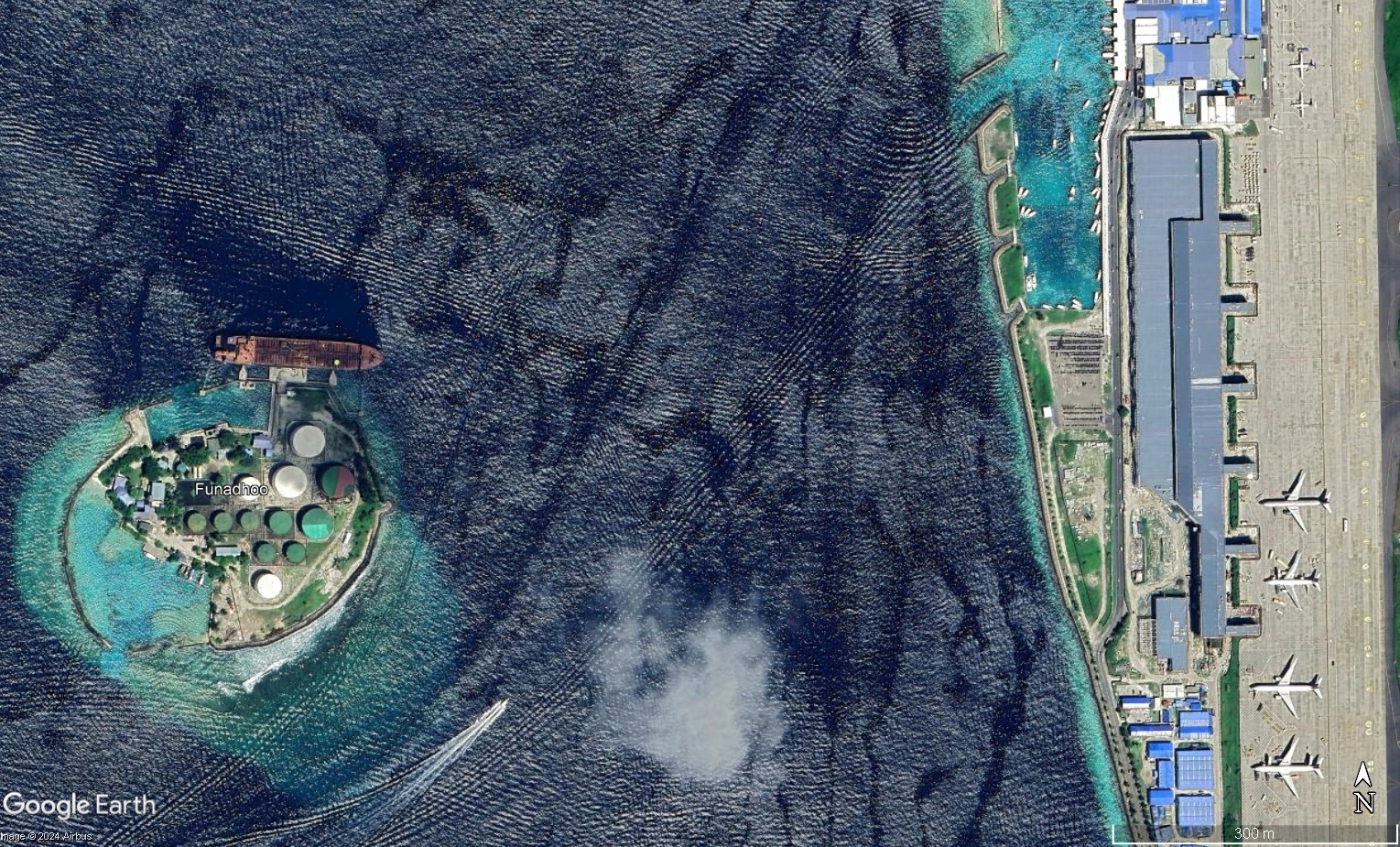
There are plans to remove the oil tanks on Funadhoo, between Velana Airport and Malé, and designate the island as an Airport Economic Zone with shopping malls, hotels,convention centres. and entertainment facilities.

Ambitious plans for the small island of Funadhoo, currently taken up by oil tanks and located to the east of Velana Aiport and close to Malé, the capital city, were announced in September 2023. President Ibrahim Mohamed Solih said that the oil tanks would be removed and replaced with a convention centre, hotel and shopping malls. On 4th January 2024, current President of the Maldives, Dr. Mohamed Muizzu, inaugurated the Velana International Airport and economic zone megaproject and pledged to develop Funadhoo Island as an international financial hub. He also revealed plans to create the ‘Maldives International Financial Services Authority’ as a step towards establishing an international financial centre in the Maldives. On 22nd January President Muizzu announced that, following relocation of the fuel storage to Maagiri Falhu, Funadhoo would be designated as a special economic zone.

Over 1,000 residents protest Taoyuan Aerotropolis relocation policies

More than 1,000 residents, along with several legislators, gathered to voice their discontent over government relocation policies for the Taoyuan Aerotropolis project, the largest land expropriation case in Taiwan.

The protest took place on 13th October 2023, after continued public appeals over the high cost of resettlement housing had gone unheeded. Huang Shih-chieh, the Democratic Progressive Party legislator, said the government should adjust relocation compensation in line with the price index and that the high cost of resettlement housing should be absorbed by the government, not shifted onto the affected people. In response, the Taoyuan City Government stated that the compensation budget had been increased by 20% but affected households said they have never felt adequately compensated. Kuomintang (KMT) Councillor Hsu Chi-wan said the government had repeatedly given the same resonse to appeals from households whose property was expropriated and suggested that compensation measures executed by Taoyuan’s Land Administration Department should be expedited.

Public funds poured into Airport Business Park near Eppley Airfield, Nebraska

Large amounts of public funds are being poured into a planned Airport Business Park near Eppley Airfield, located on the northeastern edge of the City of Omaha in Nebraska. The priority site contains many residences and small urban farms. Residents have concerns over lack of information about the project and whether they will have to relocate.

On 6th December 2022 the State of Nebraska awarded US$400,000 in Economic Development Awards funds to the Omaha Development Foundation to help create a master plan for an area near Eppley Airfield. The grant was the first step in implementing the state’s Airport Business Park Program (ABP Program), created by the Nebraska Legislature in 2022 in response to negative economic impacts of the coronavirus pandemic drawing grants from Nebraska’s allotment from the American Rescue Plan Act (ARPA). Signed into law on 11th March 2021 the purpose of ARPA is to support the country’s recovery from the economic and health impacts of coronavirus and recession.

In February 2023 the Nebraska Department of Economic Development (DED) elected to double the total amount available through its ABP Program, awarding US$800,000 in Planning Grants. The Omaha Development Foundation and the Omaha Economic Development Corporation each received a US$400,000 grant. Officials have proposed a powerful inland port authority to provide a support structure for the business park; a plan was presented to Omaha City Council on 20th December 2023. The port authority would focus on bringing large commercial and industrial developers to the city. It would have limited democratic input. A 9-member board, appointed by the Mayor, would co-ordinate developments related to rail, airports and waterways and be given authority to oversee investments in the area. The inland port authority would have legislative powers to issue and sell revenue bonds to construct buildings and infrastructure and be charged with guiding economic development in a wider, approximately 300 acre area, around Eppley Airfield.

Graphic depicting map of proposed business park near Eppley Airfield, as envisaged by a development team led by the Greater Omaha Chamber, Burlington Capital and the North Omaha-based Omaha Economic Development Corp. The priority site is north of Carter Lake. Image: Nebraska Examiner, 22/12/2023

The 160-acre priority site, to the west of Eppley Airfield near the northern shore of Carter Lake, contains about 320 mixed-use land parcels. Under the ABP Program about US$90 million in state funds would be used to turn the site into shovel-ready land ready for industrial development. City of Omaha officials are in negotiations with the private owner of the second site, a 70-acre area located west of Carter Lake. The priority site contains homes and small urban farms. Community leaders say affected communities have not been informed about the project. Joe Higgins of Levi Carter Sherman Neighbourhood Association said residents had to research information about the project themselves due to scarcity of detail provided by authorities. He said the neighbourhood had been marginalized since the 1950’s but most homes pre-date that time with residents having deep roots in the area. Some Omaha lawmakers also say there has been a lack of engagement with residents.

One of the urban farms operating in the earmarked site is City Sprouts which grows thousands of pounds of produce for a community pantry. It was established in 2021 and in 2023 it provided 15,000 pounds of food. City Sprouts also teaches agriculture providing internships and other learning opportunities. Manager Ann French said the farm was drawn to the area because of the truck farm and agricultural history. Currently covering 7-acres City Sprouts has plans to grow, building a greenhouse and a barn and quadrupling the produce it shares with neighbours. She said it would be impossible to find a similar site elsewhere in Omaha.

A 19th February 2024 community meeting, the first to include most of the major players in the business park and give residents clarification about the project, was attended by about 75 people. The key issue concerning residents was whether they would be forced to relocate and, if so, how they would be compensated. Several people voiced concerns over how little information had been shared with residents about the fate of homes they had built and lived in for many years. There were outbursts of frustration and anger. At one point a woman shouted “are they taking your home?” and a man called the discussion a “clown show” then walked out. Information about the proposed inland port authority to oversee the business park project clarified that most members would be appointed, but seats would be offered to two residents, two business owners and one youth.

Large amounts of funding, including public funds, is also being ploughed into expansion and renovation of Eppley Airfield, already the largest airport in Nebraska handling more than 5 million passengers in 2023. On 17th January 2024 the Omaha Airport Authority announced approval of a US$950 million terminal expansion and renovation plan at Eppley Airfield, funded by federal grants along with airport revenues and future airport bonds. Yet more public funding for Eppley Airfield expansion was announced on 14th February 2024; a US$3.1 million grant for Terminal Building Improvement Phase 7 will support increased capacity and improvements including a new terminal. The money is part of US$15 billion in funding for US airport infrastructure under the provisions of the 2021 Bipartisan Infrastructure Law, $11 million of which was allocated for Nebraska airports.

VVIP airport for Indonesia’s new capital city triggers land tensions

In East Kalimantan on the east coast of Borneo a new VVIP (Very Very Important Person) airport is being constructed to support development of Nusantara (IKN), the future capital city of Indonesia. With a VVIP and VIP terminal covering an area of 7,350 square metres and three helipads IKN VVIP Airport will support the mobility of the President, high-ranking officials, state guests and investors. The international airport will have a 3,000 metre runway to accommodate Airbus A400 military airaft and will be used in coordination with the Indonesian Air Force (IAF). Development of IKN VVIP Airport was accelerated by Presidential Regulation No. 31 on 6th June 2023.

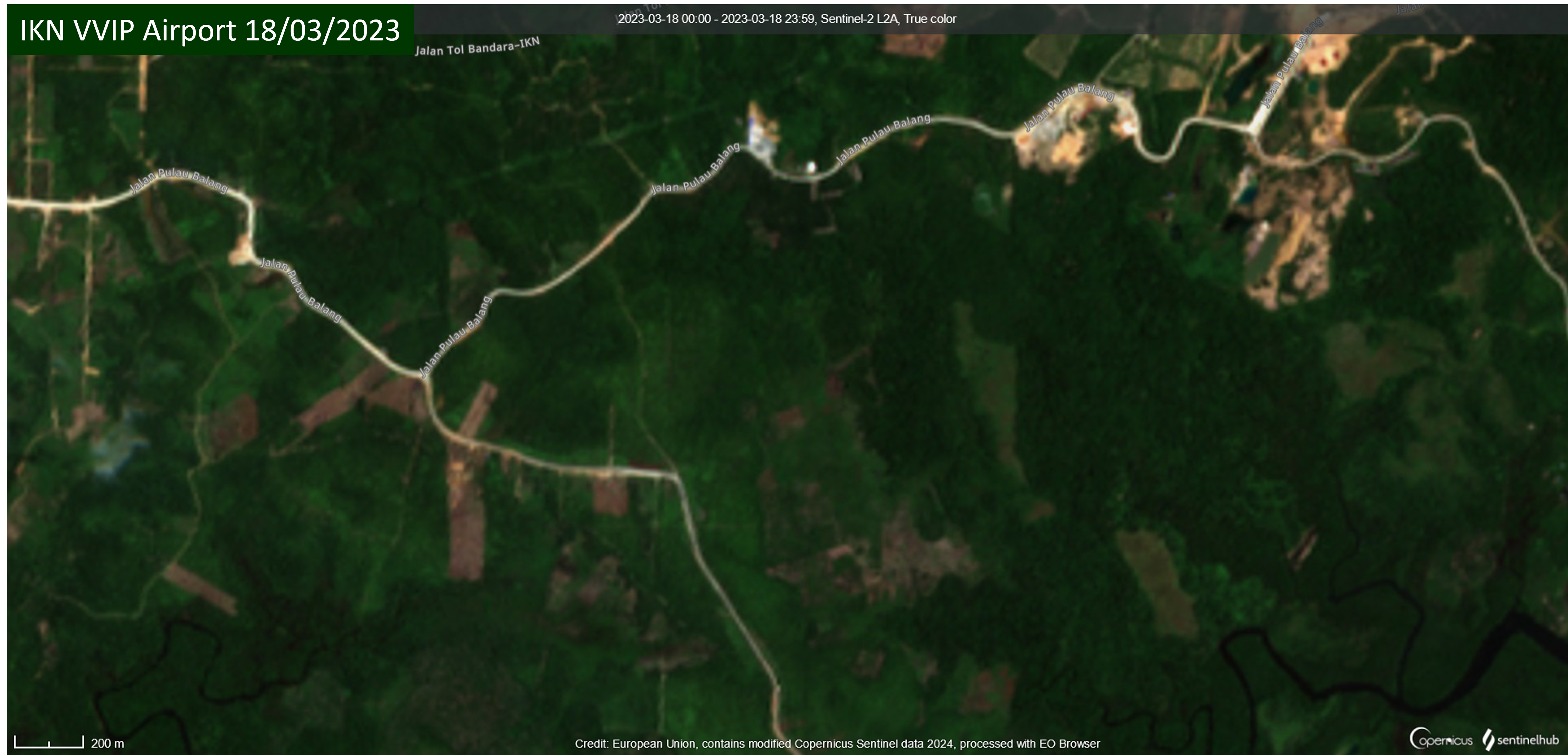
Satellite imagery shows land clearance and earthworks. The image on the left is from 18th March 2023 before works began. On the right is an image from 16th February 2024 where development of the IKN VVIP Airport terminal, runway and access road are clearly visible.

Demarcation of a 360-hectare site began within a few days and triggered reaction from some affected residents. On 30th June Muslimah News reported that hundreds of residents from five sub-districts – Gersik, Jenebora, Pantai Lango, Kelurahan Riko and the Maridan village area in Sepaku – were protesting take-over of land they occupied by the Land Bank Agency for construction of the VVIP airport. They refused to hand over their land to the Land Bank Agency because stakes were installed without prior notice and the government’s promise, made the previous year, to provide land for agrarian reform had not yet been fulfilled. There was a lot of evidence that construction was consuming residents’ land and authorities were ignoring their protests. Protest was not just in response to construction of the airport; there was also some controversy over whether the land bank serves public interest or corporate projects. The Land Bank Agency made reassurances that residents’ rights to replacement land would be accelerated and that agrarian reform land was being prepared for this purpose.

On 3rd August 2023 many palm farmers gathered at their former plantation area where they unfurled banners and made speeches demanding compensation for land affected by the VVIP airport construction project. A lawyer representing some of the residents said that oil palm land previously managed by them was suddenly cleared with heavy equipment. Palm oil trees had been damaged and razed to the ground but the farmers said they had not received compensation and there had been no discussions or meetings with authorities.

Land clearance and installation of boundary markers continued and on 10th January 2024, during socialisation for communities impacted by construction of the VVIP airport and access toll road, it was announced that 400 hectares of replacement land had been prepared for them. Yet complaints about the land acquisition process continued. On 14th January 2024 TribunKaltim reported that some farmers whose land was used for construction of the VVIP airport were unable to farm the land and had no clarity regarding replacement land. The land declared for the airport was the only land they owned and they relied upon it for their livelihoods. Many affected farmers owned one or two hectares of land. Many residents who lost their land had still not received compensation.

On 9th February 2024 Acting Regent of North Penajam Paser, Makmur Marbun, said the number of people whose land was allocated for the VVIP airport but had not yet been acquired had reduced from 80 to 22, explaining that the land of these 22 people is in the area that will be the runway and vital for the airport project. The residents had brought a lawyer to the airport site where they met with officials but Makmur Marbun said he would continue to attempt to resolve the issue through discussions. Completion of IKN VVIP Airport and commencement of operations is targeted for early August 2024.

Favourable ruling in Taoyuan Aerotropolis land expropriation case

Taoyuan Aerotropolis is the largest zone expropriation case in Taiwan. The plan for development centred around Taoyuan Airport, the largest and busiest in Taiwan located 40km west of Taipei, encompasses over 4,500 hectares. The megaproject is fraught with controversies, not least because it is estimated that at least 6,000 households will be impacted by land expropriation for the first phase, covering an area of 2,599 hectares. But expropriation for Taoyouan Aerotropolis will be constrained by a June 2023 ruling from the Taipei High Administrative Court. The Taiwan Association for Human Rights reported that a lawsuit calling for cancellation of Taoyuan Aerotropolis land expropriation obtained a favourable ruling with most of the plaintiffs winning their cases.

The 4,500 hectare Taoyuan Aerotropolis plan is centred around Taoyuan Airport and includes a third runway to the north

The lawsuit discussed issues of public interest, necessity and proportionality principles regarding land expropriation. Representing the legal team, Xiong Yiling (熊依翎) expressed gratitude for the court’s judgement which allows for preservation of the plaintiffs’ land and homes. In this case it was found that clients’ land was not expropriated for public interest or necessity. Lu Xueshin (呂學信), representing plaintiffs from both sides of Yugang Road, north of Taoyuan Airport where a third runway is planned, said that their community was not within the scope of Taoyuan Aerotropolis for many years. But they were forcibly included after residents in a neighbouring area petitioned for their inclusion. Lu Xueshin said the land is not needed to construct a third runway and was expropriated due to others’ private interests. Wu Mingzhe (吳明哲), representing Ziqiang Community plaintiffs located near the airport entrance, stated that the area was supposed to remain residential. However, without the knowledge of residents, a large group of other residents expressed their wishes to be included in expropriation plans. As a result a large area of the community was included in expropriation plans, in spite of a 2019 plan for preserving the Ziqiang community and a public hearing establishing that those who refuse to be expropriated can be excluded.

Yu Yicha (余宜家), Deputy Secretary-General of the Taiwan Association for Human Rights, said that the locations of the plaintiffs were excluded from the expropriation plan for many years, or neighboured almost identical lands not requiring expropriation, demonstrating that these areas do not need to be expropriated and keeping their land does not hinder construction of Taoyuan Aerotropolis. Futhermore, Taiwan’s land expropriation system, a system rarely seen in democratic countries, has been heavily criticised becasue of the large areas and numbers of households affected and violation of people’s housing and property rights. The Taiwan Association for Human Rights welcomed the Taipei High Administrative Court’s careful consideration of the serious infringement of people’s basic rights and a verdict marking a significant milestone in Taiwan’s land expropriation system. They urged the relevant authorities to review the Taoyuan Aerotropolis plan as a whole and negotiate with residents to return expropriated land.

The land expropriation case is one of five lawsuits relating to Taoyuan Aerotropolis, assisted by non-governmental organisations including Taiwan Association for Human Rights, Taoyuan Aerotropolis Anti-Forced Eviction, the Environmental Jurists Assoication and the Environmental Rights Foundation.

Dust pollution from levelling Long Thanh Airport construction site

Long Thanh Airport, under construction in the Đồng Nai Province, is slated to be Vietnam’s biggest airport. With a 5,000 hectare site and costing USD16 billion the airport is designed to have capacity to handle 100 million passengers and five million tonnes of cargo per annum. High levels of dust pollution from levelling Long Thanh Airport construction site, caused distress and posed health risks for neighbouring communities. Between April and October 2022 inspections by Đồng Nai Department of Natural Resources and Environment found dust pollution at the site up to 18 times higher than permitted levels. Levelling works entailed digging up and filling and flattening vast volumes of soil and trucks carrying soil on the site stirred up clouds of dust. In December 2022 more than 1,800 vehicles and machines were operating on the airport site. By the end of March 2023 residents of neighbourhoods near Long Thanh Airport construction site had been shrouded in dust for several months. Satellite imagery dated 13th March 2023 showed progress of the levelling works.

Long Thanh Airport site, 13/03/2023
Long Thanh Airport site 13/03/2023. Image credit: Esri, European Commission, European Space Agency, Amazon Web Services

One place worst affected by dust was the primary school at the heart of the Binh Son Commune. Doors were kept closed for the entire day but dust still seeped in. “It’s impossible to clean” said a school security guard, “the dust is everywhere and comes at all times.” A teacher at the school said pupils’ books were “terribly dirty”. Pupils’ hands were always red and they were not comfortable with wearing face masks. Ten people cleaned the school three times every day but dust got into every corner. Some households attempted to keep dust out with canvas tarpaulins or plastic sheeting. A local resident said before airport construction started air quality in the area had been good, but now it was “unbearable”. Another resident said it would be another two of three years until the airport is completed and they “could not bear the red dust”. The deputy chairman of the Vietnam Lung Association said exposure to dust on a daily basis can severely affect people’s health, causing damage to the lining of the respiratory tract or leading to pneumonia, lung infection or pulmonary fibrosis.

Green roofs were coated in red dust and residents spoke of dust on every surface. Farmers in Binh Son Commune grappled with pervasive red dust from the airport construction site. Dust had stuck to mangosteen and rambutan leaves just as the trees began to bear fruit. One farmer said his durian trees had not developed properly and more than half of the fruit had fallen. He and other farmers attempted to wash their trees, spraying them with water which was of limited effectiveness. Another farmer cleaned his trees from 2am to 8am each day, consuming a lot of water and electricity. Other crops were affected, including jackfruit, lychee, banana and sapodilla. Red plumes rose like fires from the construction site and dust was carried by the wind, turning the sky red and impacting on people living at some distance from the construction site, including in the Loc An-Ninh relocation area, a resettlement site for people displaced to make way for Long Thanh Airport. A blanket of dust hung in the air extending as far as 10 kiometres from the site.

A video filmed on the airport site in March 2023 shows a red dust ‘tornado’, a large, dense, rotating plume of dust. You can hear the rumbling sound of the tornado. Clouds of dust are generated when a bulldozer pours red soil into a truck. Footage from a moving vehicle shows areas of the site under a heavy haze of dust and trucks pumping water onto part of the site.

Efforts to address the dust problem, such as spraying water and deploying trucks to dampen the ground to reduce airborne dust, had been ineffective. Officials noted that the size of the site, the dry season and windy weather exacerbated the dust problems. Beginning in April 2023 dust mitigation measures were increased with construction of 10 reservoirs, each with capacity to store 3,200 cubic metres of water, to supply water for 60 trucks including two firefighting trucks. It was also announced that air conditioners would be installed at some schools near the construction site, to prevent dust from entering classrooms.

For more information see the case report on EJatlas, the world’s largest, most comprehensive online database of social conflict around environmental issues: Dust pollution from Long Thanh Airport construction, Vietnam. In April 2023, after publication of the case study, ACV was fined VND180 million (US$7,670) for dust pollution during construction of Long Thanh Airport, plus an additional fine of VND90 million (US$3,835) for failure to implement the environmental impact assessment report.

Demolitions for ‘airport zone’ (zone aéroportuaire Modibo Kéita), Mali

Mass evictions for an ‘airport zone’ next to Modibo Keita Airport, Mali’s main airport on the outskirts of Bamako, the capital city, began on 20th April 1995. Without warning, the government began bulldozing the Senou neighbourhood to make way for expansion of the zone. Demolitions continued for ten days and about 3,707 families, approximately 30,000 people, were forcibly evicted. Further waves of demolitions followed with many instances of land grabbing and speculation. Farmers were displaced for a fertilizer plant on the land in 2007-8 and in 2009 residents resisted instructions to leave the land. A drive to clear remaining communities began in 2021. Bulldozers arrived early in the morning of 14th January, in a major eviction drive covering 1,600 hectares; about 20,000 families in 11 neighbourhoods were impacted. About 800 evictees said they had permits to occupy the land and many affected people were left destitute without shelter.

zone aéroportuaire Modibo Kéita
Map showing zone aéroportuaire Modibo Kéita. Source: https://journals.openedition.org/eps/docannexe/image/7707/img-3.png

The ‘airport zone’ – zone aéroportuaire Modibo Kéita – is vast, extending over 7,194 hectares northwest of the airport. It was classified as a plot of land for airport company use in 1999. Residents contest government claims that their occupation of the airport zone is illicit; they have lived on the land for several generations. An inhabitants’ organization – Plateforme deshabitants de la zone dite aéroportuaire (PHZA) – has been established with active groups, sometimes holding different views about land management, in many affected villages. Women, some of them elderly, play a prominent role in resistance against eviction from the ‘so-called airport zone’. The land struggle is supported by l’Union des Associations et Coordinations d’associations pour le Dévelopement et la Défense des Droits des Démunis (UACDDDD), a national federation fighting the injustices of dispossession. Demonstrations and meetings about the airport zone have been attended by hundreds of people. In November 2021 an independent national commission of inquiry to investigate demolitions in the airport area was established.

For more information about the Modibo Keita airport zone evictions see the case report on EJatlas, the world’s largest, most comprehensive online database of social conflict around environmental issues: Modibo Keith airport zone, Mali