Egypt: Tourism megaproject in St. Catherine displaces Bedouin people and damages ecosystems and heritage

Construction of the Great Transfiguration Project – a mega tourism development n the St. Catherine area comprising luxury hotels, villas, chalets, visitors centre, shopping bazaars, housing and roads is linked to expansion of St. Catherine Airport.

Great Transfiguration Project (GTP), Egypt
Great Transfiguration Project (GTP) area, Egypt. Aerial imagery: 2nd July 2023

The Great Transfiguration Project (GTP), a mega tourism development project including hotels, villas, chalets, private housing, shopping bazaars, other facilities and roads in and around the St. Catherine area – a designated UNESCO World Heritage Site which includes St. Catherine’s Monastery and Mount Sinai – was announced by the Egyptian government in March 2021. Within weeks demolitions and construction works by private companies began. An August 2022 statement by the Egyptian Human Rights Forum (EHRF) detailed the project components, situation on the ground, impacts on and response from local communities and NGOs and comments from experts. Many contributors confirmed that GTP implementation had already caused serious, irreversible damage of nature, ecosystems, heritage and negative impacts on local people. EHRF’s statement said authorities had not included the local Jebeleya Bedouin tribe or the wider local community and that local organisations, community representatives, experts and representatives of St. Catherine’s Monastery (one of the oldest continuously inhabited monasteries in the world) and its inhabitants had not been consulted. A St. Catherine’s expert said homes were being demolished without compensation, part of the mosque had been demolished and the cemetery dug up. An eyewitness said many old olive and pistachio trees had been removed and some locals had worked together to replant them in different gardens. Construction of a 70km highway connecting St. Catherine with Al-Tur, on the Gulf of Suez, raised concerns over the environmental impacts. An expert on St. Catherine’s natural environment said, “This highway destroys an area designated by Egypt’s government as a nature protectorate, it cuts through the protected area and splits it in two, causing environmental ruin.”

In March 2022 a Middle East Eye correspondent gathered testimony from several local people concerned about the impacts of the GTP. One resident spoke of concern for the future of the heritage site, saying, “What is sold to us as development is in fact ruining this ancient and beautiful city.” A tourism worker, one of several people commenting on social media and posting photos of demolished buildings, said, “The view to most of the ancient sites of the city will be blockade by the concrete buildings now constructed in it”. One resident spoke of bulldozers tearing down important buildings, replacing them with blocks of concrete. Another resident said, “We wake up every day to discover that some buildings have been demolished and other made of cement constructed instead of them.” Mada Masr reported that two anonymous sources said the government began implementation of the project before submitting environmental impact assessments. A resident raised concerns over the project’s water consumption in a city reliant on wells and tanker trucks from Al-Tur saying, “Where will you get water for those employed in hotels, chalets and homes? They’re building swimming pools while people still wait for the water trucks once a week.” Accommodation built for relocation of residents, apartments in multi-storey buildings, some of which were already housing displaced residents, were very different from Bedouin’s traditional single-floor dwellings with gardens. One resident said, “These do not look like our homes nor do they align with our customs. We would not know how to live comfortably. But when they relocate us, we will have no other choice.”

Concluding a 10th March 2024 inspection tour in St. Catherine to assess the development projects Prime Minister Mostafa Madbouli said the GTP would be Egypt’s gift to the entire world. He said the state had made significant efforts to implement the project, beginning with development of St. Catherine International Airport, located 20km northeast of the city, into an international airport. A World Heritage Watch press release entitled ‘Mount Sinai: A Sacred Landscape Disfigured by a Megatourism Project’, issued on 18th December 2024 stated, “A new urban world is being built around a people of nomadic heritage,” It stated that the site surrounding St. Catherine’s monastery had been transformed. Landscapes had been damaged, the rights of indigenous people violated, houses demolished, important cultural sites destroyed and Bedouins had lost tribal territories. Heritage groups around the world had raised the alarm about the scale of commercial and infrastructure development in St. Catherine. Fourteen plots of land confiscated from the monastery by the Court of Appeals included agricultural land, gardens and buildings protected as antiquities including Saint Panteleimon Church on Mount Sinai which dates back to the 6th-7th centuries. In 2023, UNESCO had asked the Egyptian government to halt further development projects, evaluate the impacts and prepare a conservation plan for the area. The requests were ignored and construction of concrete buildings including luxury hotels, new roads and development of St. Catherine’s Airport into an international facility with a 3km runway, enlarged terminal and VIP lounge continued. Speaking to New Lines Magazine in June 2025 an anonymous resident said, “the fate of personal property that falls in the way of this construction remains unclear. Assurances and fake promises change day by day.” An anonymous expert said Jebeleya people’s homes were being demolished with no compensation. The aforementioned bulldozed cemetery had been paved over to create a parking lot. Plans for 700 new housing units caused worries that Bedouins might be displaced. An anonymous expert said, “Many fear they could be compensated with an apartment, which does not suit their way of life. They need outdoor space – for their livestock and to plant.”

For more information including references for all source material see the case study on EJAtlas, the world’s largest, most comprehensive online database of social conflict around environmental issues – Great Transfiguration Project, Egypt

Pacific Airport displaces communities, destroys agriculture and is intended to serve a planned Bitcoin City

In Conchagua, El Salvador, the Condadillo and Flor de Mangle communities are being displaced from their homes and farmland for construction of Pacific Airport. A linked ‘Bitcoin City’ on the slopes of an inactive volcano has yet to materialise.

Pacific Airport location map with respect to environmental zoning
Location of Pacific Airport project with respect to environmental zoning, Ministry of the Environment and Natural Resource (MARN), 09/2021. Source: Mala-Yerba

El Salvador’s Legislative Assembly approved a new law expediting procedures for building the Pacific Airport on 26th April 2022, allowing the Autonomous Executive Port Commission (CEPA) to acquire title to property deemed necessary. In June 2022 the Earth Journalism Network reported that vegetation was being cut to make way for the airport and eucalyptus trees had been marked for felling. Inhabitants who cultivated crops said government personnel had entered the land to cut plants, without reaching a sale agreement as had been promised. In November 2022 Mongabay reported that the airport faced backlash from local communities after breakdown of negotiations with the government. Residents said they were being pressured to accept buyouts for their properties. Mala-Yerba reported that works on the airport site had begun at the end of February 2023, before the environmental permit was issued by MARN on 21st March. A source from Condadillo expressed concern over irreparable damage to trees, mangroves, animals, birds and aquifers. Flor de Mangle residents, depending on sea fishing and harvesting molluscs from the nearby El Tamarindo mangrove will also be impacted, as the area is a nursery for crabs, molluscs and other crustaceans and many residents make an income from collecting and selling them.

Residents of Condadillo and Flor de Mangle recounted workers entering agricultural and housing land plots with machinery, in the absence of authorisation from landowners or a court order. Drilling and excavation left the area unsuitable for agriculture and unsafe for people and livestock. Residents also denounced pressure from CEPA to sell land at unfair prices. Farming families and MILPA (Indigenous Movement for the Integration of the Struggles of the Ancestral Peoples of El Salvador) representatives said that more than 225 families had been directly affected by being unable to produce crops – including watermelons, tomatoes, grains and chillies. At the beginning of July 2024 MILPA stated that human rights violations against Condadillo and Flor de Mangle inhabitants impacted by construction of Pacific Airport had worsened. More than 225 families said their rights to consultation, legal advice and compensation had been violated. Many inhabitants reported being threatened and intimidated by CEPA.

New laws, tax exemptions and an “air-tropolis”

On 29th September 2021 MARN issued a statement that the Pacific Airport was not environmentally feasible and the Autonomous Executive Port Commission (CEPA) submitted a request to MARN for reconsideration. Within 24 hours the MARN website changed the status of the airport project to ‘high impact’. New environmental zoning and a new eminent domain law approved by the Legislative Assembly on 17th November 2021 made legal provision to continue the project. Then, on 26th April 2022 the Legislative Assembly approved a new law expediting procedures for building the Pacific Airport, allowing CEPA to acquire title to property deemed necessary for construction of the airport. It is estimated that the new airport will handle 1 million passengers per year, possibly rising to 3 million within 25 years. Construction of Pacific Airport, for civilian and military use, is expected to cost $500 million over 10 years. Purchases made within the framework of the airport project will be granted exemptions from income tax, Value Added Tax (VAT) and municipal taxes for 25 years. According to CEPA’s projections, the airport will bring poles of economic development to El Salvador’s eastern zone. CEPA president, Federico Anliker, said the airport terminal will be converted into an “air-tropolis”: a city with industrial plants, resort centres, hospitality and factories for export of technological products. For more information about Pacific Airport, including references for all source material, see the case study on EJAtlas, the world’s largest, most comprehensive online database of social conflict around environmental issues: Pacific Airport (Aeropuerto del Pacífico), El Salvador

An airport for a planned Bitcoin City

Pacific Airport is linked with the Bitcoin City project announced by President Bukele in November 2021, two months after El Salvador became the first country to adopt Bitcoin as legal tender. Bukele unveiled a model and graphics showing a coastal circular city (the shape of a Bitcoin) on the slopes of the volcano, crammed with golden skyscapers radiating from a central plaza with the Bitcoin logo, along with images of an airport. In February 2022 CEPA President Federico Anliker said, “Bitcoin City, well, is going to have its own airport”. The proposed Bitcoin City site is in an inactive volcano in Conchagua and plans include a bitcoin mining complex to be powered by a new geothermal plant. Environmentalist Ricardo Navarro, from Cesta Amigos de la Terra, expressed concerns over geothermal energy generation for Bitcoin mining, saying “The big problem is that it consumes a large amount of electricity”. Lourdes Molina of the Central American Institute for Fiscal Studies said, “Here it is not only the operation of the servers but also that they demand a lot of energy, they have to be at certain controlled temperatures to be able to work, we are talking about the almost industrial use of air conditioning.”

Funding for Bitcoin City is as uncertain as the energy supply. As of July 2024 the ambitious plans for Bitcoin City, compared by Bukele to Alexandria, have not materialised, the ground has yet to be broken. Construction was supposed to be part-funded by $1 billion in government-issued ‘volcano bonds’ with a portion of the earnings to be invested in geothermal energy facilities. Initially scheduled to go on the market in February 2022, several deadlines were missed, most recently in the first guarter of 2024. The government has not announced an alternative source of funding for Bitcoin City. Bitcoin was central to Bukele’s promises of prosperity; three years after it became legal tender few citizens use it. Bitcoin was promoted as a way of making savings on fees for remittances from the US, but only 1.3% of remittances were sent through crypto wallets in the three year period and the amount of saved fees has not been disclosed. The future of Bitcoin City, anticipated to bring in an influx of wealthy crypto investors and returning expats buying luxury apartments and paying no income or property taxes, seems to depend upon construction of Pacific Airport. However, Bitcoin city could be revived by another transportation project. Turkish port operator Yilport Holdings has made the pargest private investment in El Salvador, committing $1.6 billion to two port projects, La Unión, near the Bitcoin City site, and Acajutla. which is the country’s main seaport.

Aerocity catalyst for Little Andaman plan

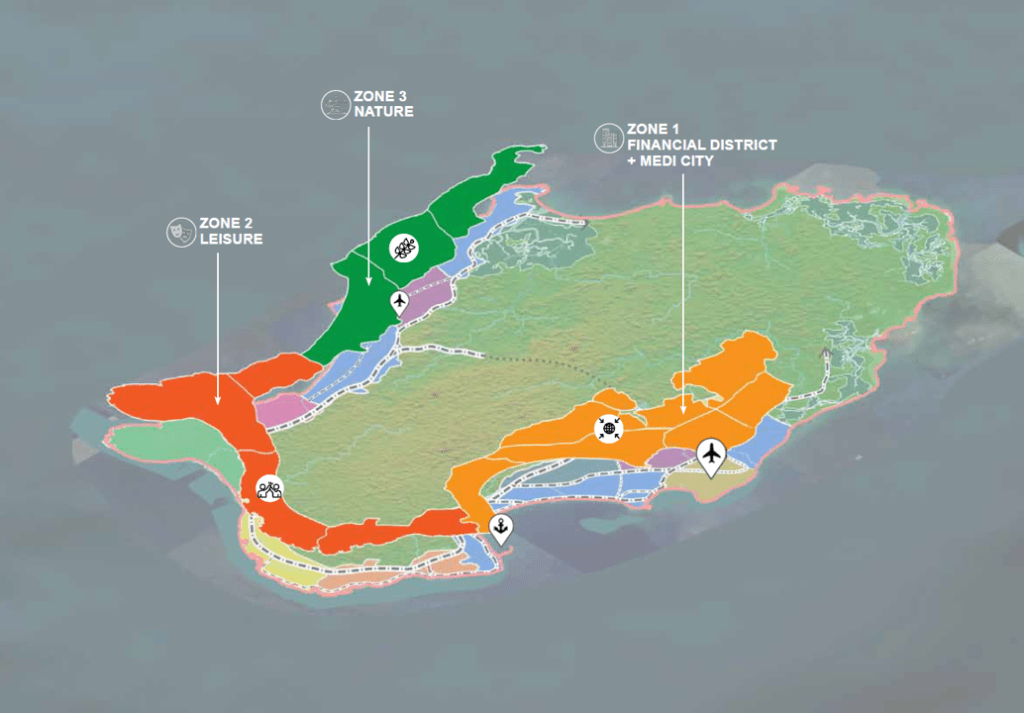
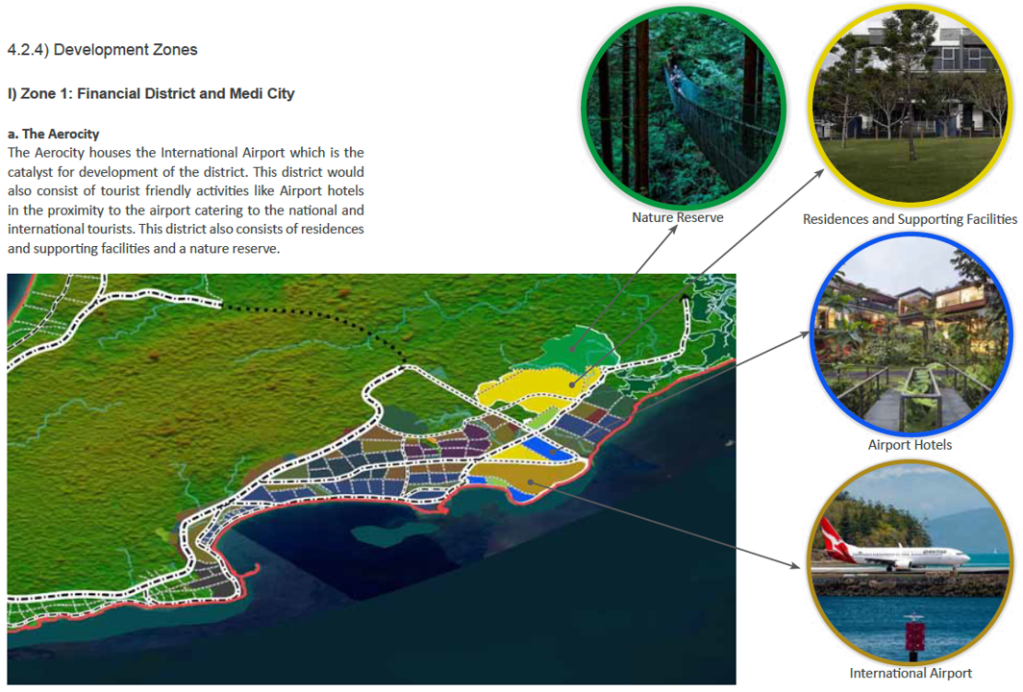
Airport development features heavily in a plan for tourism-oriented megaprojects on Little Andaman Island, the southernmost island of the Andaman archipelago. Graphics below, from the 58-page ‘Sustainable Development of Little Andaman Island – Vision Document’, show: Zone 1, on the eastern coast, featuring an Aerocity, housing an international airport, envisaged as ‘the catalyst for development of the district’; Zone 2, on the southern coast, including a Leisure Zone and Tourism SEZ (special economic zone) with casinos, theme park and beach hotels; Zone 3, on the western coast, a Nature Zone containing super-luxury resorts and hotels, with an airstrip for private charter flights.

  • Little Andaman plan
  • Little Andaman plan indicating 3 zones
  • Map of Zone 1 of Little Andaman plan. The Aerocity is the catalyst for developmen

Sudden news of the plan, in January 2021, alarmed conservationists. The ‘Vision Document’, thought to have been finalised a few months previously but not in the public domain, is included in ‘A MONUMENTAL FOLLY: NITI Aayog’s Development Plans for Great Nicobar Island (An evolving archive of reports, information and documents)’, compiled by Panjaj Sekhsaria and published by Kalvpavriksh Environmental Action Group. The total project area is nearly 240 sq km, 35% of the island; the three zones would take up 107 kilometres of the island’s coastline. Development of this scale would have major impacts on indigenous people and the island’s unique biodiversity and forests. Little Andaman is home to the Onge tribe, living on the island for more than 50,000 years, the population dwindling since 1900. Now numbering an estimated 125 people the Onge tribe is categorised as one of India’s Particularly Vulnerable Tribal Groups (PVTG). According to the plan the Onge Tribal Reserve would be reduced by 31%; the Vision Document states that steps would be taken to relocate and protect Onge people but no detail is given. An anthropologist pointed out that bringing areas where Onge, with nomadic origins, do not live into the proposed development would still impact them, saying “the Onges have a close attachment with their territory be it inhabited or not”.

The Divisional Forest Officer of Little Andaman raised concerns that the major diversion of forest land for the project would cause irreversible damage to the island’s forests, entailing the loss of more than 2 million trees. An official source said there are over 2.4 million trees in the “vast tract of forests” in the areas where development is proposed. Removal of trees would cause topsoil erosion and reduce rainfall, impacting on the small area of the island with cultivable soil. Uprooting more than 2 million trees for the Little Andaman plan would also result in carbon emissions and carbon stock losses. Carbon pools were calculated for the four forest types in the development areas: nearly 136 sq km of Evergreen/Semi Evergreen and smaller areas of Deciduous, Swamp/Mangrove and Plantation forests. A study estimated that implementation of the ‘Sustainable Development of Little Andaman – Vision Document’ would result in carbon stock loss of 2,996.286 tonnes from five categories of carbon pools: 55% from woody debris and soil organic matter, 32% from above ground living biomass, 9% from below ground biomass, 3% from dead mass of litter and 1% from dead wood.

Nesting sites of Giant Leatherback Turtles, the world’s largest turtles growing over 6 feet in length, with many populations in precipitous decline, are threatened by the Little Andaman plan. South Bay and West Bay on Little Andaman are both high-intensity nesting sites and among the most important in the entire island chain. Along with other nesting beaches on the islands, the two sites are specifically mentioned as ‘Important Marine Turtles Habitats in India’ in the National Marine Turtle Action Plan. There are fears that implementation of the ‘vision’ would push the leatherback turtles to the brink of extinction. A 2019 report on a long-term monitoring programme at Little Andaman island identified previously unknown migratory routes of Great Leatherback Turtle nesting in the region, highlighting their dependence upon foraging and nesting sites that are thousands of kilometres apart. Nine tracked turtles traversed much of the Indian Ocean, as far southeast as Western Australia and towards the eastern coast of Africa. The turtle travelling the furthest, close to the western coast of Mozambique, covered 13,237km in 266 days; it was also the fastest, travelling an average of 49.8km per day.

More information about the Little Andaman plan has been published on EJatlas, the world’s largest, most comprehensive online database of social conflict around environmental issues: Little Andaman Development Plan

Scientist group condemns detention and harassment of fisherfolk in Bulacan, seeks probe by CHR and DENR

national's avatarAGHAM - Advocates of Science and Technology for the People

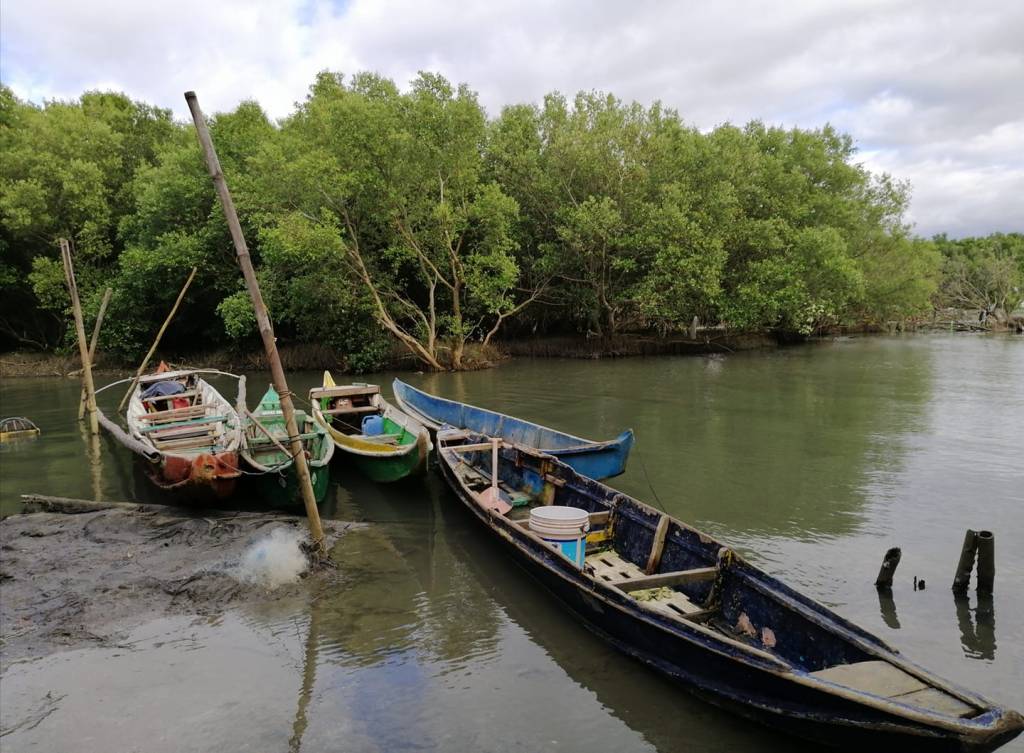
Photo: AKAP KA Manila Bay

AGHAM – Advocates of Science and Technology for the People vehemently condemns the detention and harassment of fisherfolk and youth in Malolos, Bulacan, and urges government agencies, in particular the Commission on Human Rights (CHR) and the Department of Environment and Natural Resources (DENR), to investigate human rights violations related to the construction of San Miguel Corporation’s 2,500-hectare New Manila International Airport (Bulacan Aerotropolis).

According to AKAP KA Manila Bay, two armed men detained around forty fisherfolk, including six minors, from Sitio Balot, Brgy. Pamarawan, Malolos, Bulacan around noon on October 29 [1]. The fisherfolk were brought to the military detachment in Sitio Dapdap, Brgy. Taliptip, Bulakan, Bulacan. The armed men threatened to destroy the fisherfolk’s boats if they wouldn’t come to the military detachment. Due to this incident, the fisherfolk were not able to catch fish that day and were not even allowed to…

View original post 335 more words

New Research: Airport projects responsible for human rights violations and ecological destruction around the world

Map of Airport-related Injustice and Resistance

Interactive map documents 80 cases of airport-related injustice and resistance

A new interactive map documents cases of airport-related injustice and resistance around the world. All across the globe airport projects are generating serious conflicts and social and environmental impacts: land acquisition, displacement of people, destruction of ecosystems, local pollution and health issues. A new map based on scientific research presents 80 cases as detailed examples of the conflicts generated by airport projects around the world. The research also identified more than 300 cases of airport projects where there is evidence of conflict, that merit further investigation. Research began in 2018 and has been jointly conducted by the EnvJustice project of the Environmental Science and Technology Institute at the Autonomous University of Barcelona (ICTA-UAB) and the Stay Grounded network. 

In many countries, airport planning, construction and expansion continues, in spite of the steep decline in air traffic since the beginning of the Covid-19 pandemic. All aviation expansion, wherever it takes place, contributes to the global problem of climate destruction. Aviation, being fossil fuel dependent and intensive, is a major and growing source of greenhouse gas emissions. By documenting a multitude of local struggles against airport projects the Map of Airport-related Injustice and Resistance contributes to a broad and diverse global movement for degrowth of aviation and transition to a just and sustainable mobility system.

Communities around the world struggle against eviction from their homes and farmland for aviation expansion, and to protect forests, wetlands and coastal ecosystems, our research shows. Our interactive feature map, the first of its kind, documents a multitude of airport-related injustices and inspirational resistance movements,” say Sara Mingorría of EnvJustice (ICTA-UAB) and Rose Bridger of Stay Grounded.

Many of the cases documented and analysed involve affected communities opposing  land acquisition for airport projects. In about half of those cases studied there were problems of land dispossession (50%) and displacement (47%). Many communities resisting displacement have suffered human rights violations and state repression: forced evictions, harassment, intimidation, arrests, imprisonment and violence. In around a third of the cases studied there were problems of repression (30%), militarization (29%) and the conflicts reached a high level of intensity (35.5%).

Site clearance for many airport projects also obliterates wildlife habitats and biodiversity. In 48 percent of the cases analyzed, problems of loss of landscape were registered, 41 percent involved deforestation impacts and 32 percent loss of biodiversity. 

The Map of Airport-Related Injustice and Resistance is a joint project by the EnvJustice (ICTA-UAB) and Stay Grounded. Information has been contributed by organizations, journalists, activists and academics. The research project is co-founded and coordinated by Rose Bridger (Stay Grounded/Global Anti-Aerotropolis Movement-GAAM/EnvJustice ICTA-UAB) and Sara Mingorría (Stay Grounded/EnvJustice ICTA-UAB); Yannick Deniau (Envjustice/GeoComunes) and Mira Kapfinger (Stay Grounded) joined the coordination team during the project. The 80 published cases are just the beginning of the mapping project. The research team anticipates that many more conflicts will be documented on the map as the project continues.

EJAtlas is an online database and interactive map documenting and cataloguing environmental conflict around the world. It started in 2011 and counted on the collaboration of hundreds of researchers and organizations. It is now coordinated by the ENVJUSTICE project at ICTA-UAB.

Stay Grounded is a network of more than 160 member organisations from all over the world, among them: NGOs, climate justice groups, indigenous organisations, labour unions and civil initiatives against airport noise and expansion. Together, they fight for climate justice and a fair reduction of aviation.

See the airport injustice cases on the Feature map

For more information see Voices from affected communities and overview of cases.

The FPDT Again Denounces the Intrusion of Machinery with Protection of the Army and Federal Police

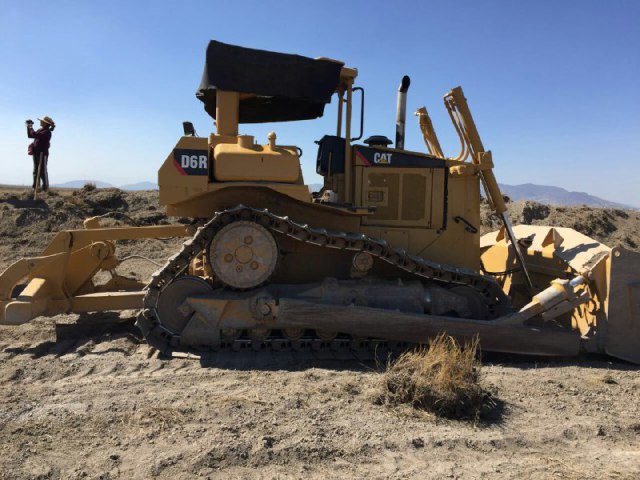
Bulldozers supported by a military tank and police entered communal Atenco farmland intent on constructing a highway for the new Mexico City Airport, violating the suspension of the project and the human rights of the inhabitants.

dorsetchiapassolidarity's avatardorset chiapas solidarity

.

The FPDT Again Denounces the Intrusion of Machinery with Protection of the Army and Federal Police

5

Today, January 22, crews of workers from the companies CIPSA and Pinfra entered the ejido of Atenco with two bulldozers intent on carrying out the construction of the highway Pirámides-Texcoco. With the protection of a military tank and federal police, the companies again violated the definitive suspension awarded against this project that is part of the new airport of Mexico City. This took place one day after sharing testimony of human rights violations against members of the FDPT and of the habitants of the communities on the Eastern shore of Lake Texcoco with a special reporter of the UN.

The ejido members and habitants of the communities went to the place of intrusion to demand the fulfilment of the suspension and the respect of their human rights. They talked with the workers to…

View original post 134 more words

Welcome to La ZAD

Buzz Tour's avatarBuzz tour

The ZAD (Zone A Defendre or Zone to Defend) in France is variously described as an occupation, a no-go area of radical militants, a resistance community, and the proposed second airport for Nantes.  During my first visit to La ZAD I explored some of the reasons that people have made this beautiful place their home.

Cycling or driving into La ZAD you may be unaware that you have entered it but after a time you may come to a signpost which no longer has a place name, but instead has ‘ZAD’ spray painted pointing in each direction. Or you may come across a road with artistic barricades, a burnt out car with plants growing through it, or damaged tarmac. Whilst now, all is peaceful farmland, gardens and communities of hand-built houses, it’s clear that something big happened here a few years ago. If you want to orientate yourself and begin to explore this special…

View original post 420 more words

Defending the zad: A new little book about the struggle against an airport and its world.

A book written by some of the occupants of the ZAD (Zone a Défendre) – a site in Western France which has been occupied for over 9 years – in resistance against the construction of the planned Notre-Dame-des-Landes airport. Over 5,000 acres of farmland and wetladns would be destroyed. Evictions and mass protests are documented, and the sustained solidarity which has held the ZAD together for so many years. The ZAD is a ray of hope in the resistance against destructive megaprojects.

Concerns over Bhogapuram aerotropolis plan

This article was written by advocate Jogi Naidu KV Allu. It is an insightful and informative summary of key concerns over the planned aerotropolis at Bhogapuram, in the district of Vizianagaram, Andhra Pradesh. GAAM is very grateful for his contribution:

Proposed Green Field Airport in 15000 acres of ‘agriculture land’ at Bhogapuram, Vizianagaram District, Andhra Pradesh, India.

1. The project would wipe out approximately 10,000 families property, livelihood causing huge displacement.

2. The distance between the proposed Project and existing Visakhapatnam Airport is less than 25 nautical miles and is against all established norms. There should be a minimum of 150 nautical miles distance between any two airports.

3. The project would effect environment and cause ecological imbalance in the area. “Champavathi River” runs in the area.

4. The project directly effects fishermen villages who depend on both the agriculture holdings and also on the sea. Their life cycles are directly related to location. Displacing them would only nullify their fundamental rights under the constitution of India.

5. Right to property could be deprived only by authority of Law and the relevant Law for land Acquisition is the Right to Fair Compensation and Transparency in Land Acquisition, Rehabilitation and Resettlement Act, 2013. BUT the Government of Andhra Pradesh is adopting a novel unconstitutional method “Land Pooling” to avoid the implementation of 2013 Act. In other words, the Government is trying to take land without spending a single rupee.

6. There was or is NO DEMAND made by anyone from any quarter for the proposed airport at Bhogapuram.

7. The real requirement for an airport is between Viziawada and Nellore. Whereas, the Government is unnecessarily proposing airport in a region where there are five air strips in a distance of 300 KM range.

8. The existing Visakhapatnam Airport is operating at below 50% of its capacity and could take air traffic for another Twenty years. Moreover, Government has invested more than Rs.200 crores for its expansion and there is scope for further expansion with additional runway and new terminal.

9. The Government of India may think of establishing a New Airport between existing Visakhapatnam Airport and Bubaneswar Airport in Odisha. 10. The requirement of 15000 acres of Land for Green Field Airport itself stinks of interests and motives beyond establishing a mere airport. All concerned with good governance, environment, human rights and constitutional propriety should closely examine the developments of this proposed Green Field Airport at Bhogapuram.

A.K.V.JOGI NAIDU ADVOCATE

The map below includes the fertile farmland area where the aerotropolis is planned. An article in the Times of India states that the government plans to acquire land from the following villages: A Ravivalasa, Gudepuvalasa, Chepalakancheru, Kouluwada, Tudem, Basavapalli, Mujeru, Chakivalasa, Kongavanipalem, and part of Bhogapuram village. I assume ‘Mujeru’ is misspelled and actually the village of Munjeru. Amatam Ravivalasa, Gudepuvalasa, Munjeru, Chakivalasa, Kongavanipalem can be seen on the map.