Following an armed attack on Diori Hamani International Airport and an adjacent military base a massive operation to evict about 26,000 people from four surrounding neighbourhoods began.
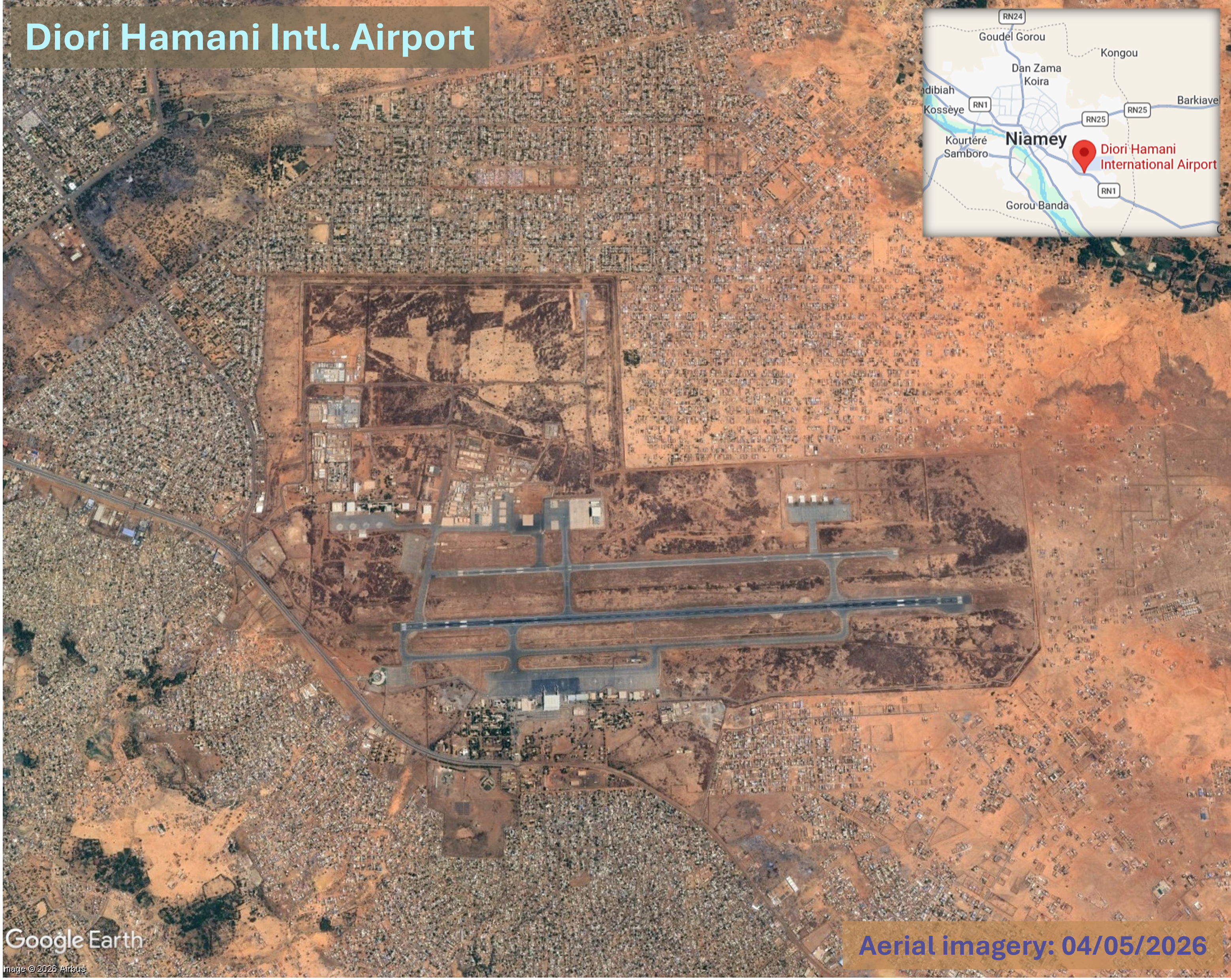
On 31st May 2026 authorities in Niamey, the capital city of Niger, began a massive operation to evict about 26,000 people living in four neighbourhoods – Mutram, Alpha Djadi, Extension Alpha Djadi and Extension Kobontafa – surrounding Diori Hamani International Airport. Residents in the path of demolition machinery dismantled their homes, salvaging iron roofing and other materials. The eviction began without informing them about financial compensation. Nigerien authorities claimed the demolition exercise was necessary, to remove obstacles posing risks for aviation safety and because the settlements are a threat to national security. The airport and Base Aérienne 101, part of the same complex and just 10 kilometres from the presidential palace, are of strategic importance to Niger’s security architecture, hosting important military installations and the headquarters of the Niger, Burkina Faso and Mali Joint Force. Security concerns were heightened in the aftermath of the militant attack on the airport and airbase that occurred on the night of 28-29th January 2026. Nigerien forces killed 20 assailants, four soldiers were wounded and damage to three aircraft was reported. Islamic State (IS) claimed responsibility for the attack; President General Abdourahamane Tchiani said the attack was an infiltration attempt by ‘mercenaries’ and alleged that the assailants had been directed by external influences.
Residents had only received three and a half weeks’ notice of the impending eviction, several property owners had requested an extension of the notice period before demolitions began, but authorities refused. At a 7th May press briefing the governor of the Niamey region, Major General Assoumane Abdou Harouna, said, “The presence of illegal homes near the airport is not only a factor of congestion but also a serious threat to national security.” Many residents disputed claims by authorities that their settlements are illegal, saying that their acquisition of the land from developers was legitimate, that they have documentation and have invested significant funds to build their homes. The four affected areas occupy 19 per cent of land title No. 784 which was assigned to the Agency for Aerial Navigation Safety in Africa and Madagascar (ASECNA) in 1953. Moves to evict people from the area date back many years, a deadline for eviction of occupants on the land had been set for 5th May 2013 but the plan was not executed. Authorities executing the current mass eviction have acknowledged that there are ‘legitimate victims’ who purchased plots of land in good faith,
On 4th June African Insider reported that thousands of homes were being razed, predominantly to the east of the airport, with evicted people loading furniture and other possessions onto cars and tricycles. Transport and Aviation Minister, colonel Amados Abdramane said this was the area where attacker came from and that it was “occupied in an anarchic way”. Interior Minister, general Mohamed Toumba, said he feared “a new terrorist infiltration through those neighbourhoods” and that lack of security might cause international authorities to downgrade the airport. A civil society figure said, “Forcing 26,000 people to leave is the equivalent of a small town”, adding, “Even if the operations is considered ‘necessary’, whatever the reason, Nigerien law and international standards require strict support measures. Without that, it becomes a forced and inhuman eviction.” A political analyst said, “The government should have taken the social aspect into account and made appropriate arrangements to rehouse those concerned before demolishing the homes they had acquired over many years. Social justice is a demand of the sovereign people.”
Authorities had promised to compensate affected people but on 10th June it was reported that residents had been neither rehoused nor compensated. Justice Minister Alio Daouda said, “The State cannot leave people in the streets” but claimed that the sudden demolitions were necessitated by “security imperatives that cannot wait”. On 16th June 2026 the affected residents’ legal representative, Maître Idrissa Tchernaka, held a press conference in response to the Justice Minister’s announcement that all displaced households would be allocated a new plot of land and receive compensation according to the size and value of the properties they had lost. He said his clients welcomed the authorities’ willingness to provide redress for their abrupt displacement but that their acceptance depended on fair and transparent valuation of their property. Residents welcomed the promise of resettlement but expressed concerns over possible bureaucratic delays and called for the land allocation process to be expedited.
Following the 28th-29th January attack the airport perimeter fence was extended and more than 350 security cameras installed inside and outside of the perimeter. On the morning of 18th June 2026 a second armed attack on Diori Hamani International Airport and the military base took place. Gunshots and explosions were first heard at 5am and continued for several hours. In the afternoon a lock down was imposed with security forces searching vehicles entering and leaving the airport vicinity. The Ministry of Defence stated that 35 people were killed in the attack: 22 assailants, eleven soldiers and two civilians. Al-Qaeda affiliate Jama’at Nusrat al-Islam wal-Muslimin (JNIM) claimed responsibility for the attack and the defence ministry placed the blame on ‘armed mercenaries’ sponsored by France.

