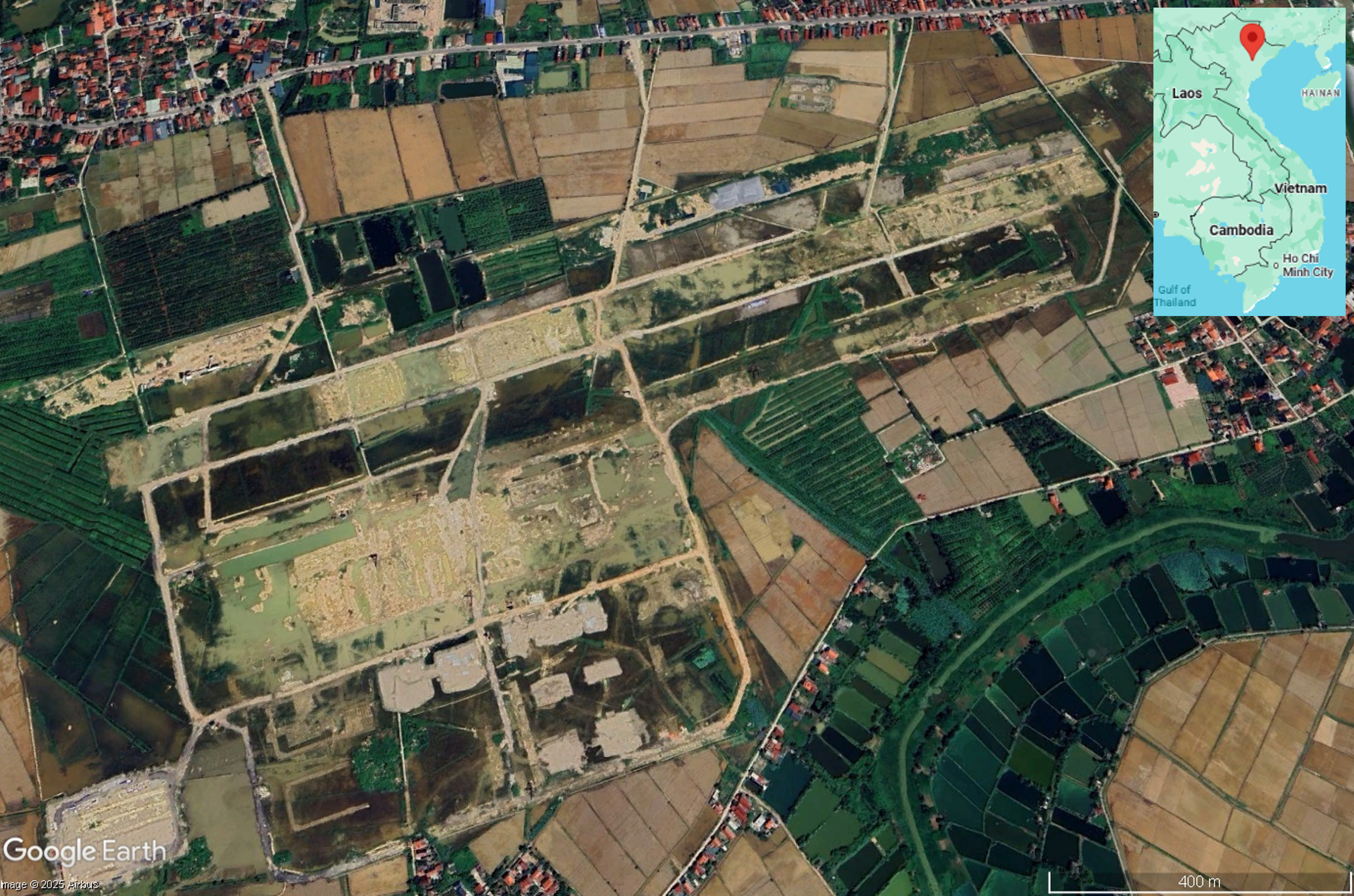
Land clearance for and construction of Gia Binh Airport, accelerated for APEC 2027, is displacing thousands of households. Delays in providing replacement housing or compensation have caused difficulties for many of the residents forced to leave their homes. An airport city development surrounding the new airport, the ‘southern Duong River urban area’, is planned.

Land clearance and construction of Gia Binh AIrport, about 40 kilometres east of Hanoi in a rural area of Vietnam’s Bac Ninh province, are underway. A mega-airport is planned with four runways arranged in two pairs, handling 30 million passengers and 1.6 million tonnes of cargo per year by 2030 increasing to 50 million passengers per year and 2.5 million tonnes of cargo by 2050. The total investment is estimated at VND196,378 trillion (USD7.5 billion). A vast swath of productive farmland is being sacrificed for the new airport. Land allocated for the Gia Binh Airport site, in the communes of Gia Ginh, Luong Tai, Nhan Thang and Lam Thao, encompasses about 1,184.78 hectares of agricultural land, including about 920 hectares of rice fields yielding two crops per year. The site also comprises 415 hectares of non-agricultural land, 159.4 hectares of residential land and 124.8 hectares of land utilised for defence and security purposes. Preparation of the airport project site has triggered one of the largest land clearances in Vietnam’s recent history, affecting approximately 7,100 households and individuals and 118 organisations; about 5,800 households and individuals are being relocated. By 25th December 2025 almost 600 hectares of land had been cleared and land registration for 6,309 households within the project area was complete. The Bac Ninh province had advanced over VND2,700 billion (USD102.5 million) to pay compensation to about 5,000 households. Plans for a second phase of compensation were progressing with a further VND1,102 billion (USD41.8 million) in payments for approximately 360 hectares of agricultural land. An inventory of religious structures and tombs had identified 17,800 graves within the project area to be relocated, but the process was complexified by the many unique buildings including churches, temples and communal houses with a higher value than the price framework and therefore requiring specific estimates.
Acceleration for APEC 2027
As well as a major passenger and cargo hub Gia Binh Airport is being built as strategic infrastructure to host major diplomatic events, beginning with the APEC (Asia-Pacific Economic Cooperation) 2027 Leaders’ Week gathering of high level officials, to be hosted by Vietnam and scheduled for November 2027. Construction of key components of Gia Binh Airport has been accelerated for APEC 2027, even though the primary event venues are on Phu Quoc island, 15 kilometres off the coast of Cambodia in the Gulf of Thailand. On 7th March 2026, nearing the end of his term, Prime Minister Pham Minh Chinh visited the Gia Binh Airport project and directed stakeholders to develop the site as an “airport economic ecosystem”. He stated that the airport will be a dual-use (civilian and military) facility, stressing the importance of completion in time for APEC 2027 Leaders’ Week, and was briefed on the progress of construction of the VIP terminal. By 19th March pile driving and removal of topsoil for the VIP area was complete and foundation works were underway. Authorities had handed over 1,259.45 hectares, 66.82% of the 1,883.93 hectare required land area, and relocation of 4,761 graves was expedited. But land clearance of about 1,260 households, scheduled to be complete by 30th April, was highlighted as the ‘most significant bottleneck’ impeding the expedited construction programme.
Land clearance for a road network
Development of road networks serving the airport, involving land clearance for wide corridors to accommodate multiple lanes, has been accelerated for APEC 2027. The total investment for a 41.3 kilometre road connecting Gia Binh Airport with Hanoi, linking directly with several major arterial roads, including intercity expressways, is estimated at VND83 trillion (USD3.165 billion). People in the Thuan Thanh, Tram Lo, Tri Qua and Mao Dien wards are being resettled to make way for the Gia Binh Airport – Hanoi road and a resettlement site is being urgently constructed in Lam Thao commune southwest of the airport site. By 24th July 2026 304 out of 412 hectares of land in Bac Ninh had been cleared for the 10-lane, 120 metres wide road which is expected to open in October 2026, in time to serve APEC 2027. Rapid advancement of the Bac Ninh segments of the Ring Road No. 4 project linking Hanoi with satellite urban centres and northern industrial zones, was reported in My 2026. Clearance of agricultural and residential land within the 90-metre corridor for one component of Ring Road No. 4 was complete along with most of the infrastructure for nine resettlement areas, with excavation and embankment filling works for another component ongoing. Clearance of over 82 hectares for the direct access road was complete and resettlement schemes had been expedited.

Displacement difficulties
In early June Bac Ninh Catholic communities voiced concerns over displacement for Gia Binh Airport. Bishop Joseph Đỗ Quang Khang said he had seen “many families forced to live in temporary housing, facing compounded difficulties over shelter, work, schooling, faith life, and daily activities”. One affected resident wrote on the Diocese’s website “The image of excavators tearing down homes within the planning area of a major national project is striking. Walls collapse. Tiled roofs are stripped away. Belongings are loaded onto trucks. Trucks operate nonstop”. Another resident commented on the previous view of graves and crosses around the parish church abruptly replaced by ‘deep trenches gouged into the earth, overturned patches of land, and fresh marks left by excavators and bulldozers’. A woman representing the Sisters of Our Lady of Unity said their charity home was affected by low valuation of agricultural land and was uncertain where the sisters and 40 disabled children could relocate to. During land clearing operations on 13th June 2026 17 graves in Ngọc Xuyên village were illegally levelled and affected families were pressured to accept the compensation offer and sign a pledge not to file complaints.
Residents forced to dismantle homes
A 24th June 2026 communication from the Bac Ninh province required residents to dismantle their homes and relocate with just a few hours notice, by 4pm that same day. The notice stated that land in four villages – Ngô Thôn, Mỹ Thôn, Lương Pháp, and Thủ Pháp – had been officially handed over to the investor on 20th June but some residents were still dismantling their homes. The following day a preliminary review on land clearance for the airport reported that 1,400 households in the four villages had been relocated in just 38 days. Since late May hundreds of households had been forced to dismantle their homes and move into temporary housing but authorities had not yet constructed resettlement areas nor provided reasonable compensation for affected people. A Bac Ninh province announcement on Facebook met with more than 2,000 reactions, about half of which were ‘haha’ and ‘angry’, and over 600 comments expressing frustration. Residents also posted critical comments in response to Bac Ninh news outlet videos praising the relocation process and claiming it was a ‘high consensus’ exercise. Several residents expressed their difficulties related to the airport at a dialogue meeting held on 3rd July. Their families had received eviction notices instructing them to relocate before 30th August but temporary housing had not yet been organised for them.
Relocation and resettlement delays
One resident spoke of her loss of trust as she had been assured she would not be forced to move again before the resettlement area with permanent replacement housing was ready. Acting on this information she had not rented a house and the only places still available were very small and expensive. She was worried that being forced to vacate by 30th August would push her out onto the street. Another resident with three children had found temporary relocation “extremely difficult and exhausting” and said it would be impossible for more than 500 households in Tử Nê and nearby villages to relocate under the current process. A Phú Dưới village resident said there was not yet official notice of the date by which their family would be required to leave. The Gia Bình Commune Party Committee issued a document stating that relocation of assets must be completed by 20th July in the Đồng Lâm and Quỳnh Bội residential areas and by 20th August in the Đỗ Xá residential area.
‘High consensus’ claims
Interviews conducted by Luật Khoa Magazine contradicted government claims of ‘high consensus’ with the relocation process. A man from Quỳnh Bội village said, “People now have no voice. We have to follow along. How can we resist? If anyone refuses to move, they just impose it.” In the villages of Tử Nê, Bái Giang, and Hương La the relocation deadline was fast approaching but residents reported a lack of preparation. A woman from Tử Nê village said, “Officials say we have to move by Aug. 30, but there is no resettlement yet. We have not received anything.” On 3rd August 2026, for the second time, Gia Binh Commune authorities threatened to disconnect residents’ water, electricity and telecommunications if they did not comply with instructions to leave their homes and had over the site to the investor. A resident of Trại Quỳnh Bội, regretful at the loss of a house built by his family only three years previously, said “The government says electricity will be cut on Aug. 15 if we don’t move. Without moving, what would we live on?” He said he had not received compensation or been notified of land for resettlement and might need to ask friends or neighbours if they could provide land or shelter for temporary accommodation.
‘Fake news’ crackdown
Authorities reacted to increased scrutiny and criticism of the Gia Binh Airport project with a repressive crackdown, penalising people for spreading so-called ‘fake news’. According to research by Luật Khoa Magazine since works on the airport began in September 2025 dozens of people accused of disseminating ‘fake news’ have been warned, sanctioned or ‘educated’. Severe measures included police visiting people in their own homes to monitor their opinions and pressuring people to write pledges stating compliance with regulations. One of the key responsibilities of a committee tasked with ‘ensuring security’ and maintaining the airport project schedule is to prevent articles and comments deemed to be ‘negative’ or ‘affecting public opinion and communication efforts’ regarding land clearance for the airport.


A 12,800 hectare airport city
Vast urban areas surrounding Gia Binh Airport runways and other aviation facilities have been approved. Planning at a scale of 1/2,000 for the ‘southern Duong River urban area’, a zone covering more than 12,800 hectares described as an ‘international-class airport city’ was approved by the Bac Ninh province in September 2025. On his 7th March 2026 airport site visit the then Prime Minister Pham Minh Chinh directed stakeholders to develop the site as an “airport economic ecosystem” and to plan surrounding areas as an aviation economy. The urban area is envisaged to include a free-trade zone, duty free zone, multimodal logistics zone, inland port, conference and exhibition centre, offices, hotels and housing. With a high-density layout a population of between 750,000 and 800,000 people – permanent residents, workers and tourists – is anticipated. Plans for segments of the airport-related urban area, in the Gia Binh, Nhan Thang and Dong Cuu communes, are advancing. The ‘Gia Binh Airport urban area 1’ project, a VND39.52 trillion (USD1.51 billion) urban development covering about 200.8 hectares of land and expected to accommodate about 35,637 residents has been approved along with detailed 1/500 scale planning for ‘Gia Binh Airport Urban Area 2‘, encompassing about 560.5 hectares with an expected population of 70,000-80,000 people. Plans for a 5,000 hectare free trade zone linked to Gia Binh Airport, intending to create a ‘new growth engine for the region’, a ‘gateway connecting Vietnam to global markets’ and a ‘regional trade hub’, were adopted in June 2026.