Government plans to convert Mezzeh Airport into a hub for private aviation sparked protest over land expropriation dating back many decades and suspicions of mass graves on the site. An “aviation community” surrounding the airport, with hotels, business premises, residential development and commercial complexes, is planned.
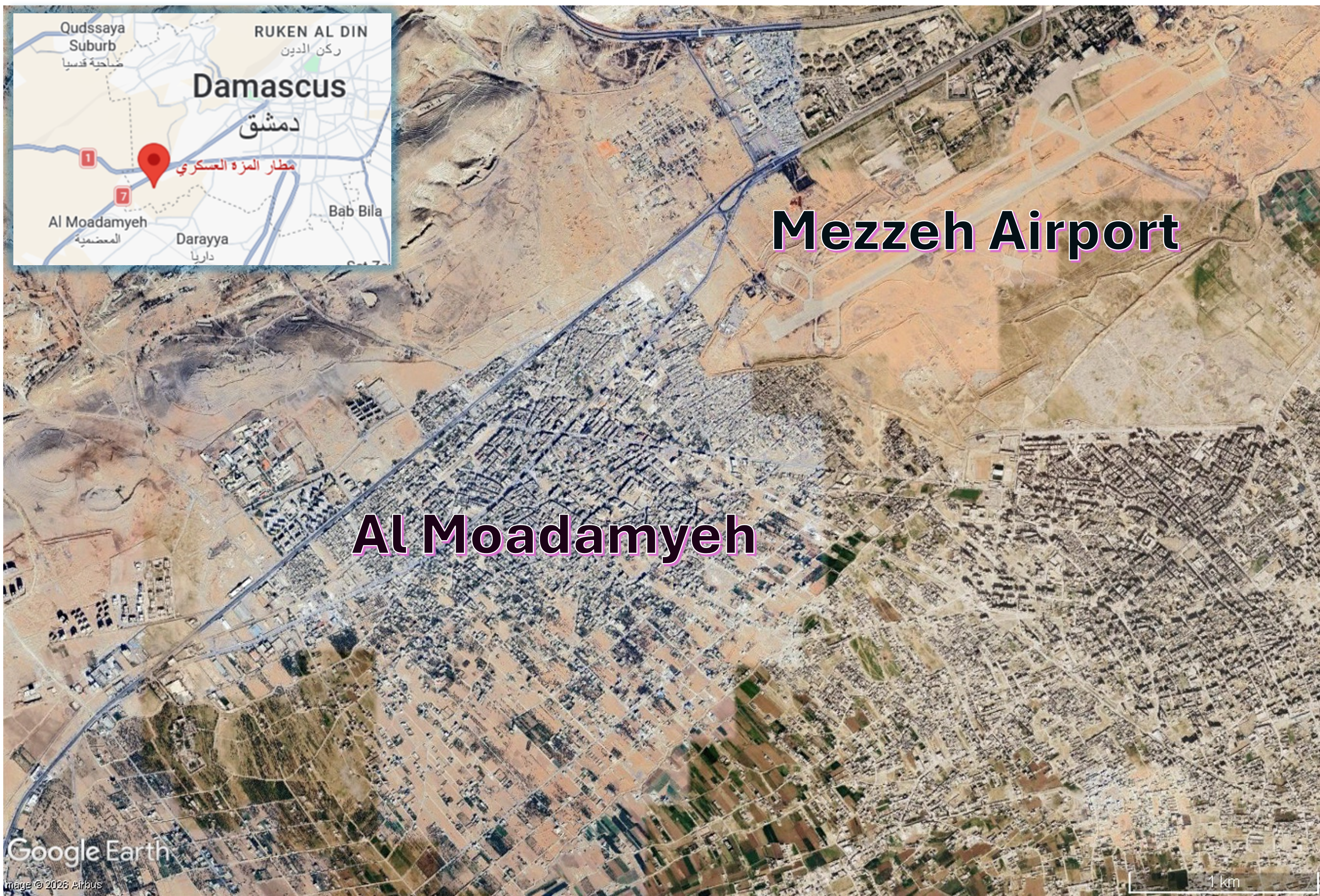
On 1tth September 2026 dozens of residents of Muadamiyat al-Sham (also known as Moadamyeh), al-Sabboura, Qudsaya, and the Kiwan area of Rural Damascus, a province surrounding Syria’s capital city, gathered to demand repeal of expropriation laws and resolution of the status of land that has been confiscated by successive governments over many decades. The protest was triggered by government plans to convert Mezzeh Airport, a military air base less than 8km southeast of Central Damascus and immediately northeast of the town and agricultural lands of Moadamyeh, into a hub for private aviation. The General Authority of Civil Aviation (GACA) had announced preparations to reclassify the airport as a civilian facility focused on private and executive aviation; removal of debris and infrastructure works on the site had already begun. Protesters expressed concerns that their land ownership rights would be disregarded and suspicions that there are mass graves within the airport site which could be disturbed by construction works, destroying evidence needed for identification of victims. A protest organiser said that residents possess documents proving their rights to the land. Land records issued by the Muadamiyat al-Sham municipality indicated that Mezzeh Airport had been built on about 276 hectares of land belonging to hundreds of citizens. Moadamyeh resident and real estate expert Moataz Sawan said the Mezzeh Airport land is part of a wider pattern of expropriation for military and government purposes, with up to 85% of the town’s 4,450 hectares seized since the 1970s. He said the original landowners of the Mezzeh Airport site did not receive fair compensation and Syrian law stipulates return of expropriated land to its original owners if the designated public purpose ceases or changes.
A specialised commercial and investment hub
A few days before the protests, announcing the reclassification and development of Mezzeh Airport, Mustafa Khairallah, head of the GACA media department, made various assurances regarding the impacts and purpose of the project. He said the surrounding environment, noise levels, air traffic levels and various related legal and community issues would be considered and that the project intended to serve the public interest, developing the country’s civil aviation system according to approved standards and recommended practices. GACA president Omar Hosari said the project aimed to diversity Syria’s aviation services and create a specialised commercial and investment hub, based on a vision balancing economic, social and environmental considerations. He said the private aviation model had been implemented in many other countries in the region, highlighting Dubai Executive Airport, the dedicated private jet facility at Al Maktoum International Airport, also known as Dubai World Central (DWC). According to Oman Hosari, the Mezzeh Airport development project extends beyond aviation supporting facilities; it is the focal point and initial stage of a bigger project referred to as an “aviation community” including hotels, business facilities, aviation training institutes, residential development and commercial complexes surrounding the airport. An “aviation community” sounds inclusive but a hub for private jet owners and users, with its no doubt luxurious terminal, hotels and shopping malls, will be an inherently exclusive development, reserved for a privileged elite. Luxury private jet facilities are totally inappropriate when so many citizens lack essentials including clean water, adequate shelter and energy. The proportion of people living in poverty increased from 33% before the conflict to 90% in 2025, while extreme poverty rose six-fold from 11% to 66%. Development around the airport, providing a foothold for investors amid heightened land expropriation grievances, risks exacerbating social fragmentation.
Expansion of Damascus International Airport
Authorities have stated that development of Mezzeh Airport will complement and reduce operational pressures on Damascus International Airport, Syria’s main airport located about 25km southeast of central Damascus. Yet major, fast-paced expansion of Damascus International Airport is underway. In November 2025 the General Authority of Civil Aviation and the government signed final concession contracts for development, construction and operation of the airport with a consortium led by UCC Holding of Qatar with participation of Cengiz İnşaat and Kalyon İnşaat of Turkey, and Assets Investments of the United States. Implementation of the project had already begun including construction of a second terminal. Valued at USD4 billion, the airport project is one of the largest investments in the country’s history. Completion of Terminal 2 and redevelopment of Terminal 1, scheduled for completion by the end of 2026, will increase Damascus International Airport’s passenger capacity to 6 million annually. While this would be a more than fourfold increase compared to the 1,392,699 passengers handled in 2025 it is only 500,000 more than the airport’s highest recorded passenger numbers, 5.5 million, in 2010, the year before the civil war began. Subsequent stages of expansion entail major capacity increases. The first phase of a a third terminal, aircraft stands, cargo centres, logistics facilities and commercial infrastructure intends to raise passenger capacity to 16 million per annum. Upon completion of Terminal 3, plus a duty-free zone and catering outlets, the final capacity is anticipated to reach 31 million annually. A five-star hotel adjacent to the airport will have 200 premium rooms. The project portfolio of the Damascus Airport hotel architect, H’Collective, includes various luxury beachfront hotels and residences, a palace in Paris Saint-German and Ithaafushi Private Island in the Maldives. As with Mezzeh Airport, development of Damascus International Airport is hardly a recipe for social cohesion.

