The Vaal Aerotropolis site encompasses a large area of farmland. Two runways, two terminals, an Airport City, solar farm and ‘vast agri-zones’ for air exports of agricultural produce and live animals are planned. Project partners view designation as, or inclusion within, a special economic zone (SEZ) as essential for attracting investors.
A multi-decade aerotropolis project
In April 2026, South Africa’s Department of Trade, Industry and Competition (dtic) announced public consultations, allowing comments and input from the local community, on designation of the Vaal Special Economic Zone (SEZ). Led by the Gauteng Growth and Development Agency (GGDA) the initiative includes a smart city and a new international airport, all to be supported by a ‘new “aerotropolis” – an industry term referring to an economic zone built around a major airport’. It was stated that the airport will be ‘supported by an extensive road network’ including direct access to the N1 highway, which is to the west of the site, so only a 50-minute journey from central Johannesburg. Nearly three years previously, in May 2023 Citibank South Africa, a subsidiary of US-based financial holding company Citigroup Inc., announced its investment in a ‘multi-decade aerotropolis project’ in the Vaal area, pledging R1.375 billion (USD84 million) having already applied for rezoning of the proposed development area into a special economic zone (SEZ). At an event held with dtic, Citibank SA’s Chief Country Officer Peter Taylor addressed the media, saying, “This is a massive infrastructure project. The timing of the airport itself will depend on a few things: the zoning, the licensing, the authority for the port etc. But a lot of work has gone into this. A lot of those [things] are being finalised. We are making an application for a an SEZ (special economic zone), which will encompass this area that the airport will be built in.”
Vaal AeroZone
Citibank SA is a major investor in Vaal AeroZone, the developer of Vaal Aerotropolis. Other partners in the Public Private Partnership (PPP) are the dtic, Gauteng Provincial Government, Sedibeng District Municipality, Emfuleni Local Municipality, PAPE Funds and Vaal Aerotropolis Design. The text at the top of the website home page reads like advertising for a particularly high-end VIP terminal: ‘VAAL AEROTROPOLIS: Pioneering a Sustainable Future for Travel and Innovation. Experience the future of luxury travel and innovation, where seamless connectivity meets sustainable opulence, shaping a world of refined possibilities.’ Yet in spite of the projected high passenger numbers, an initial capacity of 7.2 million per year (significantly higher than King Shaka Airport, the country’s third busiest airport handling just over 5.6 million passengers in 2025-26), the emphasis of the Vaal Airport project is on air cargo, ‘Vaal Aerotropolis will be the only airport in Gauteng where integrated air cargo services are designed and planned as a priority’, with initial capacity to handle 150,000 tonnes per year. Small blocks of text about development of a trade and logistics hub are packed with hype and superlatives: ‘VAAL AEROZONE: SHAPING THE FUTURE OF GLOBAL TRADE, Driving innovation, investment, and sustainable growth in the Sedibeng District’, ‘VAAL AEROTROPOLIS: A GATEWAY TO GLOBAL TRADE, Transforming the Sedibeng District into a world-class trade and logistics hub’. ‘A catalyst for economic transformation’. Green claims are prominent in the ‘AFRICA’S PREMIER GREEN AEROTROPOLIS’ and ‘CUTTING EDGE GREEN AIRPORT CITY’ sections. A timeline begins with inception of the project in 2020 and extends through to Phase 3 development commencing in 2068. A ‘GLIMPSE INTO THE FUTURE’ gallery consists of three computer generated graphics of generic airport buildings.
A video manifestation
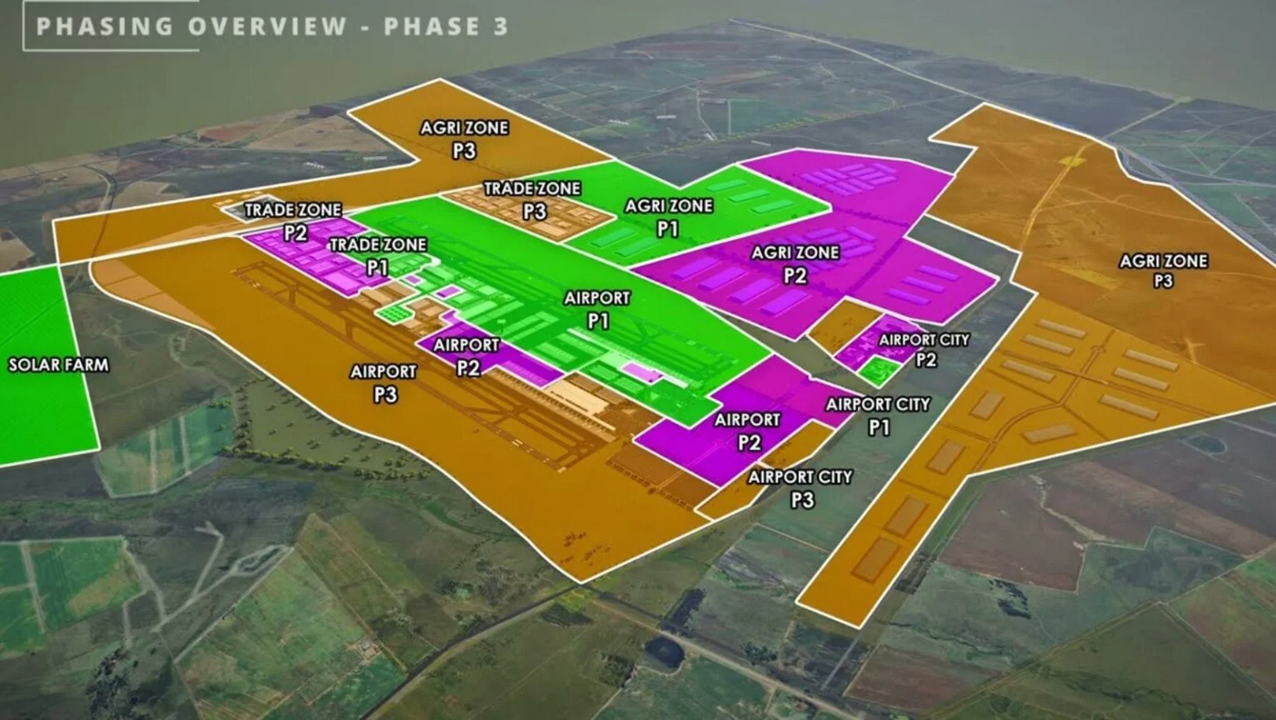
The AI generated voiceover of a promotional video, Vaal Aerotropolis: A Gateway to Global Trade. published on 18th November 2024, refers to the components of the project – Airport, Airport City, Agri Zone, Trade Zone and Solar Farm – as if they already exist or are inevitable; the word ‘will’ occurs eleven times. Graphics show development of Vaal Aerotropolis in three phases. The project, with two terminals, two runways, supported by the existing road and rail network along with future upgrades and interchanges, is called ‘a gateway to the continent’, ‘a lush aviation oasis’. A ‘great passenger experience’ is promised and ‘Vaal Airport City, one of the first purpose-built aviation cities in Africa’ sounds like a high-end development, with ‘fully serviced premium offices, retail, hospitality, medical and leisure spaces in an urban, minimum 4-star green rating’. But the envisaged facilities for passengers are dwarfed by plans for a 1,000-hectare solar farm and ‘vast agri-zones’ for ‘production of agricultural products amenable for transport by air.’ Enormous volumes of air exports of farm produce are anticipated, ‘This hi-tech agri-cluster is the largest climate controlled growing area on the continent, an integrated perishable supply chain’ (perishable air cargo is produce requiring a temperature-controlled cold-chain such as fruit, vegetables, meat, fish and flowers). Apparently, herds of livestock will be boarding flights, departing from ‘the first live animal holding area for transport by air in South Africa’.
Up to R200 billion investment, ‘pie in the sky insanity’
In December 2024, after delivering the Medium-Term Budget Policy Statement speech in which the grandiose Vaal Aerotropolis scheme was not even mentioned, Gauteng Member of the Executive Council (MEC) of Finance and Economic Development, Lebogang Maile, told SABC News, “We’ve got a new airport coming in Sedibeng which will see, I think, investment of anything between R20bn and R200bn from the private sector. In fact, it’s about R200bn, and we will be working with DTIC [Department of Trade, Industry and Competition] investing in bulk for that project”. This statement met with scepticism in a Moneyweb article ridiculing the project as ‘pie-in-the-sky insanity‘, deeming the maximum cost estimate of R200bn (USD 12 billion) ‘impossible’ when construction of King Shaka Airport in 2007-2009 had cost R6.8 billion, equivalent to R17 billion in 2024. The aim to handle 27 million passengers per year seems unrealistic; it is not clear who this vast capacity might serve with the entire population of Sedibeng amounting to just over 1 million people. The projected level of demand looks improbable as Gauteng has several underutilised airports. A notable example is Lanseria Airport, northwest of Johannesburg, which has capacity for about 4.5 million passenger per year, but was, at this juncture, only used by one commercial carrier, Flysafair, operating up to nine daily flights. The cost estimate for major expansion plans for OR Tambo Airport, including a a new passenger terminal and phase one of a new cargo terminal accommodating 650,000 tonnes of cargo per year, was estimated at R21 billion, a fraction of the possible R200 billion figure for Vaal Aerotropolis. And there is already a programme to establish another aerotropolis a mere 70km away, next to OR Tambo Airport in Ekurhuleni.
Infrastructural instability
Sedibeng’s crumbling infrastructure, leading to widespread failures in provision of basic services, casts further doubts on the feasibility of the vast, technologically advanced Vaal Aerotropolis. Major highways, including the N1 adjacent to the project site, are ‘decent’ but the wider road network is ageing. Potholes are ‘ubiquitous’. Waste management is poor leaving the landscape littered with ‘festering rubbish dumps’. The electricity supply is unstable. The situation is particularly serious iin Emfuleni, making provision of the requisite ‘infrastructural backbone’ for an aerotropolis seem like a ‘flight of fancy’. If it is constructed there is considerable risk of it becoming a ‘very large, very expensive white elephant’. The vision of handling 45 million passengers per year upon completion seems fantastical when compared to the 21 million handled by OR Tambo, South Africa’s largest and busiest airport. Community members attending a Vaal SEZ engagement held In Vereeniging town hall on 15th April 2026 raised concerns over Emfuleni’s dilapidated infrastructure, including unreliable water and electricity supplies, and how this undermines the credibility of a drive to attract investors to the municipality. The April 2026 cancellation of the licence for Vereeniging Airport, just 17 kilometres east of the Vaal Aerotropolis site, is further evidence of infrastructural collapse in the area. Maintenance of dilapidated fencing did not take place despite allocation of more than R100,000 (USD6,000) for the purpose, allowing uncontrolled access to the premises which placed the fuel farm at risk. Animals roamed freely on the site, sewage was leaking between buildings and the runway approach lights were stolen.
A ‘zone of comfort for investors’
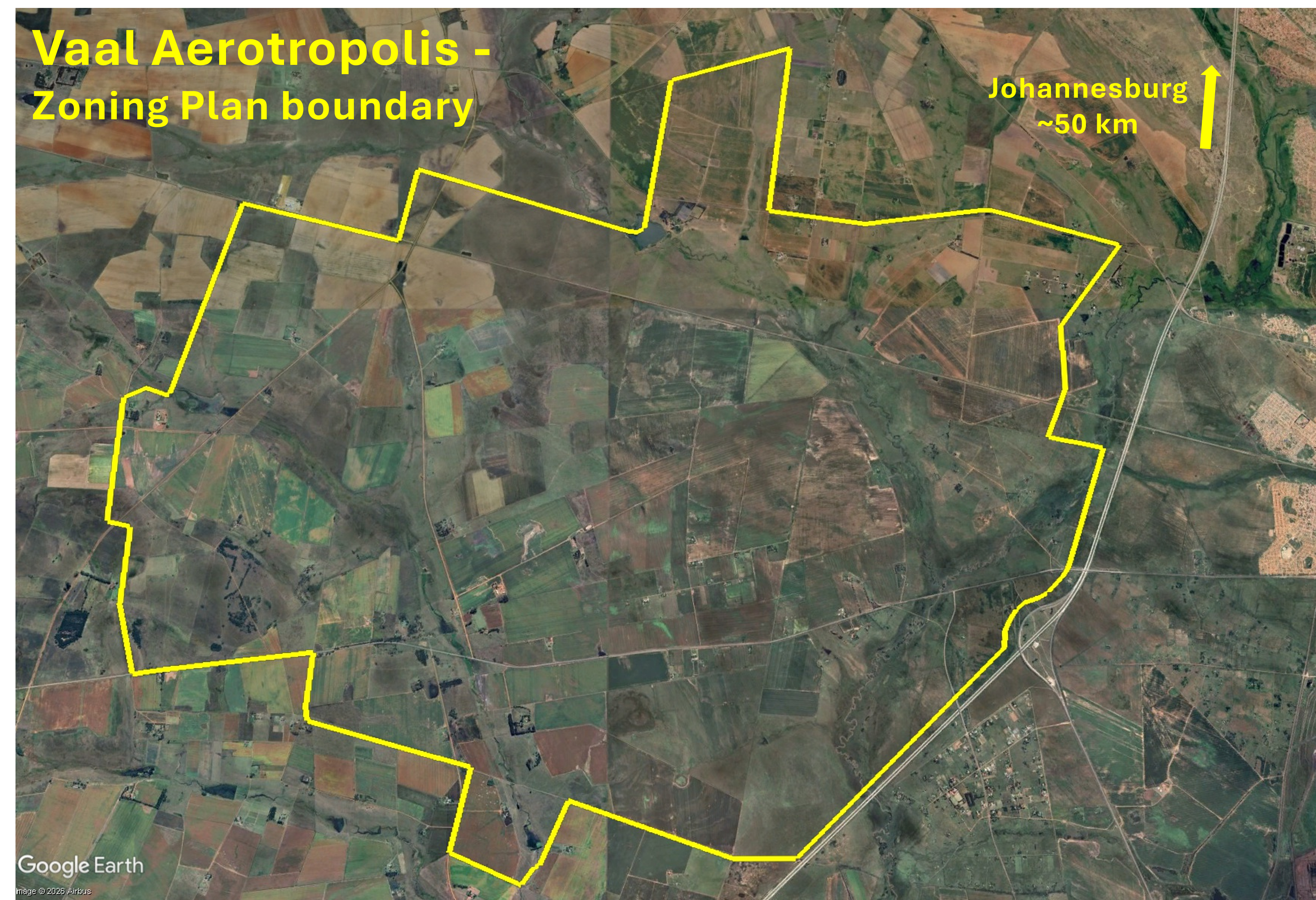
The July 2025 Vaal Aerotropolis Local Spatial Development Framework (LSDF) report, was prepared by AeroZone for the Sedibeng and Emfuleni authorities to ‘allow them to plan and budget, in order to obtain approval and proceed with the project’. Great importance is attached to Vaal Aerotropolis being designated as a SEZ, or included in an existing SEZ, in order to benefit from a supportive planning framework, development rights, infrastructure provision and a range of incentives. Zoning is viewed as vital to attract investors, ‘It is important to entrench the zoning rights as early as possible in order to create a zone of comfort for investors. The LSDF will create this comfort.’ Most of the site is owned by Vaal Aerotropolis developer AeroZone, ~4,000 hectares directly and ~1,200 through lease of publicly owned land. A small area of the site is privately owned. The area encompassed by the Zoning Plan boundary is 11,400 hectares, but the eventual site could be even larger as the ‘total envisaged site area is approximately 12,125 ha in extent’. The majority of the site within the Zoning Plan consists of land that has been farmed since the early 1900s, it is ‘mostly cultivated fields with a few patches of open grassland vegetation’. Streams run through the site and there are small areas of trees, shrubs, and wetlands. The LSDF acknowledges that the ‘environmental attributes once provided by the commercial agricultural activities will be lost’. Potential exports of agricultural produce are estimated at 11,000-15,000 tons by 2032, 15,000-20,000 tons by 2037 and 25,000-30,000 tons by 2042. No numbers are given for live animal exports but it appears facilities for this could be substantial, ‘The Vaal Aerotropolis location is ideally suited to provide enough space for holding areas for various animals.’
The future of Vaal Aerotropolis is uncertain, depending upon extent to which the plans are realised, what materialises on the site and the level of utilisation. Whatever actually happens, the combination of the large site, road and rail network access, backing from several government bodies, substantial private investment and likely SEZ zoning make the Vaal Aerotropolis site a significant asset and a locus and instrument of power for project partners.

