The local impacts of Istanbul’s third airport are explored in Whose Land? Whose Villages? The Vanishing Settlements of Istanbul’s Northern Forests by Cihan Uzunçarşılı Baysal, published by Housing and Land Rights Network. Oral history research records the testimonies of residents of eight villages in Istanbul’s Northern Forests which have been affecteded by the megaproject: Ağaçlı, Yeniköy, Karaburun, Durusu, Balaban, Tayakadın, Baklalı and Dursunköy. Construction works including quarries, excavation, cement plants, sand mining and land reclamation ‘made everyday life unbearable’. Part of the the vast 7,650 hectare airport site was forest land seized by the state, supposedly for public purpose. About 13 million trees were felled. Fertile agricultural land, meadows, lakes, wetlands and a stretch of coastline were also destroyed to make way for the airport. Impacts on agriculture and livestock breeding, in particular water buffalo, have been devastating. One resident estimated that 500-600 water buffalos used to graze around Kulakçayır lake, its landfilled remains now lying underneath the runways. This report, with some of its interviews interrupted by the incessant noise of planes flying overhead, helps keep alive memories at risk of being buried along with the ecosystems.
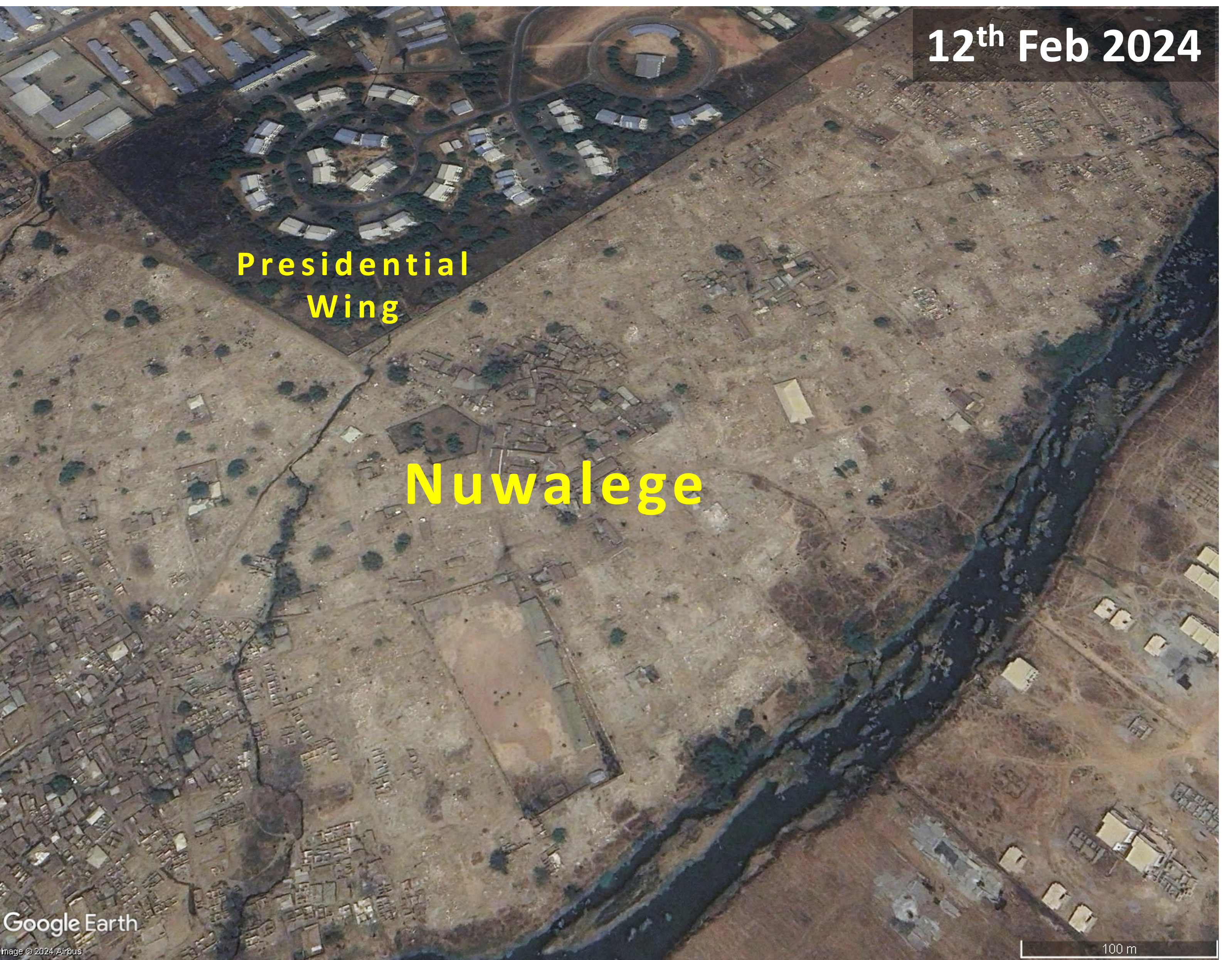
On the morning of 15th January 2024 dozens of police and soldiers stood guard as over 200 homes in the Nuwalege community, a settlement in a rural area adjacent to the Presidential Wing of Nnamdi Azikiwe International Airport (the main airport of Abuja, capital city of the Federal Capital Territory of Nigeria) were demolished to make way for expansion of the Presidential Air Fleet (PAF). Police fired teargas to disperse residents and they were prevented from entering their homes. Officials threatened to seize people’ phones and one person who took photos of the demolition was manhandled. Some Nuwalege residents including community leaders said that the demolition happened without warning.
Satellite imagery shows Nuwalege homes demolished for expansion of the Presidential Air Fleet. The image on the left is from 2nd May 2023, the most recent Google Earth imagery before the demolition exercise. On the right is an image from 12th February 2024, nearly a month after the demolition began.
Demolition of more than 200 houses in the Nuwalege community had been ordered by the Federal Capital Territory Administration (FCTA) on 18th December 2023 and a thorough investigation of compensation for affected people, involving the FCTA, the Department of Resettlement and Compensation and the Nigerian Air Force (NAF), was promised. Peter Obi, Labour Party candidate in the 2023 presidential election, spoke out against the planned demolition in a statement on his X account: “I am again pained that we are embarking on such an inconsiderate project at this critical time when the country is going through such hardship…We cannot continue to encourage those who have kept us suffering to enjoy a luxurious lifestyle far beyond our legitimate means…I therefore, advise that we have a rethink, and, most importantly, ensure that our fellow Nigerians are not rendered homeless for the sake of an unproductive presidential fleet.” He also argued that instead of expanding the Presidential Air Fleet the government should explore ways of reducing or getting rid of it to reduce costs.
Seven months after the demolition, in August 2024, The Punch reported that Nuwalege landowners who were forcibly ejected following demolition of their homes were still calling for compensation. Residents denied Department of Development Control claim that the structures belonging to indigenous people had been left intact, saying that no houses had been spared from demolition and the Director of the Department of Development Control’s claim that they had been given a two-month notice period before the demolition took place. Many displaced residents had been forced to seek shelter in nearby communities including Zamani, Sauka, Giri, Iddo and Gwagwalada.
Resource Centre for Human Rights and Civic Education (CHRICED) issued a statement expressing dismay at widespread destruction of indigenous settlements in the FCT on 1st September 2024, making specific reference to the forcible demolition of over 200 homes in Nuwalege. Urging the government to engage in dialogue with affected residents CHRICED Executive Director Ibrahim M. Zikirullahi said, “The demolition reportedly executed by the Federal Capital Development Authority (FCDA) to accommodate the luxurious lifestyle of the presidency demonstrates gross irresponsibility and insensitivity to the plight of the Abuja natives. This prioritization of luxury and expansion for a select few over the basic rights and needs of ordinary citizens is an affront to democratic values and the principles of social justice.”
Works in the demolished area have not commenced but on 1st November 2024 a N9.8bn (USD5.9m) contract for rehabilitation of facilities in the Presidential Wing was awarded to Nigerian construction firm Julius Berger. Executive Secretary of the Federal Capital Development Authority (FCDA) said the project – including rehabilitation of the link road, access road to the presidential kitchen, hangar housing presidential aircraft and holding centre for visiting presidents – would take six months. A number of civil society organisations condemned the contract. Peluola Adewwale, National Secretary of the Democratic Socialist Movement, said, ”The N9.8bn presidential wing rehabilitation contract is a misplacement of priority, frivolous and insensitive.” The Committee for the Defence of Human Rights (CDHR) described the Presidential Wing rehabilitation as an ‘unnecessary project’. CDHR chairman in Osun State, Emmanuel Olowu, said, “the Tinubu’s government prioritises a luxurious lifestyle against the welfare of the people.”
Satellite image of Lucknow Airport (Chaudhary Charan Singh International Airport) dated 20/10/2024. Location of Terminal 3 and some of the villages affected by land acquisition for airport expansion are shown.
Lucknow Airport (also known as Chaudhary Charan Singh International Airport), located 14km southwest of the capital city of Uttar Pradesh, is already the 11th busiest airport in India and traffic will increase with recent and ongoing expansion. A third terminal began operations on 30th March 2024, with capacity for 8 million passengers per year, set to rise to about 13 million upon completion of phase two. Land from Bhaktikhera village was used for the third terminal and runway extension and in March 2018 the Airports Authority of India (AAI) agreed to pay Rs 32 crore for relocation of about 600 residents. Compensation for acquisition of 70 acres of land from Bhaktikhera, Gurera and Aurangabad Jagir villages, for runway extension and other facilities, was still being negotiated in June 2018. Airport expansion had been stalled for a decade due to difficulties with land acquisition. But in June 2019 the AAI announced that ‘decks are cleared for the construction of the wall around the airport and expansion of the runway’. The district administration committed to helping AAI build the wall to keep out people ‘trespassing the area’ and stray animals posing safety risks.
Demolition notices and farmers protest boundary wall construction
Construction of houses near Lucknow Airport also raised safety concerns. At the end of August 2024 authorities served demolition notices on 50 houses which had been built next to the airport boundary without authorization. A Lucknow Development Authority (LDA) official said a builder had posed as a contractor without obtaining the requisite No Objection Certificate (NOC) from the airport administration, acquired land directly from farmers and pocketed the money. A month later construction of the airport boundary wall led to a clash between a group of farmers and police. After commencement of excavations works, with two JCBs in the presence of police, a large number of farmers, between 150 and 200, gathered and began to protest, saying the airport administration was forcibly occupying their land. The farmers, from Rahimabad and Mohammadpur Bhakti Kheda villages, said a disputed land petition was pending adjudication in the Allahabad High Court. The protest forced authorities to temporarily halt land reclamation operations for airport expansion. Farmers argued that the land had been cultivated for many generations and that land acquisition notification in the 1950s lacked important details including plot numbers, land area and the names of the landowners, thus raising questions about the legitimacy of the acquisition process.
In response to the protest the district administration postponed the land reclamation drive until 15th October. The owner and operator of Lucknow Airport, Adani, one of India’s largest multinational conglomerates, plans to reclaim approximately 260 acres on the southern edge of the airport for extension of the runway to 3,500 metres to accommodate large, wide-body aircraft and construction of two parallel taxiways. Speaking anonymously, an official stated that a total of about 400 acres owned by the airport for over 70 years would be reclaimed for airport expansion and a survey would be conducted to compensate farmers with crops growing on the land. The principal petitioner against the land reclamation said the farmland had not been legally acquired, farmers had not received any compensation and Adani was attempting to forcibly construct the airport boundary wall.
Boundary wall construction continues and Aero City plans
On 25th October the Supreme Court dismissed the farmers’ plea against expansion of Lucknow Airport, allowing LDA to proceed with the project. Lucknow Development Index announced on X that, after deployment of a ‘heavy police force’ in response to resistance, ‘work is still progressing amid farmers clashes’. A ‘massive area’ was being reclaimed and construction of the boundary wall had re-commenced. An official source said a 400-acre area was being reclaimed and a fourth terminal and an Aero City was planned on the land.
Few months previously, on 5th February 2024 Times of India had reported ‘ambitious plans’ for Lucknow Aerocity, a 1,500 acre development with ‘an array of upscale amenities, such as world-class convention centres, large parks and seven-star hotels’, announced by Uttar Pradesh finance minister Suresh Kharna. The LDA was tasked with identifying land for the project, likely to be located in Rahimabad and Gahru villages. In addition to Lucknow, Adani owns several airports in India including Mumbai, Mangaluru, Jaipur, Ahemedabad, Thiruvanthapuram and Guwahati. Plans for aero cities adjoining Adani’s airports were reported in July 2022. The Economic Times stated that Adani plans to develop ‘aero cities’ on more than 500 acres at all its airports, with hotels, convention centres, retail, entertainment, healthcare, logistics, offices and other real estate sectors.
Locals resisted eviction for Guwahati Airport expansion
At the beginning of September 2021, a month before operation of Guwahati Airport (the busiest airport in northeast India) was handed over to Adani, there were reports of locals resisting eviction to make way for expansion. An eviction notice was served to 54 households, outside the walled area of the airport in Koitasidhi village. An airport official said the land, adjacent to the runway, was to be developed as an approach area, especially for larger aircraft on international flights. Villagers said that several plots of land had been acquired for construction and expansion of the airport since 1962. Some villagers said, “We would rather give our blood than give up our land”. Continuing protest was reported on 8th September; a local person said “We heard that the Adani group which has been given charge of the Airport for 50 years under a lease agreement by the Government of India wants to do expansion work here. But we want to clarify that we will not leave our land even if we are given adequate compensation”. Some other locals said they would not give their land to Adani. On 15th September 2021 the Times of India reported that villagers were fiercely resisting giving up land for airport expansion. A tearful farmer in his late 70s said his family had been compelled to give up land for airport expansion in the 1960s, which if sold today would fetch a much higher price. His family was left with ownership of just one residential plot. More recently, in June 2024, announcing the schedule for opening of a new terminal at Guwahati Airport in April 2025, Chief Airport Officer Utpal Baruah said plans for subsequent expansion phases included a maintenance, repair and overhaul (MRO) facility, aerocity and helipad.
A new book draws attention to accelerating airport development in Asia and Africa, elucidating many factors underlying the political sensitivities frequently surrounding greenfield development, airport expansion and airport cities. Contested Airport Land: Social-Spatial Transformation and Environmental Injustice in Asia and Africa, edited by Irit Ittner, Sneha Sharma, Isaac Khambule and Hanna Geschewski, is published by Routledge.
Following a conceptual introduction and overview chapter in-depth case studies give nuanced insights into the complex socio-economic, political and administrative dynamics of seven airport projects: the suspended Nijgadh Airport (Nepal); Mattala Airport (Sri Lanka); Yogyakarta Airport (Indonesia); a critical review of airport land contestations in India focussing on Jewar and Dehradun airports; the airport reserve in Abidjan (Cote d’Ivoire); Durban Aerotropolis (South Africa) and Isiolo Airport (Kenya).
You can listen to a conversation with three of the co-editors on an episode of The Channel podcast from the International Institute for Asian Studies (IIAS) at Leiden University, hosted by Benjamin Linder.
Earthworks for construction of an airport on Koh Rong island, 25 km from the city of Sihanoukville on Cambodia’s south-west coast, began in January 2024. Satellite imagery shows the airport site, located in a flat area in the centre of the island. The new airport with a 2.650 metre runway will have capacity to handle 138,000 passengers annually upon completion of the first phase and the MoU signed in January 2023 formalised a budget of $300 million. The necessity and viability of Koh Rong International Eco-Tourism Airport seems questionable with two major international airports nearby. Newly constructed Dara Sakor Airport, with capacity for 10 million passengers per annum and scheduled to begin operations in November 2024, is only 21km away. Sihanouk Airport is 45 km away. Also, Koh Rong is already well served by boat; the ferry journey from Sihanoukville only takes about 45 minutes.
Satellite imagery of Koh Rong dated 1st November 2023, showing location of the four coastal villages, Royal Sands resort, long beach, major roads and Koh Rong International Eco-Tourism Airport construction site.
The new airport will be named ‘Koh Rong International Eco-Tourism Airport’. While an airport enables people to visit and explore protected beaches, forests and native wildlife habitats, it does the very opposite of protecting ecosystems, concreting over a vast area for runways, terminals and access roads. Then there is the issue of climate disrupting greenhouse gas emissions from flights, with aviation being energy intensive and dependent upon fossil fuels. And tourism development on Koh Rong has damaged ecosystems and the people depending on them. In 2008, Royal Group, one of the largest investment and development companies in Cambodia, was granted a 99-year land concession to develop the 78 square kilometre island. Realisation of the masterplan – featuring resorts, casinos, marinas, golf courses, two fishing villages and an airport – was delayed but commenced in 2015 with clearance of sites along the southwestern coast including forests along with construction of a road. On 3rd July 2015 Koh Touch villagers held a sit-in protest, blocking construction crews, excavators and a bulldozer, in response to construction of a road which they said would cut through their village and affect their homes. Later that month opposition to development of Koh Rong became more vocal in response to construction equipment and workers appearing on the island. Hundreds of residents began to speak out on social media. As well as cutting trees cliffs and rocky outcrops had been flattened for development, including a new pier on Long Beach, on the southeast of the island.
In August 2015 a number of Koh Kong residents called on officials to review what they called “abusive activities” by Royal Group. Construction had accelerated in recent weeks and workers and machinery had been photographed clearing large areas of forest. Residents accused Royal Group of destroying farmland and crops, including cashew, jackfruit, coconut and mango trees. A village leader said destruction could impact the livelihoods of over 100 families, who had lived on the island since 1995. Villagers said the destruction of their livelihoods was illegal and authorities should monitor the situation. Human rights and environmental campaigners supported residents’ calls for improved oversight and local groups were preparing petitions and other documents to file with provincial and national authorities. Protest groups had been formed in response to a breakdown in communications between residents and Royal Group. One villager said, “They come in and do their work, take whatever they want, but there is no communication”.
Controversy over land titles for Koh Rong villagers was reported in 2017. Some residents who had lived on the island since before 2008 had land titles, although it was uncertain whether these titles would be upheld amid disputes. Those arriving after 2008 did not have land titles. By 2018 over 1,000 land plots, belonging to 500 families, had been recognised by the government, but in April 2018, during the inauguration of the luxurious, five-star Royal Sands Koh Rong resort, about 50 people who had not yet received land titles attempted to join the event but were prohibited from doing so. Prime Minister Hun Sen ordered the Ministry of Land Management to bring an end to the Koh Rong land dispute. In June 2020 53 families protested land clearance; a 35-hectare site they believed rightfully belonged to them was being bulldozed. A Preah Sihanouk Provincial Administration spokesperson called on the protesting families to cooperate with authorities by providing relevant documents and warned them that if they caused chaos legal action would be taken against them. A member of one of the protesting families claimed they had lived in the area since 1992 and said: ”We won’t go anywhere. I will gather to protest at this site. We dare not enter the bulldozing site. I want Prime Minister Hun Sen to see and tackle this issue for us. We all have ownership documents.”
In June 2024 Mongabay reported that a new map of Royal Group’s plans for Koh Rong showed golf course zones, commercial zones, accommodation zones, casinos zones and an international airport. The latest plans did not appear to impact fishing villages but included clearing some of the Koh Rong’s protected forests to make way for golf courses. In total, project plans entail clearing more than 3,100 hectares of the island’s forests. A photo showed bulldozers and trucks working on the airport site. Sixteen years after the land was leased to Royal Group there was still no publicly available social or environmental impact assessment and islanders’ future was uncertain. Some Koh Rong residents hoped to sell their land to Royal Group while others feared that it would be taken from them.
For more information about the airport and tourism projects on Koh Rong island, including references for all source material, see the case study on EJAtlas, the world’s largest, most comprehensive online database of social conflict around environmental issues: Koh Rong island tourism development, Cambodia.
In Conchagua, El Salvador, the Condadillo and Flor de Mangle communities are being displaced from their homes and farmland for construction of Pacific Airport. A linked ‘Bitcoin City’ on the slopes of an inactive volcano has yet to materialise.
Location of Pacific Airport project with respect to environmental zoning, Ministry of the Environment and Natural Resource (MARN), 09/2021. Source: Mala-Yerba
El Salvador’s Legislative Assembly approved a new law expediting procedures for building the Pacific Airport on 26th April 2022, allowing the Autonomous Executive Port Commission (CEPA) to acquire title to property deemed necessary. In June 2022 the Earth Journalism Network reported that vegetation was being cut to make way for the airport and eucalyptus trees had been marked for felling. Inhabitants who cultivated crops said government personnel had entered the land to cut plants, without reaching a sale agreement as had been promised. In November 2022 Mongabay reported that the airport faced backlash from local communities after breakdown of negotiations with the government. Residents said they were being pressured to accept buyouts for their properties. Mala-Yerba reported that works on the airport site had begun at the end of February 2023, before the environmental permit was issued by MARN on 21st March. A source from Condadillo expressed concern over irreparable damage to trees, mangroves, animals, birds and aquifers. Flor de Mangle residents, depending on sea fishing and harvesting molluscs from the nearby El Tamarindo mangrove will also be impacted, as the area is a nursery for crabs, molluscs and other crustaceans and many residents make an income from collecting and selling them.
Residents of Condadillo and Flor de Mangle recounted workers entering agricultural and housing land plots with machinery, in the absence of authorisation from landowners or a court order. Drilling and excavation left the area unsuitable for agriculture and unsafe for people and livestock. Residents also denounced pressure from CEPA to sell land at unfair prices. Farming families and MILPA (Indigenous Movement for the Integration of the Struggles of the Ancestral Peoples of El Salvador) representatives said that more than 225 families had been directly affected by being unable to produce crops – including watermelons, tomatoes, grains and chillies. At the beginning of July 2024 MILPA stated that human rights violations against Condadillo and Flor de Mangle inhabitants impacted by construction of Pacific Airport had worsened. More than 225 families said their rights to consultation, legal advice and compensation had been violated. Many inhabitants reported being threatened and intimidated by CEPA.
New laws, tax exemptions and an “air-tropolis”
On 29th September 2021 MARN issued a statement that the Pacific Airport was not environmentally feasible and the Autonomous Executive Port Commission (CEPA) submitted a request to MARN for reconsideration. Within 24 hours the MARN website changed the status of the airport project to ‘high impact’. New environmental zoning and a new eminent domain law approved by the Legislative Assembly on 17th November 2021 made legal provision to continue the project. Then, on 26th April 2022 the Legislative Assembly approved a new law expediting procedures for building the Pacific Airport, allowing CEPA to acquire title to property deemed necessary for construction of the airport. It is estimated that the new airport will handle 1 million passengers per year, possibly rising to 3 million within 25 years. Construction of Pacific Airport, for civilian and military use, is expected to cost $500 million over 10 years. Purchases made within the framework of the airport project will be granted exemptions from income tax, Value Added Tax (VAT) and municipal taxes for 25 years. According to CEPA’s projections, the airport will bring poles of economic development to El Salvador’s eastern zone. CEPA president, Federico Anliker, said the airport terminal will be converted into an “air-tropolis”: a city with industrial plants, resort centres, hospitality and factories for export of technological products. For more information about Pacific Airport, including references for all source material, see the case study on EJAtlas, the world’s largest, most comprehensive online database of social conflict around environmental issues: Pacific Airport (Aeropuerto del Pacífico), El Salvador
An airport for a planned Bitcoin City
Pacific Airport is linked with the Bitcoin City project announced by President Bukele in November 2021, two months after El Salvador became the first country to adopt Bitcoin as legal tender. Bukele unveiled a model and graphics showing a coastal circular city (the shape of a Bitcoin) on the slopes of the volcano, crammed with golden skyscapers radiating from a central plaza with the Bitcoin logo, along with images of an airport. In February 2022 CEPA President Federico Anliker said, “Bitcoin City, well, is going to have its own airport”. The proposed Bitcoin City site is in an inactive volcano in Conchagua and plans include a bitcoin mining complex to be powered by a new geothermal plant. Environmentalist Ricardo Navarro, from Cesta Amigos de la Terra, expressed concerns over geothermal energy generation for Bitcoin mining, saying “The big problem is that it consumes a large amount of electricity”. Lourdes Molina of the Central American Institute for Fiscal Studies said, “Here it is not only the operation of the servers but also that they demand a lot of energy, they have to be at certain controlled temperatures to be able to work, we are talking about the almost industrial use of air conditioning.”
Funding for Bitcoin City is as uncertain as the energy supply. As of July 2024 the ambitious plans for Bitcoin City, compared by Bukele to Alexandria, have not materialised, the ground has yet to be broken. Construction was supposed to be part-funded by $1 billion in government-issued ‘volcano bonds’ with a portion of the earnings to be invested in geothermal energy facilities. Initially scheduled to go on the market in February 2022, several deadlines were missed, most recently in the first guarter of 2024. The government has not announced an alternative source of funding for Bitcoin City. Bitcoin was central to Bukele’s promises of prosperity; three years after it became legal tender few citizens use it. Bitcoin was promoted as a way of making savings on fees for remittances from the US, but only 1.3% of remittances were sent through crypto wallets in the three year period and the amount of saved fees has not been disclosed. The future of Bitcoin City, anticipated to bring in an influx of wealthy crypto investors and returning expats buying luxury apartments and paying no income or property taxes, seems to depend upon construction of Pacific Airport. However, Bitcoin city could be revived by another transportation project. Turkish port operator Yilport Holdings has made the pargest private investment in El Salvador, committing $1.6 billion to two port projects, La Unión, near the Bitcoin City site, and Acajutla. which is the country’s main seaport.
In November 2023 Cambodia’s State Secretariat of Aviation (SSCA) announced that construction of Dara Sakor Airport (Cambodia’s fourth international airport after Phnom Penh Airport, Siem Reap Airport and Sihanouk Airport) was in its final stages. Dara Sakor Airport has been built to serve a gigantic tourism-oriented economic zone, the 451 square kilometre Dara Sakor project encompassing about one-fifth of Cambodia’s coastline. The Dara Sakor developer, Coastal City Development Group Ltd., calls the project ‘Coastal City’ and its website has pictorial maps indicating the many components of the project such as Dara Sakor Airport, a resort, tourism zone, golf courses and a port. The China-Global South Project reflected on the Dara Sakor project in 2023. Of all the anticipated infrastructure only the airport was completed. Yet the project continued with ‘considerable support from the government’. BBC reporters visiting Dara Sakor in September 2023 described unfinished roads and buildings as a stark contrast with ‘dazzling brochures for potential investors’.
Pictorial map of Dara Sakor project including tourism zone, resort, golf courses, development zone and Dara Sakor International Airport. Source: Coastal City Development Group Ltd.
Thousands of people have been forcibly displaced from their homes for the Dara Sakor project, losing their farming and fishing livelihoods. There have been many protests against eviction and inadequate compensation, in many instances met with repression. Unrest dates back to the inception of the project in 2008 when 360 sq km of land in the Botum Sakor and Kiri Sakor districts in the Koh Kong Province was reclassified as state-owned land. A 99-year lease contract was signed with Union Development Group (UDG) of China. Cambodian Human Rights and Development Association (Adhoc) reported that affected communities were not consulted about the project, some only becoming aware when officials arrived to measuring land. In 2011 the project site grew to 451 sq km when UDG was granted an additional 91 sq km land concession to develop a water reservoir and hydropower. During 2011 UDG began dismantling and burning down some villagers’ houses and destroying productive trees.
A key protest took place in February 2014 when about 140 people blocked the road to UDG’s offices leading to a clash with 40 UDG security guards and six soldiers carrying AK-47 rifles. Kiri Sakor District Governor said district authorities had ordered about 100 families to vacate their land for the Dara Sakor project’s hotels, golf courses and an airport. By September 2014 5,791 people had moved to a relocation site where they lacked access to former farming and fishing areas and suffered many problems including poor quality housing damaged by wind and rain, limited water that did not meet national standards, lack of electricity and health care facilities. Reports of destruction of houses and productive trees emerged again in 2018. In april April Koh Kong Provincial Court heard testimony from 13 families claiming that 60 UDG guards had burned their productive trees, seeking compensation for loss of cassava, jackfruit, mango, rubber and coconut crops.
On 27th May 2019 about 20 residents protested in front of the Chinese Embassy in Phnom Penh, calling for resolution of the 11-year land dispute. A report by the Community Legal Education Center stated that 1,143 families were forced to vacate about 100 sq km of land in the first five years fo the project but many families had resisted and fought for rights to the land. Four villagers were detained for 12 hours on 29th September 2020, after camping outside Koh Kong Provincial Hall calling for action over the 12-year land dispute with UDG. A year later 1,333 families rejected compensation offers of between 1 and 3.5 hectares and said they would fight to remain on their land. Protests against compensation offers continues into 2022; some declined the offer as it was insufficient and the village the government wanted to relocate people to was 100 km away and lacked infrastructure.
In June 2023, just four months before SSCA’s announcement about construction of Dara Sakor Airport entering its final stages, there was yet another protest by people affected by displacement for the Dara Sakor project. A group of villagers involved in a Dara Sakor related land dispute attempted to travel to Phnom Penh to submit a petition at the Ministry of Justice, but were met with a police roadblock. Eleven villagers were arrested, forced into a truck, returned to Koh Kong and charged with criminal incitement. Radio Free Asia reported that authorities threatened further arrests after about 20 villagers gathered outside the offices where the 11 people were being detained. Human rights organization Licadho said the protesters had not caused any social disorder and that police had been sent to the the area where many of them lived.
For more information including references for all source material see the case study on EJAtlas, the world’s largest, most comprehensive online database of social conflict around environmental issues – Dara Sakor project, Cambodia.
Gelephu Airport, one of only four airports in Bhutan, is a domestic airport located in the southern Himalayan foothills, close to the Indian border. In August 2023, as formulation of the master plan for expansion of Gelephu Airport neared completion and groundwork preparations began, there was growing speculation among landowners with properties in the proposed site regarding replacement land and compensation. Acquisition of land was to be determined by the government. The groundbreaking ceremony for Gelephu International Airport took place on 23rd December 2023. Satelite imagery dated 1st January 2024 reveals a large area of low-lying scrub land has been cleared for the airport expansion.
Satellite imagery shows clearance of a large area of low-lying scrubland for expansion of Gelephu Airport, including the new runway, and construction of a dry port south of the existing runway.
Expansion of Gelephu Airport is a key component of an even larger megaproject, a new city, and some residents are concered about losing land to the project. On 15th December 2023 Forbes reported that King Jigme Khesar Namgyel Wangchuck would be announcing development of a new ‘megacity’ in Gelephu, called Bhutan Mindfulness City, on Bhutan’s National Day, the 17th December. Initially there were plans for the announcement to take place in Gelephu, but the town, with just 10,000 residents, lacked the requisite infrastructure such as accommodation for international guests so the event was relocated to the capital city, Thimpu. Ahead of the official announcement the article cautioned that the new city project might be met with ‘strong opposition from Bhutan’s nearly 800,000 citizens’ and that ‘fears of government land grabs and the displacement of farmers in Gelephu have already taken root, according to several Bhutanese residents’. Sources with knowledge of Mindfulness City said the King was ‘trying to avoid the preception that families will be forcibly transferred to make way for the project’.
Mindfulness City was indeed the focus of the King’s 116th National Day address. The Bhutanese reported the King’s description of the new city, explaining that it will cover 1,000 square kilometres, about 2.5% of Bhutan’s total land area. Major public investment in roads, bridges and airports is planned, with an inflow of foreign investment anticipated for construction of offices, residencies, schools, hospitals, shops, hotels and restaurants. The new city was also referred to as Gelephu Special Administrative Region (SAR), an ‘economic hub’ that will have ‘autonomy to formulate laws and policies’. Ten of the twelve gewogs (groups of villages) in the Sarpang Dzongkhag (District) – Tareythang, Umling, Chhuzagang, Serzhong, Gelephu, Samtenling, Dekiling, Shompangkha, Gakiling, and Singye – were designated for the Gelephu Mindfulness City project. Kuensel Online reported that residents and landlords were ‘excited about the the upcoming development initiative’, attributing some landlords’ anxiety and fear of losing all of their land to the project to ‘lack of awareness regarding private properties’. There was reassurance of compensation following international practices and provision of replacement land in the city area. It appeared that acquisition of private land would be limited to areas allocated for road and airport construction.
Danish architecture firm BIG, known as a masterplanner for other megaprojects such as Neom, a glass-walled linear city in Saudi Arabia, duly unveiled its masterplan for Mindfulness City, including an international airport. Connectivity was a recurring theme of BIG founder Bjarke Ingels’ description of the new city; he said “Gelephu becomes a land of bridges, connecting nature and people, past and future, local and global”. Apparently, the project will ‘be shaped by 35 rivers and streams that run through the site’. Neighbourhoods will be connected by several ‘inhabitable bridges’ hosting facilities including a university, a healthcare centre and a spiritual centre. Connectivity claims extended to the airport, its timber terminal to act as a bridge. But its runway, crossing over several rivers, while facilitating connectivity for global air travellers, will cause major disruption to hydrological systems. And how does a new city highly dependent on fossil-fuel dependent international air travel square with the Gelephu Mindfulness City website claim of ‘Sustainability as a carbon negative country’? Buildings will incorporate local materials and be ‘informed by Bhutanese architecture‘. But will techniques and structures resonating with local cultural identity be integral to the function of new buildings, or merely aesthetically pleasing adornments? Perhaps the most striking showpiece feature of Mindulness City is the plan for a hydro-electric dam containing a temple. Will the new city be, as Ingels said, “founded on Bhutanese nature and culture”, or merely garnished with it?
A 6th January 2024 Kuensel Online article stated that that Gelephu Mindfulness City would commence with expansion of Gelephu Airport and landowners with land in the area earmarked for the airport had been given replacement land or compensation. Landlords confused about the future of their holdings had been told that they had ‘nothing to worry about’ as the project would include everyone and leave nobody behind, indeed ‘the entire Bhutanese citizenry would be part of the historic project’. This claim of inclusivity is at odds with the Gelephu Mindfulness City website promotion of new city aiming to ‘attract global top talents who are global and creative’ and ‘serve as a hub of global top minds’, i.e. for an international elite. By February 2024 six JCBs had cleared about 1,800 acres of land, working towards the goal of clearing 2,500 acres. Just south of the airport, a dry port was under construction. After considering three models for the airport expansion officials had selected the Asian Development Bank (ADB) masterplan. A new runway next to the existing runway will be 3km in length; possible extension of the runway to 3.5km to accommodate the Airbus A380 would cross over two rivers. Building a new runway will allow continuation of airport operations using the existing runway, enabling visitors involved in the development of Mindfulness City to fly in and out. The initial cost estimate of the ADB masterplan was Nu 8 billion (USD96 million) but a more recent estimate by the Airport Authority of India indicated a far higher figure, possibly as high as Nu 20 billion (USD240 million).
In Tanzania state forces are forcefully evicting Maasai residents of eight villages bordering Kilimanjaro Airport. On 8th May 2024 it was reported that hundreds of homes have been demolished and cars with loudspeakers, escorted by armed police, warned residents to evacuate. Plans to expand the 460 hectare airport site to 11,447 hectares date back to 1985 and the government labels the lawful owners of the land as ‘trespassers’. For background information on the land dispute see EJAtlas: Kilimanjaro International Airport. Impacted communities and supporting organisations are calling for and immediate halt to demolition of homes, humanitarian aid including food and shelter to the hundreds of people rendered homeless and establishment of an independent enquiry into the land dispute.
A study focussing on three villages affected by land acquisition for expansion Mohali Aero City, southwest of Shaheed Bhagat Singh International Airport, raised concerns over threats to rural livelihoods.
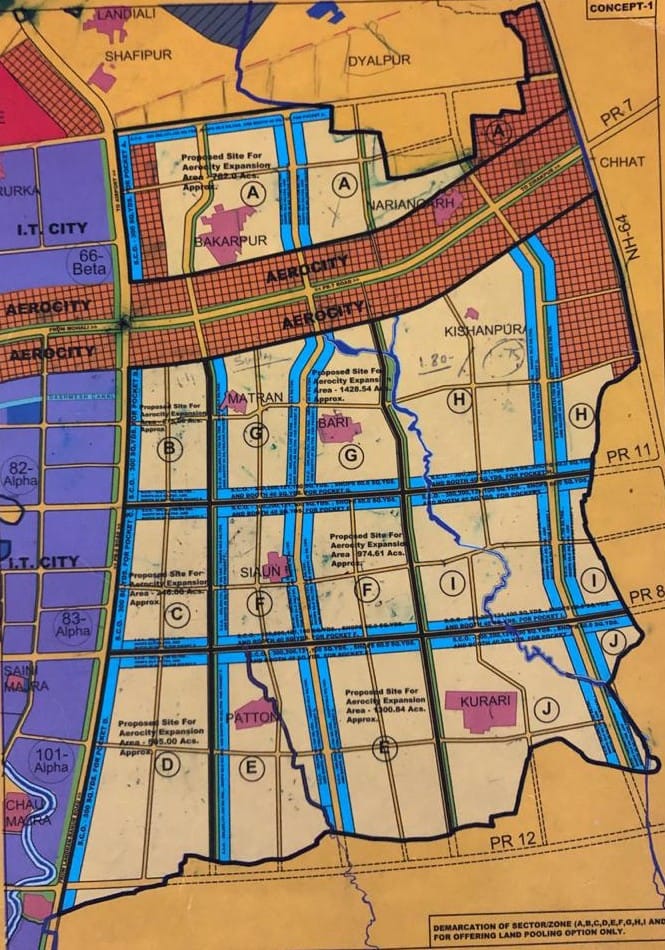
Proposed acquisition of 5,438 acres (2,200 hectares) of land from 14 villages – Bakarpur, Naraingarh, Kishanpura, Safipur, Rurka, Matran, Bari, Chatt, Saini Majra, Seon, Kurari, Chau Majra, Manauli and Paton – for AeroCity expansion, called ‘Aerotropolis’, was confirmed by Greater Mohali Area Development Authority (GMADA) in 2017. A 2021 article in the Journal of Land and Rural Studies by Thomas Reuter, Sarbjeet Singh, A.K. Sinha and Shalina Mehta, Land Grab Practices and a Threat to Livelihood and Food Security in India? A Case Study from Aerocity Expansion Project from S.A.S. Nagar, Punjab, analyses the project as an example of large-scale acquisition of highly fertile agricultural land. The authors describe ‘blatant land grab practices by the state authority in the name of development, which act as barriers to the food security and threaten the livelihoods of those whose land will be acquired’. The study focussed on three affected villages – Patton, Kurari and Seon. Fieldwork conducted in April 2019 included in-depth interviews with 50 displaced farmers.
A consolidated demographic profile of Patton, Kurari and Seon from the 2011 census showed that the total number of affected people was 3,031. A significant number, 955, belonged to the scheduled caste population, the most marginal rural people, many of them landless labourers, some of whom farm on leased land and other providing menial services. Land acquisition renders them homeless and they receive no compensation. The scheduled caste community of Patton village were marginal farmers owning only 1-2 acres of land. Scheduled caste people of Kurari and Seon did not own any land and depended entirely on agricultural activities. The working population was divided into two categories. ‘Main workers’ included marginalised individuals regularly hired by affluent farmers to work in their fields and people engaged in pastoral activities in a more favourable economic situation. ‘Marginal workers’ comprised migrant workers primarily from Uttar Pradesh and Bihar along with seasonal workers from other states coming to the area for work harvesting paddy and wheat. Agriculture was the primary economic activity in the three villages. Several farmers had modern equipment such as tractors, tillers and adequate irrigation with tube wells for which free electricity was provided by the state. Farmers getting cash compensation for surrendered land tend to lose these subsidies, along with minimum price support for cereal crops.
Narratives from three affected farmers
The article includes narratives from three farmers affected by land acquisition for the Aero City Expansion. A 59-year old man from Kurari village grieved that the pace of urbanisation would convert lush green fields into a concrete jungle. He worried that wheat, rice, maize and other cereal crops would disappear. GMADA and private builders offered different compensation packages, causing friction among those surrendering prime agricultural land and also between farmers and the state, resulting in litigations and delays in land acquisition and launch of construction activities. A respondent from Patton said that a decade ago the land was unsuitable for farming and nobody wanted to settle in the village. Residents worked hard and within two years had made all the available land suitable for agriculture. Most farmers grew vegetables and cereals which they sold at nearby farmers’ markets. When GMADA notified the village for land acquisition for the Aero City Expansion project farmers feared compulsory acquisition and sold their land to private builders. He said that when the government acquires land compensation is inadequate and the payment process often gets trapped in legislation. He had worked hard on the land he was forced to sell and was unsure of the productive capacity of new land he had purchased. A Seon villager whose land was acquired by GMADA for the Aero City Expansion had not been paid adequate compensation. He retained six acres but there was a possibility this would also fall under the proposed land acquisition, leaving him without any means of livelihood.
Loss of pastoral activities and social stability
Livestock provided an important subsidiary source of income in the three villages. Cows and buffalo were reared mainly for milk and cows also for manure. Pastoral activities in the three villages were mainly pursued by women waking up early to milk cows and buffalo. Land acquisition can deprive women of this primary economic activity making them far more vulnerable, especially when they run single-parent households. The case studies suggested that animal rearing as a livelihood became unviable because land used for pasture was no longer in villagers’ possession. Loss of agricultural land can cause cessation of pastoral activities, as most displaced households are not compensated with sufficient land to accommodate dairy animals.
Residents of the villages were content with acquisition of small portions of land along roads as it brought them improved connectivity. But acquisition of their fertile land for development of housing for wealthy urbanites and creation of infrastructure in which they were not equal stakeholders left locals feeling cheated. Their lives were marked with upheavals and displacement threatened close-knit social networks. The authors conclude that the Aero City Expansion project was ‘an ambitious ideas but executed without due diligence and groundwork’. Land acquisition brought revenue to the state but measures to support the interests of local residents were inadequate. Urban planners failed to foresee the risks of social tensions and the Aero City epxansion led to social and political instability. The article warned of agricultural decline and the prospect of food insecurity.




 antiaero.org