Plans for ‘eco-luxury and tourism’ destination surrounding Bugsuk Airport

A plan for an ‘eco-luxury and tourism project’ encompassing nearly half of Bugsuk Island is the latest of a series of projects triggering a 50-year struggle for recognition of ancestral land and water rights.

Satellite imagery of Bugsuk Island, Balabac municipality, Palawan province, 27th October 2024. Bugsuk Airport and other facilites are indicated.

In 1974 indigenous Pala’wan, Molbog and Cagayanin people were expelled from Bugsuk Island, part of the Balabac Municipality off the southern tip of Palawan, the westernmost point in the Philippines. An article by Indigenous Peoples’ Rights International (IPRI), based on an interview with Jomly Callon, President of the Sambilog-Balik Bugsuk Movement (Association of Indigenous Peoples and Small Fishers from the Southernmost Tip of Palawan), an indigenous people’s group, outlines a 50-year history marked by projects, facilitated by a series of policy decisions, taking the place of agricultural and fishing livelihoods. The land was awarded to Danding Cojuangco, Chief Executive of San Miguel Corporation (SMC), one of the Philippines’ largest business and industrial conglomerates, who established a nursery for hybrid coconut trees. In 1979 Cojuangco, in partnership with a French businessman, Jacques Branellec, formed the Jewelmer International Corporation which established a pearl farm in ancestral waters. Sambilog was formed in the year 2000 in response to land grabbing and reducing access to fishing grounds, working to gain recognition of ancestral land and water rights. They made an application for a Certificate of Ancestral Domain Title (CADT) which has still not been approved by the government. Indigenous people’s access to traditional fishing grounds was eroded further in 2005 when, without consulting indigenous people, the Balabac municipality was declared a ‘protected marine eco-region’, prohibiting indigenous people from fishing in their traditional fishing grounds. In 2014, following Sambilog protests in Manila calling for return of their lands through the Comprehensive Agrarian Reform Program Extension with Reforms (CARPER) the Department of Agrarian Reform (DAR) issued a Notice of Coverage over agricultural lands for distribution to the people of Bugsuk Island. But DAR did not implement its decision to return the land to those affected by displacement.

After Cojuangco’s death in 2020 Ramon Ang took up the role of CEO of SMC. Bugsuk Airport (also referred to as Bonbon Airport) was built by SMC to support the coconut plantation. In February 2022 Jose Alvarez, Governor of Palawan, speaking about Bugsuk Airport and a Philippine Air Force (PAF) facility in Barangay Catagupan being ‘crucial to the transformation of Palawan’s southernmost region as a new tourist haven‘, said the coconut plantation had failed but that Bugsuk Airport was still under development with the runway already operational and used by people travelling to Balabac. Satellite imagery of Bugsuk island shows Bugsuk Airport, an airstrip near the southern tip of the island that is being developed for the PAF and a helipad. In 2023 the DAR revoked the Notice of Coverage that was issued in 2014 and under which the land would be returned to its original owners. The reason given for the cancellation was that the area is unsuitable for agriculture. Callon, countered this, explaining that residents were cultivating the land, growing many types of vegetables and fruit trees.

Environmental Impact Statement and Master Plan for resort taking up half the island

Bricktree Properties Inc., a subsidiary of SMC, plans to construct various so-called ‘eco’ tourism facilities surrounding Bugsuk Airport. Bricktree’s presentation at a public scoping event held in Bugsuk Community Center, Bugsuk Island on 25th May 2023 contains a timeframe for 2023-24 which includes access road clearing and construction, tree cutting, land clearing, construction of campsites, perimeter fencing and soil compaction. A number of ‘identified environmental impacts’ includes ‘Land tenurial issues and incompatibility with existing land use’, ‘Potential lost (sic) of fish related livelihood and conflict on the access/navigation of locals’ along with potential changes in water quality, water competition and dust from land clearance. The Environmental Impact Statement Summary for the Proposed Bugsuk Island Eco-Tourism Development Project, prepared for Bricktree, contains maps of the proposed site and a Proposed Master Plan comprising serveral zones taking up much of the south of the island along with a port on the northern tip.

Proposed Master Plan including airport and zones for eco-tourism, forest tourism, coastal resort, industrial, commerical, residential, recreation, port facilities, agriculture and a road network. Screengrab from Environmental Impact Statement Summary, Proposed Bugsuk Island Eco-Tourism Development Project, Bricktree Properties Inc.

The Environmental Impact Statement Summary states ‘The Proposed Project aims to be an eco-luxury leisure and tourism destination governed by sustainable development principles’. A project schedule from 2023 to 2038 is indicated. The project location spans two barangays (districts) – Bugsuk and Sebaring – and the estimated total project land area is 5,567.54 hectares (nearly half of the 11,900 hectare island). Supporting infrastructure plans include power generator, solar farm, water supply primarily from Bugsuk River Lagoon, wastewater and sewage management, telecommunications, materials recovery facility, landfill and beach front maintenance on the Bonbon beach shoreline. The area earmarked for structures, roads and other facilities is 1,141.84 hectares, with the remaining 4.425.7 hectares consisting of areas for future development, open spaces and leasable space. A map of the Proposed Master Plan shows various zones centred around the airport and airport facilities and connected by a road network:

  • Eco-tourism area immediately to the south of the airport
  • Resort development on the southeast coast
  • Two forest / tourism areas
  • Four commercial areas
  • Low density and high density residential areas
  • Recreation area
  • Light industrial area
  • Employee facilities
  • Agriculture zone
  • An area for port facilities on the northern tip of the island

Tinig ng Plaridel, the official student publication of the University of the Philippines College of Mass Communication, challenged the statement in the document that resolutions endorsing the proposed project without objections were obtained from Barangay Bugsuk in September 2023, saying that hundreds of locals oppose the project.

Intimidation and harassment of Mariahangin residents

During the 1974 expulsion of indigenous people from Bugsuk Island the people of Mariahangin (also spelled Marihangin), a small 38 hectare island north of Bugsuk Island, resisted; the eviction was stopped and people remained on the island. But 50 years later Mariahangin residents say the presence of armed men is pressurising them to leave. On 27th June 2024 DAR officials arrived on Mariahangin, to inform residents that their homes would be demolished to make way for an eco-luxury tourism project covering over 5,000 hectares in Barangay Bugsuk. Just two days later, early in the morning of 29th June 2024 16 unidentified armed guards arrived on Mariahangin Island. On 13th September a group of indigenous people from Mariahangin Island arrived in Manila to campaign for land reform, the return of the 10,821 hectares of land awarded to Cojuangco in 1974, for the National Commission on Indigenous Peoples to process their CADT application and to raise awareness of the 50-year struggle. The group included an 18-year old witness to the presence of armed men in Mariahangin in June who said a man wearing black headgear and a black mask had pointed a gun at him.

Satellite imagery of Mariahangin Island, 27th October 2024

SMC denied involvement in the shooting incident and stated it has no connection with anyone involved in the incident and does not own any property holdings on Mariahangin Island. Yet, as reported by Bulatlat, residents claim that SMC does have an interest in Mariahangin Island and, in 2023, presented families with a ‘resettlement programme’, increasing an initial offer to P400,000 (USD6,852) per family to leave their ancestral land. In September 2024 the Philippine Misereor Partnership Incorporated (PMPI), a network of more than 230 social development and advocacy groups, expressed deep concern over human rights violations faced by the Molbog and Palaw’an communities arising from a land grabbing case. Mariahangin residents’ representatives, supported by the National Federation of Peasant Organisations (PAKISAMA) presented testimonies to the Commission on Human Rights (CHR) reporting reported ‘alarming incidents, including threats at gunpoint to force them out of their ancestral lands and intrusive surveillance and intimidation that profoundly disrupt their daily lives and livelihoods’.

On 2nd December 2024, contradicting Bugsuk residents’ assertion of their land rights, SMC reiterated its stated legal ownership of 7,000 hectares of titled properties on Bugsuk Island, saying that the titles had been held since original issuance during redistribution of agricultural land in 1974, predating the 1997 Indigenous People’s Rights Act. Earlier that day, nine indigenous Sambilog leaders began a nine-day fasting and praying event outside the DAR headquarters in Quezon City to amplify the 50 year land struggle of indigenous Bugsuk Island communities. They pointed out that Mariahangin land is agricultural – seaweed farming is the main source of residents’ livelihoods, followed by corn cultivation – so therefore the land should be returned to them under the provisions of the 1998 Comprehensive Agrarian Reform Law which states that all public and private agricultural lands are encompassed by the coverage for distribution to the people. An ILC Asia (International Land Coalition) statement in support of the seaweed farmers of Mariahangin Island raises concerns over loss of mangroves in a country particularly vulnerable to climate disasters and notes that mangroves on Bugsuk Island have already been cleared to make way for a 20km white sand beach.

In February 2025 Mariahangin residents refuted government dismissal of their allegations of harassment, land grabbing and restriction of access to fishing grounds. Residents said police and people suspected of being SMC representatives attempted to enter the community on 18th and 20th November and that armed guards had been stationed about 500-500 metres from Mariahangin. One resident said, “People there can barely earn a living because they’re constantly guarding against those armed men at the edge of the island.” Residents guarding the area reported threats from armed guards. Fishermen said guards were blocking access, seizing their equipment nad harassing them, with some being hit with paddles and illegally detained. One fisherman said his boat had been destroyed. On 5th March 2025 The Guidon reported that eight Mariahangin residents had been subpoenaed over allegations of assault and an individual received a subpoena for alleged cyberlibel. residents described these legal proceedings as part of “a pattern of relentless harassment” amidst their long-running land dispute with SMC over ancestral land on Bugsuk Island.

Mega Airport City in Bishoftu, Ethiopia

Construction of Africa’s biggest airport, a Mega Airport City, in Bishoftu, Ethiopia, is set to take up a vast 35 square kilometre site and a budget of USD6 billion just for the first phase and has met with resistance from farmers impacted by the resettlement process.

Mega Airport City, Bishoftu, Ethiopia
Artist rendering of planned Mega Airport City in Bishoftu, Ethiopia. Photo: Ethiopian Airlines, September 2024

Ethiopian Airlines announced plans for an airport city in Abusera (in Bishoftu, part of central Ethiopia’s Oromia region, about 40 kilometres southeast of Addis Ababa) in September 2018. CEO Tewolde Gebremariam said the location was selected because of its elevation; at about 1,900 metres above sea level it is considerably lower than Addis Ababa at 2,400 metres. This would bring the advantage of improved fuel efficiency for flights in comparison with Ethiopia’s existing main airport, Addis Ababa Bole International Airport. French engineering firm ADP Ingénierie (ADPI) conducted a site selection study and in February 2019 the Council of Ministers was set to endorse the proposed site in Abusera. Gebremariam said the mega-hub would not just be an airport, costing USD4 billion with four runways and capacity to handle 80 million passengers per year; it would include other infrastructures making it an airport city with a large duty-free shopping area, entertainment centres, hotels, business centre, logistics centres and real estate development. By January 2020 the airport city plans had become even more ambitious; passenger capacity had increased to 100 million per year. The anticipated cost had also risen significantly. Gebremariam said “We have identified 35sqkm land to be developed as an airport and it is about a $5bn project – larger than the Grand Ethiopian Renaissance Dam (GERD). It is going to accommodate 100m passengers; larger than Dubai and more or less equal to the new Istanbul airport.”

In February 2024 Ethiopian Airlines announced that the designated land for the airport city had been secured and that the project would encompass an area of 38 to 40 square kilometres. A spokesperson said the Oromia Regional Government, in collaboration with the Federal Government, was evacuating residents from the site to make way for construction to begin. The estimated cost of the megaproject had escalated again. In August 2024 Ethiopian Airlines was searching for USD6 billion in financing just for the first phase of what was now called a ‘Mega Airport City’. Projected passenger capacity increased again, to 110 million per annum, and the Dar Al-Handasah consultancy was awarded the contract for design and supervision of the Mega Airport City. At the signing ceremony Ethiopian Airlines stated, ‘The architectural team will incorporate elements of Ethiopian heritage to establish a people-centric, intuitive airport characterised by sustainability, resilience, and future-readiness.’

The claim to be ‘intuitive airport’, ascribing sentinence to infrastructure, is just meaningless corporate guff. And the claims to be ‘people-centric’ boasting the qualities of ‘sustainability’, ‘resilience’ and ‘future-readiness’ disregard the airport city’s impacts on the people most directly affected, those who are being displaced to make way for it. Simultaneous with the search for USD6 billion to finance the airport city it was announced that construction could only go ahead if up to 2,500 farmers currently residing on and surrounding the site were resettled. Mesfin Tassev, CEO of Dar Al-Handasah, said a 740-hectare plot had been allocated by the Oromia Regional Government for this purpose, along with 17 billion Birr (USD172.5 million) for resettlement and development works. Design work was anticipated to be complete by December 2025 followed by construction of housing and other basic facilities along with development of employment opportunities for relocated residents by the end of 2026. Mesfin told The Reporter, “The construction of the airport city depends on the resettlement of the farmers. It will commence as soon as they move.”

The resettlement process is not proceeding smoothly. By January 2025 it was reported that Africa’s biggest airport was under construction but ‘faced significant challenges’ regarding coordination of finances, geopolitical dynamics, environmental concerns and the complex task of relocating affected communities. The airport city has triggered local resistance. Affected farmers, many of whom depend upon their land for subsistence and farming livelihoods, are concerned about compensation and resettlement. Many of them feel inadequately compensated and there are reports that the compensation offer was far less than the land’s market value. Resettlement has also caused discontent. Some farmers claim that clear plans for relocation and support for finding new livelihoods have not been provided. During a local meeting held to discuss the project one farmer said, “I’ve cultivated this land for decades. It’s not just my home. It’s my history and my family’s future.”

‘Entertainment destination’ in forested park would generate non-aeronautical revenue for Raleigh-Durham Airport

For more than 30 years hikers, cyclists and other recreational users have enjoyed a 14.5km network of forested trails in Lake Crabtree County Park, Wake County, North Carolina, USA. The trails are located on land managed by Raleigh-Durham Airport Authority (RDUAA) and leased to Wake County Parks and Recreation which manages and maintains the trails in partnership with Triangle Off-Road Cyclists (TORC), a non-profit organisation. Concerns that RDUAA might consider developing the land were heightened in 2014 when RDUAA commissioned a report on revenue generating possibilities for 809 hectares of land, including the park, which it manages but cannot utilise for aeronautical purposes. In June 2016 a 25-year land-use concept plan for RDUAA’s surrounding property was unveiled and park users were disappointed to see an office park and luxury hotels on land occupied by the trails. Dozens joined a rally opposing the plan and cyclists protested outside the airport CEO’s speech to the Greater Raleigh Convention and Visitors Bureau.

Raleigh-Durham International Airport wants to develop 136 acres of land
Raleigh-Durham International Airport proposes development on a 55 hectare (136 acre) site in Lake Crabtree County Park. Source: Raleigh-Durham Airport, Request for Information – Lake Crabtree Park Development, July 2024

Raleigh-Durham Airport published a Request For Information (RFI)  Lake Crabtree Park Development, for potential developers interested in leasing and developing a portion of its real estate, in July 2024. The RFI includes a map (above) showing the property in Lake County Park available for lease. The goals are stated as follows:

The Authority seeks to:
a. Create a unique and innovative entertainment destination which will be
appealing to the greater Triangle Region and may include community
assets such as food and beverage, retail, hospitality / boutique hotel,
recreational facilities, etc.
b. Develop in a manner consistent and appropriate with the natural
surroundings of the site
c. Ensure recreational users are considered in the development
d. Increase non-aeronautical revenue to the Authority

In January 2025 the possible threat to the Lake Crabtree County Park trails became imminent as notes were published for a meeting of the RDUAA Board to hear public comments on a proposal to lease 55 hectares (136 acres) within the park for commercial development, with one of the main goals being ‘to increase non-aeronautical revenue to the Authority’. TORC emphasised government responsibility for the airport lands, pointing out that RDUAA is governed by a Board comprising members from Wake County, Durham County and the cities of Raleigh and Durham. The map, shown above, reveals that most of the trails in the park are within the proposed development area.

RDUAA stated intentions to ‘develop in a manner consistent and appropriate with the natural surroundings of the site’, compatibility with established park uses and consideration of recreational users in the plans. TORC spokesperson Dave Anderson questioned these statements, saying, ‘We’re going to take three-quarters of the forest and develop something there. It’s not known that that’s going to be…but that kind of development is going to just fundamentally change what it is right now. It’s incredibly effective right now as forested outdoor recreation.” Public documents described plans for ‘a unique and innovative entertainment destination’ that might contain hotels, restaurants, shopping and recreational facilities. Anderson and other TORC leaders said there were already many similar mixed-use commercial centres nearby.

The 29th January 2025 RDUAA public comment session on potential development of Lake Crabtree County Park was packed with people with more lined up outside. Hundreds of people attended the meeting which lasted for over two hours as more than 100 had signed up to give public comment. Many of the speakers emphasised that the trails are unique to the area. RDUAA Board Members said the authority recognised the park as a community asset which the authority would not diminish, but park users at the meeting were sceptical and called for the trails to be maintained and enhanced. Researcher Natalie Lew said, “This is the heart of the community because this has been planned since the 50’s and then RDUA wants to just swoop in and take it away.” Jennifer Shetler of the TUFF Run Club group of trail and long-distance runners, read out a poem reading in part, “We do not need another store. We have restaurants and shops galore. Why trade the trails for steel and glass. These forests must be left to last.”

The Umstead Coalition, working to preserve Umstead State Park which is located immediately north of Crabtree Lake County Park and also contains many forested hiking and cycling trails, launched a letter writing campaign: Protect Lake Crabtree County Park – Demand Transparency and Inclusion of the Public with Non-Aeronautic Lands Under RDU Airport Authority. A template letter recommended rejection of the current proposals, negotiation of lease renewal, consideration of a full master plan for all lands not used for aeronautical purposes and for Wake County to purchase the lands. By 12th February more than 18,000 letters had been sent.

For more information about the campaign to preserve Lake Crabtree County Park’s forested hiking and biking trails, including references for all source material, see the case study on EJAtlas, the world’s largest, most comprehensive online database of social conflict around environmental issues – Entertainment Complex Development in Lake Crabtree County Park, NC, USA

An oral history of settlements impacted by Istanbul’s Third Airport

The local impacts of Istanbul’s third airport are explored in Whose Land? Whose Villages? The Vanishing Settlements of Istanbul’s Northern Forests by Cihan Uzunçarşılı Baysal, published by Housing and Land Rights Network. Oral history research records the testimonies of residents of eight villages in Istanbul’s Northern Forests which have been affecteded by the megaproject: Ağaçlı, Yeniköy, Karaburun, Durusu, Balaban, Tayakadın, Baklalı and Dursunköy. Construction works including quarries, excavation, cement plants, sand mining and land reclamation ‘made everyday life unbearable’. Part of the the vast 7,650 hectare airport site was forest land seized by the state, supposedly for public purpose. About 13 million trees were felled. Fertile agricultural land, meadows, lakes, wetlands and a stretch of coastline were also destroyed to make way for the airport. Impacts on agriculture and livestock breeding, in particular water buffalo, have been devastating. One resident estimated that 500-600 water buffalos used to graze around Kulakçayır lake, its landfilled remains now lying underneath the runways. This report, with some of its interviews interrupted by the incessant noise of planes flying overhead, helps keep alive memories at risk of being buried along with the ecosystems.

Report - Whose Land? Whose Villages?

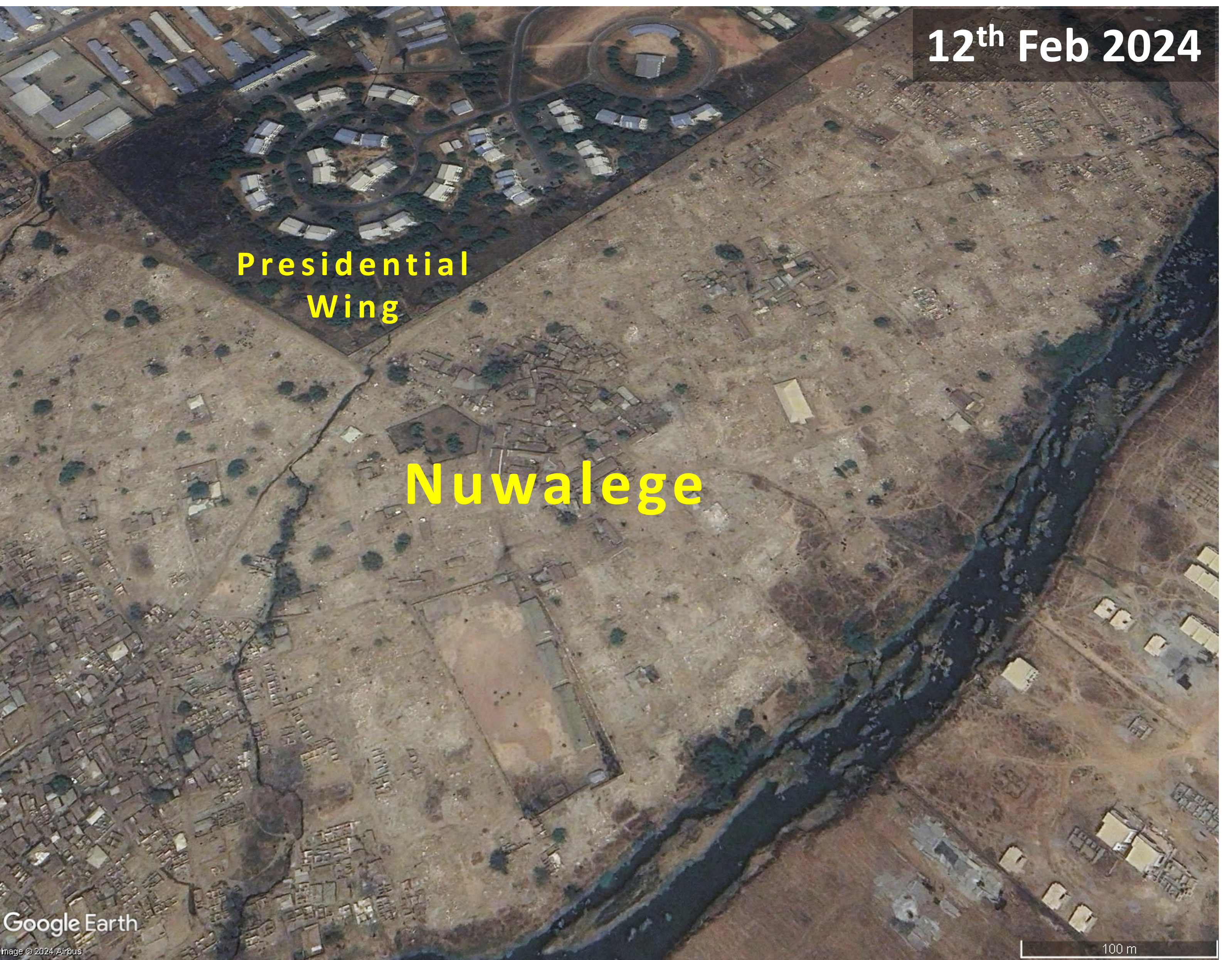
Demolition of Nuwalege homes for Presidential Air Fleet expansion

On the morning of 15th January 2024 dozens of police and soldiers stood guard as over 200 homes in the Nuwalege community, a settlement in a rural area adjacent to the Presidential Wing of Nnamdi Azikiwe International Airport (the main airport of Abuja, capital city of the Federal Capital Territory of Nigeria) were demolished to make way for expansion of the Presidential Air Fleet (PAF). Police fired teargas to disperse residents and they were prevented from entering their homes. Officials threatened to seize people’ phones and one person who took photos of the demolition was manhandled. Some Nuwalege residents including community leaders said that the demolition happened without warning.

Satellite imagery shows Nuwalege homes demolished for expansion of the Presidential Air Fleet. The image on the left is from 2nd May 2023, the most recent Google Earth imagery before the demolition exercise. On the right is an image from 12th February 2024, nearly a month after the demolition began.

Demolition of more than 200 houses in the Nuwalege community had been ordered by the Federal Capital Territory Administration (FCTA) on 18th December 2023 and a thorough investigation of compensation for affected people, involving the FCTA, the Department of Resettlement and Compensation and the Nigerian Air Force (NAF), was promised. Peter Obi, Labour Party candidate in the 2023 presidential election, spoke out against the planned demolition in a statement on his X account: “I am again pained that we are embarking on such an inconsiderate project at this critical time when the country is going through such hardship…We cannot continue to encourage those who have kept us suffering to enjoy a luxurious lifestyle far beyond our legitimate means…I therefore, advise that we have a rethink, and, most importantly, ensure that our fellow Nigerians are not rendered homeless for the sake of an unproductive presidential fleet.” He also argued that instead of expanding the Presidential Air Fleet the government should explore ways of reducing or getting rid of it to reduce costs.

Seven months after the demolition, in August 2024, The Punch reported that Nuwalege landowners who were forcibly ejected following demolition of their homes were still calling for compensation. Residents denied Department of Development Control claim that the structures belonging to indigenous people had been left intact, saying that no houses had been spared from demolition and the Director of the Department of Development Control’s claim that they had been given a two-month notice period before the demolition took place. Many displaced residents had been forced to seek shelter in nearby communities including Zamani, Sauka, Giri, Iddo and Gwagwalada.

Resource Centre for Human Rights and Civic Education (CHRICED) issued a statement expressing dismay at widespread destruction of indigenous settlements in the FCT on 1st September 2024, making specific reference to the forcible demolition of over 200 homes in Nuwalege. Urging the government to engage in dialogue with affected residents CHRICED Executive Director Ibrahim M. Zikirullahi said, “The demolition reportedly executed by the Federal Capital Development Authority (FCDA) to accommodate the luxurious lifestyle of the presidency demonstrates gross irresponsibility and insensitivity to the plight of the Abuja natives. This prioritization of luxury and expansion for a select few over the basic rights and needs of ordinary citizens is an affront to democratic values and the principles of social justice.”

Works in the demolished area have not commenced but on 1st November 2024 a N9.8bn (USD5.9m) contract for rehabilitation of facilities in the Presidential Wing was awarded to Nigerian construction firm Julius Berger. Executive Secretary of the Federal Capital Development Authority (FCDA) said the project – including rehabilitation of the link road, access road to the presidential kitchen, hangar housing presidential aircraft and holding centre for visiting presidents – would take six months. A number of civil society organisations condemned the contract. Peluola Adewwale, National Secretary of the Democratic Socialist Movement, said, ”The N9.8bn presidential wing rehabilitation contract is a misplacement of priority, frivolous and insensitive.” The Committee for the Defence of Human Rights (CDHR) described the Presidential Wing rehabilitation as an ‘unnecessary project’. CDHR chairman in Osun State, Emmanuel Olowu, said, “the Tinubu’s government prioritises a luxurious lifestyle against the welfare of the people.”

For more information including references for all source material see the case study on EJAtlas, the world’s largest, most comprehensive online database of social conflict around environmental issues – Nuwalege homes demolished for Presidential Air Fleet expansion, Nigeria.

Lucknow Airport expansion, land acquisition, protest and Aerocity plans

Satellite image of Lucknow Airport (Chaudhary Charan Singh International Airport) dated 20/10/2024. Location of Terminal 3 and some of the villages affected by land acquisition for airport expansion are shown.

Lucknow Airport (also known as Chaudhary Charan Singh International Airport), located 14km southwest of the capital city of Uttar Pradesh, is already the 11th busiest airport in India and traffic will increase with recent and ongoing expansion. A third terminal began operations on 30th March 2024, with capacity for 8 million passengers per year, set to rise to about 13 million upon completion of phase two. Land from Bhaktikhera village was used for the third terminal and runway extension and in March 2018 the Airports Authority of India (AAI) agreed to pay Rs 32 crore for relocation of about 600 residents. Compensation for acquisition of 70 acres of land from Bhaktikhera, Gurera and Aurangabad Jagir villages, for runway extension and other facilities, was still being negotiated in June 2018. Airport expansion had been stalled for a decade due to difficulties with land acquisition. But in June 2019 the AAI announced that ‘decks are cleared for the construction of the wall around the airport and expansion of the runway’. The district administration committed to helping AAI build the wall to keep out people ‘trespassing the area’ and stray animals posing safety risks.

Demolition notices and farmers protest boundary wall construction

Construction of houses near Lucknow Airport also raised safety concerns. At the end of August 2024 authorities served demolition notices on 50 houses which had been built next to the airport boundary without authorization. A Lucknow Development Authority (LDA) official said a builder had posed as a contractor without obtaining the requisite No Objection Certificate (NOC) from the airport administration, acquired land directly from farmers and pocketed the money. A month later construction of the airport boundary wall led to a clash between a group of farmers and police. After commencement of excavations works, with two JCBs in the presence of police, a large number of farmers, between 150 and 200, gathered and began to protest, saying the airport administration was forcibly occupying their land. The farmers, from Rahimabad and Mohammadpur Bhakti Kheda villages, said a disputed land petition was pending adjudication in the Allahabad High Court.  The protest forced authorities to temporarily halt land reclamation operations for airport expansion. Farmers argued that the land had been cultivated for many generations and that land acquisition notification in the 1950s lacked important details including plot numbers, land area and the names of the landowners, thus raising questions about the legitimacy of the acquisition process.

In response to the protest the district administration postponed the land reclamation drive until 15th October. The owner and operator of Lucknow Airport, Adani, one of India’s largest multinational conglomerates, plans to reclaim approximately 260 acres on the southern edge of the airport for extension of the runway to 3,500 metres to accommodate large, wide-body aircraft and construction of two parallel taxiways. Speaking anonymously, an official stated that a total of about 400 acres owned by the airport for over 70 years would be reclaimed for airport expansion and a survey would be conducted to compensate farmers with crops growing on the land. The principal petitioner against the land reclamation said the farmland had not been legally acquired, farmers had not received any compensation and Adani was attempting to forcibly construct the airport boundary wall. 

Boundary wall construction continues and Aero City plans

On 25th October the Supreme Court dismissed the farmers’ plea against expansion of Lucknow Airport, allowing LDA to proceed with the project. Lucknow Development Index announced on X that, after deployment of a ‘heavy police force’ in response to resistance, ‘work is still progressing amid farmers clashes’. A ‘massive area’ was being reclaimed and construction of the boundary wall had re-commenced. An official source said a 400-acre area was being reclaimed and a fourth terminal and an Aero City was planned on the land.

 Few months previously, on 5th February 2024 Times of India had reported ‘ambitious plans’ for Lucknow Aerocity, a 1,500 acre development with ‘an array of upscale amenities, such as world-class convention centres, large parks and seven-star hotels’, announced by Uttar Pradesh finance minister Suresh Kharna. The LDA was tasked with identifying land for the project, likely to be located in Rahimabad and Gahru villages. In addition to Lucknow, Adani owns several airports in India including Mumbai, Mangaluru, Jaipur, Ahemedabad, Thiruvanthapuram and Guwahati. Plans for aero cities adjoining Adani’s airports were reported in July 2022. The Economic Times stated that Adani plans to develop ‘aero cities’ on more than 500 acres at all its airports, with hotels, convention centres, retail, entertainment, healthcare, logistics, offices and other real estate sectors.

Locals resisted eviction for Guwahati Airport expansion

At the beginning of September 2021, a month before operation of Guwahati Airport (the busiest airport in northeast India) was handed over to Adani, there were reports of locals resisting eviction to make way for expansion. An eviction notice was served to 54 households, outside the walled area of the airport in Koitasidhi village. An airport official said the land, adjacent to the runway, was to be developed as an approach area, especially for larger aircraft on international flights. Villagers said that several plots of land had been acquired for construction and expansion of the airport since 1962. Some villagers said, “We would rather give our blood than give up our land”. Continuing protest was reported on 8th September; a local person said “We heard that the Adani group which has been given charge of the Airport for 50 years under a lease agreement by the Government of India wants to do expansion work here. But we want to clarify that we will not leave our land even if we are given adequate compensation”. Some other locals said they would not give their land to Adani. On 15th September 2021 the Times of India reported that villagers were fiercely resisting giving up land for airport expansion. A tearful farmer in his late 70s said his family had been compelled to give up land for airport expansion in the 1960s, which if sold today would fetch a much higher price. His family was left with ownership of just one residential plot. More recently, in June 2024, announcing the schedule for opening of a new terminal at Guwahati Airport in April 2025, Chief Airport Officer Utpal Baruah said plans for subsequent expansion phases included a maintenance, repair and overhaul (MRO) facility, aerocity and helipad.

New book – Contested Airport Land in Asia and Africa

A new book draws attention to accelerating airport development in Asia and Africa, elucidating many factors underlying the political sensitivities frequently surrounding greenfield development, airport expansion and airport cities. Contested Airport Land: Social-Spatial Transformation and Environmental Injustice in Asia and Africa, edited by Irit Ittner, Sneha Sharma, Isaac Khambule and Hanna Geschewski, is published by Routledge.

Following a conceptual introduction and overview chapter in-depth case studies give nuanced insights into the complex socio-economic, political and administrative dynamics of seven airport projects: the suspended Nijgadh Airport (Nepal); Mattala Airport (Sri Lanka); Yogyakarta Airport (Indonesia); a critical review of airport land contestations in India focussing on Jewar and Dehradun airports; the airport reserve in Abidjan (Cote d’Ivoire); Durban Aerotropolis (South Africa) and Isiolo Airport (Kenya).

You can listen to a conversation with three of the co-editors on an episode of The Channel podcast from the International Institute for Asian Studies (IIAS) at Leiden University, hosted by Benjamin Linder.

Contested Airport Land: Social-Spatial Transformation and Environmental Injustice in Asia and Africa

Construction of an ‘Eco-Tourism Airport’ on Koh Rong island

Earthworks for construction of an airport on Koh Rong island, 25 km from the city of Sihanoukville on Cambodia’s south-west coast, began in January 2024. Satellite imagery shows the airport site, located in a flat area in the centre of the island. The new airport with a 2.650 metre runway will have capacity to handle 138,000 passengers annually upon completion of the first phase and the MoU signed in January 2023 formalised a budget of $300 million. The necessity and viability of Koh Rong International Eco-Tourism Airport seems questionable with two major international airports nearby. Newly constructed Dara Sakor Airport, with capacity for 10 million passengers per annum and scheduled to begin operations in November 2024, is only 21km away. Sihanouk Airport is 45 km away. Also, Koh Rong is already well served by boat; the ferry journey from Sihanoukville only takes about 45 minutes.

Satellite imagery of Koh Rong dated 1st November 2023, showing location of the four coastal villages, Royal Sands resort, long beach, major roads and Koh Rong International Eco-Tourism Airport construction site.

The new airport will be named ‘Koh Rong International Eco-Tourism Airport’. While an airport enables people to visit and explore protected beaches, forests and native wildlife habitats, it does the very opposite of protecting ecosystems, concreting over a vast area for runways, terminals and access roads. Then there is the issue of climate disrupting greenhouse gas emissions from flights, with aviation being energy intensive and dependent upon fossil fuels. And tourism development on Koh Rong has damaged ecosystems and the people depending on them. In 2008, Royal Group, one of the largest investment and development companies in Cambodia, was granted a 99-year land concession to develop the 78 square kilometre island. Realisation of the masterplan – featuring resorts, casinos, marinas, golf courses, two fishing villages and an airport – was delayed but commenced in 2015 with clearance of sites along the southwestern coast including forests along with construction of a road. On 3rd July 2015 Koh Touch villagers held a sit-in protest, blocking construction crews, excavators and a bulldozer, in response to construction of a road which they said would cut through their village and affect their homes. Later that month opposition to development of Koh Rong became more vocal in response to construction equipment and workers appearing on the island. Hundreds of residents began to speak out on social media. As well as cutting trees cliffs and rocky outcrops had been flattened for development, including a new pier on Long Beach, on the southeast of the island.

In August 2015 a number of Koh Kong residents called on officials to review what they called “abusive activities” by Royal Group. Construction had accelerated in recent weeks and workers and machinery had been photographed clearing large areas of forest. Residents accused Royal Group of destroying farmland and crops, including cashew, jackfruit, coconut and mango trees. A village leader said destruction could impact the livelihoods of over 100 families, who had lived on the island since 1995. Villagers said the destruction of their livelihoods was illegal and authorities should monitor the situation. Human rights and environmental campaigners supported residents’ calls for improved oversight and local groups were preparing petitions and other documents to file with provincial and national authorities. Protest groups had been formed in response to a breakdown in communications between residents and Royal Group. One villager said, “They come in and do their work, take whatever they want, but there is no communication”. 

Controversy over land titles for Koh Rong villagers was reported in 2017. Some residents who had lived on the island since before 2008 had land titles, although it was uncertain whether these titles would be upheld amid disputes. Those arriving after 2008 did not have land titles. By 2018 over 1,000 land plots, belonging to 500 families, had been recognised by the government, but in April 2018, during the inauguration of the luxurious, five-star Royal Sands Koh Rong resort, about 50 people who had not yet received land titles attempted to join the event but were prohibited from doing so. Prime Minister Hun Sen ordered the Ministry of Land Management to bring an end to the Koh Rong land dispute. In June 2020 53 families protested land clearance; a 35-hectare site they believed rightfully belonged to them was being bulldozed. A Preah Sihanouk Provincial Administration spokesperson called on the protesting families to cooperate with authorities by providing relevant documents and warned them that if they caused chaos legal action would be taken against them. A member of one of the protesting families claimed they had lived in the area since 1992 and said: ”We won’t go anywhere. I will gather to protest at this site. We dare not enter the bulldozing site. I want Prime Minister Hun Sen to see and tackle this issue for us. We all have ownership documents.”

In June 2024 Mongabay reported that a new map of Royal Group’s plans for Koh Rong showed golf course zones, commercial zones, accommodation zones, casinos zones and an international airport. The latest plans did not appear to impact fishing villages but included clearing some of the Koh Rong’s protected forests to make way for golf courses. In total, project plans entail clearing more than 3,100 hectares of the island’s forests. A photo showed bulldozers and trucks working on the airport site. Sixteen years after the land was leased to Royal Group there was still no publicly available social or environmental impact assessment and islanders’ future was uncertain. Some Koh Rong residents hoped to sell their land to Royal Group while others feared that it would be taken from them.

For more information about the airport and tourism projects on Koh Rong island, including references for all source material, see the case study on EJAtlas, the world’s largest, most comprehensive online database of social conflict around environmental issues: Koh Rong island tourism development, Cambodia.

Pacific Airport displaces communities, destroys agriculture and is intended to serve a planned Bitcoin City

In Conchagua, El Salvador, the Condadillo and Flor de Mangle communities are being displaced from their homes and farmland for construction of Pacific Airport. A linked ‘Bitcoin City’ on the slopes of an inactive volcano has yet to materialise.

Pacific Airport location map with respect to environmental zoning
Location of Pacific Airport project with respect to environmental zoning, Ministry of the Environment and Natural Resource (MARN), 09/2021. Source: Mala-Yerba

El Salvador’s Legislative Assembly approved a new law expediting procedures for building the Pacific Airport on 26th April 2022, allowing the Autonomous Executive Port Commission (CEPA) to acquire title to property deemed necessary. In June 2022 the Earth Journalism Network reported that vegetation was being cut to make way for the airport and eucalyptus trees had been marked for felling. Inhabitants who cultivated crops said government personnel had entered the land to cut plants, without reaching a sale agreement as had been promised. In November 2022 Mongabay reported that the airport faced backlash from local communities after breakdown of negotiations with the government. Residents said they were being pressured to accept buyouts for their properties. Mala-Yerba reported that works on the airport site had begun at the end of February 2023, before the environmental permit was issued by MARN on 21st March. A source from Condadillo expressed concern over irreparable damage to trees, mangroves, animals, birds and aquifers. Flor de Mangle residents, depending on sea fishing and harvesting molluscs from the nearby El Tamarindo mangrove will also be impacted, as the area is a nursery for crabs, molluscs and other crustaceans and many residents make an income from collecting and selling them.

Residents of Condadillo and Flor de Mangle recounted workers entering agricultural and housing land plots with machinery, in the absence of authorisation from landowners or a court order. Drilling and excavation left the area unsuitable for agriculture and unsafe for people and livestock. Residents also denounced pressure from CEPA to sell land at unfair prices. Farming families and MILPA (Indigenous Movement for the Integration of the Struggles of the Ancestral Peoples of El Salvador) representatives said that more than 225 families had been directly affected by being unable to produce crops – including watermelons, tomatoes, grains and chillies. At the beginning of July 2024 MILPA stated that human rights violations against Condadillo and Flor de Mangle inhabitants impacted by construction of Pacific Airport had worsened. More than 225 families said their rights to consultation, legal advice and compensation had been violated. Many inhabitants reported being threatened and intimidated by CEPA.

New laws, tax exemptions and an “air-tropolis”

On 29th September 2021 MARN issued a statement that the Pacific Airport was not environmentally feasible and the Autonomous Executive Port Commission (CEPA) submitted a request to MARN for reconsideration. Within 24 hours the MARN website changed the status of the airport project to ‘high impact’. New environmental zoning and a new eminent domain law approved by the Legislative Assembly on 17th November 2021 made legal provision to continue the project. Then, on 26th April 2022 the Legislative Assembly approved a new law expediting procedures for building the Pacific Airport, allowing CEPA to acquire title to property deemed necessary for construction of the airport. It is estimated that the new airport will handle 1 million passengers per year, possibly rising to 3 million within 25 years. Construction of Pacific Airport, for civilian and military use, is expected to cost $500 million over 10 years. Purchases made within the framework of the airport project will be granted exemptions from income tax, Value Added Tax (VAT) and municipal taxes for 25 years. According to CEPA’s projections, the airport will bring poles of economic development to El Salvador’s eastern zone. CEPA president, Federico Anliker, said the airport terminal will be converted into an “air-tropolis”: a city with industrial plants, resort centres, hospitality and factories for export of technological products. For more information about Pacific Airport, including references for all source material, see the case study on EJAtlas, the world’s largest, most comprehensive online database of social conflict around environmental issues: Pacific Airport (Aeropuerto del Pacífico), El Salvador

An airport for a planned Bitcoin City

Pacific Airport is linked with the Bitcoin City project announced by President Bukele in November 2021, two months after El Salvador became the first country to adopt Bitcoin as legal tender. Bukele unveiled a model and graphics showing a coastal circular city (the shape of a Bitcoin) on the slopes of the volcano, crammed with golden skyscapers radiating from a central plaza with the Bitcoin logo, along with images of an airport. In February 2022 CEPA President Federico Anliker said, “Bitcoin City, well, is going to have its own airport”. The proposed Bitcoin City site is in an inactive volcano in Conchagua and plans include a bitcoin mining complex to be powered by a new geothermal plant. Environmentalist Ricardo Navarro, from Cesta Amigos de la Terra, expressed concerns over geothermal energy generation for Bitcoin mining, saying “The big problem is that it consumes a large amount of electricity”. Lourdes Molina of the Central American Institute for Fiscal Studies said, “Here it is not only the operation of the servers but also that they demand a lot of energy, they have to be at certain controlled temperatures to be able to work, we are talking about the almost industrial use of air conditioning.”

Funding for Bitcoin City is as uncertain as the energy supply. As of July 2024 the ambitious plans for Bitcoin City, compared by Bukele to Alexandria, have not materialised, the ground has yet to be broken. Construction was supposed to be part-funded by $1 billion in government-issued ‘volcano bonds’ with a portion of the earnings to be invested in geothermal energy facilities. Initially scheduled to go on the market in February 2022, several deadlines were missed, most recently in the first guarter of 2024. The government has not announced an alternative source of funding for Bitcoin City. Bitcoin was central to Bukele’s promises of prosperity; three years after it became legal tender few citizens use it. Bitcoin was promoted as a way of making savings on fees for remittances from the US, but only 1.3% of remittances were sent through crypto wallets in the three year period and the amount of saved fees has not been disclosed. The future of Bitcoin City, anticipated to bring in an influx of wealthy crypto investors and returning expats buying luxury apartments and paying no income or property taxes, seems to depend upon construction of Pacific Airport. However, Bitcoin city could be revived by another transportation project. Turkish port operator Yilport Holdings has made the pargest private investment in El Salvador, committing $1.6 billion to two port projects, La Unión, near the Bitcoin City site, and Acajutla. which is the country’s main seaport.

Dara Sakor Airport serves tourism zone taking up 1/5 of Cambodia’s coastline

In November 2023 Cambodia’s State Secretariat of Aviation (SSCA) announced that construction of Dara Sakor Airport (Cambodia’s fourth international airport after Phnom Penh Airport, Siem Reap Airport and Sihanouk Airport) was in its final stages. Dara Sakor Airport has been built to serve a gigantic tourism-oriented economic zone, the 451 square kilometre Dara Sakor project encompassing about one-fifth of Cambodia’s coastline. The Dara Sakor developer, Coastal City Development Group Ltd., calls the project ‘Coastal City’ and its website has pictorial maps indicating the many components of the project such as Dara Sakor Airport, a resort, tourism zone, golf courses and a port. The China-Global South Project reflected on the Dara Sakor project in 2023. Of all the anticipated infrastructure only the airport was completed. Yet the project continued with ‘considerable support from the government’. BBC reporters visiting Dara Sakor in September 2023 described unfinished roads and buildings as a stark contrast with ‘dazzling brochures for potential investors’.

Pictorial map of Dara Sakor project including tourism zone, resort, golf courses, development zone and Dara Sakor International Airport. Source: Coastal City Development Group Ltd.

Thousands of people have been forcibly displaced from their homes for the Dara Sakor project, losing their farming and fishing livelihoods. There have been many protests against eviction and inadequate compensation, in many instances met with repression. Unrest dates back to the inception of the project in 2008 when 360 sq km of land in the Botum Sakor and Kiri Sakor districts in the Koh Kong Province was reclassified as state-owned land. A 99-year lease contract was signed with Union Development Group (UDG) of China. Cambodian Human Rights and Development Association (Adhoc) reported that affected communities were not consulted about the project, some only becoming aware when officials arrived to measuring land. In 2011 the project site grew to 451 sq km when UDG was granted an additional 91 sq km land concession to develop a water reservoir and hydropower. During 2011 UDG began dismantling and burning down some villagers’ houses and destroying productive trees.

A key protest took place in February 2014 when about 140 people blocked the road to UDG’s offices leading to a clash with 40 UDG security guards and six soldiers carrying AK-47 rifles. Kiri Sakor District Governor said district authorities had ordered about 100 families to vacate their land for the Dara Sakor project’s hotels, golf courses and an airport. By September 2014 5,791 people had moved to a relocation site where they lacked access to former farming and fishing areas and suffered many problems including poor quality housing damaged by wind and rain, limited water that did not meet national standards, lack of electricity and health care facilities. Reports of destruction of houses and productive trees emerged again in 2018. In april April Koh Kong Provincial Court heard testimony from 13 families claiming that 60 UDG guards had burned their productive trees, seeking compensation for loss of cassava, jackfruit, mango, rubber and coconut crops.

On 27th May 2019 about 20 residents protested in front of the Chinese Embassy in Phnom Penh, calling for resolution of the 11-year land dispute. A report by the Community Legal Education Center stated that 1,143 families were forced to vacate about 100 sq km of land in the first five years fo the project but many families had resisted and fought for rights to the land. Four villagers were detained for 12 hours on 29th September 2020, after camping outside Koh Kong Provincial Hall calling for action over the 12-year land dispute with UDG. A year later 1,333 families rejected compensation offers of between 1 and 3.5 hectares and said they would fight to remain on their land. Protests against compensation offers continues into 2022; some declined the offer as it was insufficient and the village the government wanted to relocate people to was 100 km away and lacked infrastructure.

In June 2023, just four months before SSCA’s announcement about construction of Dara Sakor Airport entering its final stages, there was yet another protest by people affected by displacement for the Dara Sakor project. A group of villagers involved in a Dara Sakor related land dispute attempted to travel to Phnom Penh to submit a petition at the Ministry of Justice, but were met with a police roadblock. Eleven villagers were arrested, forced into a truck, returned to Koh Kong and charged with criminal incitement. Radio Free Asia reported that authorities threatened further arrests after about 20 villagers gathered outside the offices where the 11 people were being detained. Human rights organization Licadho said the protesters had not caused any social disorder and that police had been sent to the the area where many of them lived.

For more information including references for all source material see the case study on EJAtlas, the world’s largest, most comprehensive online database of social conflict around environmental issues – Dara Sakor project, Cambodia.