Airports in India

The ‘Airports in India’ report by Equitable Tourism Options (Equations), is a useful critique of government plans for massive airport expansion. Published in May 2015, the report is skeptical regarding the viability of plans to construct 200 new airports over the next two decades, when most of India’s established airports operate at a loss. Vast amounts of public expenditure on airport infrastructure would benefit only a small wealthy minority, in a country where 22 per cent of the population live below the poverty line.

In many instances new airport plans are rushed, without proper consultation of the local community and the requisite environmental clearances. Several Indian airport projects have met with opposition from affected communities. The Bhogapuram airport project has seen massive protests by farmers (also see GAAM blogposts from 15th April and 17th April 2015). Airports in Sikkim and Aranmula have been stalled by community protests. There has also been vigorous opposition to privatization of Mumbai, Delhi and Chennai airports. Chennai Airport is thought to have 2,000 acres of land which the private operator can lease for facilities like five-star hotels. The report urges the government to reconsider new airports in favour of upgrading existing airports.

Army Invades the Ejidal Lands of San Salvador Atenco

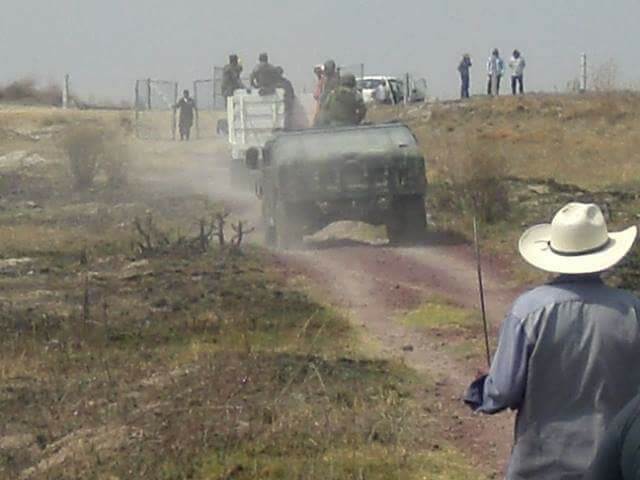
The Mexican army invaded ejidal (communal) lands of Atenco, where communities have resisted land expropriation for an airport for more than a decade. The military convoy was escorting a party of workers from one of the companies contracted to construct the airport. The community of Atenco has begun daily patrols to prevent further intrusion into ejido lands and is calling for international solidarity.

dorsetchiapassolidarity's avatardorset chiapas solidarity

.

Army Invades the Ejidal Lands of San Salvador Atenco

atenco invade 

In the morning of April 12, while the police forces of the State of Mexico continued advancing at the other end of the state, in San Francisco Xochicuautla, a convoy of military entered the ejidal lands of the community of San Salvador Atenco to escort a gang of workers from one of the private companies in charge of the construction of the new airport in Mexico City.

Community members who have resisted the expropriation of their lands for more than ten years told Desinformémonos that the day before, April 11, an official of the company had already arrived in the communal lands, at the base of Cerro Huatepec, with the intention to “carry our measurements.” Facing the intrusion, villagers moved in and responded.

“The compañerxs told them that they could not be on communal lands because we are in…

View original post 738 more words

Farmers in Ekiti, Nigeria achieve High Court victory in fight against airport project

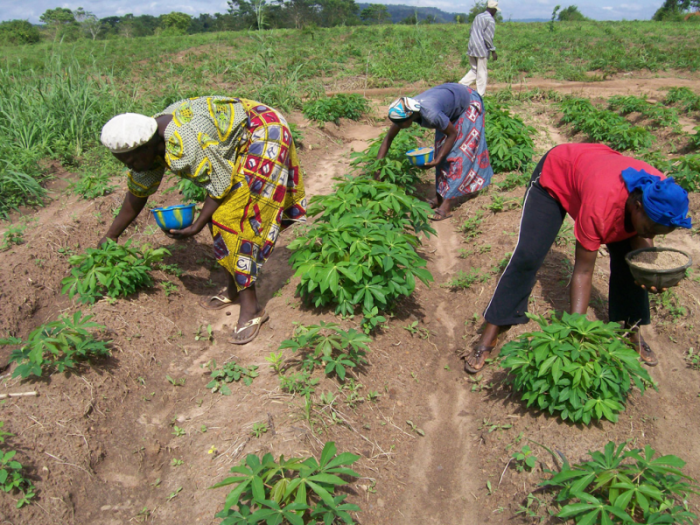
An article in The Ecologist, Nigerian farmers win High Court victory in fight against Ekiti airport, is a story of a successful struggle against a land grab for an airport. On 2nd October 2015 the state government of Ekiti, in western Nigeria, sent in bulldozers to clear 4,000 hectares of farmland for an airport. Bulldozers were sent in and began destroying crops, without even warning the farmers, never mind making provision for compensation for their loss of land and livelihood. Affected farmers from the five affected villages fought back, organizing a protest and filing a suit.There was widespread criticism of the airport project, allocated an enormous amount of public funds in a state where many residents are impoverished. The viability of the project was dubious as many airports in Nigeria, including one in the neighbouring state, are underutilized.

Ekiti picThe plan for Ekiti airport was not, to my knowledge, referred to as an ‘aerotropolis’. But the land area allocated, 4,000 hectares, is far more than would be required even for an enormous global hub airport (an unlikely prospect in an agrarian state). In comparison, Atlanta Airport, in the USA, the busiest passenger airport in the world handling over 100 million passengers in 2015, covers an area of about 1,600 hectares. As well as land used for airport operations.this includes considerable commercial space, such as retail and warehouses.

On 20th January 2016 farmers held a protest, storming the Ekiti airport project site and demanding that work cease immediately, in respect of the suit that they had filed. They held placards with slogans reading: “Gov Fayose, Please Leave Us Alone, Don’t Damage Our Life”, “This Land Is The Major Cocoa Plantation, Please No Trespass”, “Please Relocate Your Airport to Government Forest”, “We All Say No To Illegal Airport Project”, “Iwajo, Aso Say No To Illegal Airport”, and “Igbogun Cries Over Illegal Destruction of Our Property”. They also stated that at least ten farmers, including three women, had ‘died of shock’ caused by the destruction of their farms.

In 22nd March the Ekiti farmers secured victory in the High Court, which ordered that forcible take-over of their land for the airport was unconstitutional, illegal, null and void. But there are plans for major new airports all over Nigeria, in the states of Osun, Bayelsa, Abia, Ogun, Anambra and Nasarawa, all of which are being vigorously opposed. Citizens are calling on governments to use the vast amounts of public funds being allocated to these airports to infrastructure that will benefit ordinary people – to repair roads and bridges and support small businesses. And yet another major airport plan is looming. The Yobe state government plans to build a N6 billion (over US$30 million) cargo airport in Damaturu, to act as a gateway for investment in the state and facilitate export of meat, dairy produce and gum arabic (acacia gum). The scheme which is meeting with criticism and goes against state commitments to prioritise water supply, schools, clinics and roads to benefit local communities.

Opposition to airport project in Kaş

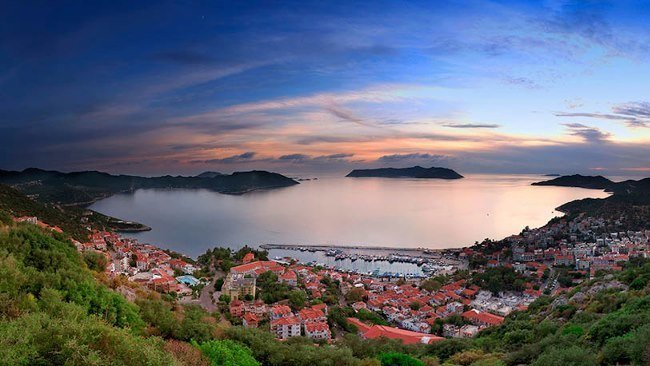
A proposal for an airport near the town of Kaş has raised serious concerns over threats to the region’s heritage, agriculture and natural environment. Kaş is a popular tourism destination on the mountainous southernmost shore of Turkey, known as the ‘Turquoise Coast’ and one of least developed areas of the Mediterranean. The rugged coastline has beautiful bays, coves and beaches. Outdoor activities include kayaking, paragliding, mountain-biking and trekkers flock to the area as it is situated along the 509 kilometre Lycian Way. The proposed airport site is a few kilometres inland from Kaş in the Çomucak-Pınarbaşı-Çukurbağ-Ağullu area. It is thought that the proposed land area to be allocated for the airport is about 20 square kilometres. This is almost twice the 11.7 square kilometre area of Istanbul’s Ataturk Airport, the busiest airport in Turkey, handling over 61 million passengers in 2015.

Kas

If the airport project goes ahead there will be negative impacts on historical and archeological sites, including Phellos, the largest ancient city in the area, on the outskirts of Kaş. Forested areas would be destroyed and the area is rich in native plants such as the endangered Lycian orchid. Fertile land that is cultivated, with agricultural plots, livestock grazing and beehives, would be lost, along with farming livelihoods. Parts of Pınarbaşı village are in the expropriation area, so people may face displacement. There are also concerns that residents of the Ağullu, Belenli, Çukurbağ, and Yeniköy neighbourhoods would be forced to relocate. Noise pollution from aircraft flying overhead would ruin the tranquillity of the villages. The Greek island of Kastellorizo is close to the coast so building the airport would require permission from Greece.

Kaş has a population of just 8,000 people and mass tourism would damage unique natural, cultural and historical assets. Major and international firms would take trade away from local tourism-based businesses. Campaigners warned that an airport in Kaş would lead to the area meeting the same fate as the coastal resort towns of Marmaris and Side, also on the Mediterranean coast, and Kuşadası on the western Aegean coast, their distinctiveness deteriorating due to large-scale tourism developments.

A consortium of eight companies, DETUYAB, has applied to the Ministry of Transport and Communications to build the airport on the BOT (build-operate-transfer) model. DETUYAB is already heavily involved with mass tourism projects in the area. The consortium is developing a 115 hectare tourism zone in the coastal town of Demre, about 47 kilometres east of Kaş, including restaurants, villas, hotels with a total of 7,500 beds and a 700 berth marina. Demre has sandy beaches and, like Kaş, is surrounded by historic sites, cultivated land and important wildlife habitats.

Opposition to the airport plan is gathering momentum. A group of local organisations – including Kaş Tourism Association, Kaş Kalkan Patara Hoteliers Association, Kaş Underwater Association and Kaş Environment Platform – has submitted a seven-page report to local state bodies opposing construction of the airport, detailing the damage that would be caused to nature, communities and the local economy. An online petition, We don’t want an airport in Kaş, had already attracted nearly 19,000 signatures.

Video playlist: Aviation expansion – resisting displacement

GAAM has posted a video playlist Aviation expansion – resisting displacement on our YouTube channel. All over the world communities are resisting displacement for airport expansion and new airports. Airport development on greenfield sites often entails concreting over agricultural land, and rural communities fight against loss of their land and livelihoods. People living in slums near airports face an uncertain future and are fighting for secure and decent housing. Already there are 14 videos on the list – campaigns in many countries including Cambodia, India, South Africa, Turkey, Laos, Taiwan and Mexico. GAAM would will be adding more films to the list, do let us know of any videos that should be included.


Defending the zad: A new little book about the struggle against an airport and its world.

A book written by some of the occupants of the ZAD (Zone a Défendre) – a site in Western France which has been occupied for over 9 years – in resistance against the construction of the planned Notre-Dame-des-Landes airport. Over 5,000 acres of farmland and wetladns would be destroyed. Evictions and mass protests are documented, and the sustained solidarity which has held the ZAD together for so many years. The ZAD is a ray of hope in the resistance against destructive megaprojects.

Indigenous Islanders are Employing Shamanic Symbolism to Resist Jeju Island’s Proposed 2nd Airport.

Residents of Jeju Island (South Korea) are resisting a proposed airport that would displace people from five villages. The project has been imposed on local communities without consultation, and with little consideration on how the planned influx of millions of tourists would impact on rural people. The majority of local people oppose the airport, and it is being met with a series of protests.

pagans we are's avatarpagans we are

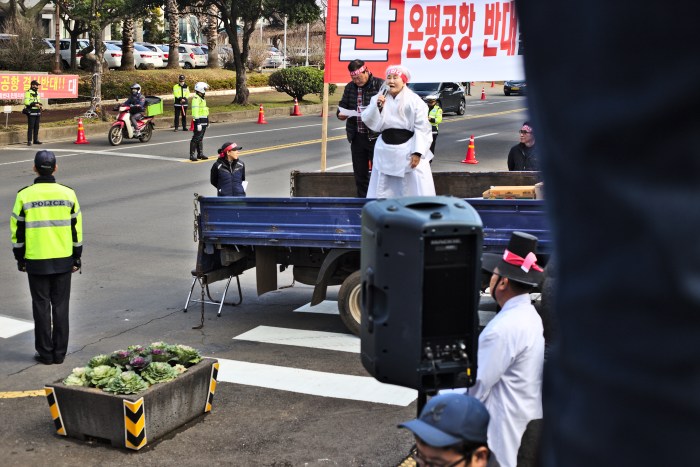
IMG_3012 Onpyoung Village resident in costume, speaking as the Youngdeung Goddess at a demonstration last week. The goddess is worshipped in a rite performed by shamans each lunar February.

Indigenous residents of Jeju Island’s southeastern region are employing traditional shamanic culture to protest the airport that is slated to displace the populations of five villages. So far, the mainstream media outside of Jeju has done little to document resistance to the project. The new airport is opposed by the majority of residents in the villages affected. Hundreds of locals from Onpyoung  and Sinsan villages, elderly and young alike, including middle school students, have enacted a series of demonstrations against the development.

IMG_2997 Residents dressed as Jeju’s three founding father figures, Go, Yang and Boo, the mythical original residents of Jeju Island.

IMG_2973 “You’re trashing our hometown and we’ll have nowhere to go.”

IMG_3009 Farmers and women divers (haenyo) from the village gather in front…

View original post 532 more words

What do we get for ruining the Goyt Valley?

Communities around Manchester Airport are facing massive road building projects. It is claimed that new roads will ease traffic congestion. In reality the eye-poppingly expensive road building will create more traffic, with the inevitable increase in health damaging air pollution, and ruin homes, countryside and unique local heritage.

slowdriver's avatarStockport Bypass Facts

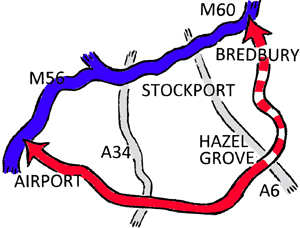
An old Hazel Grove-to-Bredbury bypass plan has been dusted off, with the Government paying £350,000 for a new feasibility study.  Since the study is being carried out by the road’s long-term promoters, Stockport Council, don’t expect it to be objective.

The Bypass would be a four-Mapand-a-half mile dual-carriageway extension of the A6-to-Manchester Airport  “relief road”, which is already under construction (the red route in the map). It’s the latest in a series of new roads claimed to sort out the terrible congestion south of Manchester. The bypass would cost a huge £580 million! The result might not be what people imagine….

More traffic problems The bypass will draw drivers into and through Stockport from all directions – M56, A34, M60 and  A6. To start with, some local roads will see moderate traffic reductions, but these may be short-lived. At times there will be so much traffic on the bypass that local drivers will struggle to…

View original post 373 more words

Statement on Tourism, Aviation and Children’s Rights

Can we still have hope that at the end of the United Nations climate conference (COP21) in Paris a good and fair agreement will be reached that works for people and not profits? The sad truth is that negotiators there act as if travel and tourism, which belong to the great contributors of greenhouse gases, do not exist.

With new research suggesting that emissions from global tourism and aviation are likely to increase by 300% by the end of the century, it is also highly ironic that the International Civil Aviation Organization (ICAO) celebrates an International Civil Aviation Day on 7 December to promote air travel as a mode of mass transport that is “safe, secure and sustainable”.
Please find below and in the attachment a Statement of the Tourism Action and Advocacy Forum (TAAF), which calls for the implementation of special measures in the aviation and tourism industries to protect today’s children and future generations. The Statement has been delivered to COP21 in Paris and we would like to ask you to share it widely.

AVIATION, TOURISM & CHILDREN’S RIGHTS:

A GLOBAL EMERGENCY
 
Statement of the Tourism Advocacy and Action Forum (TAAF)
Prepared by the International Support Centre for Sustainable Tourism
 
The International Civil Aviation Organization (ICAO) which celebrates International Aviation Day on 7 December calls air transport “by far the safest mode of mass transportation”1.  With climate change careening beyond acceptable limits, and the biosphere endangered by mass tourism, we must broaden our concepts of safety. 
 
If we evaluate safety through an inter-generational lens, the airline business ranks among the most unsafe human enterprises. Promoting air travel elevates not only greenhouse gas emissions, but also consumer lifestyles, consumption patterns and relationships which are unsustainable.
 
Herein lies a major dilemma for the 21st Conference of the Parties to the U.N. Framework Convention on Climate Change (COP21), and the Rio Conventions generally. Tourism, considered a sustainable industry and major contributor to a ‘green economy’ by the United Nations, is actually putting humanity on the Red List as endangered.
 
The precautionary principle must be applied to tourism.  At the third United Nations Conference on Sustainable Development (or Earth Summit) in 2012, tourism was endorsed without regard for local contexts of concern or the emerging global context of harm2. The World Tourism Organization (UNWTO) is mandated to promote tourism, as a hub for unrestricted economic growth.  This engenders mass tourism: in practice, exponential growth.
 
Globally, our binge spending on tourism is destabilizing the future of children.  The mass mobility of consumers drives climate change.  In turn, it amplifies biodiversity loss, ecosystem degradation, water shortages, social inequality, conflict (including domestic violence), forced migration, and often cultural vulnerabilities. Calling this set of behaviours ‘tourism’ masks its devastating consequences across generations. 
                                                                                                           
Only a few decades ago tourism had a seasonality and geography which offered some room for regulation. Today, the tourism industry pushes all-season expansion, on a planetary scale. Tourism corridors now enwrap the Earth, expediting urbanization.  Consumer society views aviation as a commute to global playgrounds and shopping outposts.   This has normalized the practice of consumers grazing for excitement and deals worldwide.  It raises complex moral questions about the underlying economic model3. Unchecked expansion of tourism has impinged on other peoples’, species’ and now generations’ flourishing and survival.
 
The aggregate impacts of “2.3 billion passengers a year on more than 26 million flights worldwide”4 is difficult to fathom.  Tourism, being highly cross-sectoral, has a magnitude of harm beyond other industries.  Although the assessment of impacts often is framed narrowly – without adequately bridging all involved economic sectors and affected community realms – recent research shows the correlations between tourism and risky outcomes across various ecological, social and cultural systems globally5. The composite of impacts is summarized in scientific literature as a crisis or even precipice for humanity6.  This news brings increasing anxiety, distress, trauma and other threats to mental and emotional health, especially for children worldwide.
 
Since the U.N. prioritized sustainable development in 1992, there has been scant attention to reducing tourism. Worldwide, governments, financial institutions, multinational corporations and investors still advance a marketing narrative that tourism is benign, if not beneficial. Airport expansions and aerotropolis construction abound7.  The aviation sector is pursuing growth, as if that is a lawful option under present biosphere constraints.   Business proceeds as if there is no inter-generational context to international law or to fundamental human rights.
 
Globally, the persons with weakest citizenship are most vulnerable to this economic model.  Children shoulder its costs more than any other population.  This is evident in the global supply ‘chains’ of the tourism industry; for example, among oppressed populations and impoverished families of the global South, exploited in manufacturing tourism spaces, infrastructure, souvenirs and experiences.  It also manifests in the biosphere crisis now endangering all children worldwide.  While the net effect is to diminish children’s capabilities, such costs are little documented outside the research enclaves of child labour and child sex trafficking.
 
The ideology of economic growth now puts an entire generation of children at risk.  Aviation, a mainstay of this ideology, is a primary cause of accruing ecological and social imbalances globally.  This ‘big picture’ of aviation – especially its role as a key structural element of neoliberal economics – must be assessed, for us to comprehend the full spectrum of inter-generational costs associated with tourism growth.
 
Tourism prompts integration into the very economic model which causes widespread harm.  Children of affluent societies are groomed to be consumers – the pinnacle being to become a tourist, with precocious stories of travel abroad.  Children in impoverished destination areas experience dehumanizing and degrading exchanges through tourism. For both, childhood soon involves more transactions than rites of passage.  Meanwhile, adult travellers valuing attachment with their own children often practice detachment as tourists: loading up child porters and waving away child vendors.  The Asia-Pacific Child Rights Award for Television and other child-centred research initiatives raise awareness about such dynamics. As tourism displaces communities, disrupts in situ conservation, supercedes customary practice requiring mobility (such as shifting cultivation and pastoralism), and eclipses the mobility needs of refugee children, affected children are deprived of life essentials, safety, and cultural health and must adapt to life on the economic fringes.   
 
We therefore appeal to COP21 to evaluate aviation and tourism in meaningful context, implementing special measures to safeguard today’s children and future generations, including:


*  prioritizing inter-generational rights and responsibilities, in U.N. decision-making;

 *  foregrounding an ethic of care, to hasten implementation of the Rio Conventions;

*  correcting the misleading narratives of tourism, to protect human rights

*  setting limits for the aviation sector, which address its systemic impacts and the urgent need for degrowth of both tourism and other unnecessary travel;

centring the well-being of children and future generations in evaluation frameworks;

*  implementing the full framework of human rights of children, as per international law

applying the capabilities approach to make children visible in benefit/cost equations and to remedy the inter-generational harms of gross domestic product (GDP) ideology;8

 *  identifying the mobility needs of children which are impeded or superceded by tourism, including their developmental needs and specific cultural rights to mobility.

 A child-centred approach to managing climate change must be adhered to in the aviation and tourism industries.
 
For further information contact the Tourism Advocacy & Action Forum c/o taaforum@gmail.com or ISCST at sustour@axionet.com

References:

1 International Civil Aviation Organization (2010).  Message from the President of the Council of ICAO, Mr. Roberto Kobeh González, on the Occasion of International Civil Aviation Day.  Montreal, Canada, December 3.
2. Johnston, Alison M. (2012).  “Tourism: For Next Generations? Rethinking the Future We Want”.  Third World Resurgence, Third World Network, Malaysia,  No. 262, June: 35-38.
3. Brenner, Neil (2013).  “Theses on Urbanization,” Public Culture, Vol. 25, No. 1: 85-113.
4. International Civil Aviation Organization, ibid.
5. Third World Network (2015). Global Tourism Growth: Remedy or Ruin? Third World Resurgence #301/302, Sept/Oct 2015.
6. Rees, William E. (2011).  Toward A Sustainable World Economy.  Paper delivered at Institute for New Economic Thinking Annual Conference, April 8-11, Bretton Woods, USA.
7. Global Anti-Aerotropolis Movement (GAAM). https://antiaero.org/
8. Nussbaum, Martha (2011).  Creating Capabilities: The Human Development Approach.  The Belknap Press of Harvard University Press, Cambridge, USA and London, UK.

Third World Resurgence – tourism issue

3WR coverThe September / October 2015 issue of Third World Resurgence magazine, published by the Third World Network, is a double issue with a special focus on tourism. The digital edition of the magazine is now available as a pdf file.

The tourism section of the magazine is introduced with an in-depth article by Anita Pleumarom, coordinator of the Bangkok based Tourism Investigation & Monitoring Team (tim-team) and member of the Tourism Advocacy and Action Forum (TAAF) and includes the following articles:
  • Tourism – a driver of inequality and displacement – Anita Pleumarom
  • Tourism and the biosphere crisis: Provisions for inter-generational care – Alison M Johnston
  • Rise of the aerotropolis – Rose Bridger
  • Tourism for women’s rights? – Albertina Almeida
  • Maasai fight eviction from Tanzanian community land by US-based ecotourism company – Susanna Nordlund
  • The puputan struggle against the Benoa Bay reclamation project – Anton Muhajir
  • Tourism, the extractive industry and social conflict in Peru – Rodrigo Ruiz Rubio
  • Tourism and the consumption of Goa – Claude Alvares
  • The occidentalisation of the Everest – Vaishna Roy
  • The getthoisation of Palestine – tourism as a tool of oppression and resistance – Freya Higgins-Desbiolles
  • The bitter irony of ‘1 billion tourists – 1 billion opportunities’

The magazine critiques the assumption that expansion of the tourism industry is an economic panacea for poor countries – a passport to eradicating poverty, providing livelihoods for poor and marginalised communities. Massive expansion of tourism is championed by the United Nations World Tourism Organisation (UNWTO), which also proclaims broader social benefits of preserving cultural heritage and protection of precious ecosystems and biodiversity.

Yet research of the impact of tourism, over many decades, refutes these purported miraculous benefits. Only a minimal proportion of tourists’ expenditure remains in the host community. Most of the profits are siphoned off by transnational firms – tourism operators, airlines and hotel chains. Megatourism projects supported by governments follow neoliberal diktats of privatization, deregulation and financial liberalization, all of which benefit big business.

In spite of the wealth of evidence that tourism has a very poor record of lifting people out of poverty, vast amounts of aid funding – from foreign governments, international and multilateral aid agencies – is spent on luxury tourism facilities such as five star hotels, in the midst of impoverished communities lacking even basic housing and amenities. And, instead of protecting cultural heritage and ecosystems, mega tourism complexes – such as integrated resorts combining hotels and entertainment facilities like casinos, marinas for supersized yachts and islands devoted entirely to tourism that require large scale land reclamation – destroy vast swaths of these precious assets.

A proliferation of tourist developments that are supposedly ‘eco’, ‘sustainable’ and ‘pro-poor’ fails to live up to these self-adopted labels. In the main such projects are still controlled by big business. Crucially,  international tourism’s supposed sustainability and environmental credentials are seriously and fundamentally undermined by heavy dependence on highly carbon intensive aviation. This dependence is deepening with the widespread planning and construction of aerotropolis projects, highlighted as epitomising the ‘mindless, destructive development engendered by tourism’.

Global travel and tourism growth continues. The sector is forecast to grow by more than 3.5% in 2015, a growth rate over 1% higher than global GDP.

Check out the Tourism Critic Facebook page for regular updates about the negative impacts of unsustainable tourism on society and the natural environment, particularly in developing countries. Tourism Critic aims to mobilize people, groups and networks to help reshape debates around tourism in favour of narratives supporting human rights, social, ecological and climate justice, and equitable, sustainable development. For more information on the negative impacts of tourism growth in Southeast Asia and southern China see the Southeast Asia Tourism Monitor (sea-tm) bi-monthly newsletter.