The playlist begins with a video showcasing the aerotropolis model of development as conceived by its leading proponent, Dr. John Kasarda. Standard components of an aerotropolis – Free Trade Zone, intermodal freight hub, manufacturing, exhibition and conference centres, hotels retail and entertainment complexes, offices, medical and wellness centre, academic institutions and a residential zone slot into place around the central core of the development, the airport. Somewhat appropriately for this dehumanized and mechanistic model of development, the aerotropolis materializes as if assembled by a robot.
Human beings barely figure in the videos that follow, made to promote a variety of aerotropolis projects around the world to prospective investors and tenants. The few people that do appear amidst gargantuan infrastructure and enormous buildings are besuited hypermobile aerotropolitans, tourists funnelled through standardized spectacles (most notably theme parks and golf courses) or insect-like animated figures behaving exactly as expected inside the aerotropolis machine. Host communities, people living outside the airport city complex, are not part of the picture. International corporate connectivity is what counts and many of the aerotropolis schemes aspire to global hub status. A corporate utopia of greenfield sites and unparalleled infrastructure to access resources and global markets is offered, with China-Belarus Industrial Park next to Minsk Airport and Detroit Aerotropolis among the projects granting tax breaks.
The video for Ekurhuleni aerotropolis, near OR Tambo, Johannesburg’s main airport, stands out in its emphasis on projects involving the local community, as well as international stakeholders. Indeed, aspects of the project are described as community oriented, its beneficiaries to include include townships. If the project proceeds as planned time will tell whether low income groups and local businesses can establish a foothold in the aerotropolis footprint, in a gateway to global markets where priority projects include state-owned aerospace and defence manufacturer Denel’s aviation college with a simulation centre and ‘mega city aviation and aerospace manufacturing precinct’, a jewellery manufacturing park , ‘digital city computing campus’ and transport related ‘nerve centre’ initiatives. Four ‘community oriented districts’ are mentioned, but there is no visualization, just identikit concrete blocks.
The aerotropolis in the Kasarda video expands into nothing, as if the hinterland does not exist. In contrast, several of the specific aerotropolis videos gleefully visualize plans for expansion over green space. Aerotropolis schemes emphasize areas of green space in vivid shades, regimented rows of trees and formal parks. Sanitized remnants of the nature that set be eliminated are presented as if gifted by the development. Green space is always dwarfed by urbanization. The occasional futuristic, sparkling, showcase edifice with an unusual shape cannot disguise the proliferation of corporate buildings endlessly replicating concrete block boringness. Road networks open up the bounty of land to make it available for commercial and industrial development. The video promoting an aerotropolis at Tocumen Airport in Panama, ‘Panatropolis’ is the most striking example; three minutes in the grid of grey buildings, the megalomaniac megaproject masterplan, begins metastasizing over green space, urban sprawl radiating outwards.
Aerotropolis projects are unified by relentless pursuit of speed and growth. Scale ranges between a few hectares to hundreds of square kilometres. Unsurprisingly, the most ambitious plan is in China, where planning and construction are particularly unconstrained by democratic processes; the 415 square kilometer Zhengzhou Airport Economy Zone (ZEAZ) is presented as an aerotropolis encompassed within a gigantic economic zone. And China boasts of plans for what could be the most elitist aerotropolis of all: ‘World Aviation City’, a permanent exhibition and showroom for private jets.
Many variants of the basic airport-centric aerotropolis concept emerge. Ekurhuleni aerotropolis plans incorporate a ‘smart city’, an attempt to achieve management efficiency by embedding information technology in its infrastructure. The EuropaCity plan for retail and theme park oriented commercial development on northern outskirts of Paris, snapping up green space on the urban periphery, is unusual as the site is between two established airports – Charles de Gaulle (Roissy) and Le Bourget. The Jeju Air Rest City site is not even next to an airport, but could, arguably, be categorized as an aerotropolis as the self-contained resort is clearly envisaged as strongly linked to Jeju’s airport and dependent on visitors arriving by air.
Aerotropolis projects are certainly ambitious, and a priority for corporations and many government bodies, but do not necessarily materialize. Some of the videos were made years ago. The Panatropolis video was published in 2010 and the ‘global hub of the world’ was first mooted in 2004, but it appears to be a pipedream (nightmare). Twelve years later all there is to report is that three companies are interested in the project and there are preparations to finalize a masterplan for a hotel, convention centre and hospital on a 325 hectares site. Jeju Air Rest City has been stalled, if not permanently halted, by a successful suit from a number of landowners, even though construction was well underway. What Kasarda calls the ‘fifth wave‘ of transport oriented development is only possible with expensive and complex physical and regulatory infrastructure, and rests on airport control of the land upon which the aerotropolis development takes place. The age of the aerotropolis may be looming, but it is not inevitable.
An article about resistance to plans for a second airport on the South Korean island of Jeju has been published on The Ecologist website – Jeju Islanders resist airport megaproject. A plan for an airport and an accompanying ‘Air City’, i.e. an aerotropolis, was announced without even consulting residents of five villages who would be seriously affected. Hailed by its proponents as the biggest project in the history of Jeju island the airport scheme is linked with other looming megaprojects such as tourism resorts, casinos and surface transportation networks.
Since announcement of the airport, in November 2015, there has been a series of protests and the campaign is being compared to long standing resistance to a Naval Base on the island, an affront to many citizens of the ‘Island of Peace’, which is destroying a large area of coastline and marine wildlife habitat. The mainstream media has misrepresented the community response to the airport plan as divided; in fact the majority of people living in and near to the proposed site are opposed to it. The photos accompanying the Ecologist article were originally published on the blog Pagansweare (one of few sources of information about opposition to the second airport) and used with kind permission. The additional photos below, also from Pagansweare, give more insight into the communities affected by the airport plan and their reaction.
It would spur privatized highway construction, destroy farming communities, increase flooding and urban sprawl, and line the pockets of contractors.
Mexican police forces invade ejidal lands in San Salvador Atenco near Mexico City where campesinos have resisted the expropriation of their lands for a controversial new airport.
This article was written by Johnny Hazard and originally published on The Rag Blog on 10th May 2016. It is republished with permission.
A special report
MEXICO CITY — The federal government of Mexico has begun a project to build a new airport, one of the biggest in the world, in a country where the vast majority of the people have never flown. This project threatens to:
spur construction of 16 to 19 new highways in the Mexico City-Toluca-Texcoco metropolitan area(s), all privatized from their inception, increasing dependence on the automobile in an area where car ownership has more than doubled in 10 years. Almost all toll roads in Mexico are privately constructed and owned but publicly subsidized. Giveaways of public money to corporations is the raison de’etre of most of the world’s new airport construction;
increase CO2 emissions (from the planes themselves and from cars and buses that would go much farther than before to get to the airport) in one of the most polluted cities in the world;
line the pockets of contractors, construction companies, and “starchitects”;
increase the risks of flooding and exacerbate the drying of lakes and rivers;
damage or destroy what remains of the farming communities around Mexico City and Texcoco;
increase suburban sprawl (result of all of the above).
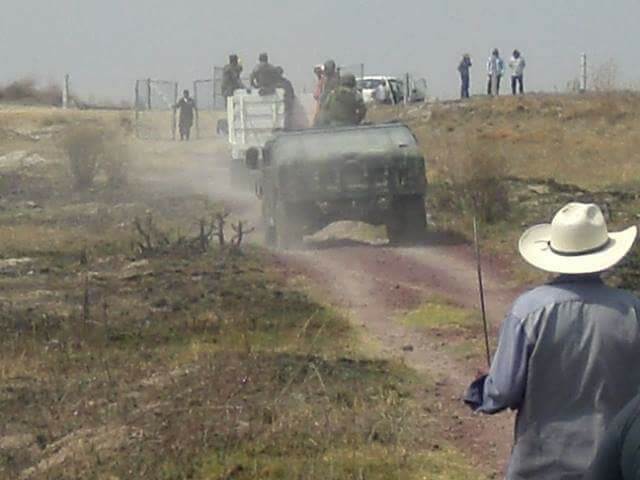
As campesinos of Atenco prepared to commemorate the 10th anniversary of the state and federal attack on their town as revenge for their having defeated the first proposal to build an airport on their farm lands, a skirmish occurred on April 12 (see photo) in which surveyors were escorted onto the lands by a small group of soldiers and a tanqueta (mini-tank). Atenco residents ran them off, removed the surveying stakes, and set up a permanent camp on a local hill.
The ejido of Atenco, with the suburb of Ecatepec in the distance. Photos courtesy of high school students in solidarity with Atenco, except where otherwise indicated.”
“Infrastructure” is the mantra of Mexican president Enrique Peña Nieto and his state and local counterparts of other political parties. But they’re not talking about water (unless it’s to divert it toward golf courses and breweries), much less schools: what’s hot now is to offer “incentives” to construct private highways, high rise buildings, and airports.
In Mexico City a small percentage of the population has the funds to pay for a plane ticket.
In Mexico City, where a small percentage of the population has the funds to pay for a plane ticket, the construction of a new airport is all the rage (among politicians, executives and media owners). A second terminal at the current site is less than 10 years old; the existing airport is served by existing highways, other thoroughfares, the subway, and confined-lane buses, and underwent a recent remodeling job.
When Vicente Fox took office as the country’s first opposition president since the Revolution — he’s since allied himself with the ruling PRI — he attempted to build an airport on communally-held lands in Atenco, outside of Texcoco. (Texcoco is a city of about 100,000 people, about 25 miles northeast of Mexico City. Atenco is an adjacent farming community of about 20,000 people.) Fox’s airport proposal sparked a campesino uprising that damaged his presidency to the point that he had to cancel the project in 2002.
But now, the retooled airport project has become the centerpiece of Peña Nieto’s attempt to salvage his own presidency after government-inflicted human rights atrocities like that of the 43 education students who disappeared in September 2014, in Iguala, Guerrero, and economic scandals like his and his associates’ acquisition of mansions with “loans” from a firm, Higa, that has been favored in no-bid highway and train construction contracts. Higa built and paid for mansions for Angélica Rivera, the wife of Peña Nieto, and Luis Videgaray, a top cabinet official.
Another firm, OHL, based in Spain but which makes lots of its money in Mexico, is accused of massive fraud in Mexico, where it’s tied to the ruling party, the PRI, and in Spain, where it’s also tied to the right-wing governing party, Partido Popular. Recordings in which one OHL executive accuses others, and the company, of fraud were released last year. Around the same time, other recordings revealed that OHL paid for the vacations, in Spain, of the state secretary of transportation and his family.
Proposed Mexico City airport design by Fernando Romero and Norman Foster. Image from eVolo.
The company’s stock fell in both countries. In an attempt to cut losses, OHL México sold some assets to an Australian pension fund and other curious buyers. OHL now controls contracts for some of the new airport-related freeways mentioned above and recently revamped its board of directors to include people from the airport authority. The government, instead of cancelling contracts, arranged to have the journalists who denounced this fraud fired. (Carmen Aristegui, dismissed from three radio stations over the years, maintains her program on CNN Español where she filed this report on the subject.)
In May 2006, police raided the town of Atenco and raped, beat, and detained residents.
The farmers, farm workers, and allies who prevented the airport from being built in the first years of this century paid a heavy price for their victory: In May 2006, state and federal police raided the town of Atenco and, according to dozens of witnesses and various human rights organizations, raped, beat, and detained residents and visitors including the Chilean cinema student Valentina Palma, who was sexually assaulted, beaten, and immediately deported. She was about to graduate from film school in Mexico but has not been able to return. Forty-seven women alleged sexual assault; no one has ever been punished.
A dirt road within the ejido.
After mass detentions, Ignacio del Valle, one of the most visible leaders of the anti-airport movement, was sentenced to 102 years in prison, and 10 others received sentences of 30 years. All were released amid public pressure after four years. This police action was a bipartisan collaboration between the outgoing president, Fox, and an up-and-coming governor named Enrique Peña Nieto.
While many were captured and imprisoned, others went into hiding; del Valle’s daughter, América, was eventually able to put herself out of danger by seeking asylum at the Venezuelan embassy.
While the activists were indisposed, new president Felipe Calderón discreetly revived the airport project. (This was against the advice of cabinet member, hydraulic engineer, and former PAN official Jose Luis Luege, who supported a plan to reconstitute the parts of Lake Texcoco that have been dried. The PAN is Partido de Acción Nacional, the conservative party of Fox and Calderón.)
As Ignacio del Valle stated at a recent forum at the Universidad Autónoma de la Ciudad de México: “the violation that many women of Atenco suffered of the most sacred rights of a human being is something that we don’t forget and we don’t pardon. But we don’t hate. In spite of having been tortured in prison, I don’t hate the oppressors.”
Del Valle adds that the Atenco campesinos organized as Frente de los Pueblos en Defensa de la Tierra hope that people will come out to protest during the 10th anniversary of the attack, “not to call us pobrecitos, but to express indignation with us.”
San Salvador Atenco is the “cabecera municipal” of a group of pueblos that include Atenco, Acuexcómoc, Nexquipayac, and others. Behind them is a vast unspoiled area that contains ejidos — communal farmland. The ejido is a figure of the Mexican revolution of 1910-1917 and was an attempt to redistribute land stolen by the pre-revolutionary president Porfirio Díaz and his cronies through a de facto slavery system.
“Our ancestors were peones on the haciendas in this area,” del Valle explains. And before that, pre-colonial, indigenous farmers: Alicia, an older woman in the Atenco community who has a third-grade education and often speaks at public forums, evokes the indigenous roots of Atenco: “This is not a battle. It’s a struggle for our mother earth.”
Campesinos move between the towns and the fields on old bikes.
Campesinos move between the towns and the fields on old bikes to which they strap shovels or machetes. The ejido of Atenco, one of three in the area, has 2,500 hectares on which around 300 people work full-time and others farm in addition to their other occupations — manual in most cases, though there are a few teachers and a dentist.
Field of cilantro, irrigated.
We visited El Cilantrero, the Cilantro Man, bearer of a Mexican tradition in which people are known by nicknames and almost no one knows their real names. He cultivates seven hectares of cilantro and spinach. This may sound like a hobby farm in U.S. terms, but it’s enough for him and three workers to live on. In 2001, the government under Fox offered seven pesos per square meter for the land that it intended to expropriate. Now the offer has increased exponentially and some have succumbed.
(The ejido system began to be destroyed, quasi-privatized, during the regime of Carlos Salinas in the 1990s in a move, similar to the Indian Allotment Act of 1924 in the U.S., to weaken collective traditions and open land up to settlers and speculators.) Ignacio del Valle remembers 2001: “We never felt that we were poor because we lived in an environment in which nobody had to steal; everybody contributed beans, hogs, etc. That tranquility was broken on October 22,” the day that the Fox administration decreed the expropriation of the ejido of Atenco (which means “on the lake shore” in the Náhuatl language).
A rigged assembly of the ejido took place in June 2014. Goons with no connection to Atenco posed as members of the ejido and hundreds of state police assured that no one would challenge them. The president of the ejido, Andrés Ruíz Méndez, now mayor of Atenco and a local leader of the PRI, called the meeting in a private location with electric fencing and railroaded a vote in favor of selling off the ejido to the federal government in this manner. The assembly lasted 15 minutes.
Fabiola Gutiérrez Quiroz reported on this assembly in Spanish in the alternative newspaper desinformémonos.
Many archaeological treasures are threatened by airport construction.
As Don Rodrigo, a local farmer and member of the movement, showed us the fields from the main hill of Atenco, four men appeared in a pick-up. “We came to see the lizard.” Someone showed them a stone in the shape of a lizard, about eight feet long and with hieroglyphics, one of many archaeological treasures threatened by airport construction. “This is where they want to put the runways,” Rodrigo said. About 50 feet away is “La silla de Nezahualcóyotl,” a rock shaped like a bench where Nezahualcóyotl (“Hungry Wolf”), also known as“the Poet King” — el Rey Poeta — sat and looked out at the valley. He reigned a century before the arrival of the Spanish in 1521and was one of the engineers responsible for the construction of some of the most sophisticated hydraulic and irrigation systems of that era.
The Instituto Nacional de Antropología e Historia (INAH), a government agency ostensibly charged with historical and cultural preservation, concedes that in Atenco there are stone artifacts that date from 8,000 ACE to 700 CE and that there is evidence of the presence of mammoths from the same period. Local activists maintain that there are 1,000 indigenous archaeological sites in Atenco alone. Anthropologists based in Mexico City who ask not to be identified allege that even in the early phases of construction and surveying, crews found and immediately destroyed indigenous artifacts and that the INAH pretended not to notice.
Nopales grow on one of the hills from which Atenco residents protect their land.
Atenco borders on Texcoco, Ecatepec (an industrialized, highly polluted suburb), and the northeastern part of Mexico City. Lake Texcoco, one of seven lakes in the metropolitan area, dominated this zone until, immediately after the conquest, the Spanish began their ecocidal practices of drying lakes and rivers, thinking that by doing so they controlled flooding.
Farmers predict that the paving of this area will aggravate flooding.
Atenco farmers predict that the paving of this area, one of the few green spaces left within an hour of Mexico City, will aggravate flooding in the city by further increasing hardscape. And local scientists with an organization called Ciéntificos Comprometidos con la Sociedad (Scientists Committed to Society) share this belief and cite a suspicious environmental impact statement that gave a fast-track authorization, at Christmastime, to the project based partly on “neighbor” interviews with residents of Ecatepec, but not of Atenco or Texcoco.
The scientific organization adds that the project violates the regional development plan for greater Texcoco, which mandates the promotion of agricultural activities and prohibits construction over the basin of Lake Texcoco, an official protected natural area.
Similarly, Grupo Aeroportuario de la Ciudad de México and Guinness report that the airport will contain the world’s largest parking lot, supplanting that of the West Edmonton Mall in Alberta, Canada, and offering 20,000 parking places.
The scientists’ group also sounds the alarm about a vague plan to construct an “Aerotrópolis,” an airport city that would include this parking lot and a host of convention and hospitality facilities so that a visit to Mexico would be limited to that area. When the Secretariat of Natural Resources approved the airport project, it “gave a blank check” to this and other aspects whose characteristics are unclear.
The environmental impact statement doesn’t indicate how big the airport city would be, but the Scientists Committed to Society estimate that it would require 3.5 million cubic meters and that it would consume 23 million cubic meters of water per year. “Starchitect” Norman Foster claims the airport project would be self-sufficient in terms of water. He also plans to put a giant tarpaulin under the airport site, and at the same time to elevate it onto a platform to prevent the airport from sinking. (Texcoco is one of the most-rapidly sinking parts of the center of the country.) At the same time, residents of Texcoco, Atenco, and other nearby communities wonder where the projected 125,000 workers will live.
(There is a detailed analysis of the project in Spanish, based on the study of Scientíficos Comprometidos con la Sociedad, in the independent newspaper desinformémonos.)
As a few ejido members cashed their expropriation checks, members of the underworld smelled their money.
Atenco residents speak of how, as a few ejido members cashed their expropriation checks, members of the underworld smelled their money and kidnappings, a previously-unknown phenomenon in the area — Texcoco is one of the safest cities in the state — began to occur. Residents fear what could happen if the project continues and boom town nightmares such as those that have happened in Alberta and North Dakota materialize: exponential growth of towns, environmental devastation, huge influx of young males and concomitant alcohol abuse and sexual violence.
Fox called this land “sterile” and “almost desert” to justify its planned destruction. Atenco residents now grow more than before in what they call an act of resistance, to prove that the land is fertile. Cilantro, lima beans, corn, wheat, spinach, and asparagus are some of the plants they grow for subsistence, sale, and to give away to occasional visitors.
As we left the town and headed into the ejido, Rodrigo said that the area is full of little rivers and showed us two. Over one of them there is a simple, one-lane bridge built recently by local residents with no government assistance. They embedded a machete into the pavement. These are “farm implements, not weapons,”* activists are fond of saying since 2001 when their marches into Mexico City, machetes held high, scandalized the respectable citizenry.
He told us that one of these rivers, now about two feet wide, is destined to be buried by one of the new highways. In the pueblo of Tezoyuca the government began in October to demolish houses, usually without warning, to make room to widen a now-modest highway. (See photographs of this Grapes of Wrath-style demolition of the home of a 71-year-old man in the nearby town of Tezoyuca in the video above.)
Most residents of the Mexico City area who have the purchasing power to buy plane tickets live in or beyond the south and west of the city — exactly opposite of Texcoco, which is about 25 miles northeast of the center of the city. From Tlalpan, a densely populated middle-to-upper income area in the southwest of the city, to Texcoco or Atenco is about two hours by car or in mass transit (buses and trains, making at least three transfers).
One of the reasons that some neighbors support the airport project is, of course, the promise of jobs — as if United Airlines were going to go door to door in low-income, rural communities asking who’s ready to work as a pilot, air traffic controller, or bilingual interpreter. In February, the CROC, a federation of hack unions controlled by the PRI, blocked two highways that serve Texcoco or Atenco for most of a day because the government was not honoring promises to channel jobs to their members.
The contractors
Architect Norman Foster of England recently found one of his airport designs rejected in London. And another London project, to expand Heathrow from two to three runways, is a subject of constant protest, as George Monbiot has reported in The Guardian in a column in which he refers to the Heathrow 13 who chained themselves to block an existing runway and were found not guilty; Monbiot calls them heroes, not hooligans.
The Mexico City airport is projected to have six runways, making it the biggest in the Americas and one of the three biggest in the world. (Some of the other mega airports, such as the one in Dubai, are also Foster-designed. And much of his work has been in oil-rich emirates. See his efforts at greenwashing and self-aggrandizement in the video above.)
One of the main contractors participated in the ‘rebuilding’ of Iraq.
One of the main contractors, Parsons of Pasadena, California, participated in the “rebuilding” of Iraq as part of the U.S. occupying force beginning in 2003, along with companies like Halliburton and Bechtel. But, having accepted acting as accomplice to this U.S. violation of Iraqi sovereignty, Parsons also defrauded the U.S. government and the neocolonial government of Iraq by not building the more than 100 clinics and hospitals it was paid for.
“They also build prisons,” as critical pedagogue and area resident Peter McLaren commented after having looked into Parsons at my request; it appears that for these, the completion rate is higher. Parsons describes itself as “an engineering, construction, technical, and management services firm with revenues of $3.2 billion in 2015. Parsons is a leader in many diversified markets with a focus on infrastructure, industrial, federal, and construction.” (Sic.)
High-speed or other rail alternatives
It’s curious, though not surprising, that a proposed train to Querétaro was halted, due to accusations of corruption and that the airport, with much more potential for environmental devastation and with the same corrupt parties involved, receives little criticism or scrutiny.
Almost all passenger trains in Mexico were eliminated in the 1990s during a phase of the ongoing privatization push under then-president Ernesto Zedillo. A conventional train could get to Querétaro in two hours instead of the highway time of three hours; the cancelled or suspended train would have done it in one hour and would be the gateway to Guadalajara, Monterrey, Laredo (San Antonio, Austin, Dallas), Zacatecas, Leon, Aguascalientes and most of the northern half of the country, thus making it unnecessary to fly to such destinations.
All these cities except the ones in Texas could be reached in less than five hours, much less in some cases, by high-speed rail, and much of the demand for domestic and even international air travel could be supplanted by rail. One rail project is underway: a train from Mexico City to Toluca, the capital of Mexico State, which is now reachable in an hour or more by bus and will reportedly take 39 minutes on the new train, which, like the airport, is immune to recent across-the-board budget cuts.
This train could easily be expanded to Morelia, Lázaro Cárdenas, and the beach towns of Zihuatenejo and Ixtapa, eliminating still more plane trips and offering a good alternative to bus and car transportation toward the west. And Toluca, coincidentally, has a new and under-used airport and is close to the parts of Mexico City where the richest people live.
*Machetes are, in fact, used in all of Mexico for farming and for landscaping in cities; they can be bought at small farm implement stores and even at Wal Mart, but sensationalist media insist on associating them with violence.
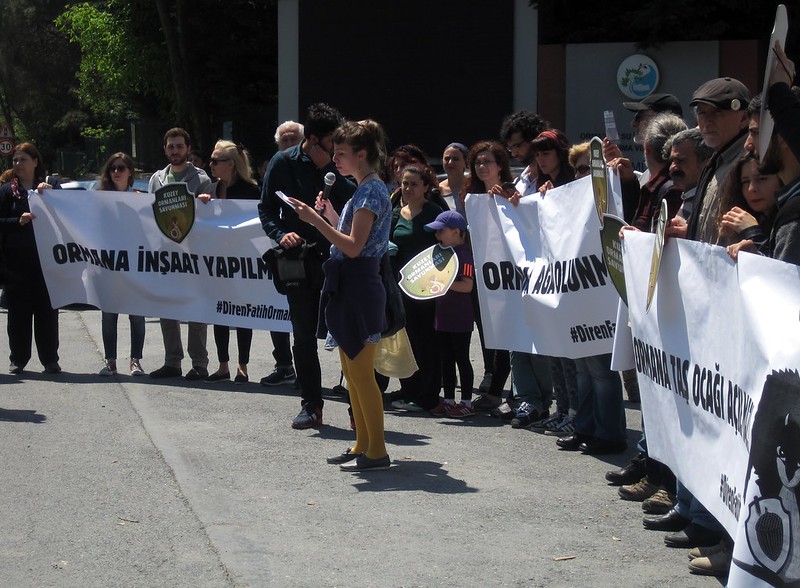
GAAM has published a video showing the ecocide underway for Istanbul’s third airport – an ecocide megaproject. The project site is north of the city on the Black Sea coast. A vast area of forests, lakes, farmland and coastline is being systematically destroyed as the site is prepared for construction. The plan is to build an aerotropolis covering 76 square kilometres. Trees are being felled, lakes filled in and land reclamation damages coastal ecosystems. The aerotropolis plan is linked with other destructive megaprojects including a third bridge across the Bosphorus Strait. Resistance against the megaprojects is led by Kuzey Ormanları Savunması (Northern Forest Defence).
The video was taken on a visit to the site on 7th May 2016, photos can be viewed on Fickr.
Earlier that day Kuzey Ormanları Savunması held a protest outside the forest directorate.
Industry videos of construction of Istanbul’s third airport are available online – giving an indication of the severity and extent of the destruction of ecosystems. The video below, made by Caterpillar shows bulldozing underway.
This video of construction of the airport – on land that used to be forest, lakes and farmland – was filmed from above.
An article about plans for a second airport, and an aerotropolis referred to as an ‘Air City’, on the South Korean island of Jeju was published in the April 2016 issue of New Internationalist magazine. Residents of five villages would be seriously affected and have held a series of protests against it. The article includes a great photo from the blog Pagans We Are, more photos can be seen on the blogpost about the proposed airport.
A control tower that has become a symbol of the protest movement against Narita Airport, in Tokyo, Japan, is to be demolished. The airport was opposed by local farmers, students and political movements from its announcement in 1966, and some of the protests resulted in violent clashes with police. It was recently announced that the former control tower will be demolished in 2018. Back in March 1978 it was raided by protesters who then occupied it and succeeded in delaying opening of the airport for three months. Resistance to the airport continues to this day, with some disputed strips of land blocking plans for a third runway.
Narita Airport is currently swamped on a daily basis with international arrivals as Japan, especially Tokyo, enjoys unprecedented numbers of foreign tourists, a trend which is surely going to roll on until the 2020 Olympics. In spring 2015, the airport generated much fanfare when it opened a new low-cost carrier terminal fitted out with a funky “running track” interior design. How many of those arriving or departing from the now hip and bustling Narita are aware of the blood and tears that lie beneath its tarmac is debatable, though a documentary film released in 2014 has returned the remarkable story of the campaigning farmers and their various student and other allies to the public eye to a certain extent.
It is now fifty years since the government finalised its decision to build an international airport in the Sanrizuka area of Chiba. Take a walk around the airport and you…
GAAM Aerotropolis Update No. 3 has been published. It looks at 43 aerotropolis developments, in 29 countries all regions of the world. Major aerotropolis projects are among the largest megaprojects that are planned and under construction. Aerotropolis Update highlights serious concerns including loss of large areas of farmland and wildlife habitat, displacement of rural communities and serious instances of land acquisition injustice. Many aerotropolis receive preferential government treatment, in particular tax breaks, and overlap with special economic zones. Maps created for GAAM show the proposed 80 square kilometre land area for Nijgadh airport and aerotropolis in Nepal, the 95 square kilometre China-Belarus Industrial Park next to Minsk Airport and farmland earmarked for the proposed Airport City Gatwick business park. The Update covers just a fraction of what is happening with airport-centric development worldwide. Material is already being compiled for Update No. 4. Issues 1 and 2 are available on the GAAM Aerotropolis Update page.
The ‘Airports in India’ report by Equitable Tourism Options (Equations), is a useful critique of government plans for massive airport expansion. Published in May 2015, the report is skeptical regarding the viability of plans to construct 200 new airports over the next two decades, when most of India’s established airports operate at a loss. Vast amounts of public expenditure on airport infrastructure would benefit only a small wealthy minority, in a country where 22 per cent of the population live below the poverty line.
In many instances new airport plans are rushed, without proper consultation of the local community and the requisite environmental clearances. Several Indian airport projects have met with opposition from affected communities. The Bhogapuram airport project has seen massive protests by farmers (also see GAAM blogposts from 15th April and 17th April 2015). Airports in Sikkim and Aranmula have been stalled by community protests. There has also been vigorous opposition to privatization of Mumbai, Delhi and Chennai airports. Chennai Airport is thought to have 2,000 acres of land which the private operator can lease for facilities like five-star hotels. The report urges the government to reconsider new airports in favour of upgrading existing airports.
The Mexican army invaded ejidal (communal) lands of Atenco, where communities have resisted land expropriation for an airport for more than a decade. The military convoy was escorting a party of workers from one of the companies contracted to construct the airport. The community of Atenco has begun daily patrols to prevent further intrusion into ejido lands and is calling for international solidarity.
Army Invades the Ejidal Lands of San Salvador Atenco
In the morning of April 12, while the police forces of the State of Mexico continued advancing at the other end of the state, in San Francisco Xochicuautla, a convoy of military entered the ejidal lands of the community of San Salvador Atenco to escort a gang of workers from one of the private companies in charge of the construction of the new airport in Mexico City.
Community members who have resisted the expropriation of their lands for more than ten years told Desinformémonos that the day before, April 11, an official of the company had already arrived in the communal lands, at the base of Cerro Huatepec, with the intention to “carry our measurements.” Facing the intrusion, villagers moved in and responded.
“The compañerxs told them that they could not be on communal lands because we are in…
An article in The Ecologist, Nigerian farmers win High Court victory in fight against Ekiti airport, is a story of a successful struggle against a land grab for an airport. On 2nd October 2015 the state government of Ekiti, in western Nigeria, sent in bulldozers to clear 4,000 hectares of farmland for an airport. Bulldozers were sent in and began destroying crops, without even warning the farmers, never mind making provision for compensation for their loss of land and livelihood. Affected farmers from the five affected villages fought back, organizing a protest and filing a suit.There was widespread criticism of the airport project, allocated an enormous amount of public funds in a state where many residents are impoverished. The viability of the project was dubious as many airports in Nigeria, including one in the neighbouring state, are underutilized.
The plan for Ekiti airport was not, to my knowledge, referred to as an ‘aerotropolis’. But the land area allocated, 4,000 hectares, is far more than would be required even for an enormous global hub airport (an unlikely prospect in an agrarian state). In comparison, Atlanta Airport, in the USA, the busiest passenger airport in the world handling over 100 million passengers in 2015, covers an area of about 1,600 hectares. As well as land used for airport operations.this includes considerable commercial space, such as retail and warehouses.
On 20th January 2016 farmers held a protest, storming the Ekiti airport project site and demanding that work cease immediately, in respect of the suit that they had filed. They held placards with slogans reading: “Gov Fayose, Please Leave Us Alone, Don’t Damage Our Life”, “This Land Is The Major Cocoa Plantation, Please No Trespass”, “Please Relocate Your Airport to Government Forest”, “We All Say No To Illegal Airport Project”, “Iwajo, Aso Say No To Illegal Airport”, and “Igbogun Cries Over Illegal Destruction of Our Property”. They also stated that at least ten farmers, including three women, had ‘died of shock’ caused by the destruction of their farms.
In 22nd March the Ekiti farmers secured victory in the High Court, which ordered that forcible take-over of their land for the airport was unconstitutional, illegal, null and void. But there are plans for major new airports all over Nigeria, in the states of Osun, Bayelsa, Abia, Ogun, Anambra and Nasarawa, all of which are being vigorously opposed. Citizens are calling on governments to use the vast amounts of public funds being allocated to these airports to infrastructure that will benefit ordinary people – to repair roads and bridges and support small businesses. And yet another major airport plan is looming. The Yobe state government plans to build a N6 billion (over US$30 million) cargo airport in Damaturu, to act as a gateway for investment in the state and facilitate export of meat, dairy produce and gum arabic (acacia gum). The scheme which is meeting with criticism and goes against state commitments to prioritise water supply, schools, clinics and roads to benefit local communities.
 Mexican police forces invade ejidal lands in San Salvador Atenco near Mexico City where campesinos have resisted the expropriation of their lands for a controversial new airport.
  The ejido of Atenco, with the suburb of Ecatepec in the distance. Photos courtesy of high school students in solidarity with Atenco, except where otherwise indicated.”
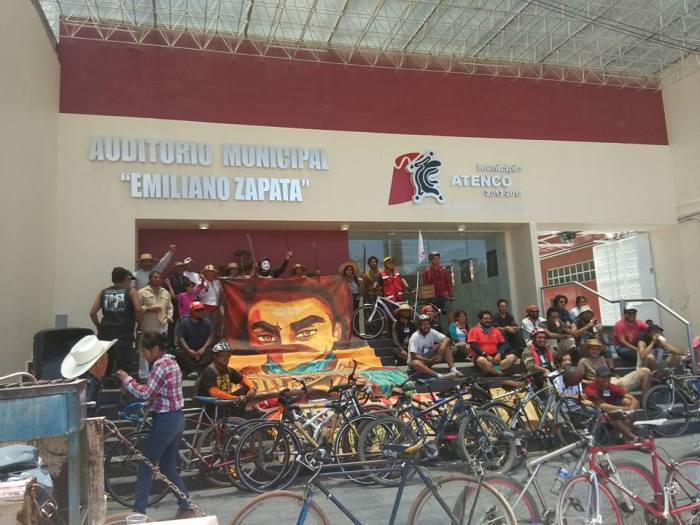 Cyclists protest plans for the airport. Image from
  Proposed Mexico City airport design by Fernando Romero and Norman Foster. Image from eVolo.
 A dirt road within the ejido.
 Field of cilantro, irrigated.
 Nopales grow on one of the hills from which Atenco residents protect their land.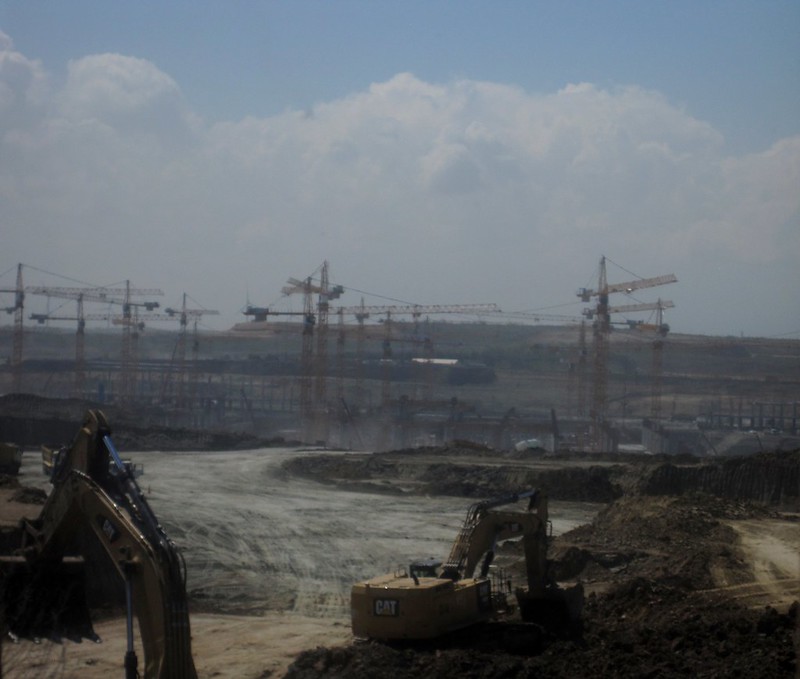


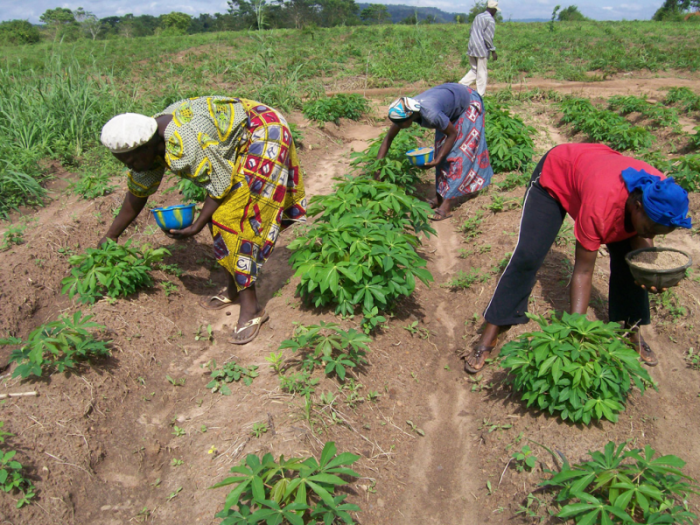 The plan for Ekiti airport was not, to my knowledge, referred to as an ‘aerotropolis’. But the land area allocated, 4,000 hectares, is far more than would be required even for an enormous global hub airport (an unlikely prospect in an agrarian state). In comparison, Atlanta Airport, in the USA, the busiest passenger airport in the world handling over 100 million passengers in 2015, covers an area of about 1,600 hectares. As well as land used for airport operations.this includes considerable commercial space, such as retail and warehouses.
