India: Over 100,000 people in 16 villages fear eviction for Guwahati Aero City and Satellite Township

Moves to acquire land, including fertile farmland, in six villages to the south of Guwahati Airport for a proposed Aero City and Satellite Township have raised fears of eviction in a larger area encompassing about 16 villages.
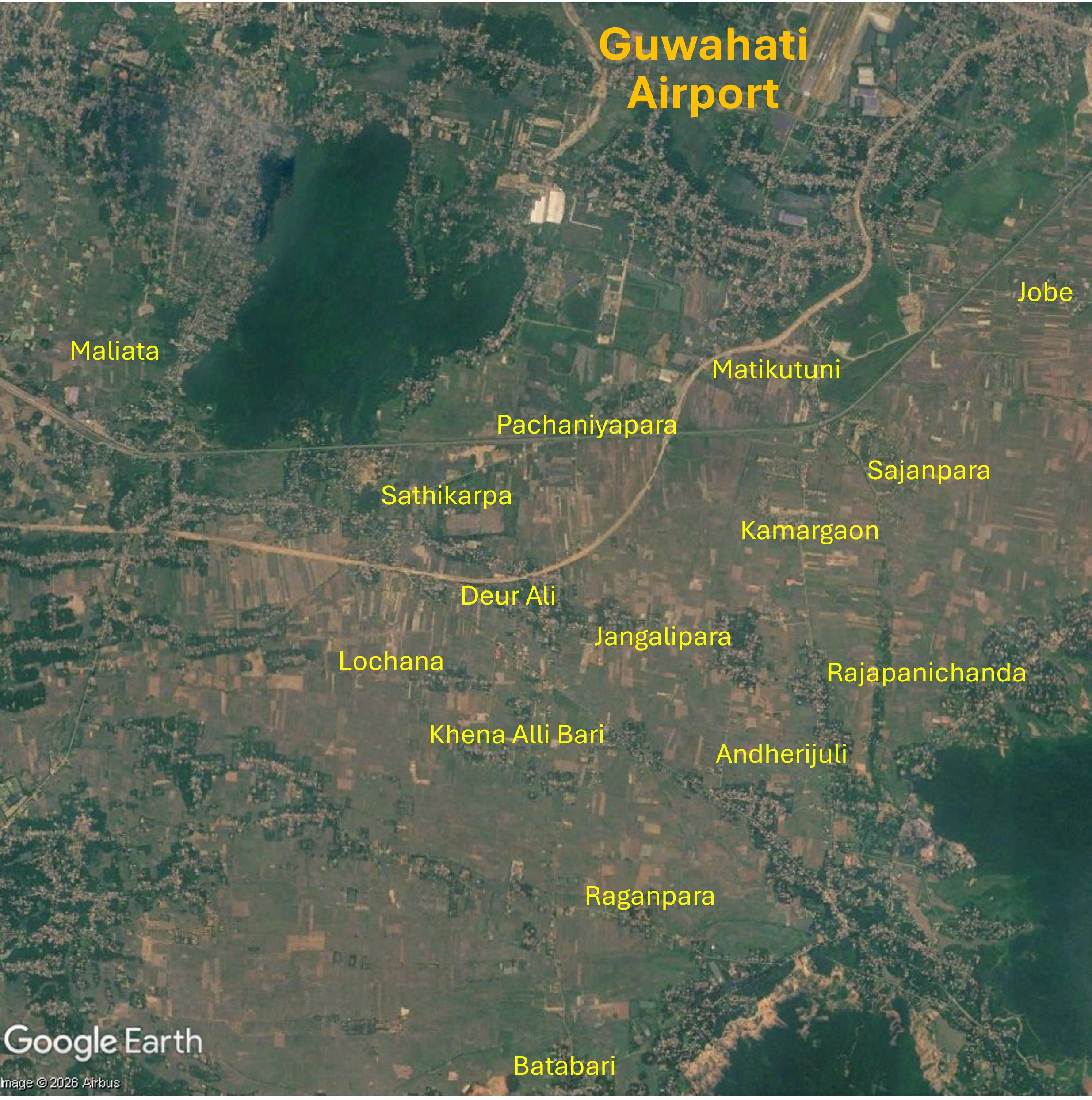
Villages south of Guwahati Airport concerned about possible land acquisition and eviction for Guwahati Aero City and Satellite Township
Map showing fifteen of the villages south of Guwahati Airport where it has been reported that residents have concerns about possible land acquisition and eviction for the proposed Guwahati Aero City and Satellite Township projects. Satellite imagery: 03/06/2026

On 26th June 2026 The Assam Tribune reported that residents of 16 villages in the Azara and Palasbari sub-districts, to the south of Guwahati Airport, feared eviction due to land acquisition for a proposed Aero City and a Satellite Township. No official eviction orders had been issued but residents of 16 villages – Andherijuli, Batibari, Deur Ali, Jobe, Jangalipara, Kachari Allibari, Kamargaon, Lochana, Matifuturi, Maliyata, Pachaniyapara, Patgaon, Rajapanichanda, Rangapara, Sajjanpara and Sathikarpa – were worried that land acquisition might be impending as revenue department activities had increased. There were reports that notifications for valuation and acquisition of agricultural land had been issued in six of these villages – Deur Ali, Jangalipara, Jobe, Kamargaon, Matifuturi and Pachaniyapara – where officials were collecting land-related documents. Farming is the only source of livelihood for many affected people and they were uncertain about provision of rehabilitation if their land was acquired. Tribal organisations voiced concerns that placing tribal areas under Guwahati Metropolitan Development Authority (GMDA) control might erode indigenous communities’ land rights, administrative autonomy, constitutional safeguards and the powers of the Rabha Hasong Autonomous Council. A number of tribal organisations including Rani Regional Tribal Sangha, Rani Regional All Bodo Students’ Union and Rani Regional Rabha Students’ Union submitted a memorandum to Chief Minister Himanta Biswa Sarma calling on the government to protect the rights and interests of indigenous communities in the proposed project area. A total of approximately 6,662 bighas of land had been earmarked for the two projects, about 2,662 bighas for the Aero City and the reminder for a Satellite Township.

More than 100,000 people fear displacement

Northeast Now reported that more than 1 lakh (100,000) people feared displacement for the proposed Aero City and Satellite Township. Land acquisition raised concerns in six villages inhabited mainly by Bodos, Rabhas, and Koch Rajbongshis people. Official GMDA Chief Executive Officer communication with the Special Chief Secretary of the Housing and Urban Affairs Department explained that the proposed acquisition encompassed 712 bighas in Kamargaon, 676 bighas in Deorali, 553 bighas in Pachaniara, 280 bighas in Jonglipara, 238 bighas in Matikotuni and 203 bighas in Jobe. Residents established Ucched Virodhi Bhumi Adhikar Sangram Samity (UVBASS) to oppose the proposed land acquisition and memorandums were submitted to The Chief Minister, local Member of the Legislative Assembly (MLA) and other senior officials. UVBASS president Dharmeswar Boro said, “If they go ahead with this proposal, more than one lakh people across 16 villages will be displaced” and that by planning the projects the government was “rolling out the red carpet for corporates”.

Opposition to large-scale acquisition of agricultural land

Two farmers’ organisations, Sangrami Krishak Shramik Sangha and Anti-Eviction Land Rights Struggle, held a press conference on 26th June demanding withdrawal of land acquisition processes that they claimed threatened displacement of thousands of families and destruction of fertile farmland. They said the government sought to acquire large areas of agricultural land for an Aero City, Satellite Township, Guwahati Airport expansion and other urban development projects, without providing adequate compensation or rehabilitation. The groups said about 500 families had already been evicted without fair compensation or rehabilitation and that if land acquisition plans move forward about 150,000 families might eventually be affected. They stated that nearly 2,662 bighas of agricultural land in several villages including Jobe, Jangalipara, Kamargaon, Matiya and Pachim Garal had been earmarked for acquisition. Sangrami Krishak Shramik Sangha spokesperson Dinesh Das said the government prioritised corporate interest over farmers, saying, “The government has stopped issuing treasury tax receipts and has deprived people of land rights. Instead of securing the future of farmers, it is preparing to hand over fertile agricultural land to companies for projects like Aerocity and Satellite Township. Farmers are being neglected while corporations are being favoured.” The organisations had made many appeals to the Chief Minister, Governor, Kamrup district administrations and MLA but the land acquisition process continued. The groups also raised concerns about potential impacts of the projects on wetlands and continuing conversion of agricultural land for commercial purposes adversely impacting on food production.

Protest and warning of ‘mass agitation’

On 2nd July 2026, hundreds of residents protested outside the Palasbari revenue circle office, opposing the Aero City and Satellite Township project and possible eviction. Together with families concerned they might be evicted from areas surrounding Guwahati Airport they marched along the National-Highway 17 in Mirza. Many protesters were from the Rani area mainly inhabited by Bodos and Rabhas people, where land surveys identifying non-tribal residents were underway. UVBASS sent a memorandum outlining their concerns over reports of GMDA preparing development of new townships in 17 villages to the Chief Minister. The memoranrum stated, “The primary livelihood of lakhs of people in this vast region is agricultural and animal husbandry. The construction of a ‘township’ will bring a severe crisis to the life and livelihood of this huge number of poor people.” Sangrami Krishak Shramik Sangha spokesperson Dinesh Das alleged that evictions were planned in Khena Alibari village where many residents do not have the official documentation required to live in legally protected tribal areas. He demanded protection and provision of land ownership certificates for the approximately 300 Hindu and Muslim families living in the village. The memorandum also raised concerns about land surveys underway in Parli and Majirgaon, north of Guwahati Airport and close to the newly inaugurated second terminal.

At a Nikhi Rabha Jatha Parishad (NRJP) press conference in Guwahati president Babul Chandra Rabha and general secretary Gobinda Rabha said the Assam government was pursuing major land acquisition without consulting the Rabha Hasong Autonomous Council, Gram Sabhas or local residents. The organisation said the Aerocity and Township projects entailed acquisition of agricultural and forest areas along with ancestral settlements, violating constitutional, legal and land rights of indigenous communities, placing the livelihoods and culture of thousands of families relying on agricultural, fishing, husbandry and forest resources at risk. NRJP demanded immediate cancellation of the Aerocity and Satellite Township projects, publication of the environmental and social impact assessment reports for the Ukiam River Dam project which would significantly impact agriculture and fisheries and withdrawal of another proposed Satellite Township, Barduar Bagan, south of the area earmarked for the Aerocity. NRJP warned that, should the government fail to hold discussions with local communities and the Rabha Hasong Autonomous Council, it would initiate mass agitation against the projects, in collaboration with other organisations such as Sangrami Krishak-Shramik Sangha and the Anti-Eviction Land Rights Struggle Committee.

Regulation and financing for the Aero City

Development of regulation and financing to support Guwahati Aerocity and other urban development proceeded quickly.  Formation of the Guwahati Satellite Cities Development Authority (GSCDA) a government-owned Special Purpose Vehicle tasked with planning, financing and developing various types of satellite townships within the jurisdiction of the GMDA was approved by the Assam Cabinet on 13th June 2026. Times of India reported that the Guwahati Satellite City Development Authority Bill, 2026 was tabled on 9th July in the face of opposition from many groups in the outskirts of Guwahati. The Bill seeks to grant the authority ‘powers to develop integrated townships, knowledge cities, aviation cities, logistics hubs, tourism zones, economic corridors, commercial centres and other planned urban projects within notified Satellite City Development Areas or areas under its jurisdiction’. Presenting the Budget on 10th July 2026 Assam Finance Minister Jayanta Mallabaruah unveiled plans for what is presumably another name for the Aero City project, an ‘Aerotropolis’ with industrial and commercial districts around Guwahati Airport, to be implemented by the GSCDA. The Budget allocated ₹2,100 crore (USD220 million) for land acquisition for the projects.

Adani prioritises airport city development

The operator of Guwahati Airport, Adani Airport Holdings (AAHL) – India’s largest private airport operator and a subsidiary of Adani Enterprises Ltd. (AEL), one of India’s largest multinational conglomerates – has adjusted its strategy and corporate structures to prioritise airport city development. In December 2025 Adani announced a shift in focus to prioritisation of urban development at its airports, integrating aviation with real estate and diversification of revenue streams. A key element of this strategy is development of airports, in cities including Guwahati, into urban destinations with retail, hospitality, entertainment venues and office space plus a new emphasis on development of in-house hotels. A key driver of Adani’s focus on city-side development is the higher yields, often exceeding 20%, from non-aeronautical revenue streams – such as retail food and beverages – than the typical yield of about 12% from aeronautical sources including landing and passenger service fees. On 6th April 2026, AEL established three wholly owned subsidiaries for real estate activities on land parcels surrounding its hub airports: Adani Navi Mumbai Airport City Limited (ANMACL), Adani Guwahati Airport City Limited (AGACL), and Adani Ahmedabad Airport City Limited (AAACL). These subsidiaries will focus on development and leasing of buildings and management of hotels, restaurants and business centres. On 25th June 2026 AAHL subsidiary Adani Airport City Limted (AACL) announced plans for the first phase of an ‘ambitious programme to develop integrated airport cities across its airport network’. A Rs 20,000 crore (USD2.07 billion) investment aims to transform six airports – Mumbai, Navi Mumbai, Ahmedabad, Lucknow, Jaipur and Guwahati – into ‘mixed-use urban destinations’ with hotels, offices, shopping and dining outlets, entertainment venues and convention centres.

Aerotropolis land acquisition notice in 2025

Opposition to a proposed Aerotropolis near Guwahati Airport dates back to 25th July 2025 when a land acquisition notice encompassing 400 bighas of land in Azara, Garal and Mirzapur, north and northeast of the airport, met with anxiety, anger and opposition from many affected residents. More than a thousand families feared loss of their homes and livelihoods. In Garal village critics of the project claimed the land acquisition process lacked transparency, consultation or a clear plan to rehabilitate affected people and that the main beneficiary would be a private company. Affected families began to protest the land acquisition process, demanding transparency, thorough impact assessment and rehabilitation guarantees. Leader of the Opposition Debabrata Saikia described the move to acquire land for the Aerocity as anti-indigenous and serving corporate interests, saying that more than 1,116 families had received eviction notices, some of whom had held land titles for nearly 200 years. Villagers attending a public meeting in Mirzapur unanimously resolved not to give their land to the government under any circumstances, declaring, “Our land is our identity and livelihood.  We will not give it away at any cost.” At this stage of the Aerotropolis residents were already concerned that development of the project might eventually require an area as large as 6,000 bighas, triggering further land acquisition.

For more information including references for all source material and photos see the case report on EJAtlas, the world’s largest, most comprehensive online database of social conflict around environmental issues – Guwahati Airport expansion and Aerotropolis, Assam, India

Kenya: Trees felled in protected Imenti forest for airstrip, State Lodge and golf course

Plans for construction of an airstrip, State Lodge and golf course in the protected Imenti forest, an important elephant habitat and water catchment area, are opposed by many residents and conservation organisations. Felling of mature trees for airstrip construction continued despite conservatory orders to protect the forest and halt the projects.

Construction of an airstrip in the Kithoka area of the protected Imenti Forest began in June 2026
Construction of an airstrip in the Kithoka area of the protected Imenti Forest began in June 2026. Satellite imagery: 16/09/2025

Reports that allocation of 50 acres of Imenti forest, near Mount Kenya, for an airstrip, State Lodge (regional presidential residence and official venue for state functions and meetings) and golf course, was under consideration emerged in September 2025. Imenti forest, a protected public forest, is a habitat for elephants and many other species, an important water catchment for rivers and streams and is a source of income from agriculture and honey harvesting. Greenpeace Africa immediately opposed allocation of part of the forest ‘for luxury projects’, arguing that it would violate the Forest Conservation and Management Act, the Constitution and be a ‘betrayal of public trust’. The Green Belt Movement called for an immediate halt to the projects, saying the developments would be a misuse of a conservation area, stating, “How does an airstrip qualify as conservation? How does a golf course protect water catchments? How does a State Lodge restore degraded ecosystems? These projects are not necessary. They are luxuries. They are symbols of privilege. They have no place in a protected public forest.” Project proponents claimed that the developments would attract investors, create employment and enable hosting of high-level government events and international visitors but environmentalists warned that a reduction in forest cover would cause soil erosion, disrupt of water flows, reduce biodiversity and facilitate further forest encroachment and ecosystem fragmentation.

The Imenti Development Forum (IDF), a group of professionals involved in conservation and establishing ICT hubs in schools, issued a press statement opposing the plans, stating, “The Imenti forest is not simply trees. It is one of the region’s most significant repositories of biological diversity- a living library accumulated over millennia that, once destroyed, cannot be rebuilt in any human timescale.” Representatives of two political parties also opposed the projects: Party of National Unity leader Peter Munya and Jubilee Party deputy leader Dr. Fred Matlang’l who said another state lodge was unnecessary as the president already has access to high-speed aircraft and safe, modern hotels. North Imenti MP Rahim Dawood had initially favoured the projects but opposed locating a State Lodge in the forest taking up more than 20 acres of land and suggested locating a golf course elsewhere.

The Meru Environment and Land Court intervened to protect Imenti forest, issuing interim preservation orders pending hearing of a constitutional petition challenging the plans. On 11th June Justice Oguttu Mboya directed maintaining the forest in its current state until a court decision, barring activities that might impact on forest before issuance of further orders. The case was filed by Francis Awino who argued that the projects could cause irreversible damage. He also asked for preservation and disclosure of records connected to the proposed development such as environmental impacts assessments, maps, correspondence, license applications and approvals and planning documentation. The petition stated. “Public forests are held in trust for both present and future generations, and the State bears a constitutional obligation to conserve and protect them.” On that same day machinery entered the Kithoka section of the forest and, protected by security, began felling mature trees. Forestry Principal Secretary Gitonga Mugambi said construction of an airstrip would be completed within a week, by 18th June, with the first plane expected to land on that day. Kenya Forest Service (KFS) rangers had been deployed to guard all entrances to the site and local people entering the forest were frisked to check for smartphones, presumably to prevent recording of activities in the forest.

Conservation charity Rhino Ark issued a statement strongly opposing airstrip construction in the Upper Imenti Forest Reserve and calling on the National Environment Management Authority (NEMA) to suspend works pending assurance of compliance with environmental laws and criticised lack of the public participation, Environmental and Social Impact Assessment ESIA) and a NEMA license authorising the project. Surveys had found that, during the dry season, the Upper Imenti Forest has the highest concentration of elephants in the Mount Kenya area. The airstrip was being constructed within this elephant habitat, close to an elephant maternity area where pregnant mothers migrate to give birth. Greenpeace Africa pointed out that Imenti forest forms part of a wildlife corridor linking Mount Kenya to conservation areas in the north of the country, along which elephants migrate for food, water and mating. Greenpeace Africa said the National Land Commission should “Stop the bulldozers. Respect the court order. Let the elephants keep their dry season home. And prove, for once, that development in Kenya does not have to cost us the things we cannot get back.” The Mount Kenya Trust (MKT) made a statement condemning destruction of part of Imenti forest for an airstrip, maintaining that the project is in violation of Articles 42, 69 and 70 of the Constitution and the 2016 Forest Conservation and Management Act and could undermine Kenya’s commitments to increase tree cover, protect biodiversity and restore degraded landscapes. MKT stated, “We stand with those defending the protection of Imenti Forest and all protected areas for future generations.”

On 24th June Meru Environment and Land Court issued another interim conservatory order to halt construction of the airstrip, in response to a petition filed by five Meru residents. Petitioners said to the court, “The Respondents have failed to disclose Environmental Impact Assessment reports, feasibility studies, approvals, maps, acreage surveys and other statutory documents relating to the project. The proposed development threatens to cause irreversible degradation and destruction of forest resources.” The following day Meru Environment and Land Court certified an application, filed by Francis Awino, seeking to cite senior officials for contempt of court over allegations of continuing destruction of Imenti forest. In the Notice of Motion, Awino stated “Unless the contemnors are immediately summoned to answer for their actions, the authority and dignity of this Honourable Court shall be undermined…The continued and wilful acts of disobedience are causing and/or threaten to cause irreparable prejudice to the Petitioner’s constitutional rights, public interest and adversely desecrate designated forest.” A supporting affidavit alleged that, in defiance of court orders, prohibited activities continued including: granting commercial contractors, earth moving machinery and workers access to the Kithoka section of Imenti forest; felling mature trees, removing forest vegetation and clearing undergrowth to open up a corridor for a runway; bulldozing, grading and levelling works to prepare the forest floor for runway construction; and surveying forest areas for a proposed State Lodge and golf course. Geotagged satellite images, photographs and videos provided evidence of continued forest clearance. A petition filed by Meru Forest Conservation Forum and Pan-African Climate Justice Alliance resulted in a further conservatory order to halt developments in Imenti forest.

Belatedly, a public participation forum on the projects in Imenti forest was held, but it descended into chaos. The Meru Environment and Land Court had suspended the exercise as a change of venue with just 24 hours notice failed to meet the constitutional threshold for meaningful engagement. Defying a court order KFS proceeded with the forum and a group of stakeholders endorsed the airstrip, State Lodge and golf course projects. A lawyer attempting to serve a valid court order was denied access to the microphone and people presenting a petition opposing the projects that had been signed by more than 7,000 people were jeered at, threatened and removed by security officers. The Standard described the forum as ‘not public participation, but more of a staged exercise to endorse a decision that had already been made’. By 15th July 2026 the online petition, Hands Off Nkunga Forest! Stop the Destruction of Meru’s water catchment area, calling for an immediate halt to plans, surveys and budget allocation for the State Lodge, airstrip and golf course, had garnered 7,114 signatures.[17]

For more information including references for all source material, videos and photos see the case study on EJAtlas, the world’s largest, most comprehensive online database of social conflict around environmental issues – Airstrip, State Lodge and golf course in Imenti forest, Kenya

Ethiopia: Displacement and loss of farming livelihoods for Bishoftu International Airport

More than 15,000 people are being displaced and losing agricultural and livestock livelihoods for Bishoftu International Airport, ‘Africa’s largest airport’ with an adjoining Airport City. Affected people have concerns about inadequate compensation and resettlement and there are reports of forced eviction, harassment and intimidation.

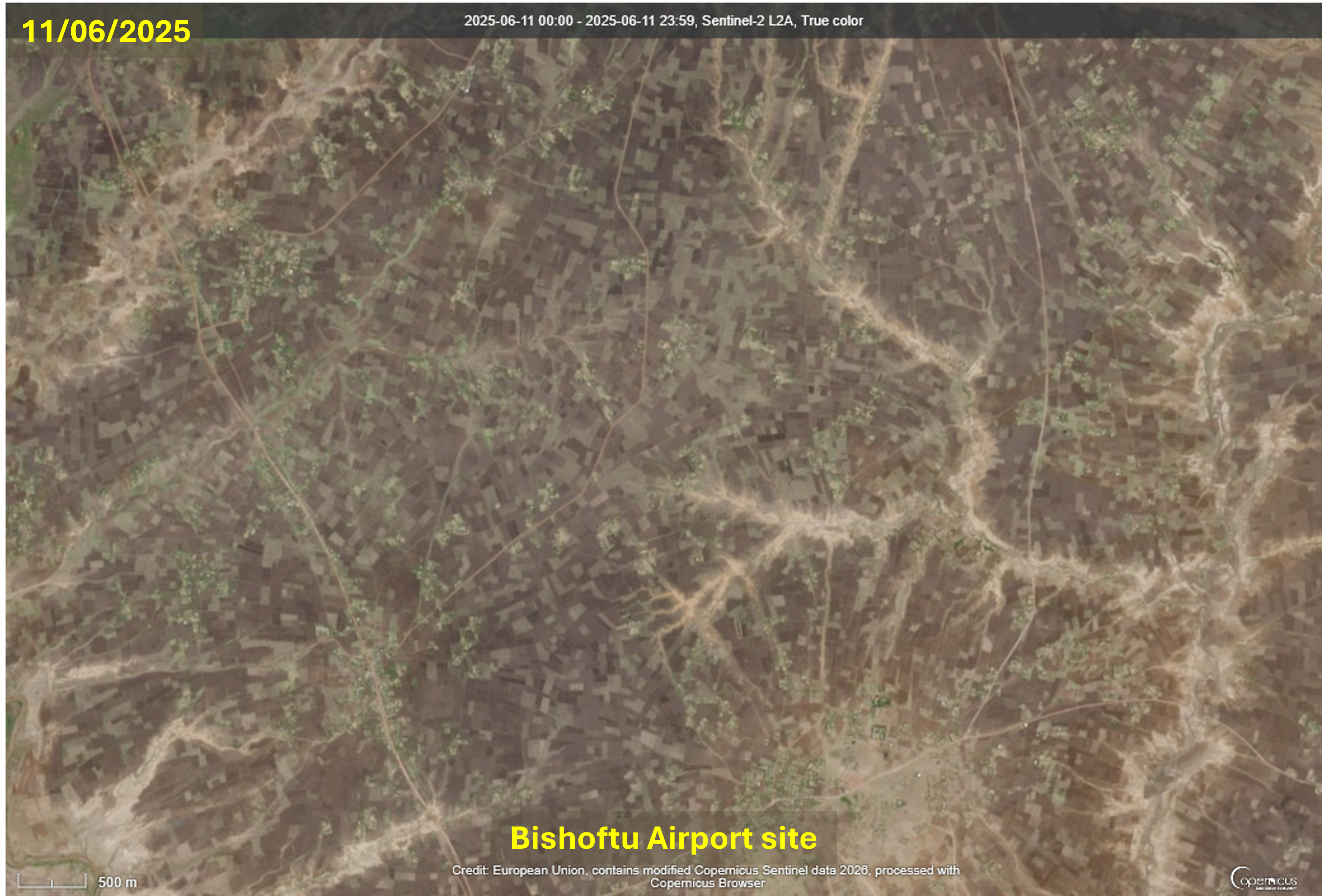
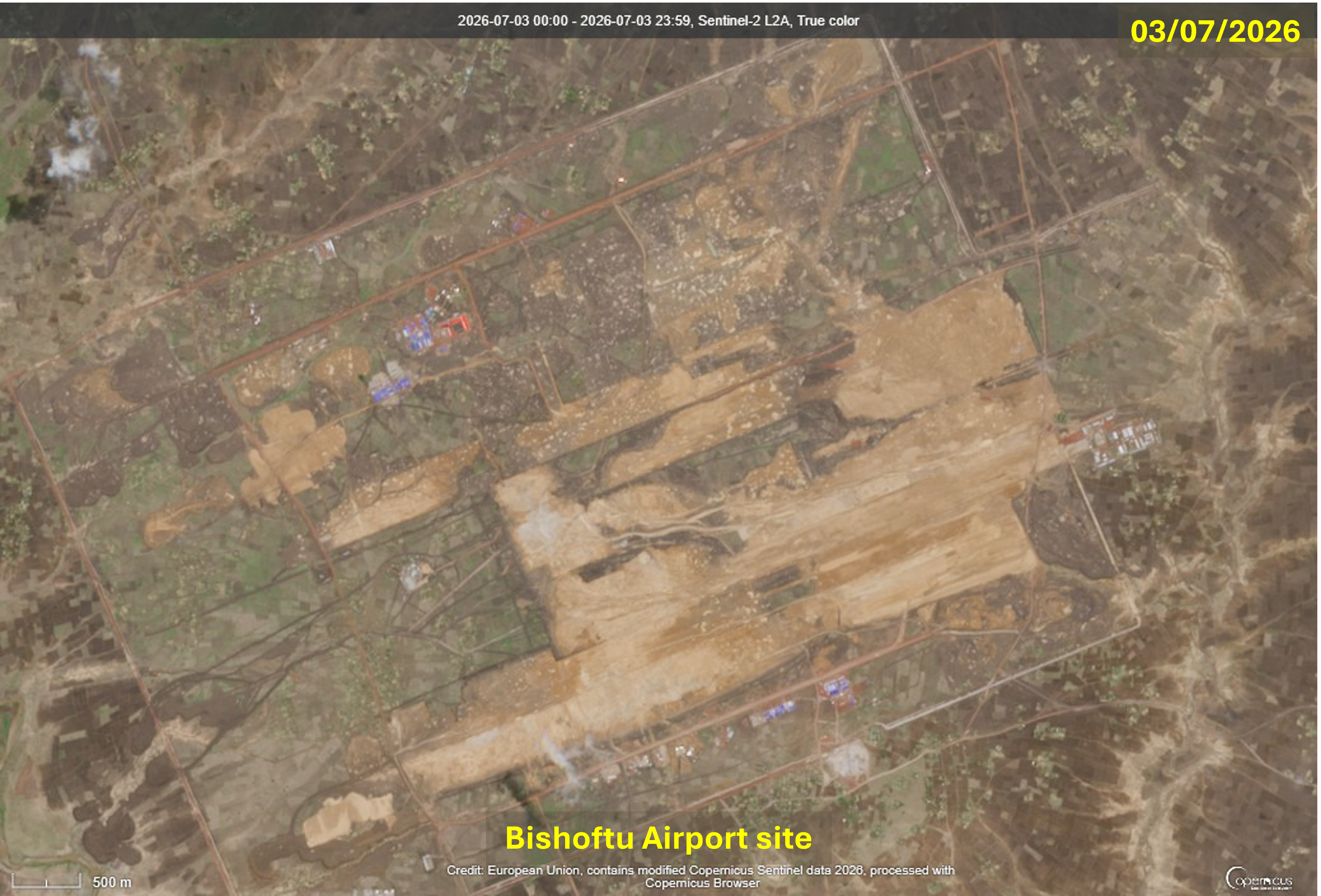
Bishoftu Airport site, 11th June 2025Bishoftu Airport, 3rd July 2026
Timelapse aerial imagery of Bishoftu International Airport construction site. The 3rd July image shows construction site preparatory works.

On 24th March 2025 Ethiopian Airlines Group (EAG) and African Development Bank (AfDB) signed a Letter of Intent for development of Abusera International Airport Project, USD7.8 billion project on a site about 40 kilometres southeast of Addis Ababa, near the town of Bishoftu. EAG allocated funds for preparation of a 35 square kilometre plot of land for the new airport, with budgets earmarked for land clearance, resettlement and preparing the site for construction. Demolishing structures and relocating residents was anticipated to be completed by September. Previously, in August 2024, EAG CEO Mesfin Tassew said that construction of what was described as a ‘Mega Airport City’ could only proceed with resettlement of up to 2,500 farmers residing on the site. In January 2025 concerns of affected farmers over inadequate compensation, resettlement and support for finding new livelihoods were reported.

Dispossession in the name of development

Oromia Today responded to the agreement between EAG and AfDB with an article titled ‘Development Draped in Dispossession: The Tragedy Behind the Abuu Seeraa Airport Deal’, focussing on more than 15,000 Tuulama Oromo people, indigenous to the regional state of Oromia, facing displacement for the airport. The article reported ‘families being harassed, homes being marked for removal and livelihoods being uprooted’ with no relocation process and eviction orders ‘delivered by undisciplined militias’. The article called for the AfDB to be held accountable and made three demands:

  1. A thorough re-evaluation of the airport project considering impacts on local people, heritage and the environment
  2. For development in Abuu Seeraa to ‘embody a thoughtful integration’ preserving, not erasing, the area’s history and environment with no forced eviction
  3. Fair compensation for displaced people not just with single payments but via a long-term scheme recognising them as stakeholders in the airport with a share in the project reflecting the value of the land acquired

Environmental and Social Impact Assessment (ESIA) Report

The Environmental and Social Impact Assessment (ESIA) Report for the airport, now called Bishoftu International Airport Project, was completed on 10th August 2025, several months after reports of resistance to the project had emerged. Major impacts detailed in the ESIA included acquisition of approximately 3,979 hectares of land displacing 2,731 households comprising 15,320 people. The local economy is predominantly rain-fed agriculture and livestock rearing. Common crops include teff, wheat, barley, maize and various legumes including chickpeas, beans, soya beans and peas. Livestock including cattle, sheep, goats, donkeys, mules and horses are integral to local livelihoods providing milk, meat and hides. About 2,518 hectares of agricultural land, where staple crops including teff, wheat, and barley are cultivated, will be lost. In addition, 163.1 hectares of grazing land will be affected and the livelihoods of pastoralists disrupted by loss of seasonal grazing lands. Schools, roads, health and water facilities will be lost and cultural and religious sites including several churches will be impacted.

Stakeholder Engagement Plan (SEP)

A Stakeholder Engagement Plan (SEP) for Bishoftu International Airport, completed on 2nd October 2025, outlines a ‘comprehensive’ framework for engaging relevant stakeholders during pre-construction, construction and operation. The report states a ‘commitment to effective stakeholder engagement to ensure that community voices are heard and considered in decision-making processes’ with particular attention to vulnerable groups such as women, youth, the elderly and people with disabilities. Several serious risks and concerns were identified during consultations undertaken for the SEP. Project Affected Persons (PAPs) highlighted problems including disputes arising from inaccurate land demarcation, concerns over the fairness of compensation, loss of farmland and impacts on and restoration of livelihoods. Young people are identified as a vulnerable group due to worries about unemployment, loss of land inheritance and exclusion from benefit-sharing mechanisms.

Project implications for communities

In November 2025 Global Oda Nabe Association (GLONA), a USA based non-profit, civil society organisation published The New Mega Airport Project in Aabbuu, Oromia, Ethiopia: The Project Implications on Aabuu Communities. Sources from the affected community said neither the government nor EAG had engaged with them to discuss detailed resettlement plans, ‘They do not know when, where, what their rights are, the process involved for relocation, and what their fate will be following the eviction from their ancestral land. So, the affected communities are now in limbo.’ The community sources also said people raising questions and voicing concerns relating to the airport, demanding full disclosure of the project and how it would affect them, in particular regarding compensation for land, were being intimidated. Many concerning environmental consequences were identified such as deteriorating air quality and waste and sewage from the site which might pollute rivers and groundwater.

Reports of forced eviction

In December 2025 The Economist reported that the airport was expected to displace approximately 15,000 people. Reports indicated that some affected residents had received promises of housing but others were in fear of their land being taken without receiving compensation. There were also reports that activists voicing concerns about the project had been harassed and arrested. A January 2026 statement by the Oromo Liberation Front (OLF) condemned the planned ‘mega airport’ and adjoining ‘airport city’ as the most recent and serious chapter of displacement spanning many decades, warning of the eviction of 15,000 people from six villages. Despite allocation of ETB17 billion (USD110 million) for resettlement and rehabilitation of farmers, the situation on the ground was reported to be ‘brutal’ with OLF reporting, ‘farmers…have been forcibly ordered, in the manner of war, to leave without harvesting their crops, moving their property, or even selling their cattle’. OLF rejected rehabilitation limited to cash compensation and demanded equity instead of eviction with displaced communities granted equity shares as co-owners of the airport and intergenerational rights extending benefits to landowners’ descendants.

Displacement in the absence of Free, Prior and Informed Consent

The Oromo Federalist Congress (OFC) issued a statement, ‘Development Without Dignity is Dispossession’, to ‘address the grave and escalating situation’ regarding the airport project. The OFC acknowledged an appeal from the Aabbuu Seeraa community and expressed solidarity with 3,000 households ‘facing imminent eviction from their ancestral lands’. OFC described the displacement, in the absence of Free, Prior and Informed Consent (FPIC), as a legal crisis, violating Article 40 of the Constitution protecting farmers’ rights to land. A call to action included demands for a moratorium on evictions, institutional dialogue, equity not eviction, cultural protection and due diligence from AfDB to ensure compliance with international human rights provisions pertaining to Development-Induced Displacement (DID). The statement concludes, ‘The Oromo Federalist Congress reiterated that we are not anti-development, we are anti-theft. We are anti-erasure. A project of this magnitude, intended to be the “Pride of Africa”, cannot begin with the shame of destroying the very people who host it.‘

Construction of ‘Africa’s largest airport’ begins

Construction of Bishoftu International Airport began on 10th January 2026. The total cost for phase 1 was stated at USD12.5 billion, accommodating 60 million passengers per year, rising to become Africa’s largest airport with a total capacity of 110 million passengers per year. Reuters reported that some young residents being displaced for the airport were worried because their parents had been given houses but they had not and renting a house is expensive. On 30th January 2026 Oromia Today published an in-depth report, ‘Aabbuu Seeraa: Building Progress on Indigenous Erasure’, decrying the displacement of approximately 15,000 people for the airport, the ‘overwhelming majority’ of whom had not received replacement housing or new livelihoods. People protesting their post-eviction situation had been incarcerated. Communities using social media to document discrepancies between the official account of their displacement and their lived reality were punished. A few new houses had been constructed but about 95 per cent of displaced people had been left without land, shelter or an alternative income. The report called for replacement housing and livelihood restoration before displacement, transparent management of compensation with auditable records, protection of the environment and heritage, sensitivity regarding demographic impacts, permanent stakeholder status for affected people and an independent international assessment to evaluate compliance with human rights standards.

Displaced residents suffer hardship

On 9th February 2026 Addis Standard reported that Abusera residents displaced for construction of Bishoftu Airport were suffering from hardship having received neither the compensation nor replacement housing they had been assured of. An affected resident said she had documentation for three inherited plots, but, since the land was acquired for the airport had not received compensation or housing. She said, “It is not only compensation, even the houses given to others were not provided to us. I am raising my grievance with government officials and I have proof of ownership.” Another resident said he had been displaced from three inherited plots of land, for which he had a court order confirming his ownership, and was living in rented accommodation having difficulties providing for his two children. On 10th February EAG stated it had built housing in Bishoftu for residents displaced by airport construction and livelihood support for had been prepared. Yet some affected residents continued to claim they had not received compensation or adequate support for resettlement. Later that month the Director General of the Petroleum and Energy Authority, Destaw Mekwanant, announced provision of a specific fuel allocation of 16.5 million litres per month for construction of Bishoftu Airport.

For more information including references for all source material, photos and graphics see the case study on EJAtlas, the world’s largest, most comprehensive online database of social conflict around environmental issues – Bishoftu International Airport and Mega Airport City, Ethiopia

Türkiye: NATO Summit in emerging complex next to Ankara Airport

Preparations for the 7-8th July NATO Leaders’ Summit in Ankara.involved the opening of a new military headquarters, airport expansion and a new/upgraded road network.

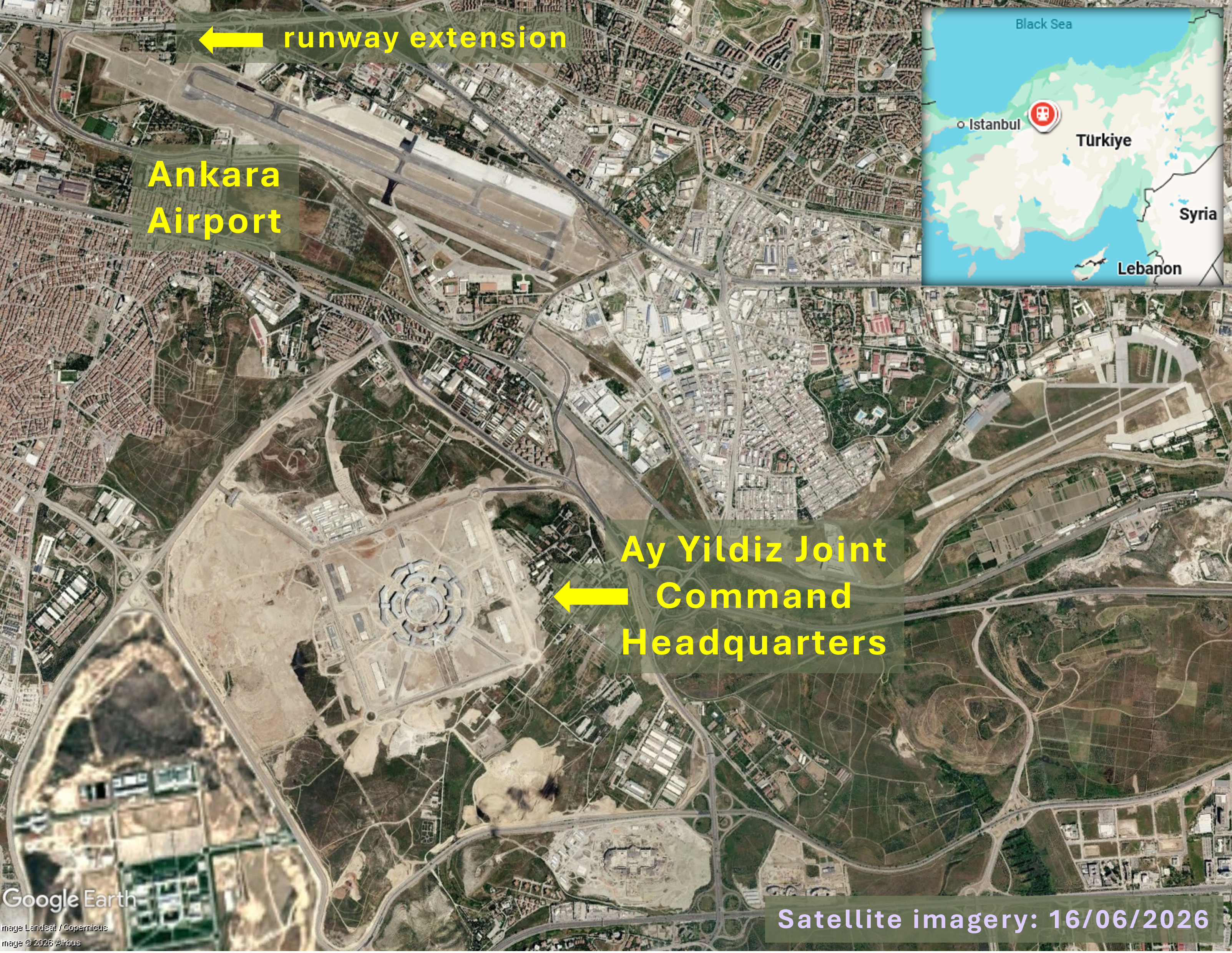
Ankara Airport and Ay Yildiz Joint Command Headquarters
Ankara Airport including runway extension, Ay Yildiz (Crescent and Star) Joint Command Headquarters and parts of the 12.5km new and upgraded road network

Heads of state of all 32 NATO member countries, along with Ukrainain representatives, are expected to attend the NATO Leaders’ Summit in Ankara, capital city of Türkiye, on 7-8th July 2026. The summit will showcase the new Ay Yıldız (Crescent & Star) Joint Command Headquarters, named after the crescent and star of the national flag. Located 15 kilometres west of Ankara the 1,280 hectare complex, larger than many city centres, will host Turkey’s main military institutions including the Defense Ministry, General Staff and the army, navy and air force commands. The NATO summit will be held in the star-shaped part of the campus, prepared specifically for the event and the focal point of a 23,000 square metre ceremonial plaza. Becoming operational in phases, the wider Ay Yildiz campus will ultimately have capacity for 15,000 personnel, the central crescent-shaped building containing five conference halls. Officials have said that Ay Yildiz is larger than the US Pentagon. A new building to host the Foreign Ministry will be constructed next to the military complex. An underground operations centre focused on chemical, ballistic, radiological, nuclear (CBRN) and cybersecurity threats will be located 30 metres beneath the surface.

A new VIP airport

To the north of Ay Yildiz, Etimesgut Aır Base, a military airfield and a main base for the Turkish Air Force, also serving as a training and logistics centre, has been transformed into what some media outlets describe as a new VIP airport for presidents, prime ministers and other high-ranking officials. US President Donald Trump will be arriving for the NATO Summit in his new Air Force One aircraft gifted by Qatar. In the lead-up to the event, just before an opening ceremony on 15th June, President Recep Tayyip Erdoğan’s aircraft was welcomed at the facility, now named Ankara Airport, with a water salute. In time for the summit, over a period of just eight months the runway was lengthened from 2,450 metres to 3,000 metres and widened from 42 metres to 60 metres to handle wide-bodied aircraft. Taxiways have been constructed and a new 160,000 square meter apron has capacity for 44 aircraft. Relocation of the VIP terminal was fast-tracked for completion in time for the NATO Summit and high-ranking visitors can be accommodated in a new 4,800 square metre state guesthouse (an official venue for state functions and meetings). A new parking area is large enough for 310 vehicles.

A new/upgraded road network

The airport expansion project, estimated by the government to cost 10 billion lira (USD320 million), included construction of Baskent Aviation Bridge (Başkent Havacılık Köprüsü) and 12.5 kilometres of new and upgraded roads connecting Ankara Airport with surrounding areas, including a 3 kilometre dedicated connection road between the airport and the NATO Summit venue. Aırport and road expansion impacted on the Ankara Sugar Factory industrial complex, which was established in the late 1950s. Several residential blocks were demolished and some administrative buildings removed. The airport upgrade and road projects have also led to changes to or removal of public transport routes in some neighbouring districts, in some of which, such as Batikent and Eryaman, where residents might experience an increase in aircraft noise.

Pre-summit crackdown

During the lead up to the summit Turkish authorities launched a crackdown on civil society. Protests were banned, along with public gatherings, press conferences and displaying posters. In Ankara, 40,000 police were deployed and on 23rd June 225 people, including academics and activists, were detained on suspicion of links to militants organisations such as Islamic State. Media freedoms were curbed including refusing accreditation dozens of journalists, to the NATO summit. Together with 14 press freedom organisations the International Press Institute (IPI) sent a letter to NATO chief Mark Rutte, calling on the alliance to reconsider the accreditations. One of the journalists whose accreditation was denied, Işın Eliçin of the independent media outlet Halk TV, said, “An unexplained exclusion of journalists restricts media freedom and ultimately the public’s rights…to receive independent information about NATO’s work.” IPI national committee member Uraz Kaspar said, “Every rejected journalist deserves a clear, specific and transparent reason for their denial.” Then, on 4th July, two days before the summit, more than 100 people, members of the TKP (Communist Party) participating in an anti-NATO demonstration in Kizilay Square in central Ankara, were detained by authorities. Protest spread from Ankara to Istanbul where there was a heavy police presence but no clashes were reported.