Preparations for the 7-8th July NATO Leaders’ Summit in Ankara.involved the opening of a new military headquarters, airport expansion and a new/upgraded road network.
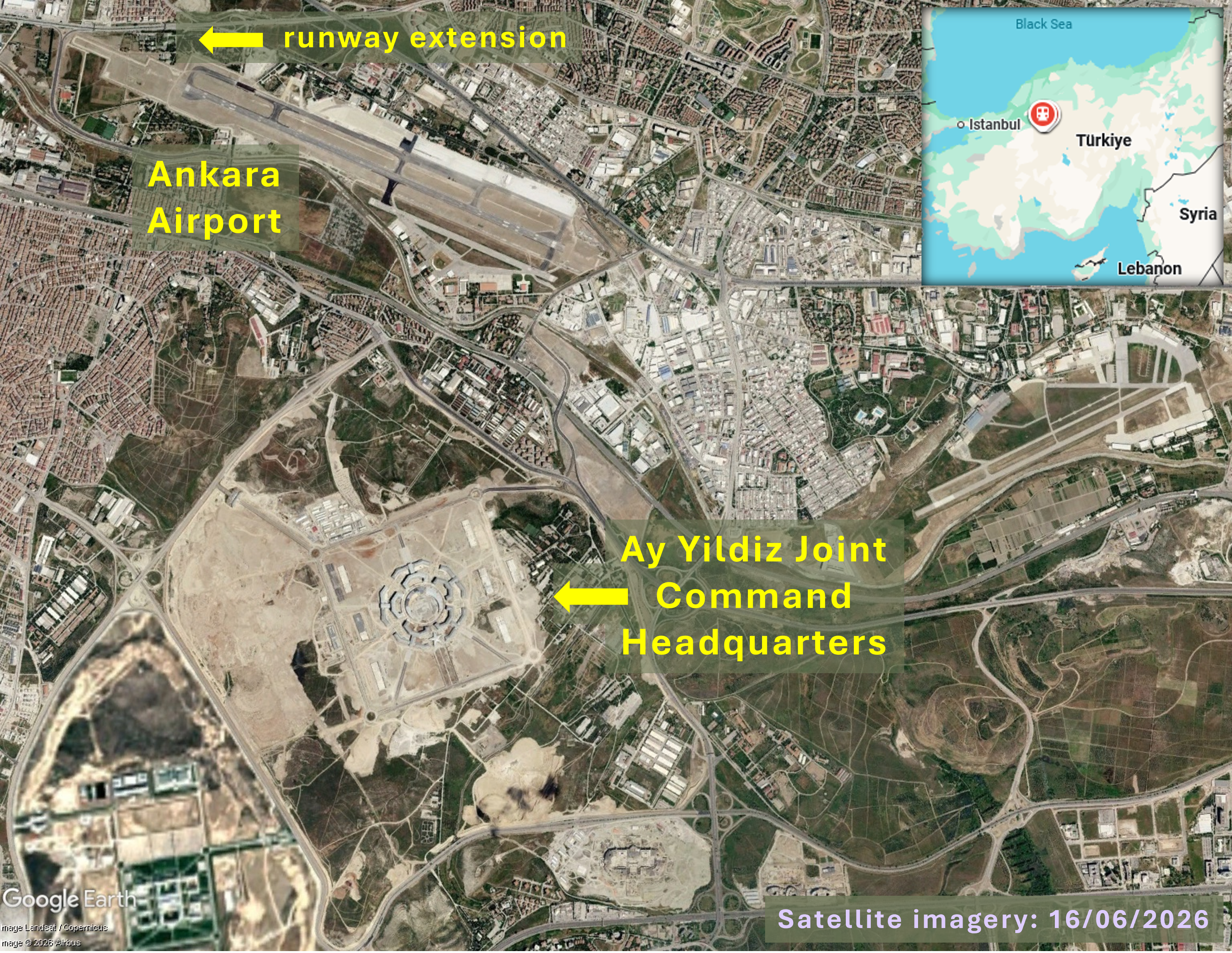
Heads of state of all 32 NATO member countries, along with Ukrainain representatives, are expected to attend the NATO Leaders’ Summit in Ankara, capital city of Türkiye, on 7-8th July 2026. The summit will showcase the new Ay Yıldız (Crescent & Star) Joint Command Headquarters, named after the crescent and star of the national flag. Located 15 kilometres west of Ankara the 1,280 hectare complex, larger than many city centres, will host Turkey’s main military institutions including the Defense Ministry, General Staff and the army, navy and air force commands. The NATO summit will be held in the star-shaped part of the campus, prepared specifically for the event and the focal point of a 23,000 square metre ceremonial plaza. Becoming operational in phases, the wider Ay Yildiz campus will ultimately have capacity for 15,000 personnel, the central crescent-shaped building containing five conference halls. Officials have said that Ay Yildiz is larger than the US Pentagon. A new building to host the Foreign Ministry will be constructed next to the military complex. An underground operations centre focused on chemical, ballistic, radiological, nuclear (CBRN) and cybersecurity threats will be located 30 metres beneath the surface.
A new VIP airport
To the north of Ay Yildiz, Etimesgut Aır Base, a military airfield and a main base for the Turkish Air Force, also serving as a training and logistics centre, has been transformed into what some media outlets describe as a new VIP airport for presidents, prime ministers and other high-ranking officials. US President Donald Trump will be arriving for the NATO Summit in his new Air Force One aircraft gifted by Qatar. In the lead-up to the event, just before an opening ceremony on 15th June, President Recep Tayyip Erdoğan’s aircraft was welcomed at the facility, now named Ankara Airport, with a water salute. In time for the summit, over a period of just eight months the runway was lengthened from 2,450 metres to 3,000 metres and widened from 42 metres to 60 metres to handle wide-bodied aircraft. Taxiways have been constructed and a new 160,000 square meter apron has capacity for 44 aircraft. Relocation of the VIP terminal was fast-tracked for completion in time for the NATO Summit and high-ranking visitors can be accommodated in a new 4,800 square metre state guesthouse (an official venue for state functions and meetings). A new parking area is large enough for 310 vehicles.
A new/upgraded road network
The airport expansion project, estimated by the government to cost 10 billion lira (USD320 million), included construction of Baskent Aviation Bridge (Başkent Havacılık Köprüsü) and 12.5 kilometres of new and upgraded roads connecting Ankara Airport with surrounding areas, including a 3 kilometre dedicated connection road between the airport and the NATO Summit venue. Aırport and road expansion impacted on the Ankara Sugar Factory industrial complex, which was established in the late 1950s. Several residential blocks were demolished and some administrative buildings removed. The airport upgrade and road projects have also led to changes to or removal of public transport routes in some neighbouring districts, in some of which, such as Batikent and Eryaman, where residents might experience an increase in aircraft noise.
Pre-summit crackdown
During the lead up to the summit Turkish authorities launched a crackdown on civil society. Protests were banned, along with public gatherings, press conferences and displaying posters. In Ankara, 40,000 police were deployed and on 23rd June 225 people, including academics and activists, were detained on suspicion of links to militants organisations such as Islamic State. Media freedoms were curbed including refusing accreditation dozens of journalists, to the NATO summit. Together with 14 press freedom organisations the International Press Institute (IPI) sent a letter to NATO chief Mark Rutte, calling on the alliance to reconsider the accreditations. One of the journalists whose accreditation was denied, Işın Eliçin of the independent media outlet Halk TV, said, “An unexplained exclusion of journalists restricts media freedom and ultimately the public’s rights…to receive independent information about NATO’s work.” IPI national committee member Uraz Kaspar said, “Every rejected journalist deserves a clear, specific and transparent reason for their denial.” Then, on 4th July, two days before the summit, more than 100 people, members of the TKP (Communist Party) participating in an anti-NATO demonstration in Kizilay Square in central Ankara, were detained by authorities. Protest spread from Ankara to Istanbul where there was a heavy police presence but no clashes were reported.

