A briefing produced for the launch of GAAM in March 2015, entitled ‘What is an Aerotropolis, and why must these developments be stopped?‘, has been translated into Indonesian. It was published on the Berita Bumi website.
Year: 2017
GAAM leaflet highlights five anti-aerotropolis campaigns
GAAM has published a leaflet outlining the aerotropolis model of development and highlighting five examples around the world which are meeting with resistance from affected communities: Kertajati in Indonesia, Jeju Island in South Korea, New Mexico City Airport (NAICM), Istanbul’s third airport and Manchester Airport City. You are welcome to download the leaflet and print your own copies.
Indonesia: Report on the Struggle Against ‘New Yogyakarta International Airport’ (NYIA) in Kulon Progo
An update on eviction of farmers for a new airport in Kulon Progo, Indonesia, calling for international solidarity with communities resisting displacement, especially from India as Indian conglomerate GVK is an investor in the project.


Received on 20.08.17:
Since 8 August last week, particularly in Macanan Glagah area and 10 August heavy machinery were already operating within the compromised area (the area in which some community of peasants already sell their land and compromised with the project, although their relocation still unsure) for the development of NYIA. Despite community and peasant resistance against NYIA, the government and PT Angkasapura, cooperating
with this large company from India as the airport major investor: GVK corporation. (We urge comrades in India to communicate with us and build international solidarity)
Mainstream coverage of past struggle against NYIA in English:
http://www.thejakartapost.com/news/2015/10/31/islands-focus-hunger-strike=
-over-kulon-progo-airport-continues.html
http://www.thejakartapost.com/news/2015/05/21/kulon-progo-airport-develop=
ment-violates-human-rights-komnas-ham.html
Grassroot and independent media coverage (Indonesia):
Facebook: Jogja Darurat Agraria
PS: The struggle against NYIA is connected to the previous struggle of peasants in Kulon Progo against iron mining in which they won the struggle, not through legal means but through community grassroots struggle (riots…
View original post 84 more words
Veteran Narita Airport protest leader Kōji Kitahara dies, aged 95

Kōji Kitahara, the Narita Airport protest leader, has died, aged 95.
He passed away in the afternoon of August 9th in a hospital in Tomisato, Chiba. A farmer and landowner, Kitahara was the official head of the Sanrizuka-Shibayama United Opposition League Against the Construction of Narita Airport (also known as the Farmers League Against the [sic] Narita Airport, or more colloquially known in Japanese as Hantai Dōmei, or the Opposition League), which campaigns against the expansion of Japan’s premier airport.
After Issaku Tomura, who initially led the protest movement until his death in 1979, Kitahara was the most prominent figure in the Hantai Dōmei. Though increasingly frail in recent times, Kitahara’s fervour was boundless. I met Kitahara once and heard him at rallies on a few occasions. He remained a passionate public speaker despite his advancing age and he was still participating in rallies until last year.
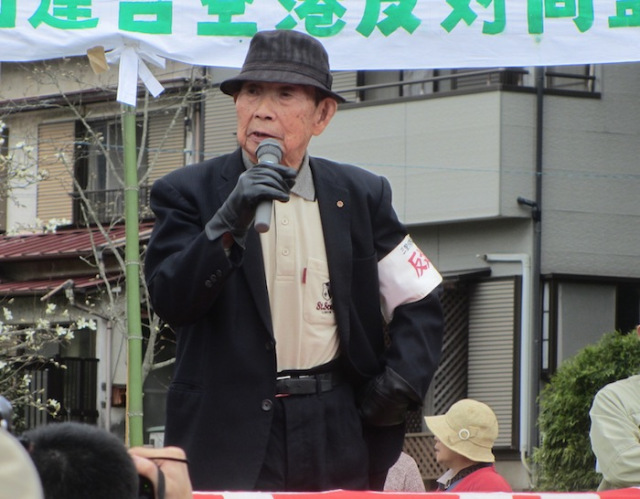 Kōji Kitahara at…
View original post 319 more words
WE NEED TO HAVE THE AVIATION CONVERSATION
An interesting article from the UK , WE NEED TO HAVE THE AVIATION CONVERSATION critiques Norwich Airport’s expansion plan, to treble its passenger number over the next 30 years. It is an example of the ‘predict and provide’ model of transport planning that assumes continued aviation growth as the starting point for all policy, which is incompatible with action on climate change. The article is reposted from The Norwich Radical website.
Spotlight on Sustainable Development 2017
 GAAM has contributed a short article about aerotropolis projects to the Spotlight Report on Sustainable Development 2017: Reclaiming Policies for the Public. The report, by the Reflection Group, a global alliance of civil society organizations and networks was launched on 10th July and is being discussed at the High-Level Political Forum, the United Nations’ central platform for follow-up and review of the 2030 Agenda for Sustainable Development.
The GAAM article The ‘Aerotropolis’ phenomenon – high risk development thwarting SDGs was written by Anita Pleumarom, coordinator of Tourism Investigation and Monitoring Team (t.i.m.-team) and appears as a box on page 115 in chapter 11, which relates to SDG (Sustainable Development Goal) 11, to Make cities inclusive, safe, resilient and sustainable. The SDGs, 17 in total, a set of goals to end poverty, protect the planet, and ensure prosperity for all as part of a new sustainable development agenda, were adopted by countries on September 25th 2015. Each SDG has specific targets to be achieved over a 15 year timeframe, by 2030.
The Spotlight report assesses the implementation of the 2030 Agenda, analyzing systemic problems in its realization. Governments recognized the essential role of the public sector, including public finance, in achieving the SDGs. But this role is being undermined by privatization and public-private partnerships (PPS), which have strengthened the grip of corporate power on people’s lives. GAAM’s aerotropolis article outlines how this new form of airport-centric development, driven by a combination of private business interests and state control and spreading rapidly worldwide, works against achieving progress towards the SDGs, as it ‘profoundly subverts the goal of building inclusive, equitable cities’. The report provides a breadth and depth of information to help enable civil society to reclaim public space, and measures that governments should undertake to establish the requisite regulatory and global governance framework.
Airport-linked special economic zones and aerotropolis projects
The aerotropolis was on the agenda at the Tax Justice annual conference held at City, University of London on 5th-6th July – Global Tax Justice at a Crossroads: Southern Leadership and the Challenge of Trump and Brexit organised by the Association for Accountancy & Business Affairs (AABA), City, University of London (CityPERC), and the Tax Justice Network (TJN). GAAM co-founder Rose Bridger presented a paper entitled ‘Airport-linked special economic zones, aerotropolis projects and the race to the bottom’. Aerotropolis planning and development worldwide is closely intertwined with a new generation of special economic zones (SEZs) offering tax breaks and other incentives.
An idiot’s guide to why Sydney doesn’t need a second airport

My opinion on this subject seems to be wildly unpopular, everywhere I turn I encounter people who genuinely believe that building a second airport at Badgery’s Creek is necessary. Desirable, even.
Now I’m not the smartest person, but even I’ve been able to see the facts and see that it’s actually a horrible, terrible idea. So here it is, a guide to why we don’t need a second airport that is so simple, even I’ve been able to comprehend it.
“Sydney Airport is too busy. It’s obvious we need two airports.”
Sydney Airport is not at capacity. Even with the curfew, there is room for a lot more growth. In fact Sydney Airport did their own independent study that showed that a second airport is neither cost effective nor necessary, which is why they’re not the ones building it. The government chose to ignore all that and build it themselves…
View original post 1,166 more words
International call for cases of evictions for tourism
The scale of forced evictions is shocking, threatening more than 70 million people worldwide. Eviction for tourism projects – including hotels, theme parks, resorts, cruise ship ports and airports – is a growing problem that is gaining recognition. Individuals and communities who are affected are invited to submit cases to an important international event which will make recommendations for effective actions and help build solidarity across the globe.
The International Tribunal on Evictions (ITE) has issued an International Call for Cases of Evictions due to Tourism. Any individual or community that has been evicted or is facing the threat of eviction for tourism development is invited to submit their case of eviction or displacement. The deadline for submissions is 15th July 2017. To submit a case of eviction please complete the online form. The selected cases will be examined at the sixth session of the ITE, which will specifically focus on cases of eviction and displacement for tourism development, to be held in Venice, Italy, from 28 to 30 September 2017.
The ITE is a peoples’ and opinion tribunal established in 2011 by the International Alliance of Inhabitants and civil society organizations to practically and interactively end forced evictions around the world, is calling on the international community to report cases of evictions and displacement in the context of tourism development. The ITE’s call for action reads:
“Is your home threatened with destruction because developers want to build a hotel? Do they want to clear your community, your neighbourhood, and your land for a resort, a golf course, a stadium, a port, or an airport for tourism? Are you and your community threatened by the precariousness of rental contracts resulting from AirBnB? Tourism development is attacking your rights where you have chosen to live in peace and dignity!”

At the ITE a jury consisting of representatives of civil society, international organizations and academics will select the cases and evaluate the claims in the light of international legal instruments relating to enforcement of economic, social and cultural rights, with particular regard to the right to housing and land security. The ITE verdict will take the form of recommendations drafted by a jury of international experts, and will serve as a road map for the cases judged and as a reference point for building international solidarity. Recommendations will be made to stakeholders, including the United Nations, governments, the economic and institutional actors responsible for the evictions, and will be monitored on regular basis.
An article on the ITE website, Why the ITE Session on Tourism? Growing human rights violations caused by over-tourism, provides useful background information on the problems host communities have contend with due to the current trajectory of rapid tourism growth. Globally, tourist numbers reached 1,235 billion in 2016 and the the number of forced evictions for this industry is growing. Entire communities are evicted for infrastructure to support mobility for tourism – ports, roads and airports. Indigenous communities are evicted from forests and coastal ecosystems under the pretext of environmental preservation or preventing natural disasters. Urban residents are displaced for gentrification schemes and escalation of rentals of private homes for tourism pushes up rental costs for residents. Authorities often view tourism as an engine of development and disregard human rights.
It is fitting that the ITE is to be held in Venice; this unique city has been dubbed the ‘global capital of resistance to tourism evictions‘. Massive tourism development has been the key factor in reducing the number of inhabitants from 175,000 in 1953 down to just 54,000 in 2017. Meanwhile, Venice is undergoing continued tourism pressure, with 9 million overnight tourists and 24 million commuter visitors in 2016. The fishing island of Pellestrina is a particularly striking example, where landlords no longer rent to residents but only to tourists. It is encouraging that, countering this negative trend, determined and vibrant civil society movement has emerged thoughout the city, organizing daily activities to support resistance against evictions for tourism projects. The ITE session will include visits to a number of islands and districts of “resistance Venice”.

 antiaero.org