On the morning of 27th November 400 officials – police, army and representatives of Indonesia’s state-owned airport developer PT Angkasa Pura I – arrived to survey land for New Yogyakarta International Airport (NYIA) in the Temon District in the Kulonprogo Regency, on the south coast of central Java. An attempted land grab for the airport, and the courageous resistance of residents resisting forced eviction is documented in a video by Jogja Darurat Agraria. In the space of just two days bulldozers have wreaked devastation reminiscent of a powerful earthquake that struck the island of Java in 2006. Parts of some houses have been destroyed and trees and plants uprooted leaving bare earth.
The land does not belong to PT Angkasa Pura I and residents are refusing to leave or to sell their property. Officials, some of them armed with guns, inform the residents that they will register their houses and instruct them to vacate, and that they have been instructed to clear the land, to tear down everything, by 4th December. But 300 residents are refusing to sell the land passed on to them by their ancestors. Their livelihoods depend upon the farming that they are determined to continue, their values embedded in the culture and nature of the southern coast area.
Women play a prominent role in resisting the forced eviction for the new airport, they stand their ground against the intimidation of large numbers of male officials, facing down heavy verbal aggression, refusing to obey commands, refuting claims that the airport is for their economic benefit and asserting their right to remain in their homes. A crowd of officials confront another woman on her doorstep, try to push the door down, shout at her to get out and try to force their way into her house. She shouts out to the officials that their role is to protect civilians. Then some men begin to wrench open the door. Another woman, also confronted by officials at her door, says that they told her that received three warnings of the impending eviction, she denies this and insists that she did not receive any warning.
Officials are shown cutting off the electricity supply to some of the houses. This move is intended to amplify the threat of destruction and make other residents give up their resistance to eviction, dismantle their homes to salvage whatever they can, and vacate the area. Jogja Darurat Agraria posted photos on Facebook showing villagers gathering to witness and resist the bulldozers at work and the severing of electrical supplies.
The Indonesian government’s attempt to evict Kulon Progo villagers from their homes and farmland at this particular time, beginning on 27th November 2017, adds irony to insult and intimidation; 29th November is designated by the United Nations as the International Day of Women Human Rights Defenders. A video posted on 28th November shows distressed residents – women, men and children – bravely standing and lying in the path of the bulldozers as roofs are ripped off houses and trees uprooted. They are dragged away by officials. Cutting off electricity supplies continues.
The new airport is a key project of the Indonesian government, led by President Joko Widodo, which is pushing for accelerated infrastructure development. PT Angkasa Pura I claims that the process of land acquisition and clearance for NYIA is under control. In reality a land grab is taking place. Forcible eviction for the airport is a shameful and serious abuse of human rights and the very opposite of the government’s stated commitment to achieving the United Nations Sustainable Development Goals (SDGS), specifically SDG 11: Make cities and human settlements inclusive, safe, resilient and sustainable.
The struggle against eviction for New Yogyakarta International Airport dates back to 2011. The site comprises six villages, 2,875 households with 11,501 residents, most of whom sustain agricultural livelihoods cultivating many crops in the fertile soil, including watermelons, chillie peppers and eggplant. Construction of the mega-project commenced and continues without approval of an Environmental Impact Assessment (EIA) and there are serious concerns that destruction of sand dunes will make the coastline more vulnerable to erosion and flooding. An aerotropolis around the airport is planned, a 2,000 hectare ‘airport city’ containing hotels and other tourism facilities, shopping malls and industrial zones.
Authorities have perpetrated repeated acts of repression and violence against villagers resisting displacement for NYIA, which, in its pre-construction phase, was referred to as Kulon Progo Airport. The worst incidence occurred on 16th February 2016. Police and army officers overseeing a boundary-marking procedure subjected a number of residents who had gathered to voice their objections to a vicious and brutal attack. People were choked, kicked and trampled on. The case was taken up by the Asian Human Rights Commission which condemned the excessive use of force and called for prosecution of the officers who were in charge of the exercise.
A new report shows that the aviation industry’s claims of ‘green growth’ are illusory. Biofuels to replace conventional kerosene, schemes purporting to ‘offset’ emissions and ‘green’ airports all fail to curb growing climate change impacts.
Climate damaging greenhouse gas emissions from aviation, the most carbon intensive form of transport, are rising rapidly. Under current growth projections, with construction of new airports, expansion of established airports, expansion of the aircraft fleet and anticipated increase in the number of air passengers and flights, aviation’s emissions are anticipated to increase between four- to eight-fold by 2050. The aviation industry, led by ICAO (International Civil Aviation Organization) promotes an image of ‘green’ growth through technological innovation, new fuels and offset schemes which purport to compensate for increasing aviation emissions through support for reductions in other sectors.
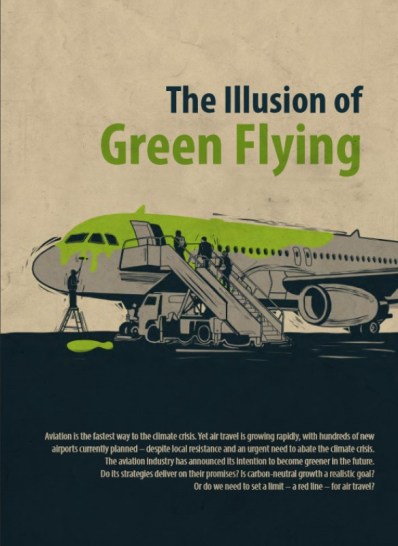
A new report, The Illusion of Green Flying published by Finance and Trade Watch, analyzes and debunks these aviation industry’s claims of ‘green’ growth. Illustrating the expected trajectory of aviation growth, the report begins with a map showing the 423 new airports that, according to aviation industry consultancy CAPA (Centre for Aviation), are planned and under construction, along with an estimated 121 additional runways.
The report shows that the minor efficiency gains and emissions reductions will barely scratch the surface of the massive increase in emissions that is looming with the projected aviation growth rate. A drive to replace conventional petroleum-derived aviation fuel with biofuels threatens to fill up plane’s fuel tanks with much needed food crops, not as yet nonviable biofuels derived from non-food sources such as algae. In addition, aviation biofuels are not climate-friendly as the total emissions, once the supply chain from cultivation, processing and transportation is factored in, can be even higher than from oil-based aviation kerosene.
Avoiding taking measures to reduce emissions, the aviation industry pursues offsetting schemes which merely provide a license to pollute, effectively attempting to outsource its emissions to other industries. Land based offset projects involving forests are particularly problematic as carbon storage in forests over long term periods cannot be reassured and, as the main agents of large-scale deforestation continue to wreak destruction, access to forests is restricted for people depending upon it for their livelihoods. Schemes to offset biodiversity proceed on the erroneous assumption that destruction of a unique, complex habitat can be compensated for by nature protection in a different location. Airports are promoted as ‘green’ or ‘carbon neutral’ by means of accreditation schemes that incorporate measures such as more energy-efficient airport operations and carbon offsets. These schemes, heavily promoted to air passengers, conveniently exclude and detract attention from the 95% of emissions which result from the actual flights.
The report also considers other aviation issues. A raft of subsidies (such as fuel tax exemptions and subsidies to aircraft manufacturers and airlines) makes flying artificially cheap. Aviation has non-CO2 impacts such as aircraft noise and emissions of particulates, which have serious negative health impacts on people living under flightpaths. The inequities of flying are considered; only a small minority of the global population ever set foot on a plane and wealthy people take the vast majority of flights. Resistance against airport expansion is vital to prevent inflated projections of aviation growth, used by the industry in lobbying for government support for expansion, becoming a reality. An ‘infrastructural lock-in’ is looming. Once airports are built or expanded there is tremendous pressure to utilize these emissions intensive facilities, with yet more subsidies and legislative support to support its passenger and cargo throughput projections and ensure economic viability.
Tackling aviation growth requires systemic change of the global economic system, a just transition from fossil fuel dependency, cultural transformation and individual commitment to reduce high-carbon lifestyles. All over the world there is opposition to aviation growth and the report concludes with some ‘resistance highlights’, local campaigns in many countries including France, Mexico, Turkey and Indonesia, and organizations working on relevant issues including biofuels, combating deforestation and promoting train travel as a more sustainable alternative to flying. There is also an Executive Summary outlining the main points of the full report.
Youth and other activists from some twenty civic groups have joined five villages in their struggle against a planned ‘aerotropolis’ on Jeju Island, South Korea.
Still waiting for a statement from the national government’s Ministry of Land and Transportation, residents of South Korea’s largest island continue their fight against the proposed second airport project. The project would push hundreds of locals off of their land and have the more drastic effect of radically transforming the island, environmentally and socio-economically.
A number of candlelight vigils and other actions are ongoing. Saturday’s vigil marked the fortieth day of Kim Young-bae’s hunger strike. Kim is the vice-chair of the 2nd airport opposition committee.
The Polish government has approved a plan for a mega-airport and ‘airport city’ on a 3,000 hectare site. An area of farmland has been identified as a suitable location for the project.
On 7th November, the second day of the UN Climate Change Conference (COP23) in Bonn, the Polish government approved a plan to build a new mega-airport, called Poland Central Airport or New Central Polish Airport, handling as many as 100 million passengers per year. The project would result in a a major increase in Poland’s greenhouse gas emissions. Poland, host of the next climate summit, COP24, in December 2018, is already widely regarded as a climate renegade for its continued investment in coal plants, and had the dubious honour of being awarded Fossil of the Day award in Bonn, for its relentless efforts to siphon European Union (EU) funds for clean energy into subsidizing its ageing coal plants. Announcement of a major airport project makes a further mockery of the country’s commitments to address climate change.
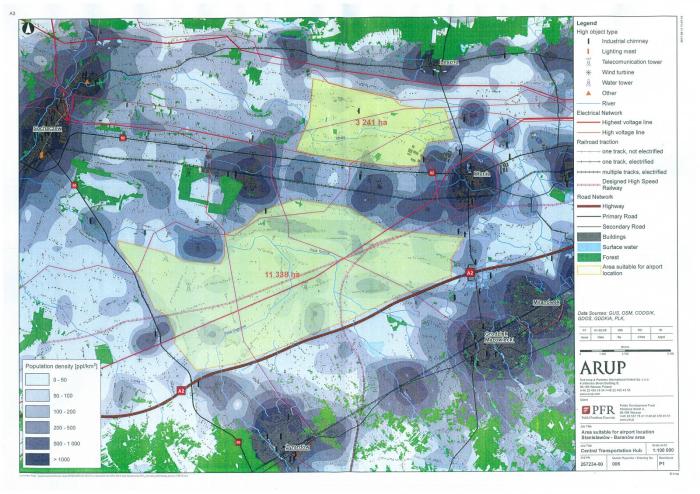
The proposed airport site is in Baranów, a rural gmina (administrative district) 40 kilometres to the west of Warsaw, Poland’s capital city. The map below, commissioned by Polski Fundusz Rozwoju (PFR) in 2008 and included in an article published on 8th October 2017, about a meeting on the airport between representatives of the government and Baranów municipality, shows two areas identified as suitable for the airport project: a 3,421 hectare area to the north of the map and a larger 11,338 hectare area to the south. Another variant of this map was included in a 100 page document discussed at the government meeting which adopted the airport plan, Poland’s biggest infrastructure project in recent years, on 7th November. At this meeting it was confirmed that the planned location of the airport is the Stanisławów village area, near the southern boundary of the area identified as suitable for the project.
Map commissioned by PFR showing areas suitable for Poland Central Airport
A map produced by GAAM shows the villages within the boundaries of the two areas identified as suitable for the airport project and the existing road and rail links.
A satellite image of the Stanisławów village area, confirmed as the planned location for the new central airport, shows the villages and small parcels of cultivated land that characterize the wider area.
A mega-airport, multi-modal transportation hub and an aerotropolis
The schedule for the new airport is for preparatory works to be complete by the end of 2019, then for construction to be complete and operations to commence by mid-2027. A mega-airport is planned, one of the largest in the world with four runways, initially serving 45 million passengers per year, rising to 100 million, a passenger throughput as high as the world’s busiest airports, almost as high as Atlanta in the US and higher than the current traffic levels at Dubai Airport and Beijing Capital Airport. A multi-modal transportation hub is planned, integrating the new mega-airport with existing and new road and rail infrastructure. Plans for the airport include a rail station and the project is also referred to as Centralny Port Komunikacyjny (CPK), which translates as Central Communication Port. The proposed airport site is between Warsaw and Łódź, Poland’s third largest city, and a high-speed rail line connecting the two cities is planned. The A2 motorway running between Poland’s western and eastern borders is immediately south of the proposed site. Immediately north of the airport site is the rail line between Berlin and Moscow, via Warsaw, providing a high-speed service that commenced operations in December 2016.
The 3,000 hectare land area for the new airport is far larger than would be required even if the number of passengers meets the projection of 100 million per annum. A 3,000 hectare site is more than 50 per cent larger than the world’s busiest airport, Atlanta in the US which handles 104 million passengers per year. Atlanta Airport’s site covers 1,900 hectares and encompasses substantial commercial development including more than 200 concession outlets such as retail, food and beverages. The oversized proposed land area for Poland Central Airport could be linked to plans for an ‘airport city‘ or aerotropolis. A 1,200 hectare new city is envisaged, with hotels and showrooms. Under the government resolution outlining plans for the new airport legal and infrastructural changes to Baranów would allow for construction of business parks, conference centres, an exhibition centre and office complexes.
A government financed megaproject
The budget for the airport project, combined with the road and rail infrastructure, is estimated at between €7 – 8 billion. Polish citizens will bear the brunt of the enormous cost of the project; the main investor is the government. The 7th November 2017 resolution announcing construction of the airport approved the financing structure as well as the location. An article in the second 2017 edition of Airport Development News, an industry newsletter published by Airports Council International, stated that two state-owned financial institutions, Polish Development Fund (Polski Fundusz Rozwoju – PFR) and Bank Gospodarstwa Krajowego (BGK), Poland’s national development bank, would be ‘heavily involved’ in financing the project.
Possibilities for European funding have been considered. The Airport Development News article states that between 75 and 80 per cent of airport construction will be financed by international institutions such as the EIB (European Investment Bank) and EBRD (European Bank for Reconstruction and Development). Such investment by the EIB and EBRD is doubtful as state aid rules preclude allocation of EU funds for construction of the airport. But a June 2017 article published by legal analyst firm Lexology stated that EU funds could be tapped for the road and rail elements of the project. The total cost of the rail infrastructure elements of the megaproject complex is estimated to be between €1.89 billion and €2.1 billion, the total cost of roads and highways between €424,000 and €1.6 billion.
Uncertainty over accessing EU funds has led to attempts to secure financing from Chinese sources. The airport was one of the vast transportation and energy infrastructure projects discussed at the May 2017 Summit of the Belt and Road in China, where the President of China repeated assurances about new credit lines by China Development Bank and China Exim Bank, and one of the outcomes was signing of a contract between Polish and Chinese state railways on facilitating container transport. The Asian Infrastructure Investment Bank (AIIB), a multilateral financial institution supporting construction of infrastructure in the Asia-Pacific region, is reported to have expressed an interest in co-financing the Poland Central Airport project, if it is in line with the bank’s policy of promoting ‘interconnectivity’ between continents, which would mean that the airport would have to promote passenger traffic with Asia. Potential benefits to Chinese exporters from the airport are evident. The project would support the Polish government’s intention to establish the country as a port of entry for Chinese goods into the EU single market.
Industry experts doubt feasibility of the new airport
Some industry experts are critical of the new airport, doubtful that a new global hub could compete with established European hub airports such as Schiphol and Frankfurt and saying that it would struggle to meet its traffic projections and fail to make a profit. And adoption of Poland Central Airport as a government priority reverses many years of sloughing huge sums of public money into several new small regional airports. A major new hub airport would compete with these regional airports, many of which are already struggling with low passenger levels and unprofitable. Some industry experts warn that opening a new hub airport would be likely to lead to the closure of several existing Polish airports.
Expenditure on a new airport that results in closure of established regional airports would be an astonishing waste of public funds. Between 2007 and 2015 Poland sank at least US$1.58 billion into building and expanding 14 regional airports, with 40 per cent of this funding coming from the European Union (EU). This was highlighted in a report Flights of fancy: A case study on aviation and EU funds in Poland published in 2012 by CEE Bankwatch Network which critiqued the development and operation of small regional airports which were not financially viable, placing a strain on regional and local government budgets, along with allocation of EU funds for rail connections to airports, arguing it should be redirected to serving mobility needs within regions.
Aviation industry consultancy CAPA (Centre for Aviation) reports that Poland Central Airport would replace Warsaw Chopin Airport, the city’s main airport located south of the city with limited room for expansion. Bloomberg also reports that, under the government plan for the new airport, Warsaw Chopin Airport would eventually be shut down. Closing Warsaw Chopin Airport would be a woeful example of enormous waste of public funds and short-sighted planning. A major, multi-million Euro programme of upgrades to Warsaw Chopin Airport, increasing its capacity to 10.4 million passengers per annum, was completed less than a year ago, in December 2016. The terminal was modernized including installation of new check-in desks and an observation deck, a new long-range fuel pipeline constructed and the runways, taxiways and apron have been upgraded. The airport upgrade programme cost €166,760,000 with the EU Cohesion Fund contributing €32,900,000.
Rafal Milczarski, CEO of Poland’s state-owned carrier, LOT Polish Airlines, has said that Warsaw Chopin Airport should be closed down and the land sold to real estate developers to help finance the new airport. This would certainly benefit LOT, a leading proponent of the central airport. Indeed, supporting growth of the national airline is part of the rationale for the project. But the role of LOT in the new airport is a factor in skepticism regarding its viability. LOT is a relatively small carrier with fewer than ten wide-bodied aircraft. A high level of investment would be required for LOT to become one of Central Europe’s main carriers, one of the goals of the the airport project. Critics are of the opinion that the LOT lacks the scale and financial capacity necessary for commercial viability of the new airport project. LOT Polish Airlines also has a history of government intervention to support ailing finances. The carrier was a direct beneficiary of state funds in 2012-2014 when it was rescued from bankruptcy with a €200 million state bailout.
There are serious doubts over the viability of the Poland Central Airport project. The only certainties are vast public expenditure on infrastructure and loss of a large area of farmland.
This means the villages have effectively bought time for a land and environmental impact assessment. Existing evaluations came under heavy criticism from many, including the some 15 environmental groups who joined the villagers’ action.
Initial studies were carried out unbeknownst to village leaders. At no point before official declaration of the new airport project were residents consulted. Most residents found out about the project when it was announced in local newspapers. ‘Aerotropolis’ projects are notorious around the globe for corruption and often get slated for areas where residents can mount little effective resistance.




 antiaero.org