Puerto Rico: Resisting Esencia, a luxury tourism and residential development with a private airport

Many local and diaspora organisations are opposing Esencia, a luxury tourism and residential megaproject with a private airport, in Cabo Rojo. The development has been granted generous tax credits and would require vast volumes of water.

In May 2024 two real estate firms, Reuben Brothers and Three Rules Capital, filed a master plan for Esencia, a USD2billion development in Boquerón Bay, Cabo Rojo on the west coast of Puerto Rico. Anchored by international hotel operators Mandarin Oriental Hotel Group, Aman Group and Rosewood Hotels and Resorts and containing up to 500 luxury hotel rooms and 900 tourist residences the complex would have a private airport. The Esencia website says the new ‘residential and hospitality community’ will have 3 miles (4.8km) of ‘pristine beachfront’. Plans also included two golf courses, spa, wellnesses centre, health clubs, equestrian centre, hiking and biking trails and a school.

Project Esencia proposed plan
The proposed Esencia plan, with sea views and a private airport, includes luxury hotels and residences and two golf courses. Image source: Reuben Brothers

The Esencia project was granted more than USD497 million in tax credits and in August 2024 four new tax exemptions of between 90 and 100 per cent were approved. A new decree granting 100 per cent fuel tax exemption for tourism-related activities was criticised for incentivising high levels of fossil fuel usage. Comité por la Verdadera Esencia del Suroeste sent statements to multimedia platform Marea Ecologista concerning the proximity of the project site to protected ecologically sensitive areas providing habitats for endangered birds such as the Puerto Rican nightjar. Responding to the absence of public hearings on permits and boundary demarcation for the Esencia project a town hall was convened by local community, environmental and cultural groups on 28th September 2024 where further detail of Esencia project components, including shopping malls and renovation of an airstrip to accommodate small aircraft, was shared.

The land within the site is rural and falls under two classifications. One category is rural land protected because of its ecological importance as it is located between two nature reserves and serves as a corridor for many species and also for its recreational value. The second category is rural land where there is more flexibility regarding development and in recent years mechanisms to evade compliance with the land use plan have been deployed such as declaring projects to be strategic or of critical importance. The project area contains at least 24 archaeological sites from the colonial and pre-colonial eras, many of which have not yet been explored.

On the first day of public hearings in March 2025 Cabo Rojo’s streets were filled with protesters holding posters and banners, many declaring ‘No to Esencia’ and calling the project an enclave for a small number of billionaires. The hall was not big enough to accommodate all the people opposing the project so many watched the proceedings on a screen in a tent outside. Puerto Rican groups opposing the project joined forces under the slogans ‘Defend Cabo Rojo’ and ‘No to Esencia’. The anti-Esencia movement gained support from Puerto Rican diaspora and pro-independence organisations, amplifying locals’ calls for cancellation of the project and holding protests throughout New York. For example, protesters occupied the lobby of the Mandarin Oriental Hotel and unfurled banners in the luxurious Columbus Circle shopping mall.

Officials said the project’s environmental impact statement (EIS) did not address the impacts on infrastructure and ecosystems and lacked hydrological studies. Esencia would place additional strain on water supplies, consuming more than 1.25 million gallons per day, a volume equal to more than a third of current consumption in the Cabo Rojo Municipality. This is a low estimate as it does not include the project proposal’s two golf courses which would increase the volume of water consumed per day to 2 million gallons. The development would require extraction from aquifers or connection to the existing drinking water system but neither of these options are feasible. Local fishers expressed concerns over the risk of damage to oyster beds and disruption of freshwater and saltwater flows that are essential to the health of the estuarine environment.
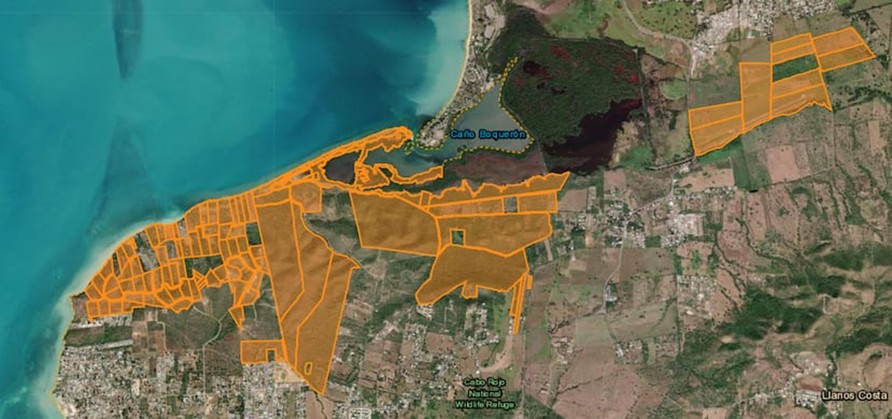
Properties in Cabo Rojo purchased for Esencia
Many of the properties purchased for the Esencia project are shown in orange, agricultural land purchased in August 2025 is shown to the right. El Nuevo Día, 20/09/2025

By September 2025 project investors had spent approximately USD147 million on properties for Esencia and were on track to acquire the target of 809 hectares of land. Recent land parcel purchases were part of the Reserva Agrícola del Valle de Lajas (Lajas Valley Agricultural Reserve) and an airstrip. On 12th September the Department of Natural and Environmental Resources (DNRA) published a 29-page report firmly reiterating its opposition to the Esencia project and concluding that the plans did not comply with environmental laws. Significant findings included fragmentation of habitats hosting endangered bird species, severe impacts on Catesbaea melanocarpa, a rare, endangered lily and threats to the habitat of Anolis poncensis, a rare lizard species. The project’s so-called ‘ecological corridors’ lacked the connectivity of existing ecosystems and golf courses, artificial ponds and landscaping claimed to be mitigations would be part of the project’s negative impacts.

For more information including references for all source material and photos see the case study on EJAtlas, the world’s largest, most comprehensive online database of social conflict around environmental issues – Esencia project, Puerto Rico

By 3rd November 2025 a petition – STOP THE LUXURY MEGAPROJECT “ESENCIA” IN CABO ROJO, PUERTO RICO NOW – calling on the Puerto Rican government and its agencies to stop the permit granting process, protect the land, study submitted material and conduct a transparent investigation prioritizing affected communities and experts, had attracted 36,327 signatures: Detengan ahora el megaproyecto de lujo “Esencia” en Cabo Rojo, Puerto Rico (STOP THE LUXURY MEGAPROJECT “ESENCIA” IN CABO ROJO, PUERTO RICO NOW)

Egypt: Tourism megaproject in St. Catherine displaces Bedouin people and damages ecosystems and heritage

Construction of the Great Transfiguration Project – a mega tourism development n the St. Catherine area comprising luxury hotels, villas, chalets, visitors centre, shopping bazaars, housing and roads is linked to expansion of St. Catherine Airport.

Great Transfiguration Project (GTP), Egypt
Great Transfiguration Project (GTP) area, Egypt. Aerial imagery: 2nd July 2023

The Great Transfiguration Project (GTP), a mega tourism development project including hotels, villas, chalets, private housing, shopping bazaars, other facilities and roads in and around the St. Catherine area – a designated UNESCO World Heritage Site which includes St. Catherine’s Monastery and Mount Sinai – was announced by the Egyptian government in March 2021. Within weeks demolitions and construction works by private companies began. An August 2022 statement by the Egyptian Human Rights Forum (EHRF) detailed the project components, situation on the ground, impacts on and response from local communities and NGOs and comments from experts. Many contributors confirmed that GTP implementation had already caused serious, irreversible damage of nature, ecosystems, heritage and negative impacts on local people. EHRF’s statement said authorities had not included the local Jebeleya Bedouin tribe or the wider local community and that local organisations, community representatives, experts and representatives of St. Catherine’s Monastery (one of the oldest continuously inhabited monasteries in the world) and its inhabitants had not been consulted. A St. Catherine’s expert said homes were being demolished without compensation, part of the mosque had been demolished and the cemetery dug up. An eyewitness said many old olive and pistachio trees had been removed and some locals had worked together to replant them in different gardens. Construction of a 70km highway connecting St. Catherine with Al-Tur, on the Gulf of Suez, raised concerns over the environmental impacts. An expert on St. Catherine’s natural environment said, “This highway destroys an area designated by Egypt’s government as a nature protectorate, it cuts through the protected area and splits it in two, causing environmental ruin.”

In March 2022 a Middle East Eye correspondent gathered testimony from several local people concerned about the impacts of the GTP. One resident spoke of concern for the future of the heritage site, saying, “What is sold to us as development is in fact ruining this ancient and beautiful city.” A tourism worker, one of several people commenting on social media and posting photos of demolished buildings, said, “The view to most of the ancient sites of the city will be blockade by the concrete buildings now constructed in it”. One resident spoke of bulldozers tearing down important buildings, replacing them with blocks of concrete. Another resident said, “We wake up every day to discover that some buildings have been demolished and other made of cement constructed instead of them.” Mada Masr reported that two anonymous sources said the government began implementation of the project before submitting environmental impact assessments. A resident raised concerns over the project’s water consumption in a city reliant on wells and tanker trucks from Al-Tur saying, “Where will you get water for those employed in hotels, chalets and homes? They’re building swimming pools while people still wait for the water trucks once a week.” Accommodation built for relocation of residents, apartments in multi-storey buildings, some of which were already housing displaced residents, were very different from Bedouin’s traditional single-floor dwellings with gardens. One resident said, “These do not look like our homes nor do they align with our customs. We would not know how to live comfortably. But when they relocate us, we will have no other choice.”

Concluding a 10th March 2024 inspection tour in St. Catherine to assess the development projects Prime Minister Mostafa Madbouli said the GTP would be Egypt’s gift to the entire world. He said the state had made significant efforts to implement the project, beginning with development of St. Catherine International Airport, located 20km northeast of the city, into an international airport. A World Heritage Watch press release entitled ‘Mount Sinai: A Sacred Landscape Disfigured by a Megatourism Project’, issued on 18th December 2024 stated, “A new urban world is being built around a people of nomadic heritage,” It stated that the site surrounding St. Catherine’s monastery had been transformed. Landscapes had been damaged, the rights of indigenous people violated, houses demolished, important cultural sites destroyed and Bedouins had lost tribal territories. Heritage groups around the world had raised the alarm about the scale of commercial and infrastructure development in St. Catherine. Fourteen plots of land confiscated from the monastery by the Court of Appeals included agricultural land, gardens and buildings protected as antiquities including Saint Panteleimon Church on Mount Sinai which dates back to the 6th-7th centuries. In 2023, UNESCO had asked the Egyptian government to halt further development projects, evaluate the impacts and prepare a conservation plan for the area. The requests were ignored and construction of concrete buildings including luxury hotels, new roads and development of St. Catherine’s Airport into an international facility with a 3km runway, enlarged terminal and VIP lounge continued. Speaking to New Lines Magazine in June 2025 an anonymous resident said, “the fate of personal property that falls in the way of this construction remains unclear. Assurances and fake promises change day by day.” An anonymous expert said Jebeleya people’s homes were being demolished with no compensation. The aforementioned bulldozed cemetery had been paved over to create a parking lot. Plans for 700 new housing units caused worries that Bedouins might be displaced. An anonymous expert said, “Many fear they could be compensated with an apartment, which does not suit their way of life. They need outdoor space – for their livestock and to plant.”

For more information including references for all source material see the case study on EJAtlas, the world’s largest, most comprehensive online database of social conflict around environmental issues – Great Transfiguration Project, Egypt

Cabo Rojo International Airport will serve a new luxury tourism complex and private jets

A new international airport under construction in the Pedernales province in the southwest of the Dominican Republic, for commercial and private flights, is integral to development of a high-end coastal tourism complex.

Cabo Rojo International Airport site
Cabo Rojo International Airport construction site. Satellite image 09/09/2024

In January 2024 the government of the Dominican Republic announced construction of a new international airport in the Pedernales province in the southwest of the country. The site is in the Manuel Goya community, part of the Oviedo municipality. A Spanish firm, Acciona Construction SA, was awarded the contract to build Cabo Rojo International Airport, even though its bid was the most expensive. The RD$3,961 million (€62 million) contract, awarded in June 2024, included construction of a 3.1 kilometre runway, taxiway, aprons for Boeing 777 aircraft (the world’s largest twin-jet aircraft accommodating up to 368 passengers) and drainage works. The new airport will serve luxury tourism and private aircraft (private jets). Director of the Airport Department, Víctor Pichardo, highlighted the new airport’s potential to transform tourism in Pedernales by attracting both commercial flights and private aviation, noting that each year more than 40,000 private aircraft fly over the Carribean. He said the new airport would position the Dominican Republic as a hub for high-end tourism. Construction of the new Cabo Rojo Airport (also known as Pedernales Airport) is scheduled to be complete by the end of 2025; it is anticipated to handle up to 1 million passengers annually within 17 years, making it the third busiest airport in the country.

Luxiry tourism development adjoining Cabo Rojo Airport
Artist rendering of development of planned luxury tourism development near the new Cabo Rojo International Airport and expansion of Port Cabo Rojo. Image: Dominican Today

The new Cabo Rojo International Airport, will form the basis for a new coastal tourism complex with 12,000 rooms located just 15 minutes away (about 25 km). The two locations are already connected by a major highway: DR Route 44. The tourism complex site is near the existing Cabo Rojo Domestic Airport, a civic/military airport currently receiving a few small aircraft, carrying 2-30 passengers, per week and serving operations of the Dominican Air Force. Tourists will also be delivered to new resorts via Port Cabo Rojo, which is expanding into a facility capable of receiving two large cruise ships carrying up to 15,000 visitors. Large volumes of fresh water will be diverted to the tourist area via a new aqueduct which will supply 8,000 tourism rooms. As of July 2024 the ProPedernales tourism development trust, a Public-Private Partnership (PPP) with the government holding a 52% stake and the private sector holding 48%, reported a total investment of USD130 million on Cabo Rojo tourism, focused on the first three hotels and the airport runway. In addition, the Dominican Government had spent nearly USD30 million on water projects, site conditioning, planning and design to prepare for and support the initiative.

Six major international hotel chains, ‘a who’s who of luxury and all-inclusive resorts’, are building new properties in Cabo Rojo: Hilton, Marriott International, therostar Group, Karisma Hotels & Resorts, Amresorts (part of World of Hyatt) and Sunwing. Luxury tourism development just 15 kilometres away from the border with Haiti, gripped by gang violence and a humanitarian crisis, might seem incongruous. But the Dominican Republic has reinforced the border with Haiti with more than 13,000 troops and the first phase of a high-tech ‘smart’ border wall with drone patrols, surveillance towers and night vision cameras is nearing completion. The exclusivity and high security requirements of luxury tourism can go hand in hand with militarisation; the established Cabo Rojo Airport nearby already serves the Dominican Air Force.

At a June 2025 National System of Protected Areas (SNAP) conference a number of environmental experts stressed the importance of responsible tourism development in Cabo Rojo, avoiding repeating the mistakes of some other Dominican tourist destinations by protecting the region’s ecology and directly benefitting local communities. But problems have been reported in the earliest stages of Cabo Rojo’s tourism development. In August 2024 environmental organisation Grupo Jaragua said the project was proceeding without clear compensation plans for affected residents of the Oviedo municipality, where the airport is being constructed. A community leader reported that tractors had destroyed land. Two months later a truck drivers’ union took strike action protesting non-payment for tranport of fill materials used for airport construction, saying the amount being paid per kilometre was not even sufficient to cover their fuel costs. The government is providing a high level of financial and infrastructural support to tourism and airport megaprojects that will primarily benefit airlines, major international hotel chains and cruise ship lines, not local businesses, and only wealthy visitors will be able to afford to stay in the luxury hotels. And the new high-end tourism complex may well boost the number of private aircraft flights, only affordable to a small number of very wealthy people, at Cabo Rojo Domestic Airport.

Aerocity catalyst for Little Andaman plan

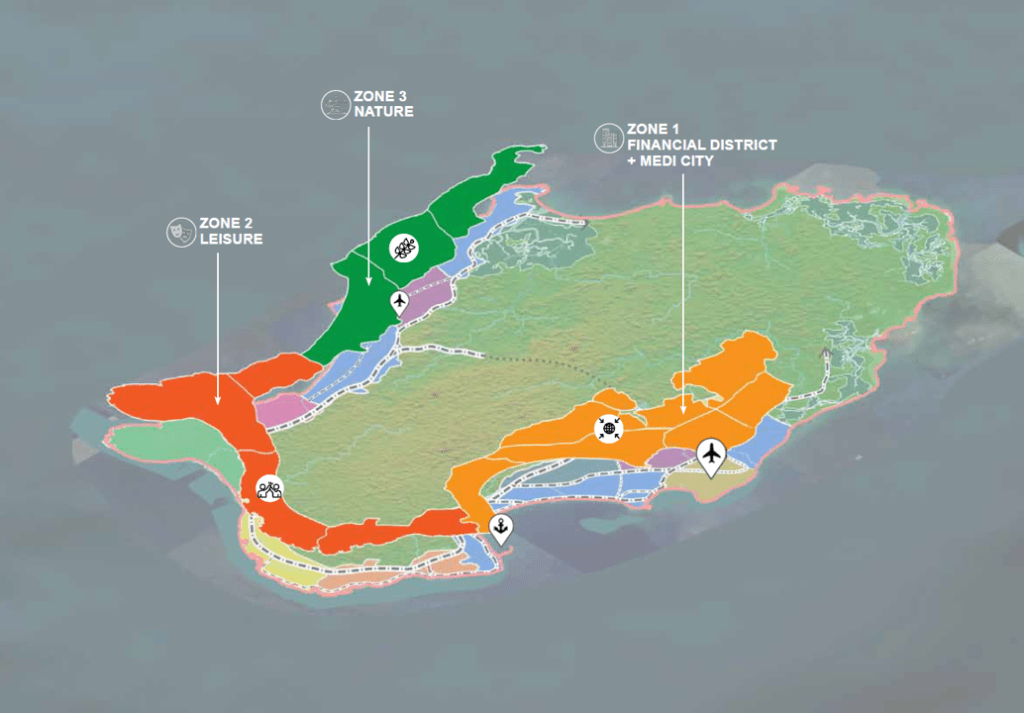
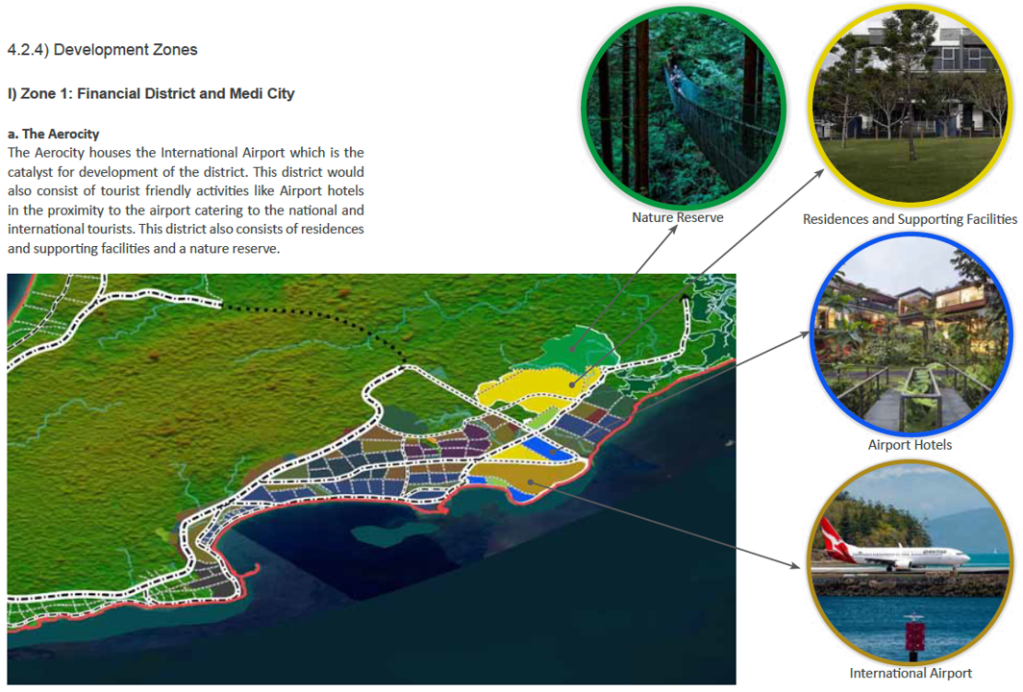
Airport development features heavily in a plan for tourism-oriented megaprojects on Little Andaman Island, the southernmost island of the Andaman archipelago. Graphics below, from the 58-page ‘Sustainable Development of Little Andaman Island – Vision Document’, show: Zone 1, on the eastern coast, featuring an Aerocity, housing an international airport, envisaged as ‘the catalyst for development of the district’; Zone 2, on the southern coast, including a Leisure Zone and Tourism SEZ (special economic zone) with casinos, theme park and beach hotels; Zone 3, on the western coast, a Nature Zone containing super-luxury resorts and hotels, with an airstrip for private charter flights.

  • Little Andaman plan
  • Little Andaman plan indicating 3 zones
  • Map of Zone 1 of Little Andaman plan. The Aerocity is the catalyst for developmen

Sudden news of the plan, in January 2021, alarmed conservationists. The ‘Vision Document’, thought to have been finalised a few months previously but not in the public domain, is included in ‘A MONUMENTAL FOLLY: NITI Aayog’s Development Plans for Great Nicobar Island (An evolving archive of reports, information and documents)’, compiled by Panjaj Sekhsaria and published by Kalvpavriksh Environmental Action Group. The total project area is nearly 240 sq km, 35% of the island; the three zones would take up 107 kilometres of the island’s coastline. Development of this scale would have major impacts on indigenous people and the island’s unique biodiversity and forests. Little Andaman is home to the Onge tribe, living on the island for more than 50,000 years, the population dwindling since 1900. Now numbering an estimated 125 people the Onge tribe is categorised as one of India’s Particularly Vulnerable Tribal Groups (PVTG). According to the plan the Onge Tribal Reserve would be reduced by 31%; the Vision Document states that steps would be taken to relocate and protect Onge people but no detail is given. An anthropologist pointed out that bringing areas where Onge, with nomadic origins, do not live into the proposed development would still impact them, saying “the Onges have a close attachment with their territory be it inhabited or not”.

The Divisional Forest Officer of Little Andaman raised concerns that the major diversion of forest land for the project would cause irreversible damage to the island’s forests, entailing the loss of more than 2 million trees. An official source said there are over 2.4 million trees in the “vast tract of forests” in the areas where development is proposed. Removal of trees would cause topsoil erosion and reduce rainfall, impacting on the small area of the island with cultivable soil. Uprooting more than 2 million trees for the Little Andaman plan would also result in carbon emissions and carbon stock losses. Carbon pools were calculated for the four forest types in the development areas: nearly 136 sq km of Evergreen/Semi Evergreen and smaller areas of Deciduous, Swamp/Mangrove and Plantation forests. A study estimated that implementation of the ‘Sustainable Development of Little Andaman – Vision Document’ would result in carbon stock loss of 2,996.286 tonnes from five categories of carbon pools: 55% from woody debris and soil organic matter, 32% from above ground living biomass, 9% from below ground biomass, 3% from dead mass of litter and 1% from dead wood.

Nesting sites of Giant Leatherback Turtles, the world’s largest turtles growing over 6 feet in length, with many populations in precipitous decline, are threatened by the Little Andaman plan. South Bay and West Bay on Little Andaman are both high-intensity nesting sites and among the most important in the entire island chain. Along with other nesting beaches on the islands, the two sites are specifically mentioned as ‘Important Marine Turtles Habitats in India’ in the National Marine Turtle Action Plan. There are fears that implementation of the ‘vision’ would push the leatherback turtles to the brink of extinction. A 2019 report on a long-term monitoring programme at Little Andaman island identified previously unknown migratory routes of Great Leatherback Turtle nesting in the region, highlighting their dependence upon foraging and nesting sites that are thousands of kilometres apart. Nine tracked turtles traversed much of the Indian Ocean, as far southeast as Western Australia and towards the eastern coast of Africa. The turtle travelling the furthest, close to the western coast of Mozambique, covered 13,237km in 266 days; it was also the fastest, travelling an average of 49.8km per day.

More information about the Little Andaman plan has been published on EJatlas, the world’s largest, most comprehensive online database of social conflict around environmental issues: Little Andaman Development Plan

Maldives ecosystems and communities threatened by aviation expansion drive

A proliferation of new airport projects in the Maldives is destroying unique coastal ecosystems and threatens devastating impacts on communities and livelihoods. As many as 20 new airports, several accompanied by hotel developments, are planned and under construction, and many projects are government funded.

In October 2017 a dredger, newly acquired by Maldives Transport and Contracting Company (MTCC) and at 92 metres in length the largest in its dredging fleet, began land reclamation for a new airport on Kulhudhuffushi, an island in the north of the Maldives. By early January 2018 land reclamation for the new airport was complete. Sediment dredged up from the ocean bed had been dumped on the largest white clay wetland and mangrove in the Maldives and destroyed a unique ecosystem. The Kulhudhuffushi mangrove system was the most biodiverse in the Maldives, hosting eight IUCN Red List species. Kulhudhuffushi mangroves had also provided a livelihood for over 400 people, predominantly women, and their families, who soaked coconut husks in the mangrove mud as part of a coir rope making industry sustained over many generations. Maldives report

The impacts of construction of Kulhudhufushi and two other new airports in the Maldives – on Funadhoo and Maafaru islands – are documented in an excellent booklet, Irreversible Damage, Destruction & Loss #SaveMaldives published by SaveMaldives a civic movement that has emerged in response to a government drive for new airports and tourism resorts. After destroying mangroves to make way for Kulhudhuffushi Airport MTCC was then awarded the contract to build facility’s  1.2 kilometre runway. Then MTCC’s new dredger moved southwards to Funadhoo island where it was deployed to reclaim land from the north west lagoon for another new airport. Upon completion of this operation MTCC was contracted to build Funadhoo Airport runway, apron and taxiway. Funadhoo is an environmentally sensitive area, sharing a reef with its twin island, Farukolhu, that includes extensive mangroves. Dredging and reclamation proceeded near to Farukolhu’s nesting grounds supporting several bird species and a bay that serves as a marine breeding site for sharks and rays.

Construction of Maafaru Airport is nearing completion and test flights are imminent. Lush vegetation has already been decimated. Ecosytems highlighted as at risk in the Environmental Impact Assessment (EIA), and now irreversibly removed, include 20,000 trees, mangroves, marshland, coral colonies and seagrass beds. The EIA flagged up the necessity of relocating mangroves but there is no evidence that any such mitigative measure has been implemented. Maafaru Airport is larger than Kulhudhufushi and Funadhoo airports. Its  2.2 kilometre runway is long enough to accommodate Boeing 737 planes with a regular terminal along with facilities for parking private jets and a hotel. Maafaru Airport is part of a US$60 million agreement with the Abu Dhabi Fund to develop ultra-luxurious tourism in Noonu atoll.

The Irreversible Damage, Destruction & Loss #SaveMaldives report draws attention to various aspects of regulatory failure which have allaowed airport projects without the obligatory safeguards. The Environmental Protection Agency (EPA) is supposed to act as an independent authority but has been stripped of its powers to regulate tourism-related projects, effectively becoming a ‘rubber stamp’ legitimizing destructive infrastructure projects. A key EPA task is to assess, approve and monitor compliance with EIAs, but new airports and tourism projects resulting in irreversible damage to fragile ecosystems have been approved. New airports already under construction in Kulhudhuffushi, Funadhoo, Maafuru are just the beginning of an ecocidal aviation expansion frenzy. The Maldives government is planning a total of 20 new airports across the archipelago. Land reclamation also looms for a proliferation of new tourism resorts. The aviation and tourism drive expansion drive is obliterating white sand beaches and pristine coastal ecosystems, the very assets that are key to the the popularity of the Maldives as a tourist destination.

New airport threatens to swallow up Fainu island

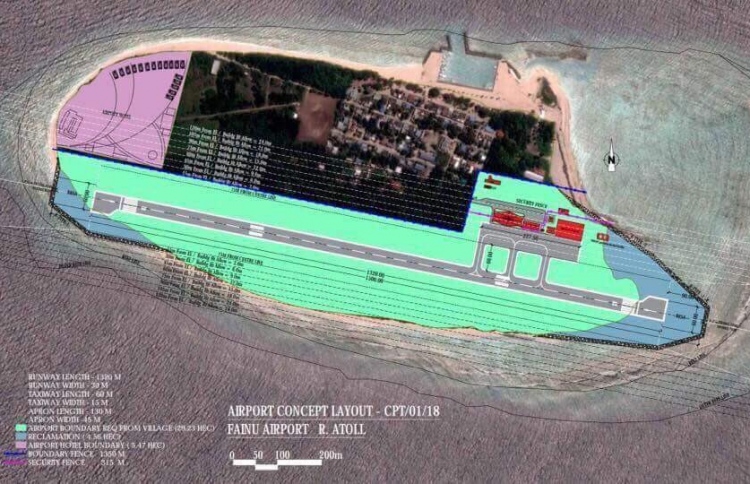
The concept drawing for a new airport on Fainu island shows the airport taking up about two-thirds of the island land area with the runway extending along the entire southern coastline. The Maldives Independent calculated that 31 hectares of vegetation would be lost, including a dense jungle area and agricultural land. The airport plan also includes about 4 hectares of land reclamation. Land earmarked for a gated hotel is shown on the map below as an area adjacent to the airport and shaded in purple.

Fainu airport + hotel

A woman speaking anonymously to the Maldives Independent said that rumours of an airport on Fainu island had circulated since she was a child, but all of a sudden the airport agreement was signed, funding allocated and work about to commence, yet even the island council did not have information. Another woman said “If they take our land for all of that, we will be boxed into the paopulated ares of the island like an open jail”. Residents also stand to lose access to 2.18 kilometers of beautiful beach to the airport security zone and hotel. Additional developments, namely a medical facility, hangar, lounges and restaurants have been mentioned. Islanders opposing the airport are concerned that even more land might be taken for a second hotel.
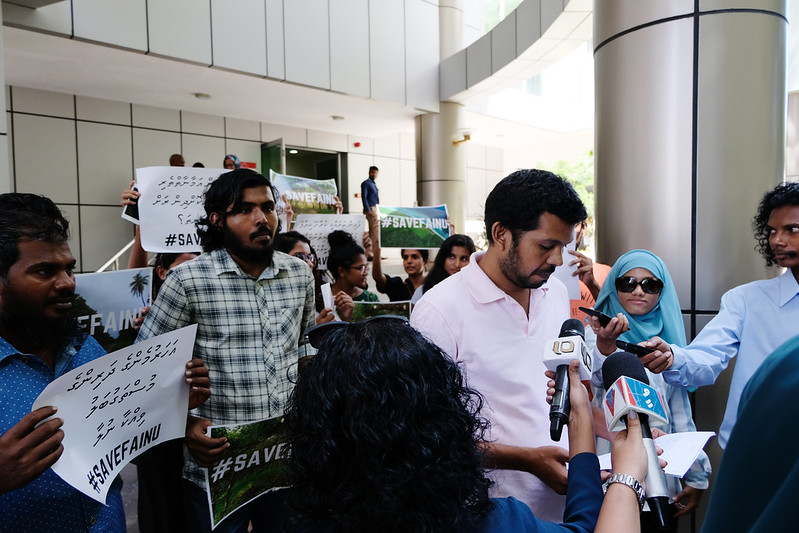
#SaveFainu
Residents acted quickly to form a campaign opposing the airport, SaveFainu and a petition submitted to the Tourism Ministry, Universal Enterprises and Island Aviation was signed by 140 people, about half of the population of Fainu island. Universal Enterprises, one of the largest hospitality companies in the Maldives, is financing Fainu Airport through bulk purchase of advance sales of air tickets. Island Aviation, owner and operator of Maldivian, the largest carrier in the Maldives, has been awarded the US$8 million contract to develop the airport. The SaveFainu petition called for more transparency from the Tourism Ministry, proper consultation with islanders and an independent EIA.

Mohamed Waheed, a leading activist in the SaveFainu campaign said some residents did not sign the petition for fear of losing their jobs, but are worried that such a large amount of the island would be lost to the airport and the secrecy and lack of transparency regarding the project. People are worried that loss of farmland to the airport would mean the loss of farming livelihoods. Waheed said job opportunities at the airport would not match the incomes made by people working on farms and pointed out that a comparable airport on Kudahuvadhoo island only employs 29 people.

More land reclamation, more new airports

Land reclamation has already created space for a new airport on Muli island. On 11th July 2018 President Yameen pledged to develop an airport on Muli island and attended a ceremony marking completion of the land reclamation project. MTCC has been paving the way for an airport on Muli island for some time. A land reclamation agreement was signed in 2014 and reclamation of 40 hectares of land was reported as completed in May 2017. An aerial photo shows an ideal site for an airport runway already in place, a strip of reclaimed land running along almost the entire eastern shoreline of Muli island, encompassing the southern tip and extending along about a third of the western coast.

MTCC has also been contracted to reclaim land for a new airport in Hoarafushi in Haa Alif Atoll, the northernmost atoll in the Maldives. The project, anticipated to cost over US$4 million, will be funded by the state budget. MTCC has already started development of an airport on Maavarulu island, a project costing US$ 3.7 million funded by the state budget, with tarring of the 1,200 metre runway scheduled to commence by the end of July. Maarvarulu is an island on Gaafu Dhaalu Atoll, where a second new airport is to be built, on Faresmaathoda, an uninhabited island situated on the south of the atoll. Tourism developer ‘Champa’ Mohamed Moosa, gave a US$4 million loan to the government to develop the airport and a press conference at the beginning of June marked the signing of a US$2.5 million contract with Gulf Cobla, a UAE based dredging company, to begin land reclamation for the project.

Mohamed Moosa is chair of Kuredu Holdings, a major resort operator which has been awarded a contract to develop another new airport, on Madivaru island, in the tourism hotspot of Lhaviyani atoll, which will entail reclaiming three hectares of land from Madivaru lagoon. Kuredu Holdings is expected to develop a hotel to support Madivaru airport operations. More land reclamation, and yet another new airport, looms in Bileyfahi, where President Abdulla Yameen pledged to reclaim land and build a domestic airport, explaining that this additional facility, together with the new Funadhoo Airport, which is located just 40 kilometres away, will make Shaviyani atoll a tourism hub.

The necessity of the new airports, many of which are generously funded by the government, is highly questionable. The Maldives already has 12 airports and all three new airports in the #SaveMaldives report are being constructed even though an existing airport is easily accessible by speedboat, a journey of 45 minutes in the case of Funadhoo Airport, 40 minutes on the case of Maafuru and just 25 minutes away from Kulhudhuffushi Airport. In a similar vein, SaveFainu campaigners regard an airport on Fainu island to be unnecessary as an existing airport in Raa atoll, 26 kilometers away on Ifuru island, can be reached by speedboat in just 25 minutes.

Climate impacts from aviation expansion, land reclamation and loss of mangroves

The Maldives government continues its drive to build new airport projects even though the country is on the front line of the battle against climate change. Rising seas are lapping at the shores of many low-lying islands. The Irreversible Damage, Destruction & Loss #SaveMaldives report points out the inconsistency of the Maldives government on the international stage when in November 2017, Environment Minister, Thoriq Ibrahim, traveled to advocate for Small Island Developing States (SIDS) at the Alliance of Small Island States (AOSIS). A key issue for small islands is their vulnerability to rising seas caused by climate change. Yet the government driven and funded aviation expansion drive is a climate double whammy; with aviation expansion increasing greenhouse gas emissions from aircraft and land reclamation increasing vulnerability to climate change induced flooding from rising sea levels, severe storm surges and more intense rainfall due to removal of vegetation which serve as a buffer absorbing excess water.

Destruction of mangroves for new airports compounds the climate impacts, because these unique ecosystems play a unique role in carbon sequestration, absorbing CO2 from the atmosphere and storing in their biomass for long periods and laying down soil that acts as a carbon sink. The Maldives government pursues environmentally devastating airport projects in the face of widespread opposition from civil society, even though it is a recipient of large amounts of donor funds for climate change mitigation and resilience. International organizations and development partners such as UNDP Maldives have remained silent.