A new international airport under construction in the Pedernales province in the southwest of the Dominican Republic, for commercial and private flights, is integral to development of a high-end coastal tourism complex.
Cabo Rojo International Airport construction site. Satellite image 09/09/2024
In January 2024 the government of the Dominican Republic announced construction of a new international airport in the Pedernales province in the southwest of the country. The site is in the Manuel Goya community, part of the Oviedo municipality. A Spanish firm, Acciona Construction SA, was awarded the contract to build Cabo Rojo International Airport, even though its bid was the most expensive. The RD$3,961 million (€62 million) contract, awarded in June 2024, included construction of a 3.1 kilometre runway, taxiway, aprons for Boeing 777 aircraft (the world’s largest twin-jet aircraft accommodating up to 368 passengers) and drainage works. The new airport will serve luxury tourism and private aircraft (private jets). Director of the Airport Department, Víctor Pichardo, highlighted the new airport’s potential to transform tourism in Pedernales by attracting both commercial flights and private aviation, noting that each year more than 40,000 private aircraft fly over the Carribean. He said the new airport would position the Dominican Republic as a hub for high-end tourism. Construction of the new Cabo Rojo Airport (also known as Pedernales Airport) is scheduled to be complete by the end of 2025; it is anticipated to handle up to 1 million passengers annually within 17 years, making it the third busiest airport in the country.
Artist rendering of development of planned luxury tourism development near the new Cabo Rojo International Airport and expansion of Port Cabo Rojo. Image: Dominican Today
The new Cabo Rojo International Airport, will form the basis for a new coastal tourism complex with 12,000 rooms located just 15 minutes away (about 25 km). The two locations are already connected by a major highway: DR Route 44. The tourism complex site is near the existing Cabo Rojo Domestic Airport, a civic/military airport currently receiving a few small aircraft, carrying 2-30 passengers, per week and serving operations of the Dominican Air Force. Tourists will also be delivered to new resorts via Port Cabo Rojo, which is expanding into a facility capable of receiving two large cruise ships carrying up to 15,000 visitors. Large volumes of fresh water will be diverted to the tourist area via a new aqueduct which will supply 8,000 tourism rooms. As of July 2024 the ProPedernales tourism development trust, a Public-Private Partnership (PPP) with the government holding a 52% stake and the private sector holding 48%, reported a total investment of USD130 million on Cabo Rojo tourism, focused on the first three hotels and the airport runway. In addition, the Dominican Government had spent nearly USD30 million on water projects, site conditioning, planning and design to prepare for and support the initiative.
Six major international hotel chains, ‘a who’s who of luxury and all-inclusive resorts’, are building new properties in Cabo Rojo: Hilton, Marriott International, therostar Group, Karisma Hotels & Resorts, Amresorts (part of World of Hyatt) and Sunwing. Luxury tourism development just 15 kilometres away from the border with Haiti, gripped by gang violence and a humanitarian crisis, might seem incongruous. But the Dominican Republic has reinforced the border with Haiti with more than 13,000 troops and the first phase of a high-tech ‘smart’ border wall with drone patrols, surveillance towers and night vision cameras is nearing completion. The exclusivity and high security requirements of luxury tourism can go hand in hand with militarisation; the established Cabo Rojo Airport nearby already serves the Dominican Air Force.
At a June 2025 National System of Protected Areas (SNAP) conference a number of environmental experts stressed the importance of responsible tourism development in Cabo Rojo, avoiding repeating the mistakes of some other Dominican tourist destinations by protecting the region’s ecology and directly benefitting local communities. But problems have been reported in the earliest stages of Cabo Rojo’s tourism development. In August 2024 environmental organisation Grupo Jaragua said the project was proceeding without clear compensation plans for affected residents of the Oviedo municipality, where the airport is being constructed. A community leader reported that tractors had destroyed land. Two months later a truck drivers’ union took strike action protesting non-payment for tranport of fill materials used for airport construction, saying the amount being paid per kilometre was not even sufficient to cover their fuel costs. The government is providing a high level of financial and infrastructural support to tourism and airport megaprojects that will primarily benefit airlines, major international hotel chains and cruise ship lines, not local businesses, and only wealthy visitors will be able to afford to stay in the luxury hotels. And the new high-end tourism complex may well boost the number of private aircraft flights, only affordable to a small number of very wealthy people, at Cabo Rojo Domestic Airport.
Vlora Airport, opposed by many environmental organisations, has received a high level of government support and will serve luxury tourism developments.
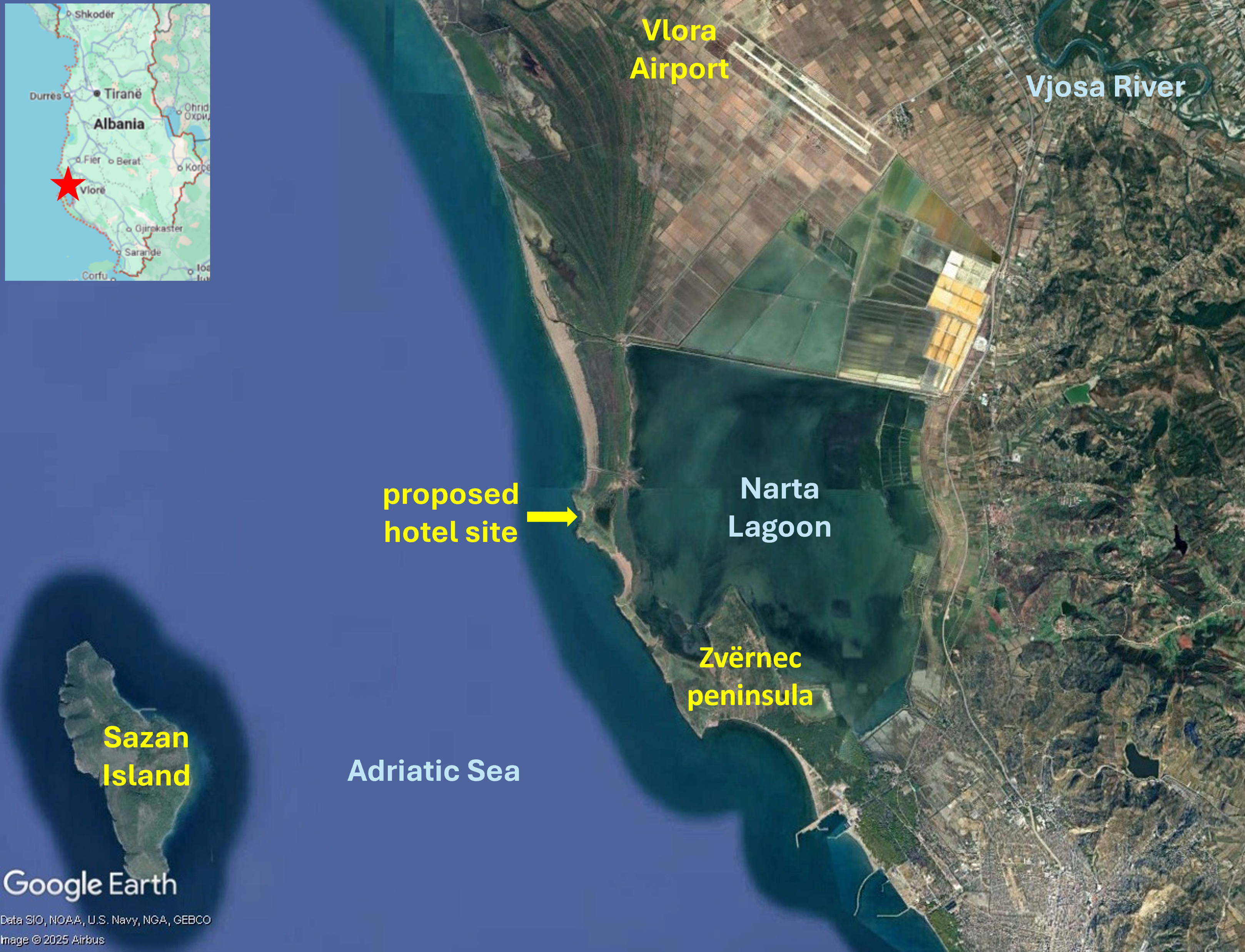
Map of southern Albanian coast showing Vlora Airport, Sazan Island and Zvërnec peninsula. Satellite imagery: 29/08/2023
Vlora Airport, a major construction project nearing completion in the Vjosa-Narta Protected Landscape on the South Albanian coast, has been opposed by many environmental organizations, including Protection and Preservation of Natural Environment in Albania (PPNEA) and EuroNatur, since it received parliamentary approval in February 2018. The project site is near Narta Lagoon, a habitat for many iconic bird species such as flamingos and the endangered Dalmatian pelican. The wider Vjosa Delta area, a complex of wetlands, marshlands, woodlands, reedbeds and sandy beaches, is vital for bird migration routes. A March 2021 letter from a coalition of NGOs to members of the European Commission and Parliament, calling for support in urging the Albanian government to respect national laws and international conventions it has ratified, and to reconsider plans for the airport, was signed by 41 organizations. In the same month it was announced that Mabco Constructions had been awarded the tender for constructing Vlora Airport.
On 7th May 2025, the day before the first test flight landed on the Vlora Airport runway, environmental activists, including representatives of PPNEA and citizens, protested in front of the Supreme Court. For over a year the court had not made a decision on returning a case against construction of Vlora Airport to the Court of Appeal; the lawsuit had been filed on 23rd November 2022. Protesters said the Supreme Court had deliberately delayed the legal process in order to facilitate completion of Vlora Airport. The first plane to land at Vlora Airport, on 8th May 2025, was the private plane of Behgjet Pacolli, owner of Mabco Constructions, the majority shareholder of the consortium constructing the airport. EuroNatur dismissed the test flight, showcasing Vlora Airport just three days before parliamentary elections, as a “big PR show”. The airport was not yet fully operational, neither the runway nor the terminal had been completed. Alexander Trajce, PPNEA Executive Director, said, “While the government is flying-high with the propaganda for the airport, what’s actually happening on the ground involves a rushed and chaotic development built inside a protected area, a myriad of safety concerns both during construction and for future operations.”
Construction fatality and investigation into possible corruption
Just 19 days before the test flight an accident a construction accident resulted in a fatal injury. A 38-year-old worker at the Vlora Airport site died on 19th April 2025 after falling from a height. Two construction company employees were arrested on suspicion of violation of workplace safety regulations. Construction of Vlora Airport has also triggered investigation into possible corruption. The Special Prosecution Office against corruption and Organised Crime (SPAK) announced the investigation in early July 2025, stating, “The Special Prosecution Office against Corruption and Organized Crime has registered criminal proceedings regarding the Vlora Airport concession contract. This proceeding is in the preliminary investigation phase.” SPAK is investigating the details of the agreement between Mabco Constructions owner Behgjet Pacolli and the Albanian government and the contract for Vlora Airport construction.
An unprotected delta and Law 21/2024
Conservationists had been hopeful that the government’s creation of Vjose Wild River National Park in 2023 would protect the Vjosa Delta from further destructive development. But the designation only covers the river and streams, not the delta which remains a target for commercial development, with only limited protection subject to Prime Ministerial veto. As airport construction continued, near Narta Lagoon at the heart of the delta, Zydjon Vorpsi of PPNEA warned that while the lagoon may still exist as a water body there will be serious hydrological impacts and aircraft noise and bright lights will disorientate and frighten away birds and turtles. Vorpsi also said Vlora Airport would lead to other development that will “transform the area, resulting in complete urbanisation of the delta”. Development in areas surrounding Vlora Airport has been facilitated by Law 21/2024, a change to the law on protected areas that was rushed through the Albanian parliament in February 2024. Many environmentalists were critical of the new legislation as it enables existing laws to be swept aside to permit construction of upmarket, luxury, five-star, tourism resorts in unprotected areas of the delta. PPNEA, EuroNatur and other environmental and conservation groups said the new law conflicts with international conventions signed by the Albanian government, including the Bern Convention on the Conservation of Wildlife and Natural Habitats. In 2023 the convention’s Standing Committee urged the Albanian government to halt construction of Vlora Airport pending a thorough environmental impact assessment. Law 21/2024 was ratified by President Bajran Begaj only three days after plans for two luxury tourism developments in the delta area were announced by US President Donald Trump’s son-in-law, Jared Kushner.
Luxury tourism proposals – Zvërnec peninsula and Sazan Island
The sites of both proposed tourism projects – the Zvërnec peninsula and Sazan Island – are within protected areas. The Zvërnec peninsula is part of the Pishë Poro-Nartë protected area and Sazan Island is in Karaburun-Sazan national marine park. The Zvërnec peninsula, to the south of Vlora Airport, is a promontory with pine forest and attractive beaches, connected by a wooden bridge to the remains of St. Mary’s, a 13th century Byzantine monastery on a small island in Narta Lagoon. Zvërnec would look very different if the tourism development goes ahead; a 445-hectare luxury resort is envisaged hosting about 6,000 hotel rooms and villas. Architectural renderings of the project published by Kushner’s Miami-based investment company, Affinity Partners, show rows of modern, multi-storey buildings alongside Narta Lagoon and on the dunes, headlands and beaches, a commercial centre, swimming pools, marinas, yachts and a cruise ship.
Plans for a 567-hectare development on Sazan Island are equally high-end. Nearly 10 kilometres west of Narta Lagoon, Sazan is currently uninhabited and one of only a few undeveloped islands in the Mediterranea. Interest in the remains of a heavily fortified military base have made Sazan Island into a tourist attraction; in summertime several ships and dozens of boats provide day trips. The island has a subtropical climate and highly biodiverse vegetation including ash, hornbeam, maritime pine and holm oak trees along with rare ferns. Marzio Mian asked Asher Abehsera, a real estate executive overseeing the Affinity Partners projects, whether the Sazan Island would still be accessible to local people. He replied, “I think everyone should have the opportunity to visit the island”. Kushner’s response seemed more indicative of plans for an exclusive enclave, “We’re creating a very high-end luxury product … One of the most compelling points about the island is just the ability to have privacy … But I also think there are certain aspects of the island we can build out that will give people the opportunity to come visit and enjoy some of the food and the trails.”
Strategic investor status for Sazan Island project
The Albanian government approved Kushner’s request to develop Sazan Island in January 2025 when it granted the project strategic investor status. The government announcement reads: “The projected investment of Sazan Island Touristic Resort of 1.4 billion euros fulfils the criteria foreseen in the legislation on strategic investments.” The project also met the criteria relating to employment, anticipated to be 1,000 people during the construction and operational phases. Strategic investor status will grant Affinity Partners zero taxes in the construction phase and the government will provide all the requisite infrastructure including electricity, water and sewage. Director of EcoAlbania, Olsi Nika, a marine biologist voiced concerns about beaches and waters protected by the Karaburun-Sazan maritime national park designation, saying, “What will large public works, the building of docks, yacht traffic and sewage run-off do to the place?”
Albania’s luxury tourism strategy
Vlora Airport and Affinity Partners’ proposed tourism developments are important components of Prime Minister Edi Rama’s campaign to transform Albania into a “champion of tourism”. PPNEA’s Zydjon Vorpsi said this would come at a huge ecological cost including to birdlife and cast doubt on the purported economic benefits. An influx of visitors to seasonal resorts in summer would place a strain on local infrastructure, leaving empty “ghost towns” in the winter. He also said it was likely that most of the tourism revenue would accrue to the firms owning the developments, not to the local community. Kushner has welcomed the government’s support for Affinity Partners’ luxury tourism projects and development of Vlora Airport. Writing in The Guardian, Marzio Mian recalled a conversation in which Kushner described Rama as a “great partner” and said of the government, “They’re building an airport right there”. Noting that in 2024 almost 12 million foreign visitors, a 15 per cent increase compared to the previous year, had travelled to Albania, Mirela Kumbaro, minister for tourism and the environment, said the number was too high, “too many for us, and too much pollution”. Kumbaro said, “Sazan is the way to go. The ideal recipe: nature and luxury tourism.” The Albanian government is extending a great deal of support to elite tourism which will benefit a small number of wealthy visitors. And the focus on developing exclusive resorts in the undeveloped southern coast appears to be at odds with the scale of Vlora Airport. The 3.2 kilometre runway is the longest in the Balkans and Vlora Airport is expected to become the second-largest in Albania with an initial capacity for 2 million passengers per year, expanding to accommodate ten million within a decade.
A plan for an ‘eco-luxury and tourism project’ encompassing nearly half of Bugsuk Island is the latest of a series of projects triggering a 50-year struggle for recognition of ancestral land and water rights.
Satellite imagery of Bugsuk Island, Balabac municipality, Palawan province, 27th October 2024. Bugsuk Airport and other facilites are indicated.
In 1974 indigenous Pala’wan, Molbog and Cagayanin people were expelled from Bugsuk Island, part of the Balabac Municipality off the southern tip of Palawan, the westernmost point in the Philippines. An article by Indigenous Peoples’ Rights International (IPRI), based on an interview with Jomly Callon, President of the Sambilog-Balik Bugsuk Movement (Association of Indigenous Peoples and Small Fishers from the Southernmost Tip of Palawan), an indigenous people’s group, outlines a 50-year history marked by projects, facilitated by a series of policy decisions, taking the place of agricultural and fishing livelihoods. The land was awarded to Danding Cojuangco, Chief Executive of San Miguel Corporation (SMC), one of the Philippines’ largest business and industrial conglomerates, who established a nursery for hybrid coconut trees. In 1979 Cojuangco, in partnership with a French businessman, Jacques Branellec, formed the Jewelmer International Corporation which established a pearl farm in ancestral waters. Sambilog was formed in the year 2000 in response to land grabbing and reducing access to fishing grounds, working to gain recognition of ancestral land and water rights. They made an application for a Certificate of Ancestral Domain Title (CADT) which has still not been approved by the government. Indigenous people’s access to traditional fishing grounds was eroded further in 2005 when, without consulting indigenous people, the Balabac municipality was declared a ‘protected marine eco-region’, prohibiting indigenous people from fishing in their traditional fishing grounds. In 2014, following Sambilog protests in Manila calling for return of their lands through the Comprehensive Agrarian Reform Program Extension with Reforms (CARPER) the Department of Agrarian Reform (DAR) issued a Notice of Coverage over agricultural lands for distribution to the people of Bugsuk Island. But DAR did not implement its decision to return the land to those affected by displacement.
After Cojuangco’s death in 2020 Ramon Ang took up the role of CEO of SMC. Bugsuk Airport (also referred to as Bonbon Airport) was built by SMC to support the coconut plantation. In February 2022 Jose Alvarez, Governor of Palawan, speaking about Bugsuk Airport and a Philippine Air Force (PAF) facility in Barangay Catagupan being ‘crucial to the transformation of Palawan’s southernmost region as a new tourist haven‘, said the coconut plantation had failed but that Bugsuk Airport was still under development with the runway already operational and used by people travelling to Balabac. Satellite imagery of Bugsuk island shows Bugsuk Airport, an airstrip near the southern tip of the island that is being developed for the PAF and a helipad. In 2023 the DAR revoked the Notice of Coverage that was issued in 2014 and under which the land would be returned to its original owners. The reason given for the cancellation was that the area is unsuitable for agriculture. Callon, countered this, explaining that residents were cultivating the land, growing many types of vegetables and fruit trees.
Environmental Impact Statement and Master Plan for resort taking up half the island
Bricktree Properties Inc., a subsidiary of SMC, plans to construct various so-called ‘eco’ tourism facilities surrounding Bugsuk Airport. Bricktree’s presentation at a public scoping event held in Bugsuk Community Center, Bugsuk Island on 25th May 2023 contains a timeframe for 2023-24 which includes access road clearing and construction, tree cutting, land clearing, construction of campsites, perimeter fencing and soil compaction. A number of ‘identified environmental impacts’ includes ‘Land tenurial issues and incompatibility with existing land use’, ‘Potential lost (sic) of fish related livelihood and conflict on the access/navigation of locals’ along with potential changes in water quality, water competition and dust from land clearance. The Environmental Impact Statement Summary for the Proposed Bugsuk Island Eco-Tourism Development Project, prepared for Bricktree, contains maps of the proposed site and a Proposed Master Plan comprising serveral zones taking up much of the south of the island along with a port on the northern tip.
The Environmental Impact Statement Summary states ‘The Proposed Project aims to be an eco-luxury leisure and tourism destination governed by sustainable development principles’. A project schedule from 2023 to 2038 is indicated. The project location spans two barangays (districts) – Bugsuk and Sebaring – and the estimated total project land area is 5,567.54 hectares (nearly half of the 11,900 hectare island). Supporting infrastructure plans include power generator, solar farm, water supply primarily from Bugsuk River Lagoon, wastewater and sewage management, telecommunications, materials recovery facility, landfill and beach front maintenance on the Bonbon beach shoreline. The area earmarked for structures, roads and other facilities is 1,141.84 hectares, with the remaining 4.425.7 hectares consisting of areas for future development, open spaces and leasable space. A map of the Proposed Master Plan shows various zones centred around the airport and airport facilities and connected by a road network:
Eco-tourism area immediately to the south of the airport
Resort development on the southeast coast
Two forest / tourism areas
Four commercial areas
Low density and high density residential areas
Recreation area
Light industrial area
Employee facilities
Agriculture zone
An area for port facilities on the northern tip of the island
Tinig ng Plaridel, the official student publication of the University of the Philippines College of Mass Communication, challenged the statement in the document that resolutions endorsing the proposed project without objections were obtained from Barangay Bugsuk in September 2023, saying that hundreds of locals oppose the project.
Intimidation and harassment of Mariahangin residents
During the 1974 expulsion of indigenous people from Bugsuk Island the people of Mariahangin (also spelled Marihangin), a small 38 hectare island north of Bugsuk Island, resisted; the eviction was stopped and people remained on the island. But 50 years later Mariahangin residents say the presence of armed men is pressurising them to leave. On 27th June 2024 DAR officials arrived on Mariahangin, to inform residents that their homes would be demolished to make way for an eco-luxury tourism project covering over 5,000 hectares in Barangay Bugsuk. Just two days later, early in the morning of 29th June 2024 16 unidentified armed guards arrived on Mariahangin Island. On 13th September a group of indigenous people from Mariahangin Island arrived in Manila to campaign for land reform, the return of the 10,821 hectares of land awarded to Cojuangco in 1974, for the National Commission on Indigenous Peoples to process their CADT application and to raise awareness of the 50-year struggle. The group included an 18-year old witness to the presence of armed men in Mariahangin in June who said a man wearing black headgear and a black mask had pointed a gun at him.
Satellite imagery of Mariahangin Island, 27th October 2024
SMC denied involvement in the shooting incident and stated it has no connection with anyone involved in the incident and does not own any property holdings on Mariahangin Island. Yet, as reported by Bulatlat, residents claim that SMC does have an interest in Mariahangin Island and, in 2023, presented families with a ‘resettlement programme’, increasing an initial offer to P400,000 (USD6,852) per family to leave their ancestral land. In September 2024 the Philippine Misereor Partnership Incorporated (PMPI), a network of more than 230 social development and advocacy groups, expressed deep concern over human rights violations faced by the Molbog and Palaw’an communities arising from a land grabbing case. Mariahangin residents’ representatives, supported by the National Federation of Peasant Organisations (PAKISAMA) presented testimonies to the Commission on Human Rights (CHR) reporting reported ‘alarming incidents, including threats at gunpoint to force them out of their ancestral lands and intrusive surveillance and intimidation that profoundly disrupt their daily lives and livelihoods’.
On 2nd December 2024, contradicting Bugsuk residents’ assertion of their land rights, SMC reiterated its stated legal ownership of 7,000 hectares of titled properties on Bugsuk Island, saying that the titles had been held since original issuance during redistribution of agricultural land in 1974, predating the 1997 Indigenous People’s Rights Act. Earlier that day, nine indigenous Sambilog leaders began a nine-day fasting and praying event outside the DAR headquarters in Quezon City to amplify the 50 year land struggle of indigenous Bugsuk Island communities. They pointed out that Mariahangin land is agricultural – seaweed farming is the main source of residents’ livelihoods, followed by corn cultivation – so therefore the land should be returned to them under the provisions of the 1998 Comprehensive Agrarian Reform Law which states that all public and private agricultural lands are encompassed by the coverage for distribution to the people. An ILC Asia (International Land Coalition) statement in support of the seaweed farmers of Mariahangin Island raises concerns over loss of mangroves in a country particularly vulnerable to climate disasters and notes that mangroves on Bugsuk Island have already been cleared to make way for a 20km white sand beach.
In February 2025 Mariahangin residents refuted government dismissal of their allegations of harassment, land grabbing and restriction of access to fishing grounds. Residents said police and people suspected of being SMC representatives attempted to enter the community on 18th and 20th November and that armed guards had been stationed about 500-500 metres from Mariahangin. One resident said, “People there can barely earn a living because they’re constantly guarding against those armed men at the edge of the island.” Residents guarding the area reported threats from armed guards. Fishermen said guards were blocking access, seizing their equipment nad harassing them, with some being hit with paddles and illegally detained. One fisherman said his boat had been destroyed. On 5th March 2025 The Guidon reported that eight Mariahangin residents had been subpoenaed over allegations of assault and an individual received a subpoena for alleged cyberlibel. residents described these legal proceedings as part of “a pattern of relentless harassment” amidst their long-running land dispute with SMC over ancestral land on Bugsuk Island.
For more than 30 years hikers, cyclists and other recreational users have enjoyed a 14.5km network of forested trails in Lake Crabtree County Park, Wake County, North Carolina, USA. The trails are located on land managed by Raleigh-Durham Airport Authority (RDUAA) and leased to Wake County Parks and Recreation which manages and maintains the trails in partnership with Triangle Off-Road Cyclists (TORC), a non-profit organisation. Concerns that RDUAA might consider developing the land were heightened in 2014 when RDUAA commissioned a report on revenue generating possibilities for 809 hectares of land, including the park, which it manages but cannot utilise for aeronautical purposes. In June 2016 a 25-year land-use concept plan for RDUAA’s surrounding property was unveiled and park users were disappointed to see an office park and luxury hotels on land occupied by the trails. Dozens joined a rally opposing the plan and cyclists protested outside the airport CEO’s speech to the Greater Raleigh Convention and Visitors Bureau.
Raleigh-Durham International Airport proposes development on a 55 hectare (136 acre) site in Lake Crabtree County Park. Source: Raleigh-Durham Airport, Request for Information – Lake Crabtree Park Development, July 2024
Raleigh-Durham Airport published a Request For Information (RFI) Lake Crabtree Park Development, for potential developers interested in leasing and developing a portion of its real estate, in July 2024. The RFI includes a map (above) showing the property in Lake County Park available for lease. The goals are stated as follows:
The Authority seeks to: a. Create a unique and innovative entertainment destination which will be appealing to the greater Triangle Region and may include community assets such as food and beverage, retail, hospitality / boutique hotel, recreational facilities, etc. b. Develop in a manner consistent and appropriate with the natural surroundings of the site c. Ensure recreational users are considered in the development d. Increase non-aeronautical revenue to the Authority
In January 2025 the possible threat to the Lake Crabtree County Park trails became imminent as notes were published for a meeting of the RDUAA Board to hear public comments on a proposal to lease 55 hectares (136 acres) within the park for commercial development, with one of the main goals being ‘to increase non-aeronautical revenue to the Authority’. TORC emphasised government responsibility for the airport lands, pointing out that RDUAA is governed by a Board comprising members from Wake County, Durham County and the cities of Raleigh and Durham. The map, shown above, reveals that most of the trails in the park are within the proposed development area.
RDUAA stated intentions to ‘develop in a manner consistent and appropriate with the natural surroundings of the site’, compatibility with established park uses and consideration of recreational users in the plans. TORC spokesperson Dave Anderson questioned these statements, saying, ‘We’re going to take three-quarters of the forest and develop something there. It’s not known that that’s going to be…but that kind of development is going to just fundamentally change what it is right now. It’s incredibly effective right now as forested outdoor recreation.” Public documents described plans for ‘a unique and innovative entertainment destination’ that might contain hotels, restaurants, shopping and recreational facilities. Anderson and other TORC leaders said there were already many similar mixed-use commercial centres nearby.
The 29th January 2025 RDUAA public comment session on potential development of Lake Crabtree County Park was packed with people with more lined up outside. Hundreds of people attended the meeting which lasted for over two hours as more than 100 had signed up to give public comment. Many of the speakers emphasised that the trails are unique to the area. RDUAA Board Members said the authority recognised the park as a community asset which the authority would not diminish, but park users at the meeting were sceptical and called for the trails to be maintained and enhanced. Researcher Natalie Lew said, “This is the heart of the community because this has been planned since the 50’s and then RDUA wants to just swoop in and take it away.” Jennifer Shetler of the TUFF Run Club group of trail and long-distance runners, read out a poem reading in part, “We do not need another store. We have restaurants and shops galore. Why trade the trails for steel and glass. These forests must be left to last.”
The Umstead Coalition, working to preserve Umstead State Park which is located immediately north of Crabtree Lake County Park and also contains many forested hiking and cycling trails, launched a letter writing campaign: Protect Lake Crabtree County Park – Demand Transparency and Inclusion of the Public with Non-Aeronautic Lands Under RDU Airport Authority. A template letter recommended rejection of the current proposals, negotiation of lease renewal, consideration of a full master plan for all lands not used for aeronautical purposes and for Wake County to purchase the lands. By 12th February more than 18,000 letters had been sent.
For more information about the campaign to preserve Lake Crabtree County Park’s forested hiking and biking trails, including references for all source material, see the case study on EJAtlas, the world’s largest, most comprehensive online database of social conflict around environmental issues – Entertainment Complex Development in Lake Crabtree County Park, NC, USA
Earthworks for construction of an airport on Koh Rong island, 25 km from the city of Sihanoukville on Cambodia’s south-west coast, began in January 2024. Satellite imagery shows the airport site, located in a flat area in the centre of the island. The new airport with a 2.650 metre runway will have capacity to handle 138,000 passengers annually upon completion of the first phase and the MoU signed in January 2023 formalised a budget of $300 million. The necessity and viability of Koh Rong International Eco-Tourism Airport seems questionable with two major international airports nearby. Newly constructed Dara Sakor Airport, with capacity for 10 million passengers per annum and scheduled to begin operations in November 2024, is only 21km away. Sihanouk Airport is 45 km away. Also, Koh Rong is already well served by boat; the ferry journey from Sihanoukville only takes about 45 minutes.
Satellite imagery of Koh Rong dated 1st November 2023, showing location of the four coastal villages, Royal Sands resort, long beach, major roads and Koh Rong International Eco-Tourism Airport construction site.
The new airport will be named ‘Koh Rong International Eco-Tourism Airport’. While an airport enables people to visit and explore protected beaches, forests and native wildlife habitats, it does the very opposite of protecting ecosystems, concreting over a vast area for runways, terminals and access roads. Then there is the issue of climate disrupting greenhouse gas emissions from flights, with aviation being energy intensive and dependent upon fossil fuels. And tourism development on Koh Rong has damaged ecosystems and the people depending on them. In 2008, Royal Group, one of the largest investment and development companies in Cambodia, was granted a 99-year land concession to develop the 78 square kilometre island. Realisation of the masterplan – featuring resorts, casinos, marinas, golf courses, two fishing villages and an airport – was delayed but commenced in 2015 with clearance of sites along the southwestern coast including forests along with construction of a road. On 3rd July 2015 Koh Touch villagers held a sit-in protest, blocking construction crews, excavators and a bulldozer, in response to construction of a road which they said would cut through their village and affect their homes. Later that month opposition to development of Koh Rong became more vocal in response to construction equipment and workers appearing on the island. Hundreds of residents began to speak out on social media. As well as cutting trees cliffs and rocky outcrops had been flattened for development, including a new pier on Long Beach, on the southeast of the island.
In August 2015 a number of Koh Kong residents called on officials to review what they called “abusive activities” by Royal Group. Construction had accelerated in recent weeks and workers and machinery had been photographed clearing large areas of forest. Residents accused Royal Group of destroying farmland and crops, including cashew, jackfruit, coconut and mango trees. A village leader said destruction could impact the livelihoods of over 100 families, who had lived on the island since 1995. Villagers said the destruction of their livelihoods was illegal and authorities should monitor the situation. Human rights and environmental campaigners supported residents’ calls for improved oversight and local groups were preparing petitions and other documents to file with provincial and national authorities. Protest groups had been formed in response to a breakdown in communications between residents and Royal Group. One villager said, “They come in and do their work, take whatever they want, but there is no communication”.
Controversy over land titles for Koh Rong villagers was reported in 2017. Some residents who had lived on the island since before 2008 had land titles, although it was uncertain whether these titles would be upheld amid disputes. Those arriving after 2008 did not have land titles. By 2018 over 1,000 land plots, belonging to 500 families, had been recognised by the government, but in April 2018, during the inauguration of the luxurious, five-star Royal Sands Koh Rong resort, about 50 people who had not yet received land titles attempted to join the event but were prohibited from doing so. Prime Minister Hun Sen ordered the Ministry of Land Management to bring an end to the Koh Rong land dispute. In June 2020 53 families protested land clearance; a 35-hectare site they believed rightfully belonged to them was being bulldozed. A Preah Sihanouk Provincial Administration spokesperson called on the protesting families to cooperate with authorities by providing relevant documents and warned them that if they caused chaos legal action would be taken against them. A member of one of the protesting families claimed they had lived in the area since 1992 and said: ”We won’t go anywhere. I will gather to protest at this site. We dare not enter the bulldozing site. I want Prime Minister Hun Sen to see and tackle this issue for us. We all have ownership documents.”
In June 2024 Mongabay reported that a new map of Royal Group’s plans for Koh Rong showed golf course zones, commercial zones, accommodation zones, casinos zones and an international airport. The latest plans did not appear to impact fishing villages but included clearing some of the Koh Rong’s protected forests to make way for golf courses. In total, project plans entail clearing more than 3,100 hectares of the island’s forests. A photo showed bulldozers and trucks working on the airport site. Sixteen years after the land was leased to Royal Group there was still no publicly available social or environmental impact assessment and islanders’ future was uncertain. Some Koh Rong residents hoped to sell their land to Royal Group while others feared that it would be taken from them.
For more information about the airport and tourism projects on Koh Rong island, including references for all source material, see the case study on EJAtlas, the world’s largest, most comprehensive online database of social conflict around environmental issues: Koh Rong island tourism development, Cambodia.
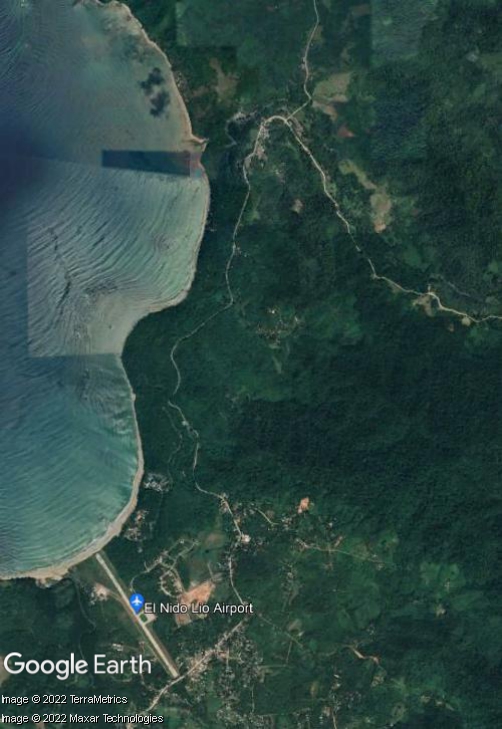
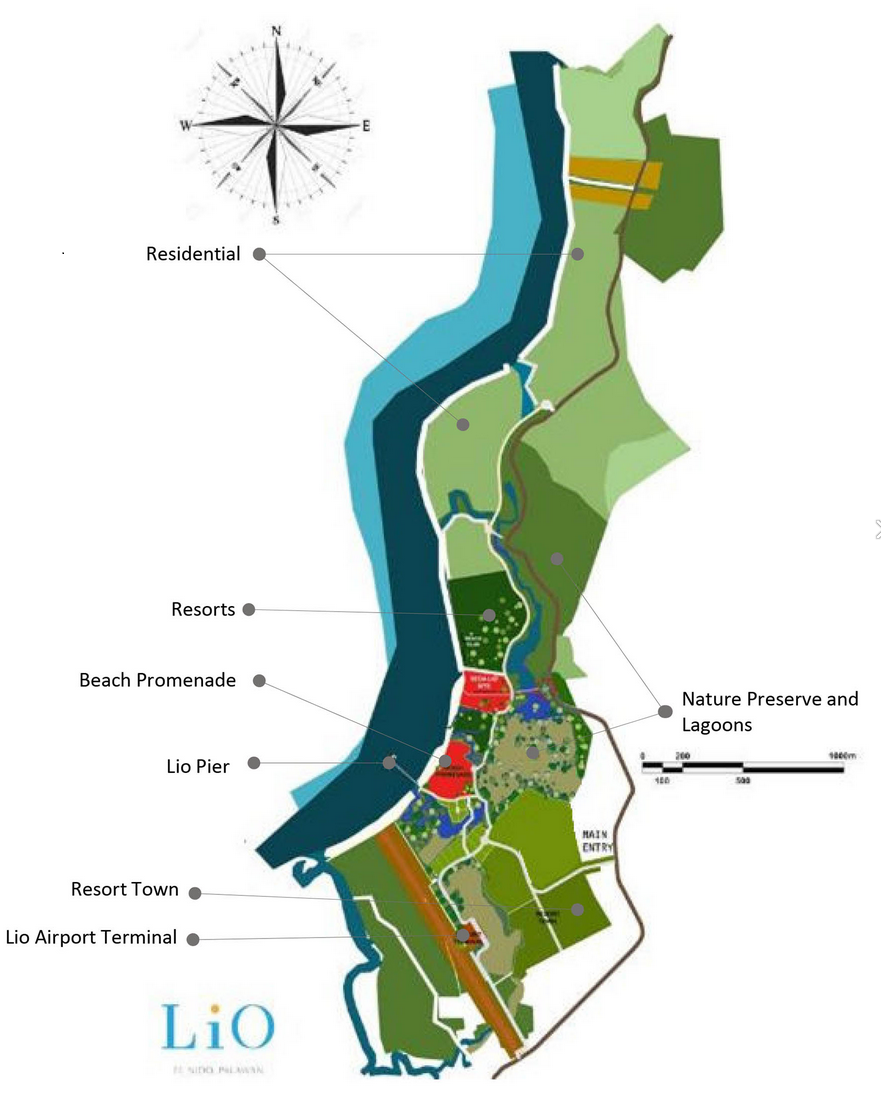
Lio Tourism Estate, a masterplanned luxurious development in El Nido, on the northern tip of Palawan – owned by Ayala, one of the largest conglomerates in the Philippines, and operated by one of its many subsidiaries, Ten Knots Philippines Inc. (TKPI) – encompasses a large 325-hectare site. As well as high-end hotels the resort contains its own private airport, Lio Airport, owned and operated by TKPI for the exclusive use of its aircraft. As with most airports worldwide the response to Covid-19 led to Lio Airport reducing operations, but by March 2022 about 600 passengers were flying in and out each day. AirSwift Philippines operates flights between Lio Airport and Manila. There is also a jetty port for visitors to embark on island-hopping boat trips. The tourism project, on a former copra (coconut) farm, began with construction of the airport and seaport to provide access, followed by accommodation and retail facilities. Shown below are satellite imagery and a site development plan published by a property firm.
But the Tagbanua Tandulanen Indigenous People (IP) claim that the project encroaches on their ancestral lands. In April 2021 their attorneys requested that the Department of Tourism (DOT) and Local Government Unit of El Nido cancel, revoke or deny applications for building permits and licenses for more than seven Ayala-owned businesses and projects in El Nido, including Lio Tourism Estate and Lio Airport. The IP group claimed ‘rampant and widespread’ proliferation of illegal transfers and conversion of their ancestral domain. On 15th March 2022, following reports of projects and activities that did not comply with Free and Prior Informed Consent (FPIC) requirements, the National Commission on Indigenous Peoples (NCIP) intervened in the land dispute, issuing a cease-and-desist-order (CDO) ordering temporary halt of projects in Barangays Libertad and Pasadeña. After issuing four notices to comply with the CDO NCIP issued a show cause order to TKPI on 13th February 2022. In March Tagbanua Tandulanen IP’s legal counsel said the group been sending letters to TKPI for two years without receiving a serious response and urged NCIP to maintain the CDO.
Extending northwards of the tourism estate developed area and Lio Airport is a 4.2 kilometre stretch of white sand beach, also part of the resort. In September 2017 the management of Lio Tourism Estate dismissed accusations that its recently opened upscale resort had blocked access to the public beach in front of it for residents of Barangay Villa Libertad. The issue stemmed from a complaint to the Palawan Provincial Board’s Environment Committee. A month previously Board Member Winston Arzaga said they had been asked by local officials to help resolve the issue, saying “The cause of it all is the access of local fishermen to their traditional fishing grounds which the Ayala management had somehow restricted.” A Safeguards Due Diligence Report for El Nido tourism development, prepared by the Tourism Infrastructure and Economic Zone Authority (TIEZA) for the Asian Development Bank (ADB), published in May 2021, includes notes of a consultation on fisheries management concerns and livelihood projects with Barangay Officials of Villa Libertad, which covers Lio beach, part of Lio Tourism Estate. Dwindling fish catch was the major fisheries issue identified by informants, resulting from overfishing and a reduced fishing area. Declining fish catch and reduced access to fishing grounds was also mentioned in relation to three other Ayala resorts in El Nido, on the islands of Miniloc, Pangulasian and Lagen.
More information about the land dispute and issues with access to fishing grounds related to Lio Tourism Estate and Lio Airport has been published on EJatlas, the world’s largest, most comprehensive online database of social conflict around environmental issues: Lio Tourism Estate and Lio Airport
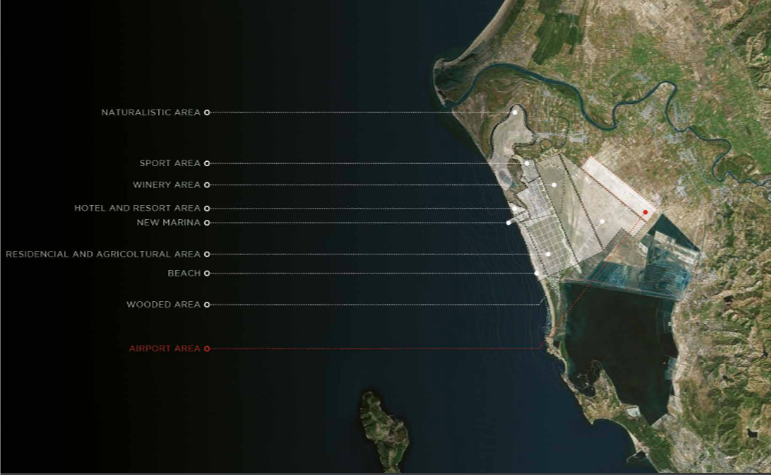
Construction of a major new airport on the Albanian coast, along with tourism development on adjoining sites, is imminent. A map of the Vlora Airport project plan shows an airport adjoined by several development areas – naturalistic area, sport area, winery area, hotel and resort area, new marina, residential and agricultural area, beach and wooded area. The project is opposed by many organizations, as outlined in a description of the case on EJatlas, the world’s largest, most comprehensive online database of social conflict around environmental issues.
The Vlora Airport project plan map shows an airport and various development areas – hotels and resorts, marina, winery area, beach, wooded area and sport area. Graphic: Invest in Albania, 20/12/2020
A wide range of groups are concerned over damaging impacts on unique wildlife habitats. The site lies within the Vjosa-Narta Protected Landscape, one of the largest near-natural wetland complexes along the Adriatic coast, encompassing the Vjosa River (one of few remaining free-flowing rivers in Europe), Narta Lagoon and other wetlands, marshlands, reed beds, woodlands, islands and sandy beaches. The area designated for Vlora Airport and associated development is at the mouth of the Vjosa River, next to Narta Lagoon which is populated by many bird species, most notably flamingos and the endangered Dalmatian pelican. The coastline forms part of the ‘Adriatic Flyway’, a migration corridor which runs across the Balkans, the Adriatic and Southern Italy over to North Africa and is a followed by water birds of Central, Northern and Eastern Europe. During migration hundreds of thousands of birds forage and shelter in the area. Aeroplane flightpaths would be incompatible with flocks of flying birds, in particular large birds like flamingos, pelicans, herons and gulls. Birdstrikes, collisions with aircraft, might occur, placing both air passengers and birds at risk.
Local NGO Protection and Preservation of Natural Environment in Albania (PPNEA) researched the plans and raised awareness about threats posed to local ecosystems. EuroNatur called for an environmental impact assessment (EIA) meeting global standards. A broader alliance criticising the airport land developed. In March 2021 a letter to the European Commision and Parliament by a coalition of NGOs, calling for support in urging the Albanian government to reconsider plans for the airport and tourism resorts in order to protect Vjosa-Narta, was signed by more than 40 organisations. The concession to build Vlora Airport was awarded to a consortium led by Mabetex Group in March 2021, on very generous terms. If Vlora Airport’s passenger numbers and profits are not as high as expected the project could cost Albanian taxpayers EUR 138 million. Clauses in the contract state that taxpayers must pay up to this sum should the concession fail or be unprofitable.
Despite constant pressure from national and international NGOs, the Albanian government persists in supporting the Vlora Airport project. On 28th November 2021 President Edi Rama opened the construction site. When the Environmental Impact Assessment (EIA) was published a preliminary anaysis by experts from Albanian environmental and scientific researchs organisations siad it was ‘baised’ and identified striking deficiencies. The most important aspects not addressed by the EIA were:
The designated area is in an internationally recognised nature reserve could result in sanctions under the provisions of the Bern convention on the Conservation of European Wildlife and Natural Habitats
Lack of involvement of international experts in the decision-making process
Risk of natural disasters such as floods, anticipated to increase due to climate change, not taken into account
Speaking in a TRT World video environmentalist Jon Vorpsi questioned the necessity of a new international airport with the country’s main airport located just an hour and a half away. Mirjan Topji of the Birds of Albania group said that Narta lagoon is vital for the survival of Dalmation pelicans and raised concerns over air safety should aircraft collide with birds. Owner of a nearby fish restaurant, Arsen Lambro, disagreed with government claims that the new airport will boost tourism, saying the destruction of ecosystems, flora and fauna would reduce the number of visitors. Yet construction of Vlora Airport is set to begin soon. In January 2022 local ornithologists said noise from trucks and excavators was already scaring pelicans and flamingos away.
Two tourism developments on the Red Sea coast, Amaala and the Red Sea Project, will not live up to claims of ecological sustainability. Both resorts will have dedicated airports, sending carbon emissions soaring and hardwiring fossil fuel dependency.
An aerotropolis of sorts, a tourism resort with its own dedicated airport, is emerging on the Red Sea coast of northwestern Saudi Arabia. Amaala is a planned tourism gigaproject covering 4,155 square kilometres of terrain on land and sea, with more than 2,500 hotel rooms and over 800 residential villas. On 26th June renderings for the terminal and control tower of a luxury airport to serve Amaala were unveiled by UK-based Foster + Partners.
Amaala Airport – ‘inspired by the optical illusion of a desert mirage’
Luxury and exclusivity characterise the three main components of Amaala: Triple Bay – a luxury wellness resort and sports facilities including golf, equestrian, polo and falconry; Coastal Development – a cultural district featuring a museum of contemporary arts, film and performance arts venue and a biennial park and The Island – one of the world’s ‘most exclusive enclaves’ featuring botanical gardens, artworks, sculptures and private residences surrounded by landscaping. Amaala aims to attract ultra-high net worth individuals (UHNWIs), specifically targetting the very wealthiest, ‘the top 2.5 million ultra-high net worth individual luxury travellers’. This really is high-end tourism; Amaala’s target market segment is the wealthiest 0.03 per cent of the world’s total population of more than 7.8 billion. The resort will have its own ‘special regulatory structure’ to attract the super-rich.
Taking premium tourism to new heights, Amaala’s own dedicated airport will be as luxurious as the resort. Chief executive of Amaala, Nicholas Naples said: the ‘gateway to Amaala…will be a unique space that personifies luxury and marks the start of memorable experiences for the world’s most discerning guests’. Scheduled to open in 2023, coinciding with opening of the first phase of the resort, Amaala airport will initially serve private jets and charter flights, before expanding to accommodate commercial airlines. When fully complete, by 2028, Amaala Airport terminal, a ‘spacious light filled courtyard’, will have capacity for 1 million passengers per year.
Zero carbon (but what about the flights?)
Listing a mutlitude of ecological features – including an organic farm, utilising biodegradable materials, preventing plastic pollution, protecting iconic species, renewable energy including solar fields, recycling, treating wastewater for use in agriculture – Amaala claims it will ‘set an example for sustainability and eco-conservation in the region’. CEO Nicholas Naples, said ‘energy requirements will be met by using renewable sources, with the entire Amaala development having a zero-carbon footprint’. All these laudable ecological measures will be undermined by the impacts of travel to and from the resort. Amaala will be heavily dependent on aviation; an estimated 80 per cent of visitors will arrive by air. Flying is the most carbon intensive mode of transport and the carbon footprint of travelling by private jet is far higher than comparable journeys by commercial airliner; some estimates quantify the differential at 10 times the amount of carbon per passenger.
Foster + Partners’ design for Amaala Airport, a ‘sleek mirrored edifice’ inspired by ‘the optical illusion of a desert mirage‘, received a lot of publicity. The angular, shiny roof is indeed striking but its just an ostentatious example of superficial architectural flourishes that are typical of airport design, a fancy veneer disguising a functional concrete box. Gerard Evenden of Foster + Partners said: “The passenger experience through the entire building will be akin to a private members club … The design seeks to establish a new model for private terminals that provides a seamless experience from resort to airplane”. Passengers will be enclosed in a bubble sealed off from the real world. Damaging environmental impacts of emissions from private jets will be externalised, inflicted on other people, predominantly the poorest, living elsewhere and in the future. As less privileged people contend with extreme weather private jets owned by UHNWI’s parked at Amaala will be protected from the slightest climactic variation, in climate-controlled hangars.
Architects criticise Amaala Airport
In Architects Journal, Greg Pitcher queried whether Foster + Partners’ involvement with the Amaala airport project aligned with the firm’s carbon reduction pledges, in particular commitment under the Architects Declare banner to ‘evaluate all new projects against the aspiration to contribute positively to mitigating climate breakdown’. Sustainability expert and consultant Simon Sturgis said: ‘These sort of projects suggest that Foster + Partners is still engaged with 20th rather than 21st century thinking … This represents a climate betrayal’. Another consultant, Robert Franklin, weighed in on the Architects Declare movement, describing it as ‘a calculated, cynical insult to anyone who understands the lease nuanced interpretation of sustainable’.
Architects Climate Action Network (ACAN) polled network members asking them about their thoughts on Foster + Partners’ involvement in Amaala Airport. A clear majority opposed the scheme and ACAN wrote an open letter to voice concerns, arguing that architecture practices working to expand aviation goes against pledges to ‘Evaluate all new projects against the aspiration to contribute positively to mitigating climate breakdown’. ACAN also questioned how the airport project could be reconciled with Foster + Partners being a signatory of Architects Declare commitments recognising rapid decarbonisation as a global imperative.
Superyachts and luxury cruises
For those arriving at Amaala by sea there will be facilities for yachts, specifically ‘luxury yachting’. Naples spoke to Superyacht News about Amaala. Explaining that Amaala is part of a ‘yachting strategy for the Red Sea’ whilst acknowledging that while ‘yachting and environmentalism often aren’t seen to go hand-in-hand’ he was ‘confident that the project will be considerate to its surroundings’. Such confidence is unwarranted as travellers on superyachts, luxury vessels with price tags upwards of $100 million, leave ‘oversized personal carbon footprints‘ in their wake. The carbon footprint of one Superyacht, Venus, the result of 51,796 kilometres travelled in 2018, was estimated at 4,571 tonnes. This astonishingly massive figure is 279 times the average Australian citizen’s annual carbon footprint – for all their activities, not just transportation – and 594 times the average Chinese citizen’s carbon footprint.
Amaala will also be a calling point for boutique luxury cruises. Each passenger on board these boats will wield an even larger carbon footprint than the thousands of people crammed on board cheaper vast cruise ships that resemble floating cities. And Amaala’s facilities for arrivals by sea, marinas to accommodate international races and regattas, are likely to have negative environmental impacts on the pristine Red Sea coastal ecosystems. Large concrete structures and air and water pollution from boats could compromise biodiverse ecosystems that provide havens for whales, turtles and healthy coral reefs.
Neom megacity and the Red Sea Project
Amaala is situated between two other developments on the Red Sea coast: Neom megacity to the north and the Red Sea Project to the south. Vivian Nereim and Donna Abu-Nasr reported for Bloomberg on their visit to Neom in July 2019. They explored an eminently desirable setting for development, an area blessed with ‘stunning untouched shorelines with waves rippling in the turquoise water’ against a backdrop of purple volcanic mountains. Residents were uncertain and divided over whether benefits from Neom megacity would accrue to them: ‘Many of the locals who have lived there for years are looking forward to some prosperity, while others are concerned they will be removed and their homes bulldozed.’ Rumours swirled of large-scale resettlement to make way for luxury villas and office complexes and Neom stated that under current estimates more than 20,000 people would be moved. Megaprojects including a ‘huge port’ and a causeway to Egypt were in the works. A small airport serving Neom opened in June 2019.
The massive Red Sea tourism project, comprising resorts on 22 islands and six inland sites, will, like Amaala, be served by its own dedicated airport. In July 2020 infrastructure contracts for Red Sea International Airport were awarded to two Saudi firms: Nesma & Partners Contracting and Almabani General Contractors. And Foster + Partners is also involved in the airport. In July 2019 the firm was awarded the design contract. As with Amaala airport a whimsical architectural facade will evoke the surroundings, ‘the form of the roof shells is inspired by the desert dunes’.
Red Sea International Airport, serving 1 million passengers per year. ‘Eco-friendly and sustainable design’.
Although not built for private jets the ‘design of the terminal aims to bring the experience of a private aircraft terminal to every traveller by providing smaller, intimate spaces that feel luxurious and personalised’. Visitors will be funnelled from the airport to the resort via ‘an immersive experience of the highlights at the resort’ in a Welcome Centre and ‘departure pods’ with spas and restaurants. Red Sea International Airport’s projected number of air passengers is identical to Amaala airport: 1 million per year. And the emphasis on environmental policies, such as zero waste-to-landfill and ban on single-use plastics, is similar to Amaala. Red Sea Project developers ‘want it to become one of the world’s most succussful sustainable tourist resorts’. Visitors will be given personal carbon footprint trackers to encourage them to think about sustainability. If these trackers were to include flights visitors would see their carbon emissions exceeding that of the majority of the worlds’ people who have never flown, before they even step off the plane into the luxury terminal.
A New Civil Engineer article, proclaiming the airport to be ‘eco-friendly‘, states that ‘the entire infrastructure of the Red Sea Project, including its transport network, will be powered by 100% renewable energy’. Conversion of transportation systems is one of the most difficult aspects of transition to renewable energy. Flights powered by renewable energy are not even remotely on the horizon. Much-hyped biofuels only provide a minute proportion of aviation fuel, just 0.01 per cent. Scaling up aviation biofuel production would destroy forests and other ecosystems and trigger land grabbing for plantations. Many airports have installed solar panels on unused land surrounding runways, providing a proportion of the power requirements for ground operations. But solar flight is a distant dream. The only solar-powered planes to successfully fly long distances, Solar Impulse 1 and 2, carry just one or two people at speeds rarely reaching 100 kilometres per hour.
Like Amaala, Neom and the Red Sea Project are supported by the Public Investment Fund KSA (PIF), Saudi Arabia’s sovereign fund, and all three projects are part of the Saudi Vision 2030 programme. Spanning various sectors including tourism, real estate and entertainment Saudi Vision 2030 aims to diversify the economy away from dependency upon oil. Tourism is a prominent sectoral focus, anticipated to increase from the current 3 per cent of gross domestic product to 10 per cent by 2030. Yet Amaala and the Red Sea Project, flagship tourism developments, are heading in the opposite direction from reducing dependency on oil. Dedicated airports serving these two resorts might not draw upon Saudi Arabia’s depleting oil deposits. But both facilities will require prodigious amounts of oil extracted from somewhere.
A group of CSOs (civil society organizations) have taken action to help raise awareness of and influence the United Nations tourism agenda. The United Nations has designated 2017 as the International Year of Sustainable Tourism for Development (IY2017) to promote tourism’s role in contributing to the Sustainable Development Goals (SDGs). Civil society groups have long voiced concerns over tourism growth that, through its aviation dependency, is fossil fuel dependent, and is a key driver of land grabs displacing communities and destroying ecosystems. GAAM joined a number of CSOs in issuing a joint statement criticizing the current global tourism and development model. Entitled ‘Tourism, Urgent Appeal for Harm Avoidance’, the statement was issued on 22nd May, the International Day for Biodiversity which was marked this year on the theme of ‘sustainable tourism’. The statement was issued by: International Support Centre for Sustainable Tourism, Tourism Investigation and Monitoring Team (Tim-Team), Global Anti-Aerotropolis Movement (GAAM), Third World Network (TWN), Consumers Association of Penang, Sahabat Alam Malaysia (Friends of the Earth, Malaysia), and Tourism Advocacy and Action Forum (TAAF).
An article by Friends of the Earth International International Day for biological biodiversity: celebrate by protecting biodiversity, not promoting tourism critiques the UN Convention on Biodiversity (CBD) for using the International Day for Biodiversity to promote tourism and mentioning the need to reduce its negative impacts, but failing to recognize that many so-called ‘sustainable tourism’ projects, fail host communities by denying them revenue generation and self-determination. In the worst cases indigenous peoples are evicted to make way for resorts. FOE calls for tourism policies that protect ecosystems and the rights of local communities, calling for celebration of International Biodiversity Day by challenging the dominant tourism business model.
Aviation is one of the most rapidly growing sources of climate damaging greenhouse gas emissions and a press release from the Global Forest Coalition Aviation Emissions Under Scrutiny On Sustainable Tourism Day raises the issue of proposals to offset these emissions, which were discussed at last week’s climate talks in Bonn, Germany. Instead of reducing its emissions the aviation industry seeks to offset them with monoculture tree plantations which are a threat to biodiversity and local communities. The plantations destroy natural ecosystems and the livelihoods of communities that depend on them.
Tourism was on the agenda at the 13th Meeting of the Conference of Parties (COP13) to the Convention on Biological Diversity (CBD), held in Cancun, Mexico in December 2016. The draft Cancun Declaration recognizes that tourism, a major sector in the global economy, is dependent upon biodiverse ecosystems. A Third World Network (TWN) briefing paper, ‘Tourism at the tipping point: Governance for future generations’, preparedby Alison M. Johnston, Director of the International Support Centre for Sustainable Tourism, Canada, urges a precautionary approach to tourism growth, challenging the institutionalization of the industry as a ‘pre-approved enterprise’ which facilitates its expansion into remote areas, often damaging rather than conserving ecosystems and biodiversity. The paper highlights the role of aviation, the tourism industry’s dependence upon the petroleum industry, the impacts on indigenous peoples and considerations for future generations.





 antiaero.org