Construction of a major new airport on Gadeok Island, a government-driven project, is imminent despite concerns over economic viability, technical feasibility, safety, relocation of residents and environmental impacts. A proposed airport city complex would support airport operations and might be designated as a free economic zone.
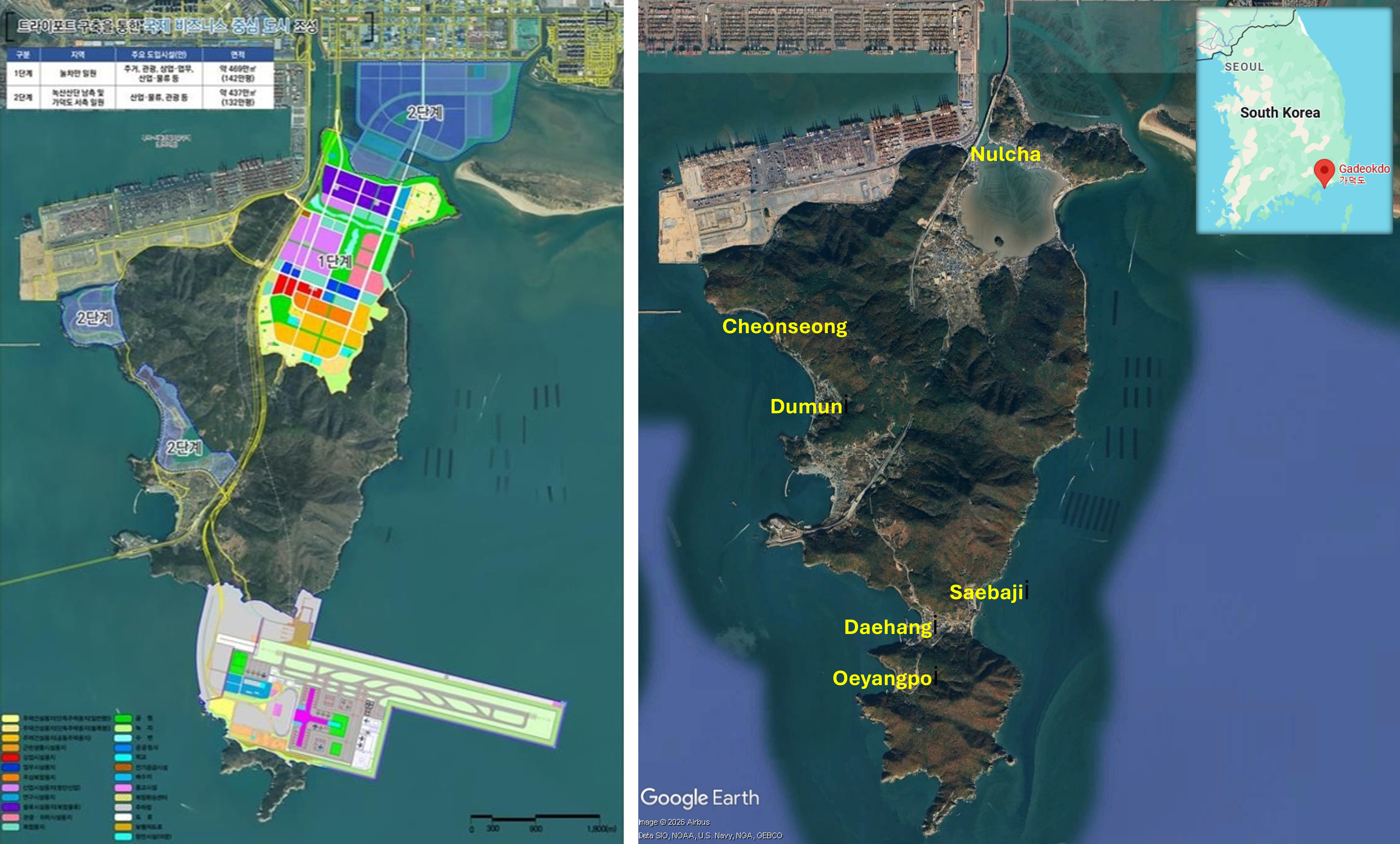
Gadeok Airport City plans
On 26th August 2026 the Busan City government released a draft designation plan and environmental impact assessment for Gadeok Airport City free economic zone, aligned with the master plan for Gadeok Airport. A graphic showed the new airport site on the south of Gadeok Island, with the runway extending eastwards into the sea, and the main Airport City sites to the north and on the west coast of the island. The city said public briefings on the Airport City would be held between the 7th and 23rd September and that, following deliberation and a decision by the Free Economic Zone Committee it aimed to finalise the development plan in 2027. If the Airport City is designated as a free economic zone, tax incentives and deregulation to attract international aviation and logistics firms are expected and there are plans for immediate commencement of compensation for land acquisition and construction. A comprehensive plan for the Gadeok airport city complex announced in August 2024 specified approximately 998 hectares of development on three areas: logistics facilities in Nulcha, tourism and leisure facilities in Cheonseong and a renewable energy hub in Dumun. A ‘car-free, eco-friendly, pedestrian oriented city’ is promised with a large lake park and a pedestrian park running north-south and east-west. But these are just superficial features of an airport city development primarily designed to support airport operations.
A special bill, opposition and protest
Plans for a major new airport in South Korea’s southeastern region first emerged in 2006, only to be repeatedly shelved due to feasibility concerns. After a November 2020 state committee decision that a proposal to expand the existing Gimhae Airport (30 kilometres northeast of Gadeok Island) was unfeasible, for safety and environmental reasons and lack of local government representation in the process, bids to site a new airport on Gadeok Island and the city of Miryang came to the fore. The Democratic Party, (DP) having a large majority in the National Assembly, has been promoting the former. Then, in March 2021, the National Assembly passed a special bill supporting construction of a new airport on Gadeok Island. Passing of the bill allows construction of the airport to bypass several obstacles, including a normally compulsory preliminary feasibility study to determine viability before embarking on the project. A large majority voted in favour of the special bill, but opposition parties and some DP legislators criticised the government and DP for rushing the bill, passing it only three months after it was proposed. An assessment by the Ministry of Land, Infrastructure and Transport was sceptical about the project and residents and environmentalists expressed concerns over risks to endangered otters. On 30th June 2021, as DP leader Song Young-gil toured the proposed site, a gathering of local residents protested against construction of the airport.
A U$10.97 billion offshore airport
A detailed plan released on 26th April 2022 specified an airport solely for international flights, forecast to handle 23.36 million passengers and 286,000 tonnes of cargo per year by 2065. It would be the country’s first offshore airport, partially built on an artificial island on reclaimed land, requiring an enormous budget of KRW13.7 trillion (U$10.97 billion) and commencing operations in June 2035. Some regional lawmakers said the airport plan would require an even larger budget and longer time frame, adding to the ongoing doubts about the economic viability and concerns over the environmental impacts. Government plans for a free trade zone surrounding the site, intending to develop an international logistics hub, were already in the works. Three days after the release of the plan, on 29th April 2022, the Ministry of Economy and Finance said the government would forgo a feasibility study for the new airport and begin construction in the second half of 2025. Criticism of the airport project was increasing and a group of environmental activists held a protest demanding that the plan be scrapped.
Gadeokdo New Airport Construction Corporation was established on 25th April 2024 to oversee development of the airport. On 5th November 2024 members of a civil society organisation opposing the airport held a press conference in front of Busan city hall, calling on the government to cancel construction plans and denouncing the no-bid development contract that had been awarded to a consortium led jointly by Daewoo E&C and POSCO E&C. Yu Jeong-whon, professor of transportation systems engineering at Ajou University, argued in an article published by Korea JoongAng Daily that Gadeok Airport was being driven by politics, not policy, with passing of the special law supporting the airport, dismissing economic viability and technical feasibility concerns, eroding trust in the government. The cost could rise and the construction period increase to nine years. Despite the huge project cost and significance there had been very little deliberation involving citizens. Building the airport on soft marine sediment would necessitate massive ground reinforcement. The bird strike risk would be high due to the site’s proximity to the Nakdong River estuary, northeast of Gadeok Island, which is a major bird migration route. Fog and high wind speeds could also compromise flight safety.
On 5th July 2025, two days after a snap election brought in a new DP administration, the Busan government stepped up the drive to develop the new airport, announcing commencement of negotiations on compensation for land and properties within the proposed site and aiming to transfer ownership to the government by the end of the year. Kim Byeong-kwon, director of Busan’s airport planning division, said, “The total number of items for compensation, including land and structures, is over 1,000.” The site contained 68 land parcels covering 37 hectares and the relocating process would affect 378 households. Busan city and the DP announced an extension of the construction timescale from six years to seven years.
Relocation anxieties
The following month Gadeok residents spoke of their anxieties over looming displacement for the airport. A total of 672 residents of three villages – Daehang, Saebaji and Oehaengpo (Oeyangpo) – were facing displacement. A 77 year old woman who had settled in Gadeok in the 1970s and run a small supermarket for 40 years was tearful and having difficulties sleeping due to rapid progress of the airport project and uncertainty over where to relocate to. Banners in Daehang village displayed slogans criticising the airport project and demanding relocation measures. Residents were anxious about the lack of clear answers from the Gadeokdo New Airport Construction Corporation which is in charge of relocation and that they might only receive compensation money rather than land or dwellings. The head of the Daehang Fishing Village Association said that in two years of meetings with the corporation relocation measures had not been mentioned. Dissatisfaction with compensation for land taken for development project is common and in Gadeok these concerns were intensified by claims that land prices had not risen in the 20 years of proposals and plans for the airport. On 3rd July 2025 residents holding a rally in front of Daehang breakwater demanded relocation measures and protested the compensation offer. A representative of the Daehang compensation committee demanded formalisation of relocation measures, including support for livelihoods, that had been omitted from the plan.
Lawsuit calls for cancellation
By September 2025 a lawsuit calling for cancellation of the airport master plan, filed by about 1,000 members of Action Against the Promotion of the Gadeokdo New Airport, was heading towards it fourth reading. The lawsuit stated that the site was unsuitable for an airport, having received a less favourable evaluation than alternatives in Gimhae and Miryang, and Gadeok’s natural environment and cultural value should be preserved. Attention to the opposition to Gadeok Airport had been heightened by the 11th 2025 September Seoul Administrative Court ruling cancelling the Saemangeum International Airport project, based on inadequate review of environmental factors, most pertinently the risks to tidal flats and of bird strikes. While the estimate of the likely number of bird strikes was lower for Gadeok Airport than Saemangeum Airport it was higher than Incheon Airport or Gimpo Airport, and some thought that collisions with seabirds around Gadeok’s coastal site, larger and flying at higher altitudes, were a more serious threat to flight safety. Arguments that too many new airports – ten planned and under constriction – were being pursued came from within the aviation and construction industries.
Delay, cost dispute and cost escalation
In November 2025 the government extended the Gadeok Airoprt construction period again, from seven years to ten years and eight months; the completion date was pushed back from 2032 to 2035. Calls for evaluation of the project site risks continued. Land reclamation would be a gargantuan task as the soft layer of ground beneath the site is 50-metres thick and typhoons causing 12 metre high waves would pose risks during construction and operations. In comparison, Incheon Airport was constructed on a soft ground layer one quarter of the thickness and ocean waves are only a third of this height. The Ministry of Land, Infrastructure and Transport announced finalisation of the basic design for Gadeok Airport site development on 7th September 2026. The design, prepared by the Daewoo E&C led consortium, will be reviewed by the Central Construction Technology Deliberation Committee. If the basic design is approved construction of the priority section of the airport is due to start in November 2026 with works on the main project anticipated to begin during the first half of 2027. A further project cost escalation is possible. Daewoo E&C requested a KRW620 billion (US$463,860) total project cost increase, citing increasing costs of fuel and materials caused by conflict in the Middle East. Daewoo E&C is benefiting from the airport even before construction begins; the firm’s shares surged by 12% on the day the Gadeok Airport basic design was finalised and it submitted its documents, and by a further 9% on the following day.