The ‘Airports in India’ report by Equitable Tourism Options (Equations), is a useful critique of government plans for massive airport expansion. Published in May 2015, the report is skeptical regarding the viability of plans to construct 200 new airports over the next two decades, when most of India’s established airports operate at a loss. Vast amounts of public expenditure on airport infrastructure would benefit only a small wealthy minority, in a country where 22 per cent of the population live below the poverty line.
In many instances new airport plans are rushed, without proper consultation of the local community and the requisite environmental clearances. Several Indian airport projects have met with opposition from affected communities. The Bhogapuram airport project has seen massive protests by farmers (also see GAAM blogposts from 15th April and 17th April 2015). Airports in Sikkim and Aranmula have been stalled by community protests. There has also been vigorous opposition to privatization of Mumbai, Delhi and Chennai airports. Chennai Airport is thought to have 2,000 acres of land which the private operator can lease for facilities like five-star hotels. The report urges the government to reconsider new airports in favour of upgrading existing airports.
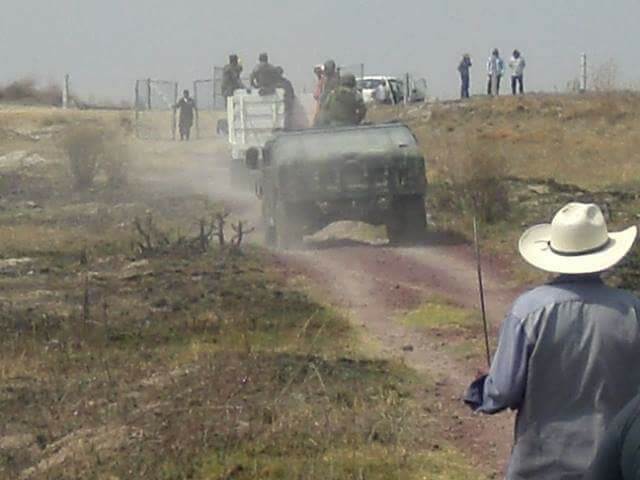
The Mexican army invaded ejidal (communal) lands of Atenco, where communities have resisted land expropriation for an airport for more than a decade. The military convoy was escorting a party of workers from one of the companies contracted to construct the airport. The community of Atenco has begun daily patrols to prevent further intrusion into ejido lands and is calling for international solidarity.
Army Invades the Ejidal Lands of San Salvador Atenco
In the morning of April 12, while the police forces of the State of Mexico continued advancing at the other end of the state, in San Francisco Xochicuautla, a convoy of military entered the ejidal lands of the community of San Salvador Atenco to escort a gang of workers from one of the private companies in charge of the construction of the new airport in Mexico City.
Community members who have resisted the expropriation of their lands for more than ten years told Desinformémonos that the day before, April 11, an official of the company had already arrived in the communal lands, at the base of Cerro Huatepec, with the intention to “carry our measurements.” Facing the intrusion, villagers moved in and responded.
“The compañerxs told them that they could not be on communal lands because we are in…
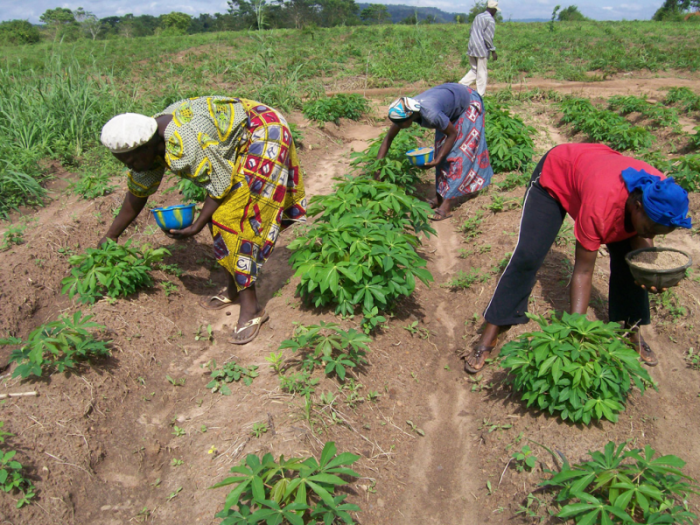
An article in The Ecologist, Nigerian farmers win High Court victory in fight against Ekiti airport, is a story of a successful struggle against a land grab for an airport. On 2nd October 2015 the state government of Ekiti, in western Nigeria, sent in bulldozers to clear 4,000 hectares of farmland for an airport. Bulldozers were sent in and began destroying crops, without even warning the farmers, never mind making provision for compensation for their loss of land and livelihood. Affected farmers from the five affected villages fought back, organizing a protest and filing a suit.There was widespread criticism of the airport project, allocated an enormous amount of public funds in a state where many residents are impoverished. The viability of the project was dubious as many airports in Nigeria, including one in the neighbouring state, are underutilized.
The plan for Ekiti airport was not, to my knowledge, referred to as an ‘aerotropolis’. But the land area allocated, 4,000 hectares, is far more than would be required even for an enormous global hub airport (an unlikely prospect in an agrarian state). In comparison, Atlanta Airport, in the USA, the busiest passenger airport in the world handling over 100 million passengers in 2015, covers an area of about 1,600 hectares. As well as land used for airport operations.this includes considerable commercial space, such as retail and warehouses.
On 20th January 2016 farmers held a protest, storming the Ekiti airport project site and demanding that work cease immediately, in respect of the suit that they had filed. They held placards with slogans reading: “Gov Fayose, Please Leave Us Alone, Don’t Damage Our Life”, “This Land Is The Major Cocoa Plantation, Please No Trespass”, “Please Relocate Your Airport to Government Forest”, “We All Say No To Illegal Airport Project”, “Iwajo, Aso Say No To Illegal Airport”, and “Igbogun Cries Over Illegal Destruction of Our Property”. They also stated that at least ten farmers, including three women, had ‘died of shock’ caused by the destruction of their farms.
In 22nd March the Ekiti farmers secured victory in the High Court, which ordered that forcible take-over of their land for the airport was unconstitutional, illegal, null and void. But there are plans for major new airports all over Nigeria, in the states of Osun, Bayelsa, Abia, Ogun, Anambra and Nasarawa, all of which are being vigorously opposed. Citizens are calling on governments to use the vast amounts of public funds being allocated to these airports to infrastructure that will benefit ordinary people – to repair roads and bridges and support small businesses. And yet another major airport plan is looming. The Yobe state government plans to build a N6 billion (over US$30 million) cargo airport in Damaturu, to act as a gateway for investment in the state and facilitate export of meat, dairy produce and gum arabic (acacia gum). The scheme which is meeting with criticism and goes against state commitments to prioritise water supply, schools, clinics and roads to benefit local communities.
GAAM has posted a video playlist Aviation expansion – resisting displacement on our YouTube channel. All over the world communities are resisting displacement for airport expansion and new airports. Airport development on greenfield sites often entails concreting over agricultural land, and rural communities fight against loss of their land and livelihoods. People living in slums near airports face an uncertain future and are fighting for secure and decent housing. Already there are 14 videos on the list – campaigns in many countries including Cambodia, India, South Africa, Turkey, Laos, Taiwan and Mexico. GAAM would will be adding more films to the list, do let us know of any videos that should be included.
A book written by some of the occupants of the ZAD (Zone a Défendre) – a site in Western France which has been occupied for over 9 years – in resistance against the construction of the planned Notre-Dame-des-Landes airport. Over 5,000 acres of farmland and wetladns would be destroyed. Evictions and mass protests are documented, and the sustained solidarity which has held the ZAD together for so many years. The ZAD is a ray of hope in the resistance against destructive megaprojects.
Residents of Jeju Island (South Korea) are resisting a proposed airport that would displace people from five villages. The project has been imposed on local communities without consultation, and with little consideration on how the planned influx of millions of tourists would impact on rural people. The majority of local people oppose the airport, and it is being met with a series of protests.
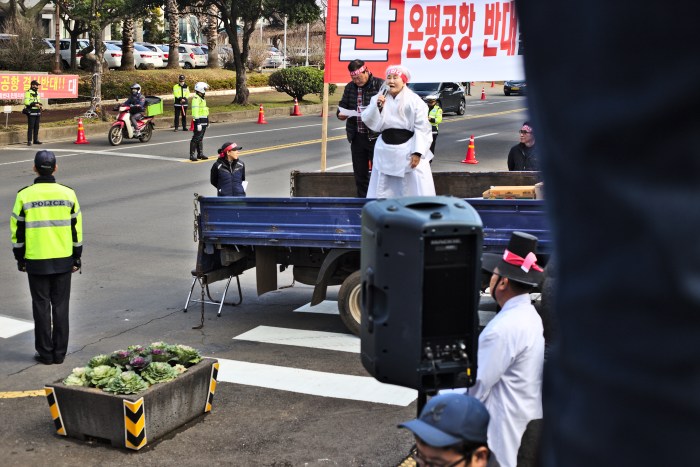
Onpyoung Village resident in costume, speaking as the Youngdeung Goddess at a demonstration last week. The goddess is worshipped in a rite performed by shamans each lunar February.
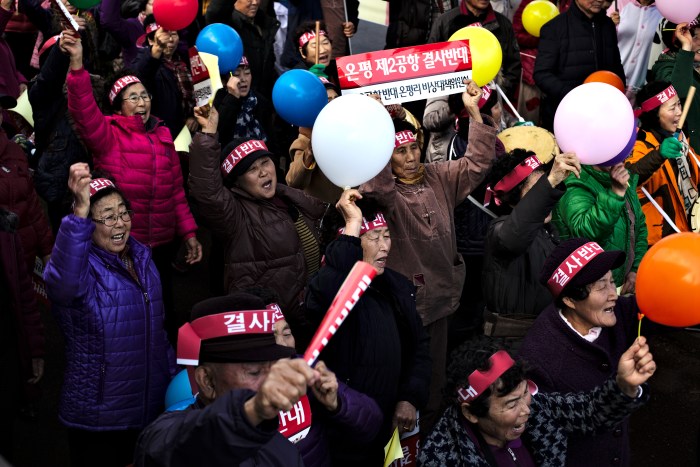
Indigenous residents of Jeju Island’s southeastern region are employing traditional shamanic culture to protest the airport that is slated to displace the populations of five villages. So far, the mainstream media outside of Jeju has done little to document resistance to the project. The new airport is opposed by the majority of residents in the villages affected. Hundreds of locals from Onpyoung and Sinsan villages, elderly and young alike, including middle school students, have enacted a series of demonstrations against the development.
Residents dressed as Jeju’s three founding father figures, Go, Yang and Boo, the mythical original residents of Jeju Island.
“You’re trashing our hometown and we’ll have nowhere to go.”
Farmers and women divers (haenyo) from the village gather in front…
Landholders of San Salvador Atenco, Mexico, successfully resisted plans to build a mega-airport on farmlands in 2001. In 2006, the government punished the community with a brutal police raid. The propject was revived, even larger than before, in 2014. Resistance continues, and UK based Dorset Chiapas Solidarity is urging people to write to the two UK firms that have been contracted as the airport’s architect and engineering consultant.
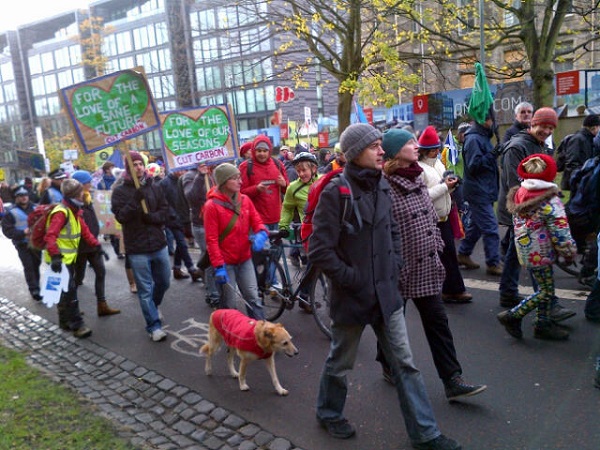
Leaflet distributed at the Climate Change March in Edinburgh
Defending their lands and opposing the new airport in Mexico City
On the front line of Blockadia, resisting climate change
Solidarity with the people of San Salvador Atenco
British companies are involved
Take action!
In her book THIS CHANGES EVERYTHING – CAPITALISM VS THE CLIMATE, Naomi Klein writes of the central importance of Blockadia. She describes how round the globe local people are taking direct action to resist extreme extractive industries and mega-projects which cause great damage to the environment and contribute significantly to climate change. One such struggle is happening now in Mexico.
In 2001, the indigenous common landholders of San Salvador Atenco were successful in their fight against the building of a new airport in Mexico City on their ancestral farm lands. The Peoples Front in Defence of the Land (FPDT) became emblematic for their highly symbolic machetes…
Indigenous communities are protesting the expansion of Suriname’s international airport. The airport has obtained title to the neighbouring, indigenous land, and wants to expell most of the population of the Arawak villages Hollandse Kamp and Witsanti. Indigenous people reject the airport’s claim that they are the trespassers. They also protest against the airport’s dumping of untreated sewage into waterways that run through the two neigbouing Arawak villages.
Despite 500+ years of resistance, Indigenous people in Suriname are still not recognised as land owners. Suriname law doesn’t recognise collective land ownership at all. The state owns all land which is not individually owned. The government recently transfered ownership of the two indigenous villages to the state-owned International Airport of Suriname, without any consultation with the indigenous people who have lived there for generations.
For more information, contact http://www.vids.sr/
Press conference of chiefs, Hollandse Kamp, Suriname, 16 October 2015
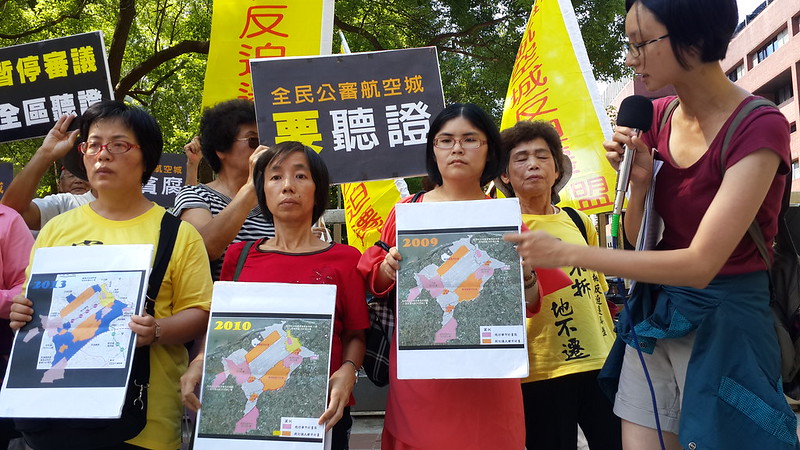
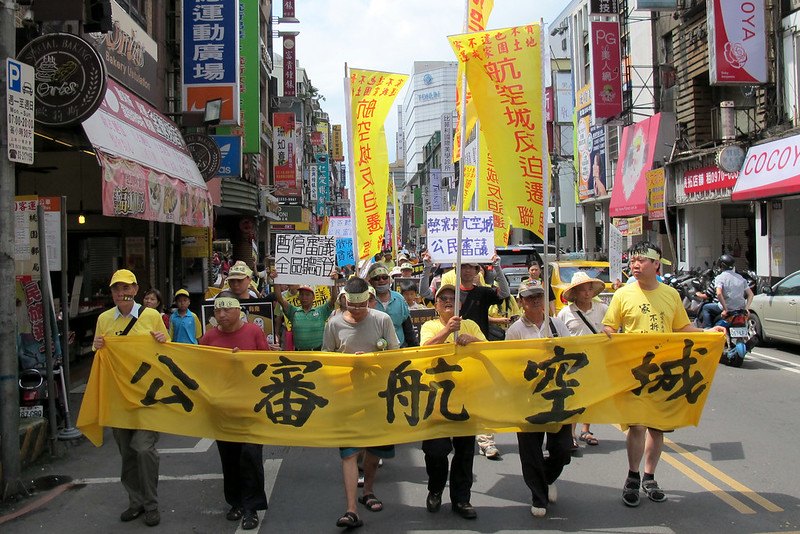
The long struggle for justice for affected people facing displacement for Taoyuan Aerotropolis continues. Planned land expropriation for Taoyuan Aerotropolis would be the largest in the history of Taiwan, taking up 4,700 hectares of land, mostly consisting of prime agricultural land, about 3,200 hectares of this land would be expropriated and 46,000 people face eviction from their homes and farmland.
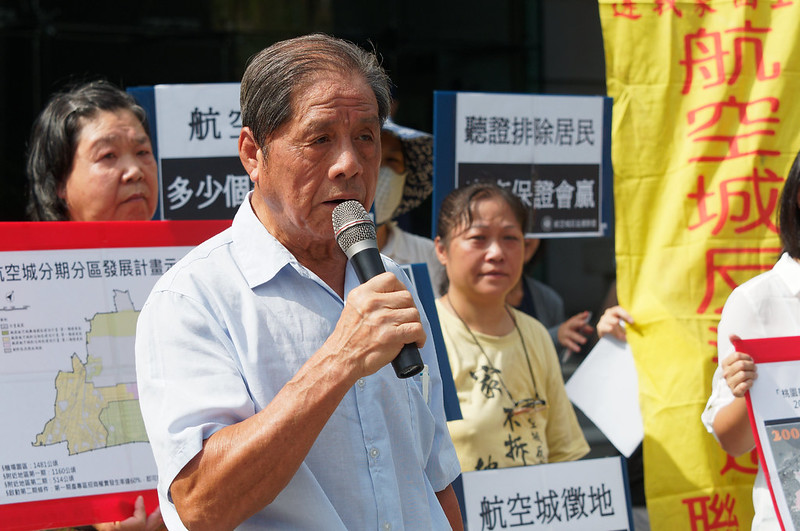
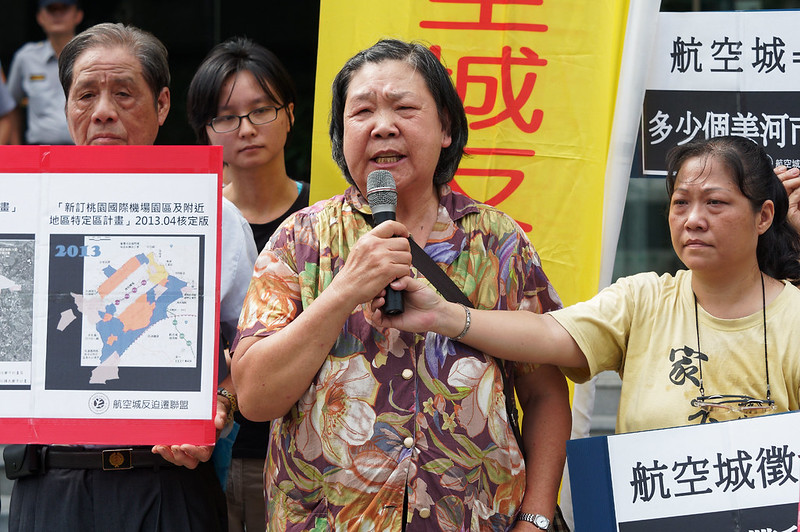
On 30th September, residents from the group Alliance Against Aerotropolis Forced Evictions protested at the Ministry of Transportation and Communications over their concerns that some people will be excluded from upcoming hearings regarding the Taoyuan Aerotropolis project, submitting petitions requesting permission that they be included. The first phase of Taoyuan Aerotropolis is a third runway at the airport, the necessity of which the protesters said must be reconsidered, and development immediately surrounding it. The second phase is development over a wider area. Owners of property scheduled to be expropriated for the project’s second phase have not been invited to attend. Alliance spokesperson Wang Pao-hsuan argued that they should be able to attend as their property is included in government plans and will be forbidden from building on their land if the project is approved.
Environmental Jurists Association director Thomas Chan said that plans for the aerotropolis should ‘start from scratch’ in the light of a new ruling on from the Council of Grand Justice, which found that land should only be expropriated for infrastructure projects. This is pertinent to the planned Taoyuan Aerotropolis, which includes industrial and business parks, plus residential districts.
The 30th September demonstration is one of many protests against forcible land expropriation for the aerotropolis. On 11th March 2015, 300 people gathered outside government buildings in Taipei, capital city of Taiwan, demanding formal hearings . Photo by Coulloud, Creative Commons License
As with so many of the endless protests by people facing eviction for Taoyuan Aerotropolis, the demonstrators met with a heavy police presence.
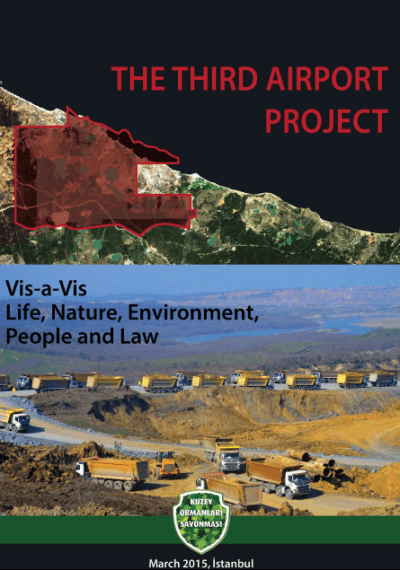
In March, Kuzey Ormanları Savunması (the ‘North Forest Defence’) which campaigns to protect the forests to the north of Istanbul from industrialization and urbanization, published a 100 page comprehensive report into Istanbul’s third airport, currently under construction. Entitled The Third Airport Project: Vis-a-Vis Life, Nature, Environment, People and Law, this report has been translated into English. It exposes the ecological destruction of the project, and examines the drive for economic growth and corporate profits that is the real reason it is being so relentlessly pursued by the government and firms that stand to benefit.
The site is gigantic, over 76 square kilometres. About 80 per cent of this area is forested, the remainder consists of 70 large and small lakes, meadows, farmland and coastline. All are being destroyed as airport construction progresses.
The reason for the gigantic site is that the plan is not for an airport. Land is being expropriated for an ‘aerotropolis’, an airport surrounded by commercial development that is designed to be aviation dependent and support growth of the airport.
Istanbul’s last large area of green space is being sacrificed for a vast urbanisation incorporating the world’s biggest duty-free shopping centre, hotels, a convention centre, sports centre, business space, a clinic and other facilities. Ostensibly, the land is allocated for an airport with the incredibly ambitious goal of handling 90 million passengers annually, ultimately becoming the world’s busiest airport with 150 million passengers passing through.
But even if the airport does indeed grow to handle this number of passengers, an eventuality regarded as unlikely within the aviation industry as well as by its critics, there will be plenty of space for commercial activity. North Forest Defence estimates the area surplus to requirements for aeronautical activities at 57 square kilometres. This is illustrated by comparison with the world’s busiest passenger airport, Atlanta in the USA, which, with a a far smaller land area of 1,625 hectares, handles about 95 million passengers per year.
Preparation of the site for construction commenced on approval of an Environmental Impact Analysis (EIA) that North Forest Defence’s work exposes as utterly inadequate, full of serious omissions and trivialising the impacts of the project. Lakes are described as ‘ponds’, the number of species at risk is under-reported and the bizarre claim is made that, of the 2.5 million trees earmarked for felling, over 1.8 million would be moved to another place, a mass replanting that is technically impossible. The reality is that the habitat of animal and plant species is being obliterated. Endangered bird species whose habitat is imperilled include the greater spotted eagle and the pygmy cormorant. Istanbul’s northern forests are one of the world’s major bird migration routes with hundreds of thousands flying over every spring and autumn. This means that the airport will endanger human life as well as birds, as there will be a considerably higher flight safety risk from bird strikes – collisions between birds and aircraft that can cause fatal air accidents.
Istanbul’s third airport has proceeded in the face of vigorous opposition from a broad coalition of environmental, community and civil organisations, plus professional associations of engineers, architects, scientists and economists. There have been endless campaign meetings and protests, in the centre of Istanbul and in villages affected by the project. The two photos below are of the protest to mark the groundbreaking ceremony for the airport, on 7th June 2014. A slideshow with more photos of this lively protest can be viewed here.
Protest against Istanbul’s third airport, 7th June 2014. Photo: MURAT DELIKLITAS/ISTANBUL-DHAForest defending protesters meet with a wall of riot police, 7th June 2014
North Forest Defence’s report is also a powerful critique of the financing of the airport, and the economic implications. The tender to construct the airport and operate it for 25 years, the biggest in the history of Turkey, was awarded to a consortium of five firms, all with close ties to the government. These firms stand to profit from operating the airport, regardless of the actual level of traffic, because of a state guarantee of liabilities that may be incurred. The consortium’s economic benefit from the airport is also assured because of revenue guarantee of €6.3 billion over 12 years, from a fee levied on the projected 342 million international passengers over this period. There is a precedent for state payment to airport operators when the projected number of passengers fail to materialise; €27 million has been paid to reimburse the operator of three of Turkeys’ airports to compensate for a shortfall. Treasury guarantees mean that the economic risks of the project fall onto citizens.
Every Turkish citizen will incur debt due to the cost of the project, which has already escalated from $16 billion to $20 billion. The airport project is part of a construction and real estate speculation frenzy that serves as Turkey’s main economic stimulus, keeping up a flow of ‘hot money’ – international capital seeking short term profits from interest rate differences and anticipated shifts in currency exchange rates – that buoys up capital markets and keeps the plates spinning.
The campaign to stop construction of Istanbul’s third airport is bolstered by an extraordinary visual record of the ecological destruction that is underway – photographs and videos. It is highly unusual for a megaproject to be documented in this way and it is extremely effective in raising the alarm over the scale and severity of the ecocide that is happening. The site is crawling with hundreds of trucks excavating and dumping earth, the level of infill required to raise and level the site is estimated at 2.5 billion square metres, and compacting the soil is on the swampy site is proving problematic.
Trucks in the Istanbul third airport excavation area, the number of trucks in the project area is expected escalate from 1,200 to 2,000
A video shows destruction of forests and meadows and filled in lakes, swathes of bare earth being worked by bulldozers, and piles of felled trees. There is nowhere left for the wild animals or for farmers to tend their sheep.
Video of storks, one of the 300 species of birds whose habitat is being destroyed for Istanbul’s third airport, flying around bewildered and traumatised in the immediate aftermath of their habitat being bulldozed.
This video, published in May 2015, shows the impact of airport construction on the coastal village of Yenikoy. It begins with a farmer explaining the ‘airport city’ plans, shows the farmland that is at risk as bulldozers move ever closer, then reveals the destruction of forest, lakes, farmland and coastline that is already underway.
Istanbul’s third airport is integrated with other ecologically destructive megaprojects – a multi-lane third bridge over the Bosphorus Strait and a canal running alongside it. Highways to provide surface access mean the loss of yet more green space. All these projects open up the virgin forests for further plunder and feed each others growth. Campaigners have stepped up their efforts to tackle these megaprojects as a package. North Forest Defence has joined forces with Istanbul Kent Suvanmasi (Istanbul City Defence) and on 5th July 2015 a new campaign was launched. The slogan is: ‘Stop the Killer Projects! Be the Breath of Istanbul‘. The forests north of Istanbul are depicted as the lungs of the city, providing oxygen for people and all life to breathe. As well as resisting the megaprojects the campaign is about envisioning and creating a future city which lives in harmony with nature rather than destroying it, taking forward the optimism that concludes North Forest Defence’s report into the third airport, the conviction that ‘it is in our hands to write another story’.
5th July 2015 – campaign meeting, ‘Stop the Killer Projects! Be the Breath of Istanbul!’. Photo: North Forest DefenceA banner is unfurled from the top of a building, it reads: ‘Stop the killer mega projects, defend 250 million trees, be the breath of Istanbul’: Photo: North Forest Defence“Stop the Killer Projects! Be the Breath Of Istanbul!” campaign ribbon, slogan translates as ‘Be the Breath’. Photo: North Forest Defence

 The plan for Ekiti airport was not, to my knowledge, referred to as an ‘aerotropolis’. But the land area allocated, 4,000 hectares, is far more than would be required even for an enormous global hub airport (an unlikely prospect in an agrarian state). In comparison, Atlanta Airport, in the USA, the busiest passenger airport in the world handling over 100 million passengers in 2015, covers an area of about 1,600 hectares. As well as land used for airport operations.this includes considerable commercial space, such as retail and warehouses.
 Onpyoung Village resident in costume, speaking as the Youngdeung Goddess at a demonstration last week. The goddess is worshipped in a rite performed by shamans each lunar February.
  Residents dressed as Jeju’s three founding father figures, Go, Yang and Boo, the mythical original residents of Jeju Island.
  “You’re trashing our hometown and we’ll have nowhere to go.”
  Farmers and women divers (haenyo) from the village gather in front…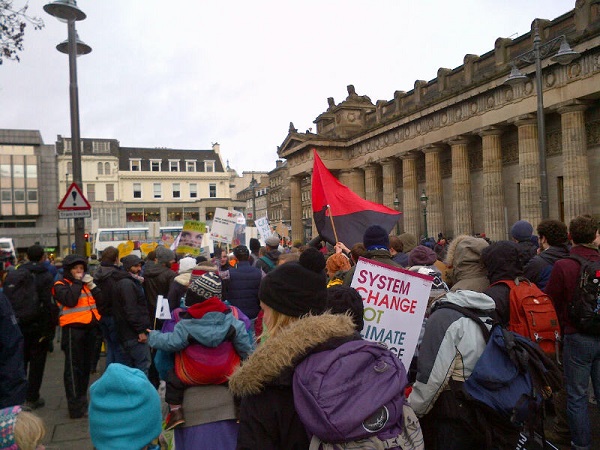







 antiaero.org