‘Mindfulness City’ megaproject begins with expansion of Gelephu Airport

Gelephu Airport, one of only four airports in Bhutan, is a domestic airport located in the southern Himalayan foothills, close to the Indian border. In August 2023, as formulation of the master plan for expansion of Gelephu Airport neared completion and groundwork preparations began, there was growing speculation among landowners with properties in the proposed site regarding replacement land and compensation. Acquisition of land was to be determined by the government. The groundbreaking ceremony for Gelephu International Airport took place on 23rd December 2023. Satelite imagery dated 1st January 2024 reveals a large area of low-lying scrub land has been cleared for the airport expansion.

Satellite imagery shows clearance of a large area of low-lying scrubland for expansion of Gelephu Airport, including the new runway, and construction of a dry port south of the existing runway.

Expansion of Gelephu Airport is a key component of an even larger megaproject, a new city, and some residents are concered about losing land to the project. On 15th December 2023 Forbes reported that King Jigme Khesar Namgyel Wangchuck would be announcing development of a new ‘megacity’ in Gelephu, called Bhutan Mindfulness City, on Bhutan’s National Day, the 17th December. Initially there were plans for the announcement to take place in Gelephu, but the town, with just 10,000 residents, lacked the requisite infrastructure such as accommodation for international guests so the event was relocated to the capital city, Thimpu. Ahead of the official announcement the article cautioned that the new city project might be met with ‘strong opposition from Bhutan’s nearly 800,000 citizens’ and that ‘fears of government land grabs and the displacement of farmers in Gelephu have already taken root, according to several Bhutanese residents’. Sources with knowledge of Mindfulness City said the King was ‘trying to avoid the preception that families will be forcibly transferred to make way for the project’.

Mindfulness City was indeed the focus of the King’s 116th National Day address. The Bhutanese reported the King’s description of the new city, explaining that it will cover 1,000 square kilometres, about 2.5% of Bhutan’s total land area. Major public investment in roads, bridges and airports is planned, with an inflow of foreign investment anticipated for construction of offices, residencies, schools, hospitals, shops, hotels and restaurants. The new city was also referred to as Gelephu Special Administrative Region (SAR), an ‘economic hub’ that will have ‘autonomy to formulate laws and policies’. Ten of the twelve gewogs (groups of villages) in the Sarpang Dzongkhag (District) – Tareythang, Umling, Chhuzagang, Serzhong, Gelephu, Samtenling, Dekiling, Shompangkha, Gakiling, and Singye – were designated for the Gelephu Mindfulness City project. Kuensel Online reported that residents and landlords were ‘excited about the the upcoming development initiative’, attributing some landlords’ anxiety and fear of losing all of their land to the project to ‘lack of awareness regarding private properties’. There was reassurance of compensation following international practices and provision of replacement land in the city area. It appeared that acquisition of private land would be limited to areas allocated for road and airport construction.

Danish architecture firm BIG, known as a masterplanner for other megaprojects such as Neom, a glass-walled linear city in Saudi Arabia, duly unveiled its masterplan for Mindfulness City, including an international airport. Connectivity was a recurring theme of BIG founder Bjarke Ingels’ description of the new city; he said “Gelephu becomes a land of bridges, connecting nature and people, past and future, local and global”. Apparently, the project will ‘be shaped by 35 rivers and streams that run through the site’. Neighbourhoods will be connected by several ‘inhabitable bridges’ hosting facilities including a university, a healthcare centre and a spiritual centre. Connectivity claims extended to the airport, its timber terminal to act as a bridge. But its runway, crossing over several rivers, while facilitating connectivity for global air travellers, will cause major disruption to hydrological systems. And how does a new city highly dependent on fossil-fuel dependent international air travel square with the Gelephu Mindfulness City website claim of ‘Sustainability as a carbon negative country’? Buildings will incorporate local materials and be ‘informed by Bhutanese architecture‘. But will techniques and structures resonating with local cultural identity be integral to the function of new buildings, or merely aesthetically pleasing adornments? Perhaps the most striking showpiece feature of Mindulness City is the plan for a hydro-electric dam containing a temple. Will the new city be, as Ingels said, “founded on Bhutanese nature and culture”, or merely garnished with it?

A 6th January 2024 Kuensel Online article stated that that Gelephu Mindfulness City would commence with expansion of Gelephu Airport and landowners with land in the area earmarked for the airport had been given replacement land or compensation. Landlords confused about the future of their holdings had been told that they had ‘nothing to worry about’ as the project would include everyone and leave nobody behind, indeed ‘the entire Bhutanese citizenry would be part of the historic project’. This claim of inclusivity is at odds with the Gelephu Mindfulness City website promotion of new city aiming to ‘attract global top talents who are global and creative’ and ‘serve as a hub of global top minds’, i.e. for an international elite. By February 2024 six JCBs had cleared about 1,800 acres of land, working towards the goal of clearing 2,500 acres. Just south of the airport, a dry port was under construction. After considering three models for the airport expansion officials had selected the Asian Development Bank (ADB) masterplan. A new runway next to the existing runway will be 3km in length; possible extension of the runway to 3.5km to accommodate the Airbus A380 would cross over two rivers. Building a new runway will allow continuation of airport operations using the existing runway, enabling visitors involved in the development of Mindfulness City to fly in and out. The initial cost estimate of the ADB masterplan was Nu 8 billion (USD96 million) but a more recent estimate by the Airport Authority of India indicated a far higher figure, possibly as high as Nu 20 billion (USD240 million).
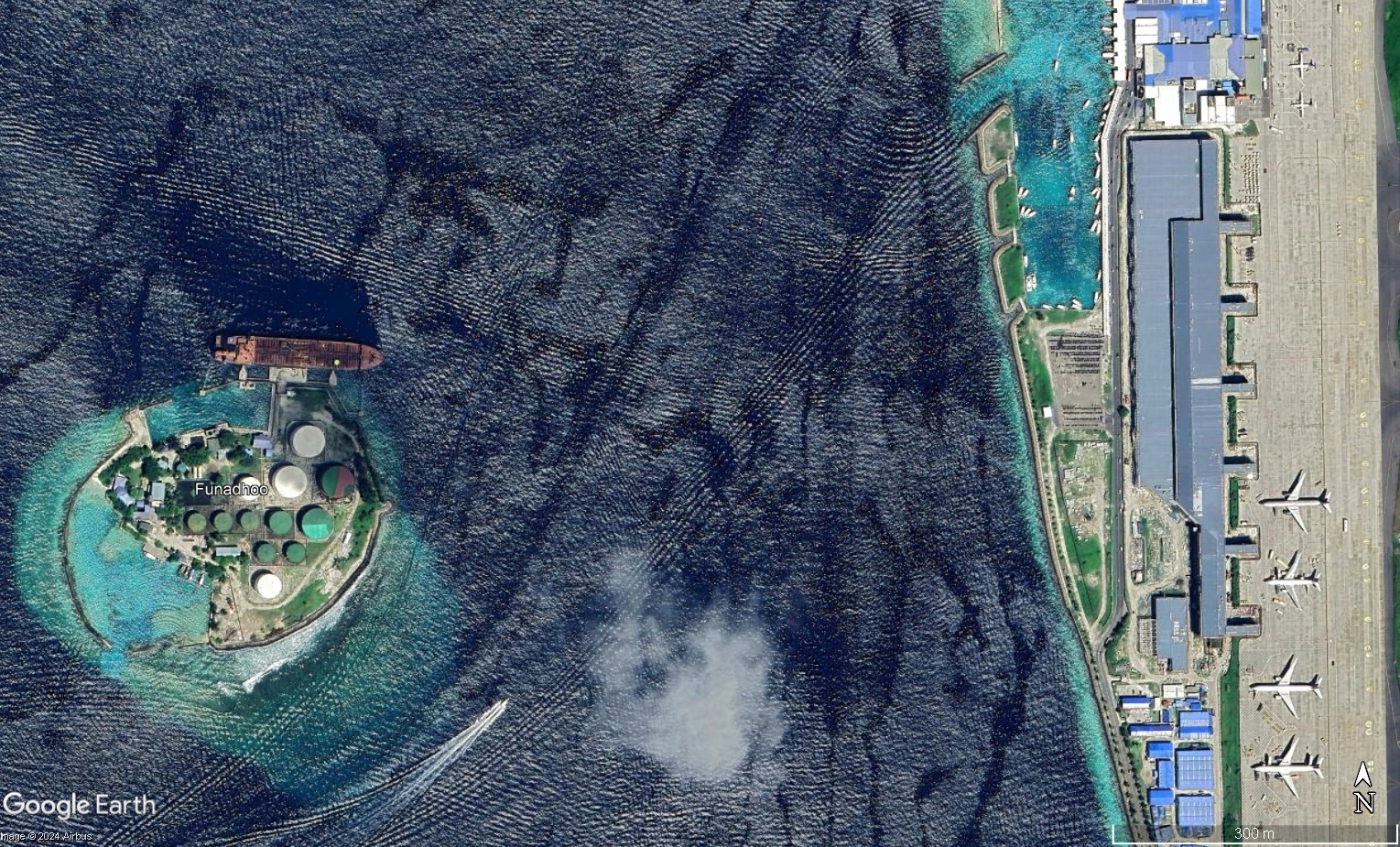
Velana Airport expansion and designation of Funadhoo Island as an economic zone

Plans for expansion of Velana Airport, the main airport in the Maldives, and a linked Economic Zone on Funadhoo Island are certainly ambitious. A video outlines a blueprint for a 20-year, multi-billion dollar development.

The expanded airport will be designed to accommodate 25 million passengers per year (nearly a six-fold increase over 4.3 million passengers in 2022). A new cargo terminal is forecast to handle 100,000 tonnes by 2025, rising to 300,000 tonnes by 2050. Aviation fuel farm storage will be expanded fro 15 million litres to 100 million litres. The passenger processing capacity of the domstic terminal will be increased from 300 per hour to 2,000. A self contained jet terminal is described as ‘serving niche market segments of the airline industry, exploiting this market segment and investing in it is an essential part of the future airport infrastructure’. The airport footrpint will extend to other islands. Seaplane facilites operations will be relocated to another island and linked to passenger terminals via a new bridge. The ‘epitome of this futuristic vision’ is development of an Airport Economic Zone on the island of Funadhoo, linked to the rest of Velana Airport and ‘offering a plethora of shopping opportunities’ along with hotels, convention centres and entertainment facilities.

There are plans to remove the oil tanks on Funadhoo, between Velana Airport and Malé, and designate the island as an Airport Economic Zone with shopping malls, hotels,convention centres. and entertainment facilities.

Ambitious plans for the small island of Funadhoo, currently taken up by oil tanks and located to the east of Velana Aiport and close to Malé, the capital city, were announced in September 2023. President Ibrahim Mohamed Solih said that the oil tanks would be removed and replaced with a convention centre, hotel and shopping malls. On 4th January 2024, current President of the Maldives, Dr. Mohamed Muizzu, inaugurated the Velana International Airport and economic zone megaproject and pledged to develop Funadhoo Island as an international financial hub. He also revealed plans to create the ‘Maldives International Financial Services Authority’ as a step towards establishing an international financial centre in the Maldives. On 22nd January President Muizzu announced that, following relocation of the fuel storage to Maagiri Falhu, Funadhoo would be designated as a special economic zone.

Airport Expansion in Indonesia: tourism, land struggles, economic zones and aerotropolis projects

Indonesia cover mA new report Airport Expansion in Indonesia: tourism, land struggles, economic zones and aerotropolis projects has been published by the Third World Network (TWN) in partnership with GAAM. Airport expansion in Indonesia is closely intertwined with a government drive for massive tourism growth, and the 64-page report looks at 58 airports, operational, under construction and still in the planning stage.

New airports, and expansion of existing airports, frequently entails displacement of communities and loss of farmland and the report documents land rights struggles relating to 25 airport projects. Planners often hone in on forested land as an alternative to the use of agricultural land for airport projects.

Aviation expansion in Indonesia is integrated with other megparojects such as multi-lane highways and sea ports, and linked to new Special Economic Zones (SEZs). These areas are designated for industrial and tourism development, provided with surface transportation networks and other supportive infrastructure and lavished with tax breaks and other incentives. Several SEZs have been bestowed with long stretches of coastline boasting white sand beaches, natural assets that are a cornerstone of tourism.

There are many plans for aerotropolis-style development, including around two airports currently under construction in Java – Kulon Progo and Kertajati – in the face of vigorous and long standing resistance from communities being forced to leave their homes and productive agricultural land. A number of aerotropolis plans are integrated with development of tourist resorts that aspire to become aviation dependent destinations in their own right. The report accompanies GAAM’s digital map which features all the airports that are mentioned, integrating spatial information with text and images.

Since the report went to print plans for a new airport in the Seribu Islands (Thousand Islands) off the coast of Jakarta have been announced. This appears to be a scheme for tourism oriented aerotropolis style development as the Jakarta administration has stated that the winner of the tender will be permitted to build resorts near the airport, and will be provided with incentives.

For paper copies of the report, please contact:  Third World Network, 131 Jalan Macalister, 10400 Penang, Malaysia, Tel: 60-4-2266728/2266159, Fax: 60-4-2264505, Email: twn@twnetwork.org.

Mapping aviation expansion in Indonesia

Following extensive research GAAM has published a digital interactive map: Aviation expansion in Indonesia: tourism, land struggles, economic zones, and aerotropolis projects. The map includes 60 airports – operational, under construction and still at the proposal stage, plus two airport projects which were cancelled. The issue of land rights in particular is highlighted, documenting disputes and resistance against displacement relating to 25 airport projects. Two airports currently under construction in Java, Kertajati and Kulon Progo, are of particular concern because of human rights violations, including police brutality, against people resisting eviction from their homes and productive agricultural land. Aerotropolis development is planned adjoining both of these airports.

Indonesia map graphic
Screengrab of GAAM Aviation Expansion in Indonesia digital map

The digital map represents only a fraction of airport projects in Indonesia, which already has 237 operational airports with a government expansion drive aiming for 62 new airports within 15 years, bringing the total number to 299. Yet it demonstrates the exciting potential of online mapping for organizing, analyzing and presenting information. GAAM hopes to collaborate with other organizations in the development of online maps to develop a more comprehensive picture of aviation expansion and the impacts on affected communities, making the most of this wonderful technology to support our research, awareness raising and campaigning. The map was designed and produced by InTouch GIS using the Storymap app.

A forthcoming report, Aviation expansion in Indonesia: tourism, land struggles, economic zones, and aerotropolis projects, contextualizes the information in GAAM’s online map, examining the central role of aviation expansion in a government drive for tourism growth and the integration of several airport projects with other infrastructure such as road networks and ports, economic zones and aerotropolis developments. The report will be published by GAAM in partnership with the Third World Network (TWN).