Landholders of San Salvador Atenco, Mexico, successfully resisted plans to build a mega-airport on farmlands in 2001. In 2006, the government punished the community with a brutal police raid. The propject was revived, even larger than before, in 2014. Resistance continues, and UK based Dorset Chiapas Solidarity is urging people to write to the two UK firms that have been contracted as the airport’s architect and engineering consultant.
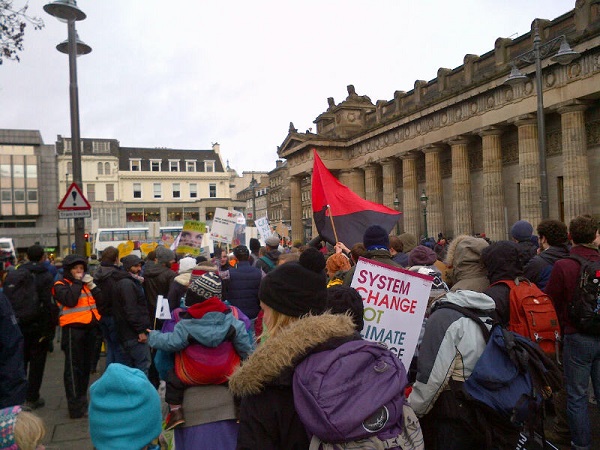
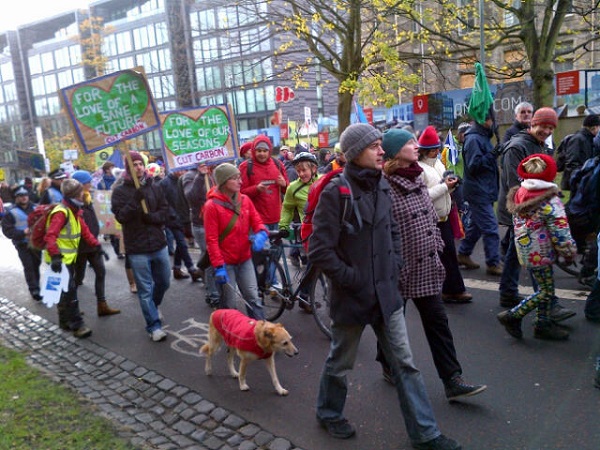
Leaflet distributed at the Climate Change March in Edinburgh
Defending their lands and opposing the new airport in Mexico City
On the front line of Blockadia, resisting climate change
Solidarity with the people of San Salvador Atenco
British companies are involved
Take action!
In her book THIS CHANGES EVERYTHING – CAPITALISM VS THE CLIMATE, Naomi Klein writes of the central importance of Blockadia. She describes how round the globe local people are taking direct action to resist extreme extractive industries and mega-projects which cause great damage to the environment and contribute significantly to climate change. One such struggle is happening now in Mexico.
In 2001, the indigenous common landholders of San Salvador Atenco were successful in their fight against the building of a new airport in Mexico City on their ancestral farm lands. The Peoples Front in Defence of the Land (FPDT) became emblematic for their highly symbolic machetes…
The second issue of GAAM Aerotropolis Update has been published. It looks at a total of 46 aerotropolis developments, in all regions of the world, with major land allocation for greenfield projects (on undeveloped land). Maps created for GAAM show the land area for three major aerotropolis projects:
plans for KZN (KwaZulu-Natal) Aerotropolis, around King Shaka Airport in South Africa, span over 200 square kilometres
plans for Long Thanh aerotropolis, in Vietnam, covers 50 square kilometres, requiring relocation of 15,000 people, and that’s just for phase one
the Atlanta Aerotropolis Alliance highlights an area of 418 square kilometres, predominantly urban and suburban land with areas of woodland
At the other end of the scale, the smallest aerotropolis developments cover a few hectares, but still raise concerns of loss of ecosystems and preferential treatment for firms, such as tax breaks. The Update covers just a fraction of what is happening worldwide. Material is already being compiled for Issue 3. If you missed Issue 1 it is available on the GAAM Aerotropolis Update page.
There are a lot of internet videos promoting aerotropolis projects – here is one that is critical. ‘Parasitic Urbanization: The Transformation of Istanbul’, a talk by Cihan Uzunçarşılı Baysal
The presentation highlights Istanbul’s airport, currently under construction, and other mega infrastructure projects in the region, which are symptomatic of the phenomenon of “planetary urbanisation”. What is happening with this wave of urban development is not new cities, it is not settlements that are contained within boundaries. A new type of urbanisation is extending its influence over the entire surface of the earth, even encroaching into the atmosphere and into the oceans and underground. A key characteristic of this new wave of urbanisation is that it is “parasitic” – it depends on nutrition from its host – sucking in water and other resources from a large hinterland area.
Baysal describes Istanbul’s third airport as an “ecocide” project. Forest is being felled and lakes filled, on a massive scale, and not just for an airport; land is being prepared for an ‘aerotropolis’ extending over a much larger area. An aerotropolis is the opposite of traditional airports, built to serve an established city. An aerotropolis is an airport-centric development, commercial development around an airport that is designed to serve aviation growth.
The talk explains that Istanbul’s third airport is one of the largest of no less than 43 megaprojects underway and planned in the region – most notably a third Bridge across the Bosphorus Strait and a canal alongside it. There is no democratic process whatsoever for deciding to embark on the megaprojects; they are imposed by the government and the firms awarded contracts. Citizens simply do now know what “insane” scheme is going to be announced next.
Campaigners against the Istanbul megaprojects make use of satellite images to reveal the reality of the ecological destruction. These images reflect a global phenomenon. They are examples of the 21st century iconic image of urbanisation, an aerial photograph of excavated and bulldozed area of land, a site being prepared for construction, an image of destruction that is similar to the tar sands in Alberta. This is a marked contrast with the exciting iconic image of 20th century urbanisation: the skyscraper.
Ecologically destructive urban development in Istanbul also exacts a human cost. People are being displaced for the airport and other megaprojects – forced out of their homes by eminent domain, then dumped in new settlements on the periphery, far away from their livelihoods and social life in Istanbul, having to undertake long commutes for work and leisure.
The underlying agenda for the orgy of construction is opening up land for plunder, turning it into a financial and speculative asset, which facilitates the accumulation of capital. The megaprojects are in the process of “privatising and commercialising each and every urban space” and must be halted.
Indigenous communities are protesting the expansion of Suriname’s international airport. The airport has obtained title to the neighbouring, indigenous land, and wants to expell most of the population of the Arawak villages Hollandse Kamp and Witsanti. Indigenous people reject the airport’s claim that they are the trespassers. They also protest against the airport’s dumping of untreated sewage into waterways that run through the two neigbouing Arawak villages.
Despite 500+ years of resistance, Indigenous people in Suriname are still not recognised as land owners. Suriname law doesn’t recognise collective land ownership at all. The state owns all land which is not individually owned. The government recently transfered ownership of the two indigenous villages to the state-owned International Airport of Suriname, without any consultation with the indigenous people who have lived there for generations.
For more information, contact http://www.vids.sr/
Press conference of chiefs, Hollandse Kamp, Suriname, 16 October 2015
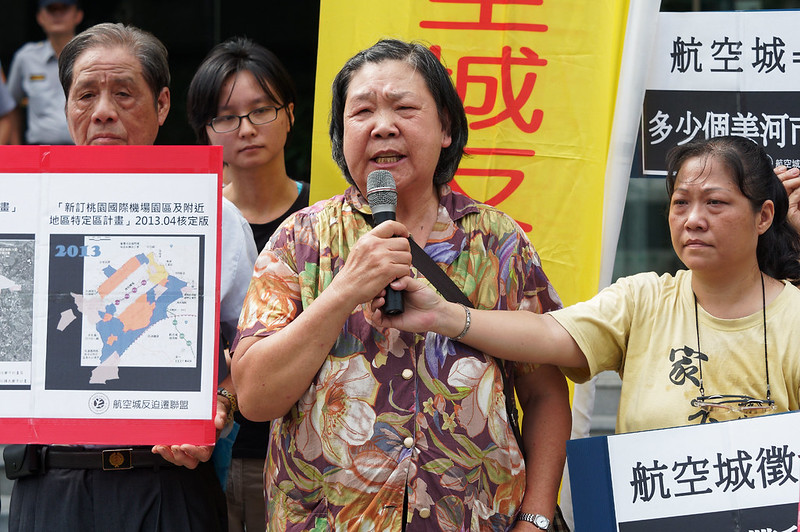
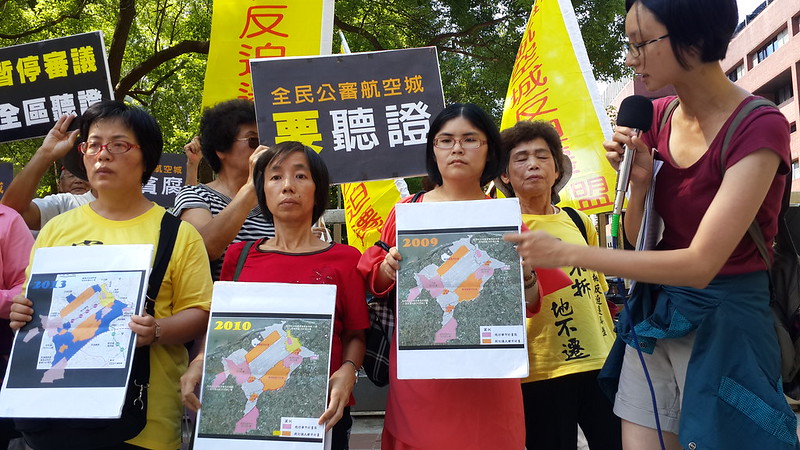
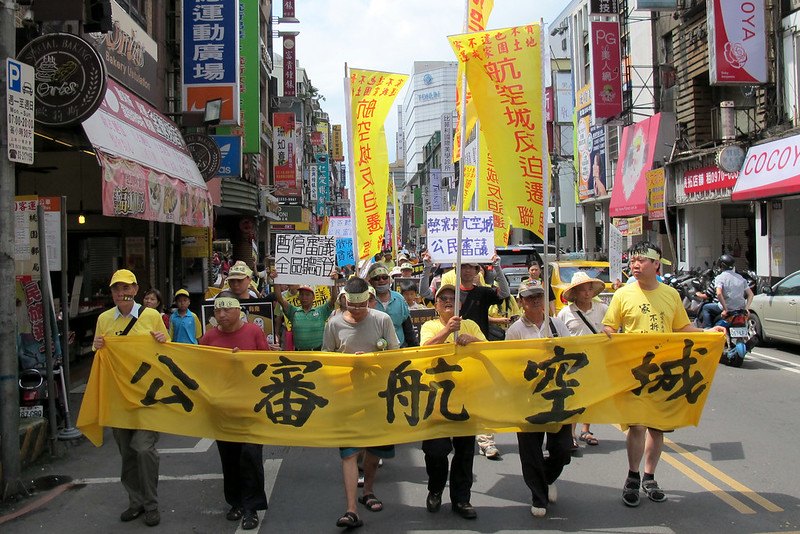
The long struggle for justice for affected people facing displacement for Taoyuan Aerotropolis continues. Planned land expropriation for Taoyuan Aerotropolis would be the largest in the history of Taiwan, taking up 4,700 hectares of land, mostly consisting of prime agricultural land, about 3,200 hectares of this land would be expropriated and 46,000 people face eviction from their homes and farmland.
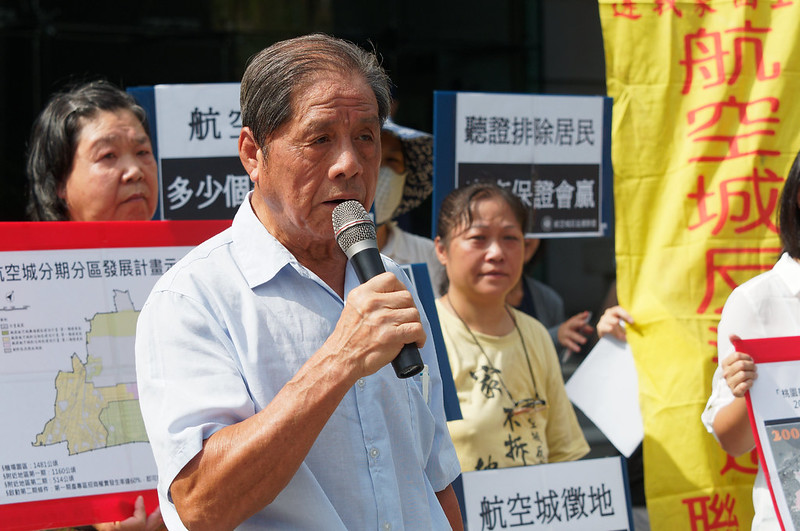
On 30th September, residents from the group Alliance Against Aerotropolis Forced Evictions protested at the Ministry of Transportation and Communications over their concerns that some people will be excluded from upcoming hearings regarding the Taoyuan Aerotropolis project, submitting petitions requesting permission that they be included. The first phase of Taoyuan Aerotropolis is a third runway at the airport, the necessity of which the protesters said must be reconsidered, and development immediately surrounding it. The second phase is development over a wider area. Owners of property scheduled to be expropriated for the project’s second phase have not been invited to attend. Alliance spokesperson Wang Pao-hsuan argued that they should be able to attend as their property is included in government plans and will be forbidden from building on their land if the project is approved.
Environmental Jurists Association director Thomas Chan said that plans for the aerotropolis should ‘start from scratch’ in the light of a new ruling on from the Council of Grand Justice, which found that land should only be expropriated for infrastructure projects. This is pertinent to the planned Taoyuan Aerotropolis, which includes industrial and business parks, plus residential districts.
The 30th September demonstration is one of many protests against forcible land expropriation for the aerotropolis. On 11th March 2015, 300 people gathered outside government buildings in Taipei, capital city of Taiwan, demanding formal hearings . Photo by Coulloud, Creative Commons License
As with so many of the endless protests by people facing eviction for Taoyuan Aerotropolis, the demonstrators met with a heavy police presence.
TourismWatch, a quarterly newsletter that provides reports and background information about tourism in developing countries, has an article about aerotropolis developments in the September issue:
The September issue of the newsletter also contains articles about resource use in tourism, peak oil, climate justice, and the United Nations adopting new Sustainable Development Goals (SDGs).
‘Aerotropolis’ projects – commercial development around airports including facilities targeted at tourists such as hotels, retail, catering, entertainment and cultural centres – are proliferating around the world. These airport-centric developments are central to the growth of the tourism industry. In a press release to mark World Tourism Day (which has been celebrated on 27th September since 1980) the World Tourism Organization (UNWTO), the United Nations agency responsible for the promotion of tourism, calls for further growth: World Tourism Day: Celebrating the billion opportunities brought about by the tourism sector. UNWTO advocates that we “work together to maximize the immense potential of tourism to drive inclusive economic growth, protect the environment and promote sustainable development and a life of dignity for all.”
In response to UNWTO’s press release the Tourism Advocacy and Action Forum (TAAF), a founder member of the Global Anti-Aerotropolis Movement (GAAM), has released a statement, which draws attention to the sharp contrast between tourism’s benefits for the privileged, for whom the world is ever more easily accessible, and the plight of ‘irregular tourists’, people fleeing from war, poverty and persecution. Militarization of the world’s borders is infringing the rights of refugees and migrants. TAAF also criticizes UNWTO for hailing tourism a “transformative force” bringing livelihood opportunities and helping to alleviate poverty, failing to recognise that tourism can result in displacement and impoverishment, especially for people in developing countries. TAAF urges the UNWTO to “stop acting like a PR agency for the travel and tourism industry and genuinely work for the common good of humanity as deemed appropriate for a UN body”.
In March, Kuzey Ormanları Savunması (the ‘North Forest Defence’) which campaigns to protect the forests to the north of Istanbul from industrialization and urbanization, published a 100 page comprehensive report into Istanbul’s third airport, currently under construction. Entitled The Third Airport Project: Vis-a-Vis Life, Nature, Environment, People and Law, this report has been translated into English. It exposes the ecological destruction of the project, and examines the drive for economic growth and corporate profits that is the real reason it is being so relentlessly pursued by the government and firms that stand to benefit.
The site is gigantic, over 76 square kilometres. About 80 per cent of this area is forested, the remainder consists of 70 large and small lakes, meadows, farmland and coastline. All are being destroyed as airport construction progresses.
The reason for the gigantic site is that the plan is not for an airport. Land is being expropriated for an ‘aerotropolis’, an airport surrounded by commercial development that is designed to be aviation dependent and support growth of the airport.
Istanbul’s last large area of green space is being sacrificed for a vast urbanisation incorporating the world’s biggest duty-free shopping centre, hotels, a convention centre, sports centre, business space, a clinic and other facilities. Ostensibly, the land is allocated for an airport with the incredibly ambitious goal of handling 90 million passengers annually, ultimately becoming the world’s busiest airport with 150 million passengers passing through.
But even if the airport does indeed grow to handle this number of passengers, an eventuality regarded as unlikely within the aviation industry as well as by its critics, there will be plenty of space for commercial activity. North Forest Defence estimates the area surplus to requirements for aeronautical activities at 57 square kilometres. This is illustrated by comparison with the world’s busiest passenger airport, Atlanta in the USA, which, with a a far smaller land area of 1,625 hectares, handles about 95 million passengers per year.
Preparation of the site for construction commenced on approval of an Environmental Impact Analysis (EIA) that North Forest Defence’s work exposes as utterly inadequate, full of serious omissions and trivialising the impacts of the project. Lakes are described as ‘ponds’, the number of species at risk is under-reported and the bizarre claim is made that, of the 2.5 million trees earmarked for felling, over 1.8 million would be moved to another place, a mass replanting that is technically impossible. The reality is that the habitat of animal and plant species is being obliterated. Endangered bird species whose habitat is imperilled include the greater spotted eagle and the pygmy cormorant. Istanbul’s northern forests are one of the world’s major bird migration routes with hundreds of thousands flying over every spring and autumn. This means that the airport will endanger human life as well as birds, as there will be a considerably higher flight safety risk from bird strikes – collisions between birds and aircraft that can cause fatal air accidents.
Istanbul’s third airport has proceeded in the face of vigorous opposition from a broad coalition of environmental, community and civil organisations, plus professional associations of engineers, architects, scientists and economists. There have been endless campaign meetings and protests, in the centre of Istanbul and in villages affected by the project. The two photos below are of the protest to mark the groundbreaking ceremony for the airport, on 7th June 2014. A slideshow with more photos of this lively protest can be viewed here.
Protest against Istanbul’s third airport, 7th June 2014. Photo: MURAT DELIKLITAS/ISTANBUL-DHAForest defending protesters meet with a wall of riot police, 7th June 2014
North Forest Defence’s report is also a powerful critique of the financing of the airport, and the economic implications. The tender to construct the airport and operate it for 25 years, the biggest in the history of Turkey, was awarded to a consortium of five firms, all with close ties to the government. These firms stand to profit from operating the airport, regardless of the actual level of traffic, because of a state guarantee of liabilities that may be incurred. The consortium’s economic benefit from the airport is also assured because of revenue guarantee of €6.3 billion over 12 years, from a fee levied on the projected 342 million international passengers over this period. There is a precedent for state payment to airport operators when the projected number of passengers fail to materialise; €27 million has been paid to reimburse the operator of three of Turkeys’ airports to compensate for a shortfall. Treasury guarantees mean that the economic risks of the project fall onto citizens.
Every Turkish citizen will incur debt due to the cost of the project, which has already escalated from $16 billion to $20 billion. The airport project is part of a construction and real estate speculation frenzy that serves as Turkey’s main economic stimulus, keeping up a flow of ‘hot money’ – international capital seeking short term profits from interest rate differences and anticipated shifts in currency exchange rates – that buoys up capital markets and keeps the plates spinning.
The campaign to stop construction of Istanbul’s third airport is bolstered by an extraordinary visual record of the ecological destruction that is underway – photographs and videos. It is highly unusual for a megaproject to be documented in this way and it is extremely effective in raising the alarm over the scale and severity of the ecocide that is happening. The site is crawling with hundreds of trucks excavating and dumping earth, the level of infill required to raise and level the site is estimated at 2.5 billion square metres, and compacting the soil is on the swampy site is proving problematic.
Trucks in the Istanbul third airport excavation area, the number of trucks in the project area is expected escalate from 1,200 to 2,000
A video shows destruction of forests and meadows and filled in lakes, swathes of bare earth being worked by bulldozers, and piles of felled trees. There is nowhere left for the wild animals or for farmers to tend their sheep.
Video of storks, one of the 300 species of birds whose habitat is being destroyed for Istanbul’s third airport, flying around bewildered and traumatised in the immediate aftermath of their habitat being bulldozed.
This video, published in May 2015, shows the impact of airport construction on the coastal village of Yenikoy. It begins with a farmer explaining the ‘airport city’ plans, shows the farmland that is at risk as bulldozers move ever closer, then reveals the destruction of forest, lakes, farmland and coastline that is already underway.
Istanbul’s third airport is integrated with other ecologically destructive megaprojects – a multi-lane third bridge over the Bosphorus Strait and a canal running alongside it. Highways to provide surface access mean the loss of yet more green space. All these projects open up the virgin forests for further plunder and feed each others growth. Campaigners have stepped up their efforts to tackle these megaprojects as a package. North Forest Defence has joined forces with Istanbul Kent Suvanmasi (Istanbul City Defence) and on 5th July 2015 a new campaign was launched. The slogan is: ‘Stop the Killer Projects! Be the Breath of Istanbul‘. The forests north of Istanbul are depicted as the lungs of the city, providing oxygen for people and all life to breathe. As well as resisting the megaprojects the campaign is about envisioning and creating a future city which lives in harmony with nature rather than destroying it, taking forward the optimism that concludes North Forest Defence’s report into the third airport, the conviction that ‘it is in our hands to write another story’.
5th July 2015 – campaign meeting, ‘Stop the Killer Projects! Be the Breath of Istanbul!’. Photo: North Forest DefenceA banner is unfurled from the top of a building, it reads: ‘Stop the killer mega projects, defend 250 million trees, be the breath of Istanbul’: Photo: North Forest Defence“Stop the Killer Projects! Be the Breath Of Istanbul!” campaign ribbon, slogan translates as ‘Be the Breath’. Photo: North Forest Defence
In northern England, Leeds City Council plans to release 36.2 hectares of land to enable expansion of Leeds Bradford Airport, supporting its goal of doubling passenger numbers to 7.1 million by 2030. The land is currently designated as ‘greenbelt’ – green space surrounding urban areas that is protected from development, in order to ensure than urban dwellers have access to countryside and prevent urban sprawl. Adjacent to the airport terminal, the land in question is currently used for farming. In addition to an increase in terminal capacity to accommodate more passengers the land would be used for commercial development to support the growth of Leeds Bradford Airport – an ‘airport village’ consisting of a hotel, restaurants and shops, an air freight park and an ‘air innovation park’.
On 15th July opponents to Leeds Bradford Airport’s plans to concrete over greenbelt land gathered to protest outside the Leeds City Council Executive Board meeting which discussed the plans for a few minutes. As documented in the minutes of the meeting, attendees emphasized the Council’s continued support for expansion of the airport. The only note of caution was an assurance that consultation with ‘all relevant parties’ would be widespread and thorough.
Protest against allocation of greenbelt land for commercial development to support growth of Leeds Bradford Airport, 15th July 2015
The report proposing allocating the 36.2 hectares of greenbelt land to Leeds Bradford Airport had already been discussed at the Development Plan Panel on 26th June 2015. Its a lengthy document – 176 pages long. On page 5, the issue that land at the airport is already allocated for ’employment’ so therefore available for development, with most of it remaining under occupied, is raised. Airport supporters’ response to this point is that the scale of land allocation proposed will make it an attractive location, and it will be supported by promotion and marketing internationally to prospective tenants. Bizarrely, the supposed solution to vacant business space is supposedly to provide even larger space, and the established business space should have received more promotion and marketing support to reduce the risk of it languishing unoccupied.
This map shows the greenbelt land, currently used for farming, that Leeds City Council wishes to release for commercial development to support expansion of Leeds Bradford Airport – the area within the red line
It is not as if there is a shortage of business space in Leeds or Bradford. Both cities have plenty of vacant business premises, already constructed or on land with planning permission for industrial/warehouse development. An industry website lists 157 industrial properties available to rent in Leeds. The largest is a new development, Leeds Distribution Park, adjacent to Junction 47 of the M1 Motorway, with planning permission for industrial/warehouse development up to a maximum single footprint of 750,000 sq ft (17 acres). The website lists 40 industrial properties available to rent in Bradford. The largest is Bronte Business Park, boasting 16 acres of development land allocated for employment use.
Leeds Bradford Airport, and its supporters at Leeds City Council, aims to support commercial development on greenbelt land with more than just promotion and marketing. They are angling for ‘Mini-Enterprise Zone’ status, as stated on the the document submitted to the Development Plan Panel, see page 13. This is already in place elsewhere in England, including at Manchester and Newquay airports. Designation as an ‘Enterprise Zone’ is a subsidy, as tenants are gifted a Business Rate tax exemption of up to £275,000 per eligible business. This tax break is unfair and unwarranted preferential treatment for tenants that are fortunate to be in the Enterprise Zone. In the case of airports, space in the Enterprise Zone is granted to businesses that are aviation dependent, thus maximizing use of the airport’s passenger and/or cargo facilities and facilitating airport growth.
Businesses which do locate in the Enterprise Zone may not even create jobs, as firms will be incentivized to relocate from other premises in order to take advantage of the tax break. The argument that the airport-linked commercial development will boost the economy for neighbouring communities and the wider region, which the proponents of the project are most insistent about, is flawed. The shops, restaurant and hotel that are planned would result in air passengers spending more of their time, and money, on airport land, instead of stimulating economic activity in Leeds Bradford Airport’s host community.
Another aspect of the rationale for commercial development on green space is to strengthen the case for more ‘surface access’ to Leeds Bradford Airport. This means construction of another road link, a dual carriageway from the A65 in Rawdon to the A658. It would not come cheap and taxpayers would have to foot the bill. It is anticipated that public sector funding will be confirmed for the new link road. The route of this road plan is not revealed. Figure 13 in the report discussed by the Development Plan Panel entitled ‘Indicative Alignment of New LBIA Road Link’ is not actually included in the report, it is ‘TBC’, left blank. Already, Rawdon Greenbelt Action Group is campaigning against the link road; they are concerned that enormous swathes of greenbelt land will be damaged or lost altogether, along with the special landscape character of the area.
Leeds Bradford Airport’s ‘airport city’ plans are a smaller scale version of aerotropolis development that is already underway across the Pennine hills, at Manchester Airport. This is opposed by the Stop Expansion at Manchester Airport campaign group. There is also a Facebook page. Airport-linked business premises is being constructed on land formerly designated as ‘greenbelt’ and, under the guise of alleviating traffic congestion, construction of a link road, costing £290 million in public funds, has commenced. Calling the road a ‘relief road’ does not disguise the fact that it is designed to increase traffic to and from the airport. Most recently, hundreds of residents of High Lane village in Stockport, on the route of the new road, turned up to an exhibition to express their concerns over increased air pollution, noise and vibration from heavy vehicles.
There is strong opposition to aerotropolis development on green space, and associated road infrastructure, at both Leeds Bradford and Manchester airports. Linking up these campaigns will strengthen them.
The Ecologist website has published an article outlining some of the key aerotropolis developments worldwide, and the ecological, social and economic problems caused by these destructive megaprojects.
Governments and corporations are driving a global wave of ecologically disastrous airport-centered mega-projects each destroying as much of 100 sq.km of farmland and forests – sucking water, resources and economic activity from surrounding areas, excluding host communities and locking in high-carbon infrastructure for decades to come.
The aerotropolis is a disastrous model of development. Those working for social, economic and environmental justice must unite in opposing the fast-tracked planning and construction that is taking place around the world.