Houses demolished for Muhammadu Buhari International Airport expansion, Nigeria

Hundreds of people were displaced by a demolition exercise to make way for expansion of Muhammadu Buhari International Airport

On 30th January 2025 a number of residents of Shuwari 5 ward in Maiduguri, near the Muhammadu Buhari International Airport runway, reported that the Borno State Government was demolishing their houses. A bulldozer destroyed houses while residents retrieved essential household items. People whose houses were still standing but had been marked for demolition worked to remove roofs from their houses. One resident said people had received only three days’ notice before their homes were demolished and appealed to the Borno State Governor to provide compensation or alternative shelter for affected residents as they had no other place to go to.

Aerial mage -Muhammadu Buhari International Airport runway, 14th July 2024
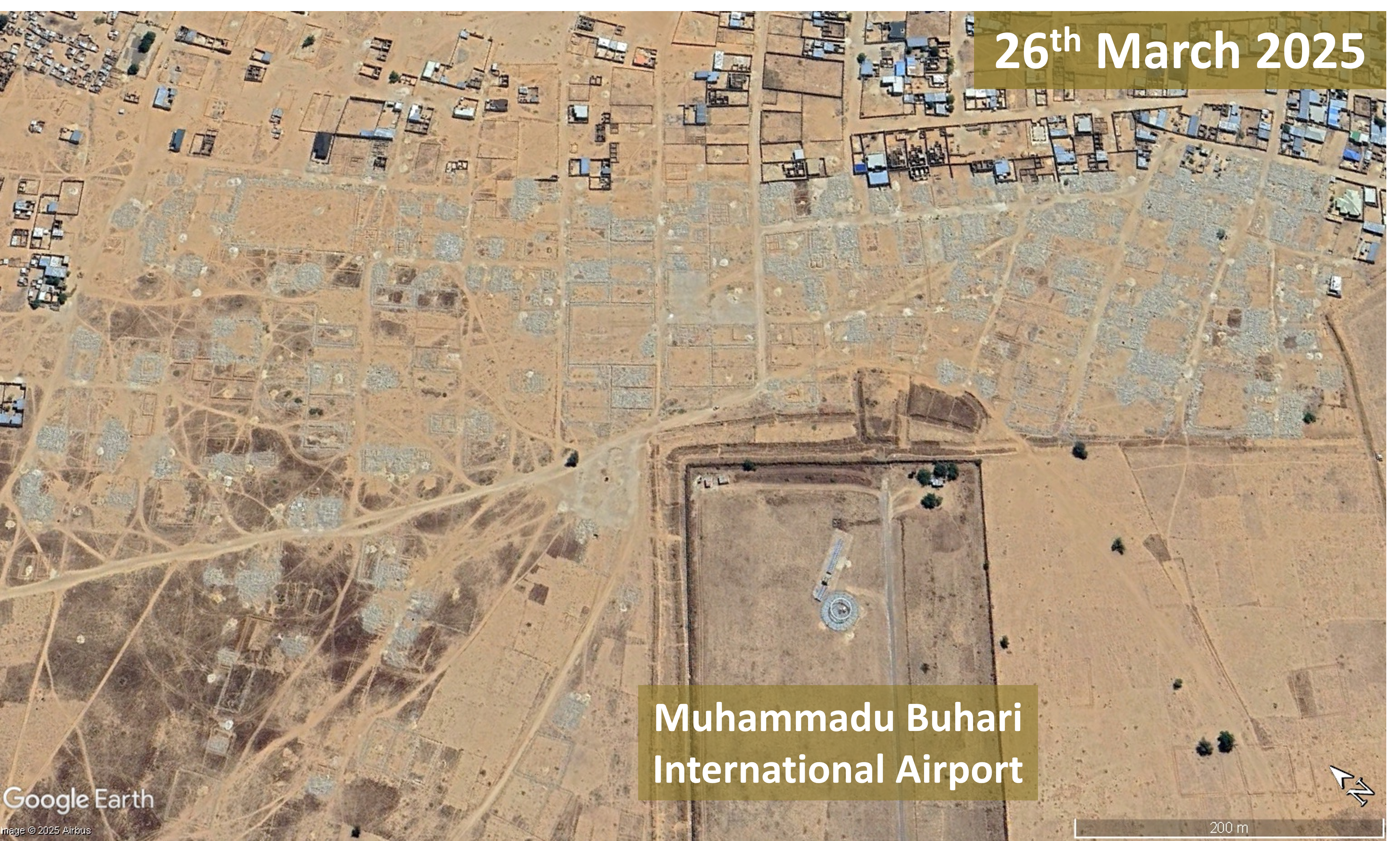
Aerial imagery of the Shuwari 5 area near the end of Muhammadu Buhari International Airport runway before and after the demolition exercise beginning on 30th January 2025 shows buildings reduced to rubble.

On a visit to Borno State in October 2024 Minister of Aviation and Aerospace Development, Festus Keyamo, had announced that Muhammadu Buhari Airport had been upgraded to international status and would commence operation as an international airport from 1st January 2025. The General Manager of Borno State Urban Planning Development Board, Liman Mustapha, said the purpose of the demolition exercise beginning on 30th January 2025 was to secure land for upgrade of the airport. He also said there would be no compensation for affected house owners and that residents had been informed that their occupation of the land was illegal in 2020 and since then authorities had attempted, unsuccessfully, to stop construction of houses on the land.

The demolition exercise targeted the area up to 500 metres from the airport fence, beginning with the area within 200 metres. Adamu Matankolo, Acting Regional Manager of the airport, said upgrade of the airport to international status by the federal government necessitated its expansion. He said, “We sympathise with the people who don’t want to obey this order. We have our plan and out plan is that the area slated for demolition is a buffer zone.”

Premium Times reported that more than 100 houses were demolished and many of the affected people had occupied the area for over 10 years having been displaced by the Boko Haram insurgency. The IDPs (Internally Displaced Persons) thought their resettlement was permanent until the state government demolished their houses. An IDP and single mother of three children said residents received a notice from the Borno State Geographical Information Service (BOGIS) just a few hours before the demolition exercise began.

Many people criticised the State government’s handling of the demolition exercise on social media, in the context of the Borno state’s socio-economic problems caused by the Boko Haram insurgency and a recent flood impacting 40% of the city of Maiduguri. Commenting anonymously a Maiduguri-based lawyer gave a detailed statement on the government’s obligations regarding compensation, concluding: “Thus, if a house is built on government land without approval, the owner is generally not entitled to compensation. However, if the government initially allowed of overlooked the development, there is scope for negotiation or legal redress.”

HumAngle, a media platform focussed on conflict, humanitarian, and development issues in Africa, reported that the demolition had displaced hundreds of people. One of them, a widow raising four children who had lived in Shuwari 5 for 17 years, said the government only notified people about the demolition two days before bulldozers arrived, not even giving enough time for gathering belongings. She said at least three affected people had died of shock and more than 20 had fallen ill due to trauma.

Liman Gana, head of Borno State Building Planning Authority, said 306 structures had been demolished, including 64 fully occupied houses, 42 incomplete structures and 17 incomplete buildings. A Federal Airports Authority of Nigeria (FAAN) official gave technical and safety reasons for the demolition exercise, saying structures built too close to the runway posed safety risks. Many displaced residents insisted that they were not informed of these risks before they bought or built their homes and said resettlement should have been planned and implemented before the demolitions took place.

For more information, including references for source material, see the case study on EJAtlas, the world’s largest, most comprehensive online database of social conflict around environmental issues – Demolition of houses for Muhammadu Buhari International Airport expansion, Nigeria

Allegations of land encroachment for Anambra Airport City/Cargo Airport

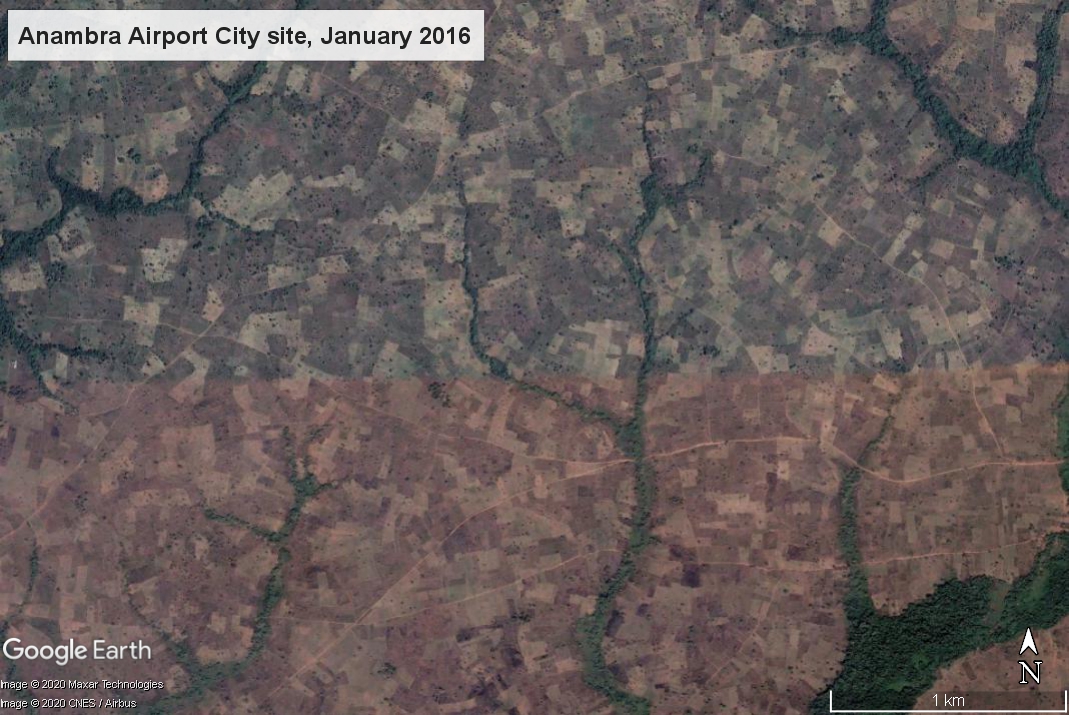
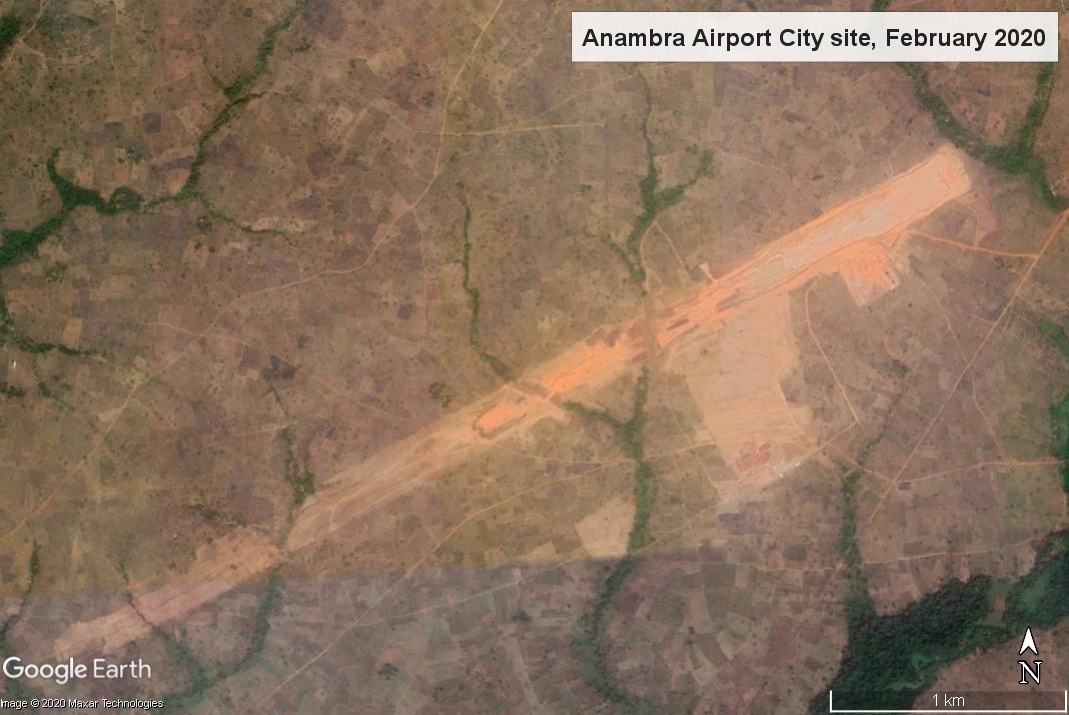
A large area of farmland was cleared for an airport city/cargo airport in Anambra, southern Nigeria and neighbouring communities complain of expansion of the project site and land grabbing. Two satellite images of the site show major changes over a four year period. The image on the left shows the airport site in January 2016, before announcement of the project, containing many plots of farmland. On the right, an image dated February 2020 shows a large expanse of farmland has been cleared for Anambra Airport City runway and other facilities.

Slide bar in the middle of the two images to see changes to landscape from clearing farmland for airport construction

The Anambra Airport City project, also also referred to as Umueri Airport City and Anambra Cargo Airport, was launched in April 2017. A two-runway airport with an airport hotel, business park, international convention centre along with aviation fuel and aircraft maintenance facilities, costing more than USD2.2 billion was announced by the governor of Anambra State, Willie Obiano. Two years later a large expanse of land had been cleared but little work had been done on the site. Igbo Renaissance Council stated that the employment for local people that was promised had not materialized and residents whose homes had been razed to make way for the project had been left ‘dejected and depressed with no sign of hope on the horizon’.

In July 2020 – in the midst of the Covid-19 pandemic, with airports that had been closed since March only slowly recommencing operations – residents of several communities around the Anmbra Airport site complained that government agents responsible for executing the project were encroaching beyond the boundary of the land area that had been allocated. People of Umuopo, Umuinu and Enuagu kindreds in Umueri, north of the airport site, stated that they were being dispossessed of their remaining portions of land and had been “thrown into pains and agony“. They said the government was deliberately making them refugees on their own land. Community investigation revealed that unscupulous individuals were annexing their land and they called on the state government for help, stating:

“By extending their hand into other portions of our land, what does the government expect us to survive with as we are just farmers? We have written, we have cried, we have pleaded and we have engaged in all forms of diplomacy to demand that government restricts itself to the agreed portion of land, all to no avail.”

It was also reported that residents of Ifite Nteje, a community to the south of the Anambra airport project, were suffering from violence meted out by youths who had seized communal land. A band of youths had ‘unleashed mayhem on the community, sacking villagers from their homes’. People opposing sale of their communal land had been beaten with many being injured and homes had been burned down. Members of the community said the crisis had ‘brought hunger and famine as they no longer have land for farming’ and ‘they dared no go to their farms anymore for fear of being maimed, while the women among them were raped’. One woman, a widow, said their formerly peaceful community had been taken over by violence and she was one of many women who no longer had land to farm that they needed to feed their families.

On 14th October 2020 it was reported that youths from the Umueri community had dispersed bulldozers that had been had been stationed, without notice, to demolish farmland and privately owned agro-investments. A farm owner maintained his affected farm was not within the airport area and appealed for intervention from the state government to halt trespassing. On 19th October residents of Umuopo, Enuagu and Umuinu protested against alleged encroachment on their land, lighting a bonfire and blocking the road to the airport site. Some of the placards read: “We can’t be refugees and IDPs in our own land”; “We’re farmers why collect our land to build housing estate”; “Anambra State government go to the portion of land given for the airport.” The protestors described the government’s action as a deliberate attempt to impoverish the people, who were predominantly farmers. The Chairman of Ifite Umueri Community claimed that they had given the government 729.60 hectares for the airport project, but over 1,901 hectares had been taken.

Obiano, Anambra State governor, continues to support the Anambra Airport project, saying it will have the second longest runway in Nigeria after Murtala Muhammed Airport in Lagos. Then on 4th November the Anambra State Government set aside Naira 5.8 billion (USD15.2 million) for completion of the Anambra Airport project during the presentation of the 2021 Appropriation Bill.

cluster of airport-related conflicts in Nigeria

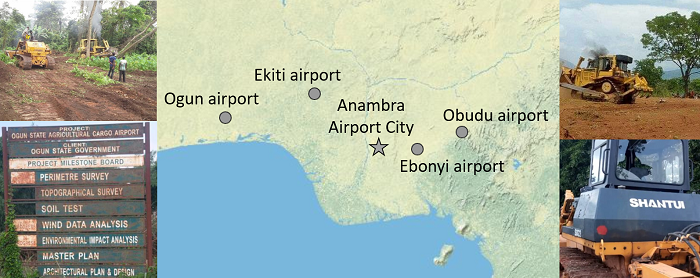
Information about Anambra Airport City/Cargo Airport and its impact on neighbouring communities is a new addition to a cluster of similar airport projects in southern Nigeria, all of which are documented and analyzed in the Map of Airport-Related Injustice and Resistance, a partnership project coordinated by EnvJustice and the Stay Grounded Network. Land has been cleared to make way for proposed cargo airports in Ekiti, Ogun, Obudu and Ebonyi. In all four cases bulldozers arrived without warning and began destroying people’s farmland and crops to make way for airport construction.

In the case of the proposed Ekiti airport bulldozers ripped down trees and cleared farmland before even consulting affected farm owners from five villages. Farmers succeeded in stalling the project and secured a major court victory with all their claims against the state government being vindicated. Hundreds of farmers protested against land-grabbing for a cargo airport in Ogun State. In 2018 it was reported that 5,000 farmers were affected by the project and some had been intimidated and their crops bulldozed. Earth moving equipment began destroying farmland and felling trees in three Obudu villages where land has been earmarked for an airport, flouting project planning and land procedures. Allocation of a large land area for a proposed cargo airport in Ebonyi cargo triggered protests by people facing displacement from their ancestral homes and farmland. Bulldozers began clearing land and destroying crops and landowners raised alarm over imminent hunger in their community.

Farmers resist land-grabbing for cargo airport in Ogun State, Nigeria

5,000 farmers from 20 villages are being displaced for a cargo airport in Ogun State, Nigeria. Residents of Igbin-Ojo and seven other communities have protested over land-grabbing. Crops have been bulldozed and they fear forcible eviction.

A major cargo airport is planned in the Wasimi area (also referred to as Wasinmi) of Ewekoro Local Government Area of Ogun State, near Nigeria’s southeast coast. On 18th December 2017 hundreds of farmers from the village of Igbin Ojo and seven other communities in Ogun State protested against land-grabbing for the airport. Appealing to the Ogun State Governor Ibikunle Amosun to intervene community leader Ademola Tiwalade Adisa stated that, on three occasions, groups of people came onto their land. Adisa reported that, on 17th November a group of people with a bulldozer invaded their land, then, on 24th November and 8th December a larger group of people encroached onto their land and began mapping portions of it. Below are photos of the 18th December protest published by The Sun Newspaper.

Narrating their ordeal of 8th December 2017 Adisa said that heavily armed men of the Rapid Response Squad (RRS) had forcefully arrested a number of people and, at gunpoint, forced him and his elder brother to sign an undertaking stating that they would not disturb work on their land. Villagers claim that the land trespassing and mapping was led by former chair of the Ewekoro Local Government Area, Mr. Dele Soluade, but he has repeatedly denied all the allegations, dismissing the claims he had illegally invaded the land as “unfounded” and insisting that he was acting under the instructions of Governor Amosun.

Affected villagers had undertaken a survey before the trespassing and mapping exercise began, clarifying the status of their land with the state government. They had obtained a land information certificate dated 13th December 2017 which confirmed that the land in question is completely free of all known acquisitions. The land information certificate was published in the The Sun Newspaper. Farmers’ land rights claims were fortified by this document and Abisa said: “We, therefore, appeal to Governor Ibikunle Amosun to come to our aid before he wipes our communities out in his desperation to grab our lands.”

Farmers dispossessed and crops destroyed

A 4th February an article in The Guardian Sunday Magazine painted an alarming picture of the plight of residents of Igbin Ojo, ‘fighting the battle of their lives’ to resist displacement from their ancestral land. Over the course of a few weeks crops worth millions of Naira, including cassava and pineapple plantations, had been destroyed by bulldozers and caterpillars. Farmland measuring nearly 164 hectares serving as their providing main source of income had been leveled and forcibly taken away. Fear had enveloped other farmers, including people who had invested heavily in poultry facilities which they feared losing. Farmers were distraught, dispossessed of their land and anticipating being evicted from their homes, desperately worried about their own survival and the future for their children. One woman said that that the entire community was living in fear and hunger and that children were unable to attend school because parents were unable to afford the fees.

One of the community elders, Pa Emmanuel Olukunle Opeagbe, said that the community had enjoyed ownership of the land from time immemorial up until 17th November 2017 when the first land invasion took place. He confirmed community leader Abisa’s account of land invasions by a group of people, which he described as “fierce-looking thugs”, and a bulldozer. He backed up community leader Adisa’s allegations of Soluade leading the land invasions and resorting to abuse, harassment, intimidation and threats to bulldoze people along with the crops. Opeagbe reported that Soluade had told villagers that their community would cease to exist. Along with Adisa, Opeagbe had been arrested and forced at gunpoint to sign an undertaking not to interfere with trespassing on the land.

Residents appealed to the Federal Government, Amnesty International and human rights activists for support. On 16th February the Civil Liberties Organisation (CLO) responded, petitioning Governor Amosun over the unlawful acquisition of land and threat to their lives. State chair of CLO, Joseph Enitan, said intervention of the governor is urgently needed because Soluade is acting under his instructions to trespass and grab lands. Farmland was being invaded and destroyed, in the name of constructing a cargo airport. Community members including council chairman Kehinde Adepegba were shocked by recent developments. New areas of land had been claimed for the airport project and encroached upon, even though the land required for the airport was allocated to the project many years previously.

A large portion of land had already been acquired for the proposed Ogun cargo airport, which was first conceived in 2005. Yet, shortly before the reports of land grabbing, in May 2017, the project languished abandoned; the only physical infrastructure that had materialized was a perimeter fence around an area of land measuring 5 x 5 kilometers. Farmers from about 35 communities, who had grown crops like rice and high-yield cassava had been displaced for the project, but they had not received compensation for the loss of their land and livelihoods. Opeagbe said the large portions of land that were “compulsorily taken for the project years back are yet to be compensated for” and that people had not protested against the airport because they believed it would bring development to their area and they would benefit from it.

Farmland is being destroyed, and farmers displaced, for an airport project which aims to export farm produce; the Ogun airport project has been described as an ‘agro-cargo airport‘. It appears that the primary purpose of the airport is envisaged as ‘transportation of agricultural products to other parts of the world’, also referred to as export of perishable (temperature controlled) goods. Only cursory mention has been made of other potential functions for the airport such as import of consumer goods, machinery and industrial raw products, pilot training school, aircraft maintenance facility, helicopter and air taxi services.

Compensation and a possible court case

At the end of February Governor Amosun announced that 500 million Naira (nearly US$1.4 million) had been allocated for payment of compensation to farmers losing their land for the airport, saying that the money would be disbursed to 20 villages directly affected by the airport project. He also said that affected farmers would be relocated to an appropriate location where they could continue their farm business, making assurances that his administration would not bring hardship to the people. It was then reported that 1,000 farmers had been compensated for loss of their agricultural land and crops and the remaining 4,000 would receive compensation within the next few weeks. If it is indeed the case that US1.4 million has been earmarked for compensation of 5,000 farmers, then assuming the same amount is to be allocated per farmer this adds up to a mere US$280 each. Igbin Ojo is one of the villages listed as beneficiaries of the first phase of compensation, along with Pataleri, Igbagba, Mosan, Igbin Orola, Igbin Arowosegbe, Idele and Balagbe.

Since this announcement GAAM has not found any reports of affected villagers’ response to the compensation offer, aside from a single resident of Igbagba village reportedly appreciative of prompt payment. There have been newspaper reports of officials making statements urging people to support the project, and exhorting its supposed benefits of employment for local people, economic development and attracting foreign investors. But it is evident that land acquisition for the airport is not supporting development, it is destroying communities. As officials proclaim potential positive impacts of the airport GAAM has not found any information on such vital matters as how the project will be funded and which firms and/or government bodies will be responsible for constructing, operating and managing the facility. But it is evident that a truly gargantuan megaproject is in the works. As he again implored residents to support the cargo airport Governor Amonsun said that ‘thousands of hectares‘ would be required for the project.

Communities resisting loss of their land for Ogun cargo airport are dragging Soluade to court in an attempt to bring the land grabbing to a halt. Their struggle has parallels with farmers’ resistance to the Ekiti airport project, north of Ogun state. In October 2015 the state government of Ekiti sent in bulldozers to clear 4,000 hectares of farmland for an airport, without even discussing the project with affected farm owners in five villages. Farmers succeeded in stalling the land clearance and suspending the airport project. Opponents from within the state government supported the farmers, arguing that the project had begun illegally without adhering to due process and criticized the high level of state funding. The farmers protested and filed a suit seeking damages for unlawful land acquisition, and in March 2016 were vindicated with a court victory upholding their claims. But in the interim ten Ekiti farmers died. Community members attributed their deaths to the terrible trauma of the injustice perpetrated by the state.