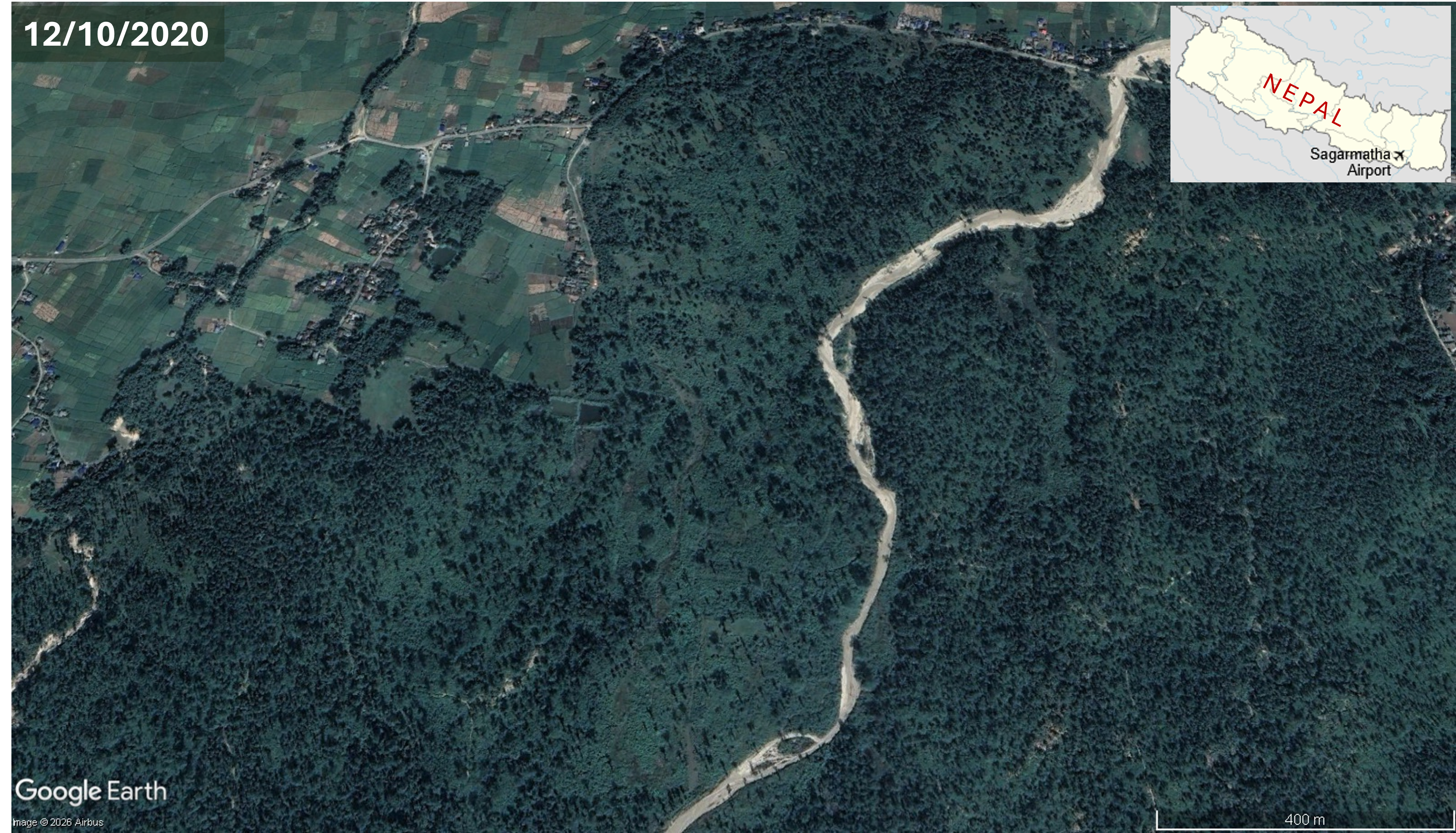
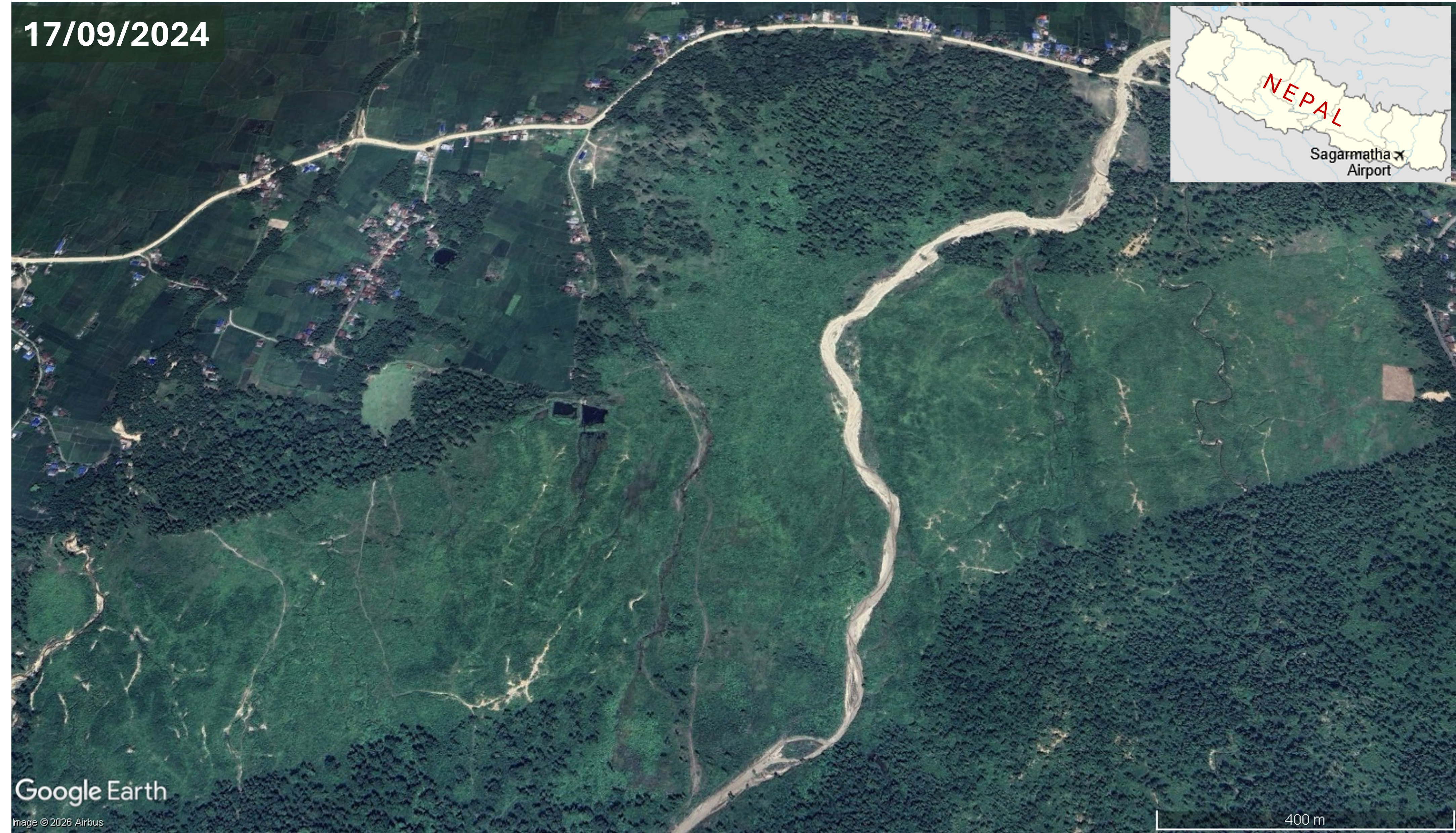
Thousands of trees were felled for the Sagarmatha Airport project, but it has not been constructed and the abandoned site has turned into pasture.
Aerial imagery of the Sagarmatha Airport site shows deforestation in perparation for construction
The Sagarmatha Airport project, in Triyuga Municipality, Udayapur District of Koshi Province, Nepal, was first announced in 2013. According to the Environmental Impact Assessment (EIA) for the airport 35,514 trees covering 124 hectares of land would be cut down to make way for a 200 metre runway, terminal, taxiways, staff quarters and other infrastructure. In April 2018, responding to protests by local people against felling trees in the local community forest for the airport, the Triyuga Municipality began to consider building the airport on unused land along the banks of the Triyuga and Luhale rivers. A year later surveys of the proposed site were complete and the Ministry of Industry, Tourism, Forest and Environment (MoITFE) announced that construction of the airport was imminent. Site clearance for Sagarmatha Airport did entail large-scale deforestation; by November 2022 70 per cent of the trees in the 105.11 hectare area allocated for the project, at this juncture named Sagarmatha Domestic Airport, had been cut down by the company awarded the tender for construction of the airport. An agreement between the Department of Forestry and Soil Conservation, signed in February 2022, had allowed use of the forested land for the airport.
In January 2024, the Centre for Investigative Journalism-Nepal reported that the Civil Aviation Authority of Nepal (CAAN) had spent Rs 24.7 million (USD169,000) clearing forest for airport construction and approximately 13,687 trees from the community forest had been cut down and sold. Foundation stones marking the start of construction had been laid in three locations. Following a site visit in February 2024 Minister for Culture, Tourism and Civil Aviation, Sudan Kirati said the government would proceed with the airport and committed more funds, “A total of Rs 50 million has been allocated for the construction of the airport.”
In October 2025, Kathmandu Post reported that, after the forest was cleared, no construction works had taken place. The airport had not materialised and 105 hectares of forest cleared for the project was being used as grazing land for cattle. A Division Forest Office Official admitted that the timber was not fully accounted for or utilised properly and said, “Some wood was distributed to local users through community forest groups, but a large quantity was reportedly sold elsewhere”. Some locals alleged that forest officials and community forest group members had colluded in illegal sales of the highest-quality timber. A Triyuga local commented, “They destroyed the forest for an airport that never got built. What’s left now is a pastureland where people graze their cattle.” Environmentalists criticised the government for permitting forest clearance for an unviable airport project. Kushal Babu Basnet, Udayapur chair of the Federation of Community Forestry Users, said “This is a textbook case of how politically driven projects can cause irreversible environmental loss.” Responsibility for protection of the site, at risk of encroachment, was unclear with the Division Forest Office insisting that land ownership had been transferred to CAAN whereas the Land revenue Office denied any record of this.
Sagarmatha Airport is not the only abandoned airport in Nepal, the country has a history of building airports that languish unused. According to a report by CAAN, of Nepal’s 55 domestic airports only 32 were operational with just seven making a profit. A retired CAAN official includes Sagarmatha Airport in a long list of airports constructed at the behest of powerful politicians. Several airports in particularly remote areas had initially served as a ‘lifeline’ for isolated communities as there were no roads; many of these airports were built 1 – 3 hours driving distance from the national highway network. But when roads connecting these airports to national highways were constructed they were utilised by poor locals for whom the airports were not a priority. Weather is another factor affecting viability of new airports, some of which can only be used as seasonal facilities. Former CAAN director general Sanjiv Gautam explained that airport viability depends on the income of the local area, saying “many airports built in past decades have turned into grazing fields”.
Research by the Centre for Investigative Journalism-Nepal into Nepal’s abandoned airports, published in January 2024, mentions Sagarmatha Airport as one of several uncompleted and unused airports incurring significant public costs, ‘From East to West, there are more than 20 domestic airports in various stages of construction and abandonment’. Airports superseded by roads include Jiri Airport, the ‘gateway to Everest’, now used as pastureland following connection to the road network and the non-operational Tikapur Airport, in the far west of Nepal, through which locals have built a road.
An 80 square kilometre aerotropolis is planned in Nijgadh, Nepal. The projects entails displacement of 7,380 people and felling of 2.4 million trees.
A major aerotropolis is planned in Nijgadh, in the Bara District in southeastern Nepal, 175 kilometers south of Kathmandu. If the megaproject proceeds as planned as many as 2.4 million trees will be felled, and 7,380 people living in the Tangiya Basti settlement within the site will be displaced. The government has repeatedly stated that Nijgadh Airport with a 80 square kilometer site, will be the largest, by area, in South Asia. An airport city adjoining the airport is planned. The map below shows the proposed Nijgadh Airport boundary as reported in the Nepal Gazette on 5th June 2015. The site is between two braided rivers, Pashah to the west and Bakiya to the east. The northern boundary is the Mahendra Highway between the two rivers. Most of the site, about 90 per cent, is densely forested land, predominantly consisting of Shorea robusta trees, which are also known as Sal or Sakhua. The settlement in the middle of the airport site, where about 7,380 residents living in 1,476 households face eviction, is called Tangiya Basti.
Nijgadh Airport site boundary , as described in Nepal Gazette, 5th June 2015
A series of government announcements underlined determination to pursue the project. In June 2014 the government emphasized determination to attract investors, reportedly ‘preparing to complete the pre-construction works to spare the investors all the hassles whether the government, private sector or foreign investors invest on the project’ as preparations were being made to fence off the land. January 2016 saw another high level push to commence construction of Nijgadh airport. The Ministry of Culture, Tourism and Civil Aviation (MoCTCA) was instructed to begin land acquisition, site clearance and resettlement of affected people and the Ministry of Soil Conservation was directed to fell trees and clear the site for the construction of primary and access roads to the airport site within two months.
It appears that a confirmed investor in the airport has proved elusive. Public funds will be used to develop the project. On 24th May 2016 the government allocated US$46.4 million for the construction of Nijgadh Airport, for land acquisition, resettlement of displaced people, environmental impact assessment and preparation of a detailed project report. The Tourism Minister said the project would be developed in phases, beginning with a single runway facility with capacity for 20 million passengers annually, with the accompanying airport city to be constructed at a later stage. In January 2017 the government assigned preparatory work on Nijgadh Airport to the Nepal Army, tasking it with building a perimeter road and an access road to the area earmarked for the runway, and clearing trees to make way for construction.
600,000 trees could be felled to fund Nijgadh Airport construction
By May 2017 forest earmarked for Nijgadh Airport remained unfelled, but vast numbers of trees could be transformed from an obstacle to airport construction into a source of funding for it. A news article entitled ‘Money grows on trees for Nijgadh airport project‘ reported a statement by officials that a vast swathe of the forest, about 600,000 trees, will be felled for the airport. The market value of the lumber was estimated at nearly US$581 million, which would be sufficient to pay for half of the US$1.172 billion construction costs for the first phase of the airport. The Forest Ministry permitted the Tourism Ministry to conduct an EIA (environmental impact assessment) on the condition that 25 trees are planted for every tree that is cut down.
Tourism Ministry officials pointed out that tree planting on this scale this would be difficult to implement, as felling 600,000 trees would require the planting of more than 15 million saplings. The suggestion that 15 million trees could be planted is more than merely ‘difficult’; it is completely unfeasible. Any such mega tree plantation could not replace the rich biodiversity of an long-established forest ecosystem and an enormous land area would be required, inevitably entailing the wholesale obliteration of an existing ecosystem in order to plant such a huge number of trees.
2.4 million trees could be felled for 80 square kilometre aerotropolis
Subsequent announcements in July and August 2017 threaten the felling of even more trees for Nijgadh Airport, over 2.4 million, to make way for the full 80 square kilometer aerotropolis. The first phase of the airport will spread over between 1,000 and 2,000 hectares, and CAAN has assigned the Nepal Army to clear trees at the airport construction site and to build access and perimeter roads. The government has allocated US$14.6 million for the project this fiscal year with CAAN setting aside an additional US$29.2 million to pay for initial works, if required.
A short video of the forest at risk of being destroyed for Nijgadh airport was posted on Twitter, by Milan Dhungana, who commented: “It’s very hard to believe that this beautiful dense forest is soon to be vanished to give way to a new airport.”
It’s very hard to believe that this beautiful dense #Sal forest is soon to be vanished to give way to a new airport. pic.twitter.com/6K8YVrnrRC
Residents of Tangiya Basti, 7,380 people living in the settlement in the midst of the forest land earmarked for Nijgadh aerotropolis, face displacement. In June 2014 MoCTCA was attempting to settle disputes over compensation for land acquisition and people’s demands for resettlement arrangements. By March 2016 the task of collecting land details had been completed, with land valuation about to commence, along with issuing public notices for land acquisition. Land had been categorized as under individual ownership, public land and ‘unidentified ownership’, the majority belonging in the latter category. A video shows the Civil Aviation Authority of Nepal (CAAN) sign erected at the Nijgadh Airport site.
A 35-day notice was published for landowners to apply for compensation in March 2017. The amount of compensation for land acquired for the airport had been confirmed and the notice required landowners to harvest their crops within a month, prohibiting them from cutting any trees or plants. But compensation is only available to a minority of residents who have recognized land ownership. A September 2016 project report by Tourism Secretary Prem Kumar Rai stated that 110 households were eligible for compensation, with between 80 and 85 of these households agreeing to the compensation and the remainder reluctant to accept the government’s offer. The majority of residents facing eviction, about 1,400 households, have been categorized as ‘squatters’. Chief of the airport project, Hari Adhikari, said that nothing had been done to resettle the ‘squatters’ living on the construction site. In July 2017 the Himalayan News Service reported that the government’s preparations to acquire land for Nijgadh Airport had left residents of the Tangiya settlement, about 7,380 people, fearing their displacement and in a state of panic over their resettlement.
Tangiya Basti residents are struggling for new homes and livelihood opportunities. The Tangiyabasti Stakeholders Committee stated that construction of the airport had made their future uncertain and held a press conference where they demanded rehabilitation. Residents facing eviction are insisting upon replacement land and food supplies, provision of water, electricity and education in the place where they will be relocated, and one job for each of the affected families. Chair of the Tangiyabasti Stakeholders Committee, Ramesh Kumar Sapotka, said that they would refuse to vacate the area unless their demands were addressed.
Tangiya Basti residents have been living in limbo for years, knowing they face eviction for the long delayed airport, which was proposed 20 years ago. The settlement was established by the government for flood victims in 1975 and the majority of people living there are from the marginalized Tamang ethnic group. For more than 40 years the government has failed to fund essential services for their established settlement, or to support their own efforts to develop these services. Tangiya Basti residents lack electricity, a reliable drinking water supply, electricity and roads. Construction of schools has been cancelled leaving pupils with a dangerous seven kilometer walk through dense forest to get to classes, with the risk of being trampled on by wild elephants that roam freely in the area. Many locals have to go to a neighboring town to make telephone calls and walk for several hours to reach healthcare facilities.
Fast-track to destruction
A 76 kilometer road, a ‘fast-track highway’, linking Nijgadh Airport with Kathmandu, has been on the drawing board since 1996. Reducing the travel time to the capital city to one-hour, is considered essential for the feasibility of the airport, but the road megaproject has also been plagued with delays. A Detailed Project Report (DPR) for the ‘fast-track’, a four-lane mega-highway, crossed by seven bridges and expanding to six lanes, was completed in August 2015.
Preparatory work for construction of the road was fraught with technical problems. The Nepal Army began excavation works without regard to the specifications for a four-lane expressway and the challenges of construction works on steeply sloping terrain, which could cause landslides. After years of delays the foundation stone for the expressway was laid on 28th May 2017, and the project handed over to the Nepal Army which will oversee construction. In the interim the road has fallen prey to the cost escalation common to megaprojects around the world. Over a seven year period the estimated construction cost of the expressway has doubled to over US$1 billion.
Megaproject mania, misplaced priorities
The Nepal government’s relentless pursuit of Nijgadh Airport and the fast-track continues in the face of criticism that the projects are draining funds from other regions of the country. Meanwhile, other megaprojects languish incomplete and have fallen far behind schedule, such as a 28 kilometer tunnel to bring water from Melamchi to Kathmandu and transmission lines. Massive deforestation looms to clear the designated site for the airport even though funding for construction has not been secured. Successive administrations have put forward different plans for financing Nijgadh Airport. As late as August 2017 no decision has been made on funding. Two financial models have been put forward. BOOT public-private partnership (PPP) would involve foreign investment or private financing. Alternatively, the government would develop the project under the engineering, procurement, construction and finance (EPCF) model.
Megaproject mania, in particular massive government expenditure on a gigantic airport, multilane highway and aerotropolis, is a serious case of misplaced priorities in one of the world’s poorest countries. Nepal is still reeling from a devastating earthquake on 25th April 2015 which killed nearly 9,000 people and destroyed over 700,000 homes. Political infighting has delayed reconstruction and, in spite of billions of dollars pledged in aid, outside of Kathmandu the majority of affected families are still living in desperate conditions, in tents or makeshift shelters, enduring harsh winter weather and heavy monsoons. In these circumstances, spending vast amounts of public money on a mega-airport that would displace over 7,000 people is nonsensical.

 antiaero.org