DR Congo: Evictions and demolitions for Mbuji-Mayi Airport rehabilitation and expansion

About 800 houses were demolished to make way for rehabilitation and expansion of Mbuji-Mayi Airport. Many affected people said compensation did not match the real value of their land plots.

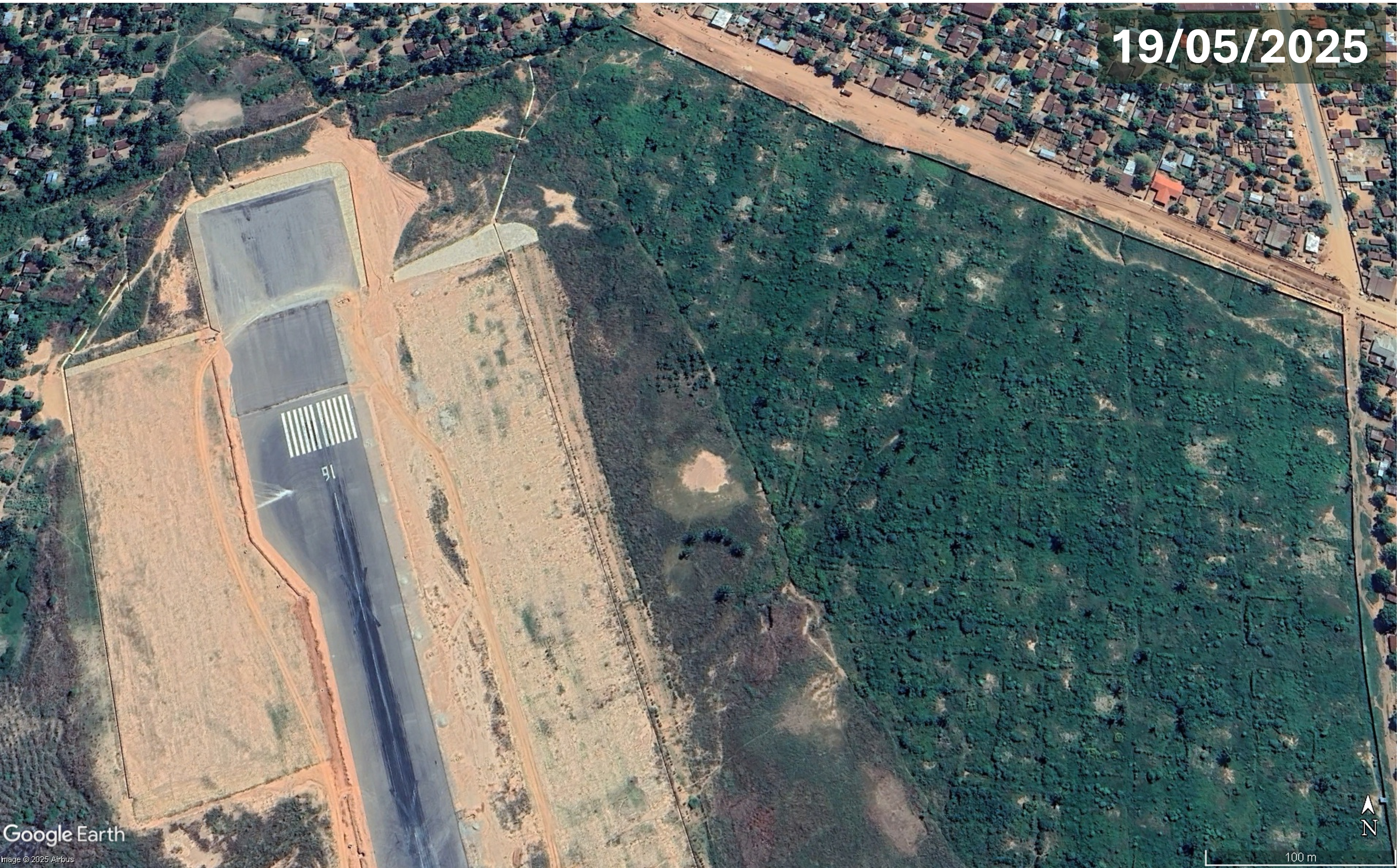
Aerial imagery of Mbuji-Mayi Airport, 17th June 2023Aerial imagery of Mbuji-Mayi Airport, 19th May 2025
Aerial imagery shows changes to the northern section of Mbuji-Mayi Airport between June 2023 and May 2025. In addition to runway works, roads have been widened and buildings next to the airport demolished and replaced with fast-growing vegetation.

Rehabilitation of Mbuji-Mayi Airport, located in the northeast of the city of Mbuji-Mayi, the capital of the Kasai-Oriental Province in south central DR Congo, is part of the Priority Air Safety Project – Phase 2 (PPSA 2) project financed by the African Development Bank (AfDB). Project components include runway extension, construction of aircraft parking aprons, control tower and works to improve aviation safety. AfDB’s 2018 Summary Environmental and Social Management Plans (ESMP) noted that the project area consists of neighbourhoods situated near the airport with dwellings and agricultural plots on the site; some activities including runway extension were postponed to enable studies and mobilisation of funding for involuntary resettlement. In February 2021 the mayor of Mbuji-Mayi set up a commission to identify all affected people who would be evicted, then in March he made reassurances that state obligations for the eviction of people who had built and rented houses would be followed.

Bulldozing of unauthorised buildings around Mbuji-Mayi Airport began on 7th November 2022. The airport project necessitated displacement of approximately 800 households but compensation of affected people was suspended in October 2023 because the census was inadequate and the process had not been accepted by all the residents with some continuing to resist. People whose land was expropriated began receiving compensation cheques on 13th October yet some voiced concerns about finding a new site, the compensation amount and demanded more transparency and guarantees regarding their property rights.

On 21st October 2023 residents whose land was expropriated for the airport project demonstrated in the street denouncing insufficient compensation, burning tyres at two road junctions before police attempted, unsuccessfully, to disperse them. An emergency meeting failed to reach an agreement satisfactory to plot owners who were given a 15-day ultimatum to relocate after receipt of compensation. In February 2024, as works at Mbuji-Mayi Airport were underway, owners of nearly 800 houses on the site were given two weeks’ notice to dismantle their homes. Occupants maintained that the compensation offer did not match the value of their assets.

On 17th July 2024 the mayor of Mbuji-Mayi announced imminent demolition of houses built on the airport site, in the name of expropriation for public purposes. Plot owners had been given tokens for replacement land on the outskirts of Mbuji-Mayi but had not vacated or demolished their houses; 800 families still contested expropriation due to lack of recognition of the market value of their plots. A delegation of residents living around the airport requested protection and support from the provincial authority and respect for expropriation law as recognised in the constitution.

Early on the morning of 29th October 2024 demolition of houses east of Mbuji-Mayi Airport, between Zaire and Dodoma avenues, began. Heavy machinery was escorted by police, as owners of the buildings demanded compensation matching the real value of their property. All their efforts, including marches, sit-in protest and suicide threats, had not dissuaded the government from expropriating the land plots. On the instructions of the president of DRC, Félix Tshisekedi, Minister of Social Affairs, Humanitarian Action and Solidarity, Nathalie Aziza Munana, visited Mbuji-Mayi on 10th November to investigate the demolition of 800 houses near the airport, collect information about evictions and meet with victims and civil society organisations. Minister of Justice, Constant Mutamba, said he had been contacted by several citizens who had not yet received the compensation they were promised, raising suspicions of misappropriation of funds allocated for this purpose.

For more information including references for all source material and photos see the case study on EJAtlas, the world’s largest, most comprehensive online database of social conflict around environmental issues – Mbuji-Mayi Airport rehabilitation, DRC

Houses demolished for Muhammadu Buhari International Airport expansion, Nigeria

Hundreds of people were displaced by a demolition exercise to make way for expansion of Muhammadu Buhari International Airport

On 30th January 2025 a number of residents of Shuwari 5 ward in Maiduguri, near the Muhammadu Buhari International Airport runway, reported that the Borno State Government was demolishing their houses. A bulldozer destroyed houses while residents retrieved essential household items. People whose houses were still standing but had been marked for demolition worked to remove roofs from their houses. One resident said people had received only three days’ notice before their homes were demolished and appealed to the Borno State Governor to provide compensation or alternative shelter for affected residents as they had no other place to go to.

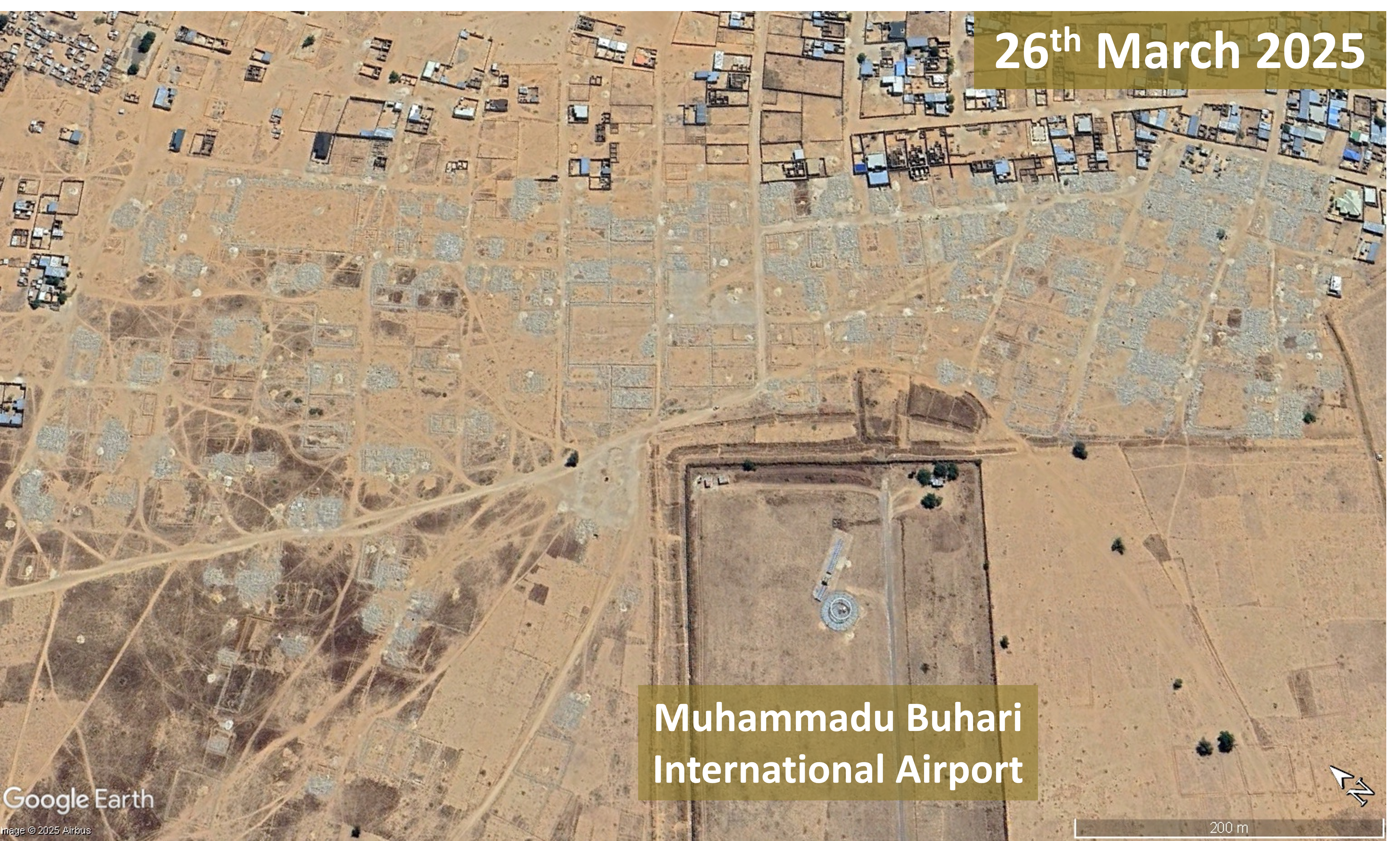
Aerial mage -Muhammadu Buhari International Airport runway, 14th July 2024
Aerial imagery of the Shuwari 5 area near the end of Muhammadu Buhari International Airport runway before and after the demolition exercise beginning on 30th January 2025 shows buildings reduced to rubble.

On a visit to Borno State in October 2024 Minister of Aviation and Aerospace Development, Festus Keyamo, had announced that Muhammadu Buhari Airport had been upgraded to international status and would commence operation as an international airport from 1st January 2025. The General Manager of Borno State Urban Planning Development Board, Liman Mustapha, said the purpose of the demolition exercise beginning on 30th January 2025 was to secure land for upgrade of the airport. He also said there would be no compensation for affected house owners and that residents had been informed that their occupation of the land was illegal in 2020 and since then authorities had attempted, unsuccessfully, to stop construction of houses on the land.

The demolition exercise targeted the area up to 500 metres from the airport fence, beginning with the area within 200 metres. Adamu Matankolo, Acting Regional Manager of the airport, said upgrade of the airport to international status by the federal government necessitated its expansion. He said, “We sympathise with the people who don’t want to obey this order. We have our plan and out plan is that the area slated for demolition is a buffer zone.”

Premium Times reported that more than 100 houses were demolished and many of the affected people had occupied the area for over 10 years having been displaced by the Boko Haram insurgency. The IDPs (Internally Displaced Persons) thought their resettlement was permanent until the state government demolished their houses. An IDP and single mother of three children said residents received a notice from the Borno State Geographical Information Service (BOGIS) just a few hours before the demolition exercise began.

Many people criticised the State government’s handling of the demolition exercise on social media, in the context of the Borno state’s socio-economic problems caused by the Boko Haram insurgency and a recent flood impacting 40% of the city of Maiduguri. Commenting anonymously a Maiduguri-based lawyer gave a detailed statement on the government’s obligations regarding compensation, concluding: “Thus, if a house is built on government land without approval, the owner is generally not entitled to compensation. However, if the government initially allowed of overlooked the development, there is scope for negotiation or legal redress.”

HumAngle, a media platform focussed on conflict, humanitarian, and development issues in Africa, reported that the demolition had displaced hundreds of people. One of them, a widow raising four children who had lived in Shuwari 5 for 17 years, said the government only notified people about the demolition two days before bulldozers arrived, not even giving enough time for gathering belongings. She said at least three affected people had died of shock and more than 20 had fallen ill due to trauma.

Liman Gana, head of Borno State Building Planning Authority, said 306 structures had been demolished, including 64 fully occupied houses, 42 incomplete structures and 17 incomplete buildings. A Federal Airports Authority of Nigeria (FAAN) official gave technical and safety reasons for the demolition exercise, saying structures built too close to the runway posed safety risks. Many displaced residents insisted that they were not informed of these risks before they bought or built their homes and said resettlement should have been planned and implemented before the demolitions took place.

For more information, including references for source material, see the case study on EJAtlas, the world’s largest, most comprehensive online database of social conflict around environmental issues – Demolition of houses for Muhammadu Buhari International Airport expansion, Nigeria

Climate refugees face displacement to make way for Cox’s Bazar Airport and Air Force Base expansion

Up to 70,000 climate refugees face displacement to make way for Cox’s Bazar Airport and Air Force Base expansion and more than 20,000 could be ineligible for replacement flats in the Khurushkul Ashrayan Project. On 7th January 2025 thousands of people protested against eviction.

Map of Cox's Bazar Airport and Bangladesh Air Force (BAF) base.
Map of Cox’s Bazar Airport, Bangladesh Air Force (BAF) base and Khurushkul Ashrayan Project. Satellite imagery 25th March 2025

Since 1981 climate refugees – people displaced by cyclones, river erosion and tidal surges from many of Bangladesh’s coastal areas – have resettled in Ward 1, Cox’s Bazar Municipality. The area is government-owned ‘khas’ land between the Bay of Bengal and Cox’s Bazar Airport and the adjoining Bangladesh Air Force (BAF) base. The largest influx of climate refugees occurred in the aftermath of a cyclone and tidal wave on 29th April 1991 when about 40,000 people displaced from Kutubdia Island settled in the area. In February 2011 several local leaders demanded cancellation of a project to expand Cox’s Bazar Airport. Officials had moved to acquire 16 areas in Ward 1 – including Kutubdiapara, Samitypara, Fadnerdail, Bandarpara and Naziraratek – and 40,000 people would become homeless. In 2012 the Civil Aviation Authority of Bangladesh (CAAB) began a project to extend Cox’s Bazar Airport runway. In 2021 an agreement for another runway extension, lengthening it northwards into the Maheshkhali Channel through land reclamation, was signed.

Climate refugees face eviction

An in-depth investigation of the climate refugees from Kutubdia Island who had settled in Ward 1 was published in December 2024. They were still vulnerable to extreme weather; storms would leave many homes flooded with seawater and the area lacked cyclone shelters. Neither Cox’s Bazar Municipality nor the Chittagong District had precise data on the number of people living in Ward 1 but Akter Kamal, elected three times to represent Ward 1 and now a former councillor, said at least 52,000 people resided there. The investigation found that ‘Every household in the climate refugee camp lives inconstant fear of eviction. All the khas land in the area has been acquired for the expansion of Cox’s Bazar Airport’s runway and the construction of an air force base’.

Resettlement in the Khurushkal Ashrayan Project

The Khurushkal Ashrayan Project, located 3 kilometres east of Cox’s Bazar Airport, was described as ‘the world’s biggest climate refugee rehabilitation project’ when the then Prime Minister Sheikh Hasina inaugurated the first phase, housing 600 families, on 23rd July 2020. It was stated that upon completion 139 five-storey blocks would rehabilitate 4,409 families, the majority living in the Cox’s Bazar Airport area since being displaced by the 1991 cyclone. By December 2024 another 85 buildings had been completed which would accommodate 2,270 families. But former councillor Akter Kamal said that at least 20,000 climate refugees living in Ward 1 were ineligible for flats. Changes to the list of project beneficiaries had caused anxiety to between 20,000 and 22,000 climate refugees who were excluded from the resettlement plan.

Thousands protest eviction plan

On 7th January 2025 thousands of climate refugees, including residents of Samitypara and Kutubdiapara, held a protest demanding cancellation of the eviction plan linked to Cox’s Bazar Airport expansion. Demonstrators blocked roads causing traffic disruption with several thousand people blocking the main city road for 2½ hours, protesting eviction and calling for long-term settlement and holding a rally in front of the Deputy Commissioner’s office. They had lived in their settlements in Ward 1 for 20-30 years but instead of rehabilitating them plans were being made to evict them. Former councillor Akter Kamal told Prothom Alo that between 60,000 and 70,000 climate refugees were living in the area and land had been acquired for Cox’s Bazar Airport runway expansion and air force base construction. He estimated the number of families not entitled to flats in the Khurushkal housing project as approximately 4,000. Protestors said they would bring the city to a standstill if the government did not reverse its decision to evict them.

Clash between locals and BAF personnel

On 24th February 2025 Shihab Kabir Nahid, a 30-year-old local trader, was killed in a clash between locals and BAF presonnel. His mother said he was standing in the doorway of their house and died after being shot in the head. The Inter Services Public Relation Directorate (ISPR) stated that Cox’s Bazar Air Base had come under a “sudden attack” by unidentified people from the neighbouring Samitypara area. But local residents alleged that the clash was triggered by altercations over BAF’s attempts to acquire land and relocate residents for expansion of Cox’s Bazar Airport and the air base. A Samitypara resident said the clash began as local representatives were on their way to a scheduled meeting with BAF officials about relocation for airport expansion. The Borderlens published an account of the violent incident and the circumstances leading up to it. Climate refugees in Ward 1 had lived in fear for many years, their homes on land earmarked for air base expansion and denied land ownership rights or resettlement. In recent months the eviction drive for air base expansion had intensified. Families’ appeals to the district administration went unanswered and BAF personnel were making threats. Gunfire began after a scuffle and social media footage showed air force personnel firing at unarmed protesters throwing bricks and stones.

Runway expansion impacts on waterway navigability

By March 2025 the runway expansion was 84% complete and aircraft navigation aid lights had been installed on concrete piles extending across the mouth of the Maheshkhali Channel. On multiple occasions the Bangladesh Inland Water Transport Authority (BIWTA) had raised concerns about lack of approvals, consultation and surveys pertaining to the risk of loss of navigability for waterway traffic, but the warnings had been ignored. A report by a committee of experts stated that the pillars in the river obstructed water flow and caused accumulation of sediment at the base of the pillars, narrowing the mouth of the Maheshkhali Channel and reducing navigability. An alternative channel that had been dug out was expanding westwards, posing risks to residents of Sonadia Island. The BIWTA report warned that sediment build-up could affect water routes along the coast from Chattogram to Cox’s Bazar along with the southward route to Saint Martin’s. The report recommended removal of the piling in the Maheshkhali Channel.

For more information, including references for source material, see the case study on EJAtlas, the world’s largest, most comprehensive online database of social conflict around environmental issues – Cox’s Bazar Airport and Air Force Base expansion

Demolition of Nuwalege homes for Presidential Air Fleet expansion

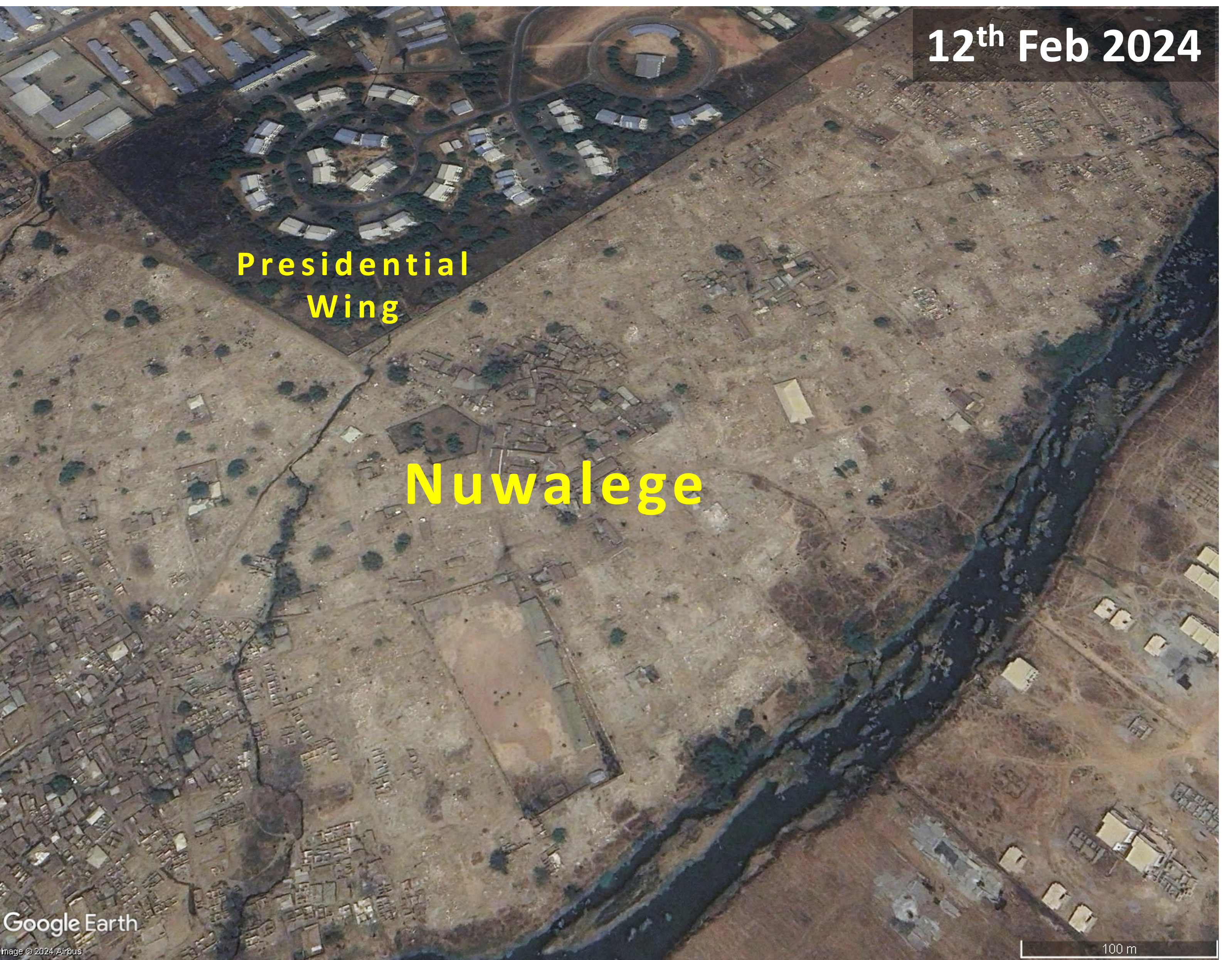
On the morning of 15th January 2024 dozens of police and soldiers stood guard as over 200 homes in the Nuwalege community, a settlement in a rural area adjacent to the Presidential Wing of Nnamdi Azikiwe International Airport (the main airport of Abuja, capital city of the Federal Capital Territory of Nigeria) were demolished to make way for expansion of the Presidential Air Fleet (PAF). Police fired teargas to disperse residents and they were prevented from entering their homes. Officials threatened to seize people’ phones and one person who took photos of the demolition was manhandled. Some Nuwalege residents including community leaders said that the demolition happened without warning.

Satellite imagery shows Nuwalege homes demolished for expansion of the Presidential Air Fleet. The image on the left is from 2nd May 2023, the most recent Google Earth imagery before the demolition exercise. On the right is an image from 12th February 2024, nearly a month after the demolition began.

Demolition of more than 200 houses in the Nuwalege community had been ordered by the Federal Capital Territory Administration (FCTA) on 18th December 2023 and a thorough investigation of compensation for affected people, involving the FCTA, the Department of Resettlement and Compensation and the Nigerian Air Force (NAF), was promised. Peter Obi, Labour Party candidate in the 2023 presidential election, spoke out against the planned demolition in a statement on his X account: “I am again pained that we are embarking on such an inconsiderate project at this critical time when the country is going through such hardship…We cannot continue to encourage those who have kept us suffering to enjoy a luxurious lifestyle far beyond our legitimate means…I therefore, advise that we have a rethink, and, most importantly, ensure that our fellow Nigerians are not rendered homeless for the sake of an unproductive presidential fleet.” He also argued that instead of expanding the Presidential Air Fleet the government should explore ways of reducing or getting rid of it to reduce costs.

Seven months after the demolition, in August 2024, The Punch reported that Nuwalege landowners who were forcibly ejected following demolition of their homes were still calling for compensation. Residents denied Department of Development Control claim that the structures belonging to indigenous people had been left intact, saying that no houses had been spared from demolition and the Director of the Department of Development Control’s claim that they had been given a two-month notice period before the demolition took place. Many displaced residents had been forced to seek shelter in nearby communities including Zamani, Sauka, Giri, Iddo and Gwagwalada.

Resource Centre for Human Rights and Civic Education (CHRICED) issued a statement expressing dismay at widespread destruction of indigenous settlements in the FCT on 1st September 2024, making specific reference to the forcible demolition of over 200 homes in Nuwalege. Urging the government to engage in dialogue with affected residents CHRICED Executive Director Ibrahim M. Zikirullahi said, “The demolition reportedly executed by the Federal Capital Development Authority (FCDA) to accommodate the luxurious lifestyle of the presidency demonstrates gross irresponsibility and insensitivity to the plight of the Abuja natives. This prioritization of luxury and expansion for a select few over the basic rights and needs of ordinary citizens is an affront to democratic values and the principles of social justice.”

Works in the demolished area have not commenced but on 1st November 2024 a N9.8bn (USD5.9m) contract for rehabilitation of facilities in the Presidential Wing was awarded to Nigerian construction firm Julius Berger. Executive Secretary of the Federal Capital Development Authority (FCDA) said the project – including rehabilitation of the link road, access road to the presidential kitchen, hangar housing presidential aircraft and holding centre for visiting presidents – would take six months. A number of civil society organisations condemned the contract. Peluola Adewwale, National Secretary of the Democratic Socialist Movement, said, ”The N9.8bn presidential wing rehabilitation contract is a misplacement of priority, frivolous and insensitive.” The Committee for the Defence of Human Rights (CDHR) described the Presidential Wing rehabilitation as an ‘unnecessary project’. CDHR chairman in Osun State, Emmanuel Olowu, said, “the Tinubu’s government prioritises a luxurious lifestyle against the welfare of the people.”

For more information including references for all source material see the case study on EJAtlas, the world’s largest, most comprehensive online database of social conflict around environmental issues – Nuwalege homes demolished for Presidential Air Fleet expansion, Nigeria.

Lucknow Airport expansion, land acquisition, protest and Aerocity plans

Satellite image of Lucknow Airport (Chaudhary Charan Singh International Airport) dated 20/10/2024. Location of Terminal 3 and some of the villages affected by land acquisition for airport expansion are shown.

Lucknow Airport (also known as Chaudhary Charan Singh International Airport), located 14km southwest of the capital city of Uttar Pradesh, is already the 11th busiest airport in India and traffic will increase with recent and ongoing expansion. A third terminal began operations on 30th March 2024, with capacity for 8 million passengers per year, set to rise to about 13 million upon completion of phase two. Land from Bhaktikhera village was used for the third terminal and runway extension and in March 2018 the Airports Authority of India (AAI) agreed to pay Rs 32 crore for relocation of about 600 residents. Compensation for acquisition of 70 acres of land from Bhaktikhera, Gurera and Aurangabad Jagir villages, for runway extension and other facilities, was still being negotiated in June 2018. Airport expansion had been stalled for a decade due to difficulties with land acquisition. But in June 2019 the AAI announced that ‘decks are cleared for the construction of the wall around the airport and expansion of the runway’. The district administration committed to helping AAI build the wall to keep out people ‘trespassing the area’ and stray animals posing safety risks.

Demolition notices and farmers protest boundary wall construction

Construction of houses near Lucknow Airport also raised safety concerns. At the end of August 2024 authorities served demolition notices on 50 houses which had been built next to the airport boundary without authorization. A Lucknow Development Authority (LDA) official said a builder had posed as a contractor without obtaining the requisite No Objection Certificate (NOC) from the airport administration, acquired land directly from farmers and pocketed the money. A month later construction of the airport boundary wall led to a clash between a group of farmers and police. After commencement of excavations works, with two JCBs in the presence of police, a large number of farmers, between 150 and 200, gathered and began to protest, saying the airport administration was forcibly occupying their land. The farmers, from Rahimabad and Mohammadpur Bhakti Kheda villages, said a disputed land petition was pending adjudication in the Allahabad High Court.  The protest forced authorities to temporarily halt land reclamation operations for airport expansion. Farmers argued that the land had been cultivated for many generations and that land acquisition notification in the 1950s lacked important details including plot numbers, land area and the names of the landowners, thus raising questions about the legitimacy of the acquisition process.

In response to the protest the district administration postponed the land reclamation drive until 15th October. The owner and operator of Lucknow Airport, Adani, one of India’s largest multinational conglomerates, plans to reclaim approximately 260 acres on the southern edge of the airport for extension of the runway to 3,500 metres to accommodate large, wide-body aircraft and construction of two parallel taxiways. Speaking anonymously, an official stated that a total of about 400 acres owned by the airport for over 70 years would be reclaimed for airport expansion and a survey would be conducted to compensate farmers with crops growing on the land. The principal petitioner against the land reclamation said the farmland had not been legally acquired, farmers had not received any compensation and Adani was attempting to forcibly construct the airport boundary wall. 

Boundary wall construction continues and Aero City plans

On 25th October the Supreme Court dismissed the farmers’ plea against expansion of Lucknow Airport, allowing LDA to proceed with the project. Lucknow Development Index announced on X that, after deployment of a ‘heavy police force’ in response to resistance, ‘work is still progressing amid farmers clashes’. A ‘massive area’ was being reclaimed and construction of the boundary wall had re-commenced. An official source said a 400-acre area was being reclaimed and a fourth terminal and an Aero City was planned on the land.

 Few months previously, on 5th February 2024 Times of India had reported ‘ambitious plans’ for Lucknow Aerocity, a 1,500 acre development with ‘an array of upscale amenities, such as world-class convention centres, large parks and seven-star hotels’, announced by Uttar Pradesh finance minister Suresh Kharna. The LDA was tasked with identifying land for the project, likely to be located in Rahimabad and Gahru villages. In addition to Lucknow, Adani owns several airports in India including Mumbai, Mangaluru, Jaipur, Ahemedabad, Thiruvanthapuram and Guwahati. Plans for aero cities adjoining Adani’s airports were reported in July 2022. The Economic Times stated that Adani plans to develop ‘aero cities’ on more than 500 acres at all its airports, with hotels, convention centres, retail, entertainment, healthcare, logistics, offices and other real estate sectors.

Locals resisted eviction for Guwahati Airport expansion

At the beginning of September 2021, a month before operation of Guwahati Airport (the busiest airport in northeast India) was handed over to Adani, there were reports of locals resisting eviction to make way for expansion. An eviction notice was served to 54 households, outside the walled area of the airport in Koitasidhi village. An airport official said the land, adjacent to the runway, was to be developed as an approach area, especially for larger aircraft on international flights. Villagers said that several plots of land had been acquired for construction and expansion of the airport since 1962. Some villagers said, “We would rather give our blood than give up our land”. Continuing protest was reported on 8th September; a local person said “We heard that the Adani group which has been given charge of the Airport for 50 years under a lease agreement by the Government of India wants to do expansion work here. But we want to clarify that we will not leave our land even if we are given adequate compensation”. Some other locals said they would not give their land to Adani. On 15th September 2021 the Times of India reported that villagers were fiercely resisting giving up land for airport expansion. A tearful farmer in his late 70s said his family had been compelled to give up land for airport expansion in the 1960s, which if sold today would fetch a much higher price. His family was left with ownership of just one residential plot. More recently, in June 2024, announcing the schedule for opening of a new terminal at Guwahati Airport in April 2025, Chief Airport Officer Utpal Baruah said plans for subsequent expansion phases included a maintenance, repair and overhaul (MRO) facility, aerocity and helipad.

‘Mindfulness City’ megaproject begins with expansion of Gelephu Airport

Gelephu Airport, one of only four airports in Bhutan, is a domestic airport located in the southern Himalayan foothills, close to the Indian border. In August 2023, as formulation of the master plan for expansion of Gelephu Airport neared completion and groundwork preparations began, there was growing speculation among landowners with properties in the proposed site regarding replacement land and compensation. Acquisition of land was to be determined by the government. The groundbreaking ceremony for Gelephu International Airport took place on 23rd December 2023. Satelite imagery dated 1st January 2024 reveals a large area of low-lying scrub land has been cleared for the airport expansion.

Satellite imagery shows clearance of a large area of low-lying scrubland for expansion of Gelephu Airport, including the new runway, and construction of a dry port south of the existing runway.

Expansion of Gelephu Airport is a key component of an even larger megaproject, a new city, and some residents are concered about losing land to the project. On 15th December 2023 Forbes reported that King Jigme Khesar Namgyel Wangchuck would be announcing development of a new ‘megacity’ in Gelephu, called Bhutan Mindfulness City, on Bhutan’s National Day, the 17th December. Initially there were plans for the announcement to take place in Gelephu, but the town, with just 10,000 residents, lacked the requisite infrastructure such as accommodation for international guests so the event was relocated to the capital city, Thimpu. Ahead of the official announcement the article cautioned that the new city project might be met with ‘strong opposition from Bhutan’s nearly 800,000 citizens’ and that ‘fears of government land grabs and the displacement of farmers in Gelephu have already taken root, according to several Bhutanese residents’. Sources with knowledge of Mindfulness City said the King was ‘trying to avoid the preception that families will be forcibly transferred to make way for the project’.

Mindfulness City was indeed the focus of the King’s 116th National Day address. The Bhutanese reported the King’s description of the new city, explaining that it will cover 1,000 square kilometres, about 2.5% of Bhutan’s total land area. Major public investment in roads, bridges and airports is planned, with an inflow of foreign investment anticipated for construction of offices, residencies, schools, hospitals, shops, hotels and restaurants. The new city was also referred to as Gelephu Special Administrative Region (SAR), an ‘economic hub’ that will have ‘autonomy to formulate laws and policies’. Ten of the twelve gewogs (groups of villages) in the Sarpang Dzongkhag (District) – Tareythang, Umling, Chhuzagang, Serzhong, Gelephu, Samtenling, Dekiling, Shompangkha, Gakiling, and Singye – were designated for the Gelephu Mindfulness City project. Kuensel Online reported that residents and landlords were ‘excited about the the upcoming development initiative’, attributing some landlords’ anxiety and fear of losing all of their land to the project to ‘lack of awareness regarding private properties’. There was reassurance of compensation following international practices and provision of replacement land in the city area. It appeared that acquisition of private land would be limited to areas allocated for road and airport construction.

Danish architecture firm BIG, known as a masterplanner for other megaprojects such as Neom, a glass-walled linear city in Saudi Arabia, duly unveiled its masterplan for Mindfulness City, including an international airport. Connectivity was a recurring theme of BIG founder Bjarke Ingels’ description of the new city; he said “Gelephu becomes a land of bridges, connecting nature and people, past and future, local and global”. Apparently, the project will ‘be shaped by 35 rivers and streams that run through the site’. Neighbourhoods will be connected by several ‘inhabitable bridges’ hosting facilities including a university, a healthcare centre and a spiritual centre. Connectivity claims extended to the airport, its timber terminal to act as a bridge. But its runway, crossing over several rivers, while facilitating connectivity for global air travellers, will cause major disruption to hydrological systems. And how does a new city highly dependent on fossil-fuel dependent international air travel square with the Gelephu Mindfulness City website claim of ‘Sustainability as a carbon negative country’? Buildings will incorporate local materials and be ‘informed by Bhutanese architecture‘. But will techniques and structures resonating with local cultural identity be integral to the function of new buildings, or merely aesthetically pleasing adornments? Perhaps the most striking showpiece feature of Mindulness City is the plan for a hydro-electric dam containing a temple. Will the new city be, as Ingels said, “founded on Bhutanese nature and culture”, or merely garnished with it?

A 6th January 2024 Kuensel Online article stated that that Gelephu Mindfulness City would commence with expansion of Gelephu Airport and landowners with land in the area earmarked for the airport had been given replacement land or compensation. Landlords confused about the future of their holdings had been told that they had ‘nothing to worry about’ as the project would include everyone and leave nobody behind, indeed ‘the entire Bhutanese citizenry would be part of the historic project’. This claim of inclusivity is at odds with the Gelephu Mindfulness City website promotion of new city aiming to ‘attract global top talents who are global and creative’ and ‘serve as a hub of global top minds’, i.e. for an international elite. By February 2024 six JCBs had cleared about 1,800 acres of land, working towards the goal of clearing 2,500 acres. Just south of the airport, a dry port was under construction. After considering three models for the airport expansion officials had selected the Asian Development Bank (ADB) masterplan. A new runway next to the existing runway will be 3km in length; possible extension of the runway to 3.5km to accommodate the Airbus A380 would cross over two rivers. Building a new runway will allow continuation of airport operations using the existing runway, enabling visitors involved in the development of Mindfulness City to fly in and out. The initial cost estimate of the ADB masterplan was Nu 8 billion (USD96 million) but a more recent estimate by the Airport Authority of India indicated a far higher figure, possibly as high as Nu 20 billion (USD240 million).

Eviction of villages bordering Kilimanjaro Airport

In Tanzania state forces are forcefully evicting Maasai residents of eight villages bordering Kilimanjaro Airport. On 8th May 2024 it was reported that hundreds of homes have been demolished and cars with loudspeakers, escorted by armed police, warned residents to evacuate. Plans to expand the 460 hectare airport site to 11,447 hectares date back to 1985 and the government labels the lawful owners of the land as ‘trespassers’. For background information on the land dispute see EJAtlas: Kilimanjaro International Airport. Impacted communities and supporting organisations are calling for and immediate halt to demolition of homes, humanitarian aid including food and shelter to the hundreds of people rendered homeless and establishment of an independent enquiry into the land dispute.

Velana Airport expansion and designation of Funadhoo Island as an economic zone

Plans for expansion of Velana Airport, the main airport in the Maldives, and a linked Economic Zone on Funadhoo Island are certainly ambitious. A video outlines a blueprint for a 20-year, multi-billion dollar development.

The expanded airport will be designed to accommodate 25 million passengers per year (nearly a six-fold increase over 4.3 million passengers in 2022). A new cargo terminal is forecast to handle 100,000 tonnes by 2025, rising to 300,000 tonnes by 2050. Aviation fuel farm storage will be expanded fro 15 million litres to 100 million litres. The passenger processing capacity of the domstic terminal will be increased from 300 per hour to 2,000. A self contained jet terminal is described as ‘serving niche market segments of the airline industry, exploiting this market segment and investing in it is an essential part of the future airport infrastructure’. The airport footrpint will extend to other islands. Seaplane facilites operations will be relocated to another island and linked to passenger terminals via a new bridge. The ‘epitome of this futuristic vision’ is development of an Airport Economic Zone on the island of Funadhoo, linked to the rest of Velana Airport and ‘offering a plethora of shopping opportunities’ along with hotels, convention centres and entertainment facilities.

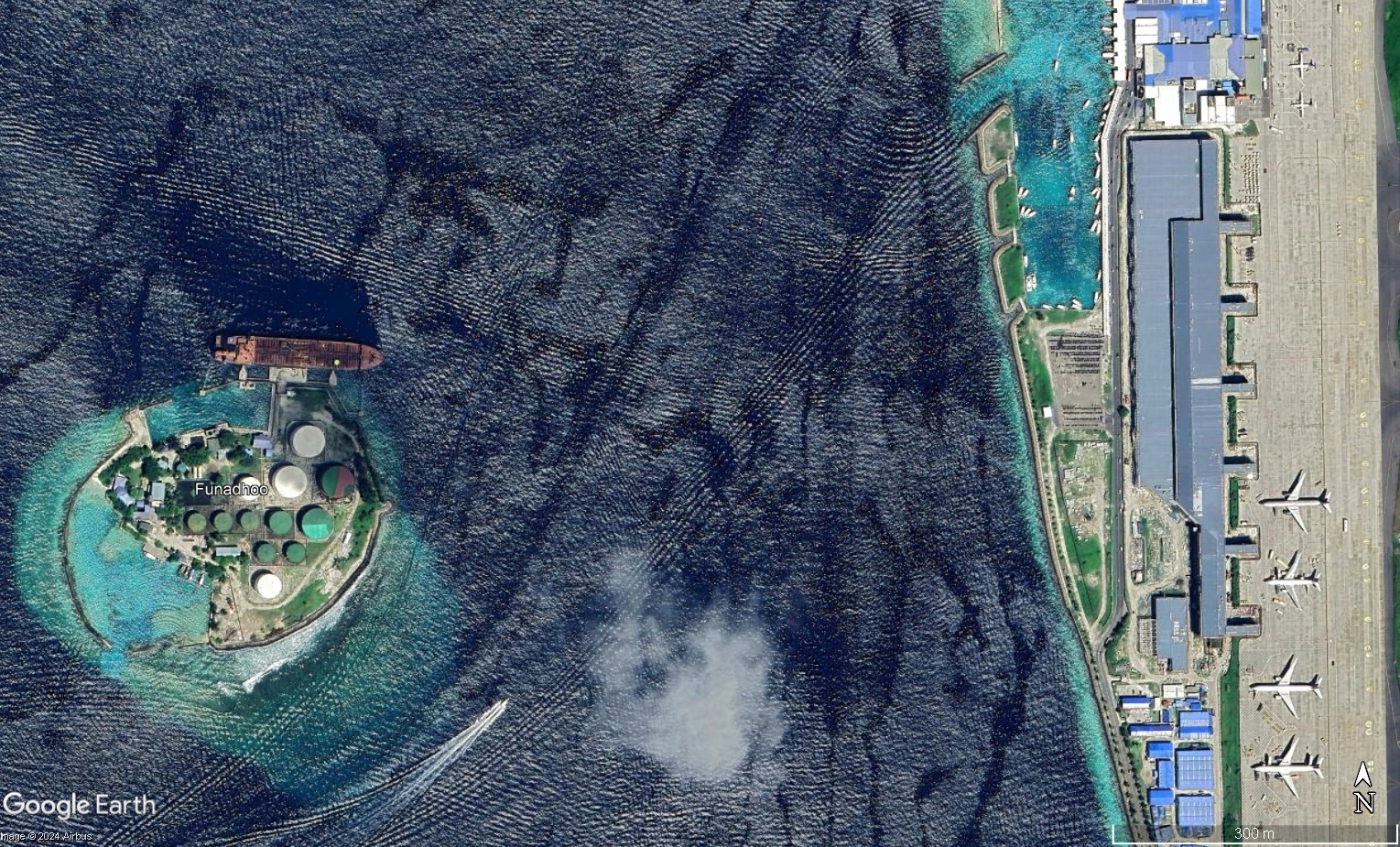
There are plans to remove the oil tanks on Funadhoo, between Velana Airport and Malé, and designate the island as an Airport Economic Zone with shopping malls, hotels,convention centres. and entertainment facilities.

Ambitious plans for the small island of Funadhoo, currently taken up by oil tanks and located to the east of Velana Aiport and close to Malé, the capital city, were announced in September 2023. President Ibrahim Mohamed Solih said that the oil tanks would be removed and replaced with a convention centre, hotel and shopping malls. On 4th January 2024, current President of the Maldives, Dr. Mohamed Muizzu, inaugurated the Velana International Airport and economic zone megaproject and pledged to develop Funadhoo Island as an international financial hub. He also revealed plans to create the ‘Maldives International Financial Services Authority’ as a step towards establishing an international financial centre in the Maldives. On 22nd January President Muizzu announced that, following relocation of the fuel storage to Maagiri Falhu, Funadhoo would be designated as a special economic zone.

Public funds poured into Airport Business Park near Eppley Airfield, Nebraska

Large amounts of public funds are being poured into a planned Airport Business Park near Eppley Airfield, located on the northeastern edge of the City of Omaha in Nebraska. The priority site contains many residences and small urban farms. Residents have concerns over lack of information about the project and whether they will have to relocate.

On 6th December 2022 the State of Nebraska awarded US$400,000 in Economic Development Awards funds to the Omaha Development Foundation to help create a master plan for an area near Eppley Airfield. The grant was the first step in implementing the state’s Airport Business Park Program (ABP Program), created by the Nebraska Legislature in 2022 in response to negative economic impacts of the coronavirus pandemic drawing grants from Nebraska’s allotment from the American Rescue Plan Act (ARPA). Signed into law on 11th March 2021 the purpose of ARPA is to support the country’s recovery from the economic and health impacts of coronavirus and recession.

In February 2023 the Nebraska Department of Economic Development (DED) elected to double the total amount available through its ABP Program, awarding US$800,000 in Planning Grants. The Omaha Development Foundation and the Omaha Economic Development Corporation each received a US$400,000 grant. Officials have proposed a powerful inland port authority to provide a support structure for the business park; a plan was presented to Omaha City Council on 20th December 2023. The port authority would focus on bringing large commercial and industrial developers to the city. It would have limited democratic input. A 9-member board, appointed by the Mayor, would co-ordinate developments related to rail, airports and waterways and be given authority to oversee investments in the area. The inland port authority would have legislative powers to issue and sell revenue bonds to construct buildings and infrastructure and be charged with guiding economic development in a wider, approximately 300 acre area, around Eppley Airfield.

Graphic depicting map of proposed business park near Eppley Airfield, as envisaged by a development team led by the Greater Omaha Chamber, Burlington Capital and the North Omaha-based Omaha Economic Development Corp. The priority site is north of Carter Lake. Image: Nebraska Examiner, 22/12/2023

The 160-acre priority site, to the west of Eppley Airfield near the northern shore of Carter Lake, contains about 320 mixed-use land parcels. Under the ABP Program about US$90 million in state funds would be used to turn the site into shovel-ready land ready for industrial development. City of Omaha officials are in negotiations with the private owner of the second site, a 70-acre area located west of Carter Lake. The priority site contains homes and small urban farms. Community leaders say affected communities have not been informed about the project. Joe Higgins of Levi Carter Sherman Neighbourhood Association said residents had to research information about the project themselves due to scarcity of detail provided by authorities. He said the neighbourhood had been marginalized since the 1950’s but most homes pre-date that time with residents having deep roots in the area. Some Omaha lawmakers also say there has been a lack of engagement with residents.

One of the urban farms operating in the earmarked site is City Sprouts which grows thousands of pounds of produce for a community pantry. It was established in 2021 and in 2023 it provided 15,000 pounds of food. City Sprouts also teaches agriculture providing internships and other learning opportunities. Manager Ann French said the farm was drawn to the area because of the truck farm and agricultural history. Currently covering 7-acres City Sprouts has plans to grow, building a greenhouse and a barn and quadrupling the produce it shares with neighbours. She said it would be impossible to find a similar site elsewhere in Omaha.

A 19th February 2024 community meeting, the first to include most of the major players in the business park and give residents clarification about the project, was attended by about 75 people. The key issue concerning residents was whether they would be forced to relocate and, if so, how they would be compensated. Several people voiced concerns over how little information had been shared with residents about the fate of homes they had built and lived in for many years. There were outbursts of frustration and anger. At one point a woman shouted “are they taking your home?” and a man called the discussion a “clown show” then walked out. Information about the proposed inland port authority to oversee the business park project clarified that most members would be appointed, but seats would be offered to two residents, two business owners and one youth.

Large amounts of funding, including public funds, is also being ploughed into expansion and renovation of Eppley Airfield, already the largest airport in Nebraska handling more than 5 million passengers in 2023. On 17th January 2024 the Omaha Airport Authority announced approval of a US$950 million terminal expansion and renovation plan at Eppley Airfield, funded by federal grants along with airport revenues and future airport bonds. Yet more public funding for Eppley Airfield expansion was announced on 14th February 2024; a US$3.1 million grant for Terminal Building Improvement Phase 7 will support increased capacity and improvements including a new terminal. The money is part of US$15 billion in funding for US airport infrastructure under the provisions of the 2021 Bipartisan Infrastructure Law, $11 million of which was allocated for Nebraska airports.

Evictions of communities close to Jacksons Airport

A drive to evict informal settlers living on parcels of land around Jacksons Airport, Papua New Guinea’s main airport located to the northeast of Port Moresby, was announced in the early days of 2022. Residents of the Saiwara community protested being issued with several eviction notices over the past year by the National Airports Corporation (NAC), the most recent giving them until the end of the month to vacate the area. A petition against the eviction was signed by 5,000 residents and a representative stated that they had been paying a traditional landowner for the land. Many tax-paying small and medium sized enterprises (SME’s) also urged the government to stop the evictions. A video by EMTV Online shows men, women and children protesting, some holding up placards with statements such as ‘No Eviction Please’, ‘No Eviction, What is Government doing For My Future’.

In January 2022 residents of the Saiwara community next to Jacksons Airport protested eviction notices issued by the National Airports Corporation (NAC)

Simultaneous with the eviction drive in Saiwara, NAC began pressuring residents to vacate Erima, another area adjacent to Jacksons Airport. A group of policemen visited communities and issued eviction notices. A long term resident said, “Police said the land close to the airport belongs to the National Airports Corporation and people must move out before the eviction date.” NAC managing director Rex Kiponge stated that the land belonged to NAC and that people must vacate the land by the end of January. He said, “I personally witnessed and heard from the police that any settlement or houses near the airport must be immediately moved out of force will be applied” and urged people living in the affected area to find a place to resettle.

Graphic from video showing parcels of land surrounding Jacksons Airport that the National Airports Corporation (NAC) lays claim to and where residents have been served with eviction notices. Image: Saiwara Eviction Notice, EMTV Online, 11/01/2022

A graphic in the EMTV Online video shows the parcels of land surrounding Jacksons Airport that the NAC lays claim to and where residents have been served with eviction notices. NAC managing director Rex Kiponge explained that the eviction drive was a strategic move to utilize the land for a non-aeronautical revenue stream, i.e. generation of revenue from sources other than airlines. (Typical sources of non-aeronautical revenue include retail, hotels, tourism facilities, business premises, real estate and car parking.) Kiponge also mentioned another hallmark characteristic of an aerotropolis/airport city: aspiriations for an airport to become a destination in its own right. He said that eviction of people from land around Jacksons Airport would support NAC’s new policy, namely ‘Converting Airports from Point of Transit to Point of Destination’. NAC’s focus on development of land for non-aeronautical purposes has been galvanised by a collapse in its revenue stream due to the drastic reduction in air traffic since the Covid-19 pandemic. Previously, NAC’s revenue had consisted of 80% from aeronautical business and 20% from non-aeronautical business. Kiponge said the NAC needed to start generating its own revenue and recouping its assets was in line with this aim.

Following questions in Parliament from member for Moresby North East, John Kaupa, PNG Prime Minister James Marape intervened, assuring settlers on airport-owned land at Erima and Saiwara that they would not be evicted by the NAC until a permanent solution was reached. He asked NAC to freeze their eviction plan. But the settlers are still under pressure to leave; Marape warned them not to move in onto state land and start building structures if they are not in possession of titles, saying that the Government would not step in to assist anyone on humanitarian grounds.

Over 200 families residing in Erima Bridge were evicted and left sleeping out in the open without food or water in February 2017. Photo: EMTV, 06/02/2017 (date accessed 06/02/2017)

The current drive to evict communities living around Jacksons Airport is the latest in a series. In February 2017 police evicted more than 200 families who were living on state-owned land in Erima Bridge. Some of them had lived in makeshift and semi-permanent housing for more than 20 years. The officer in charge of Jacksons Airport said the police were acting on the orders of the land owned by the NAC and that over the course of a week all the houses and tents in the area in question had been removed. It was reported that they were left sleeping out in cold, wet weather conditions for a few days. Their only shelter was wooden frames and roofing iron and they had no food, water or clothing. A settler who had moved to Erima from the Highlands region said some people whose homes were destroyed had not received an eviction notice. At the time of the Erima Bridge eviction the Asian Development Bank (ADB) confirmed support for expansion of Jacksons Airport, signing an agreement with NAC to develop a new international passenger terminal. In May 2015 a demolition exercise at another settlement near Jacksons Airport, 7 mile, left more than 200 people homeless. Some of them were beaten up by the eviction squad. Evictees lost all they owned during the demolition and some homes were burned down. The eviction was part of NAC’s development plan for Jacksons Airport.

Information about evictions of communities surrounding Jacksons Airport has been published on EJatlas, the world’s largest, most comprehensive online database of social conflict around environmental issues: Jacksons Airport and evictions from land claimed by National Airports Corporation, PNG