Nepal: Abandoned Sagarmatha Airport used for grazing cattle

Thousands of trees were felled for the Sagarmatha Airport project, but it has not been constructed and the abandoned site has turned into pasture.
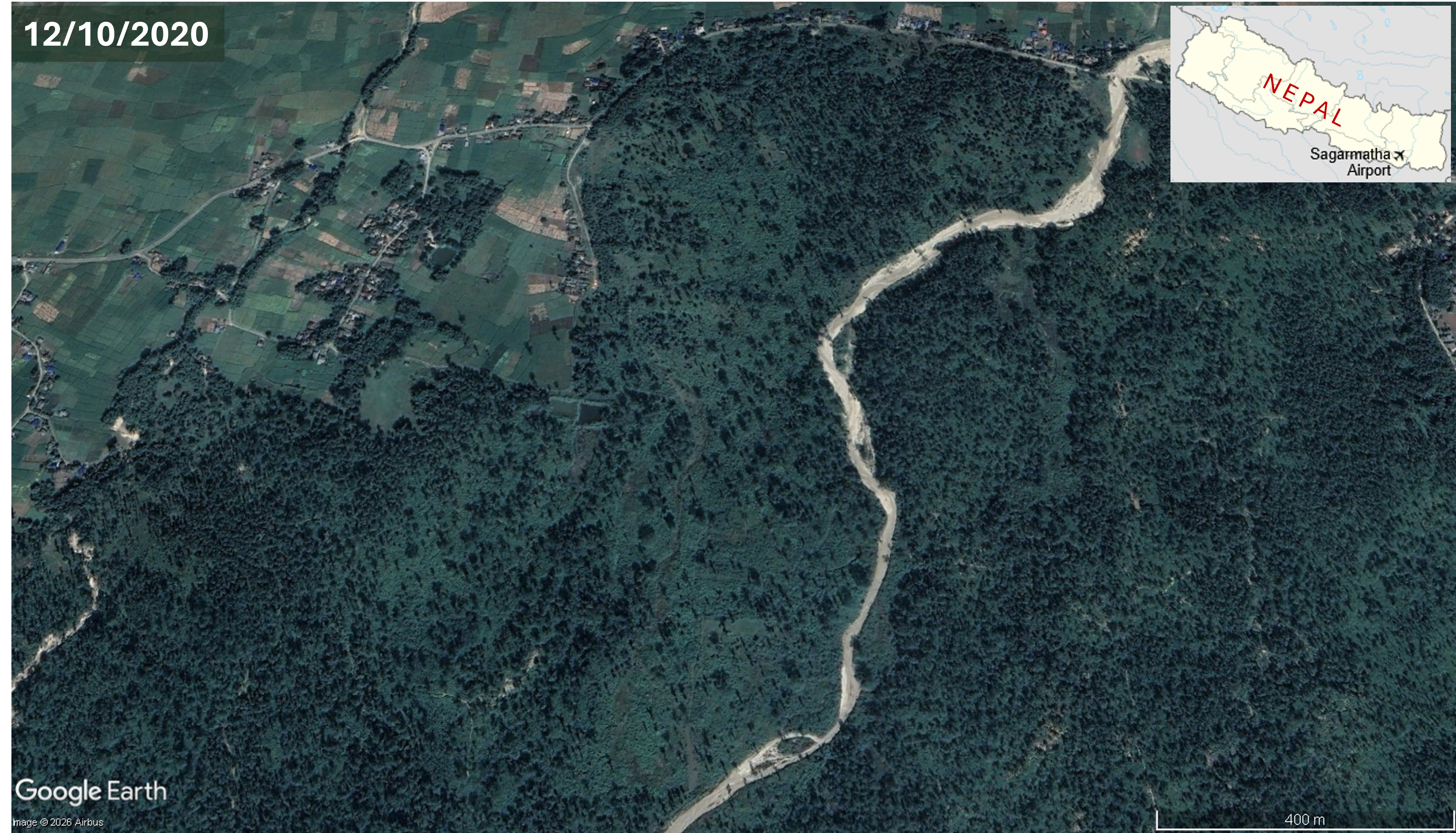
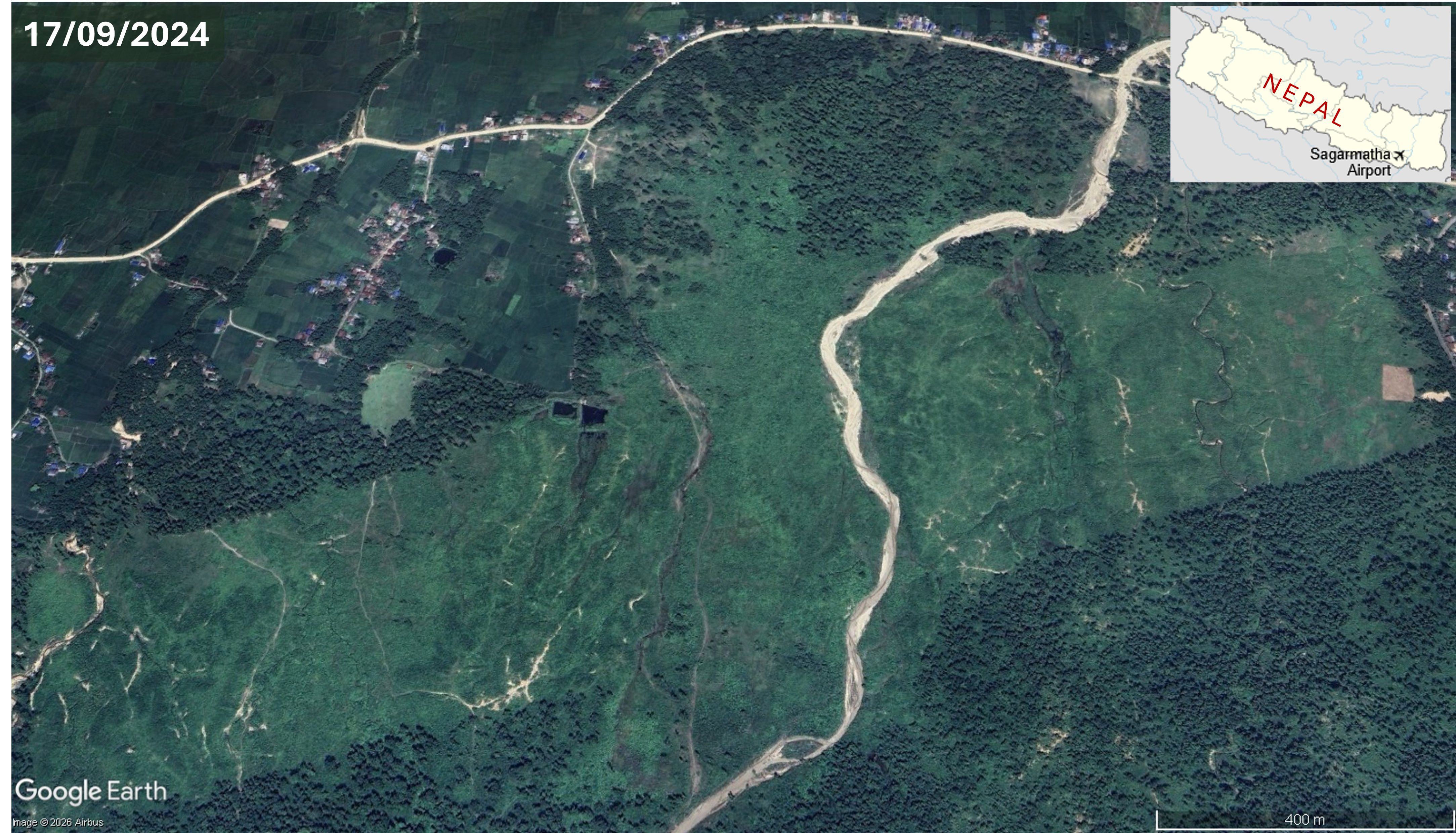
Sagarmatha Airport, 12th October 2020Sagarmatha Airport, 17th September 2024
Aerial imagery of the Sagarmatha Airport site shows deforestation in perparation for construction

The Sagarmatha Airport project, in Triyuga Municipality, Udayapur District of Koshi Province, Nepal, was first announced in 2013. According to the Environmental Impact Assessment (EIA) for the airport 35,514 trees covering 124 hectares of land would be cut down to make way for a 200 metre runway, terminal, taxiways, staff quarters and other infrastructure. In April 2018, responding to protests by local people against felling trees in the local community forest for the airport, the Triyuga Municipality began to consider building the airport on unused land along the banks of the Triyuga and Luhale rivers. A year later surveys of the proposed site were complete and the Ministry of Industry, Tourism, Forest and Environment (MoITFE) announced that construction of the airport was imminent. Site clearance for Sagarmatha Airport did entail large-scale deforestation; by November 2022 70 per cent of the trees in the 105.11 hectare area allocated for the project, at this juncture named Sagarmatha Domestic Airport, had been cut down by the company awarded the tender for construction of the airport. An agreement between the Department of Forestry and Soil Conservation, signed in February 2022, had allowed use of the forested land for the airport.

In January 2024, the Centre for Investigative Journalism-Nepal reported that the Civil Aviation Authority of Nepal (CAAN) had spent Rs 24.7 million (USD169,000) clearing forest for airport construction and approximately 13,687 trees from the community forest had been cut down and sold. Foundation stones marking the start of construction had been laid in three locations. Following a site visit in February 2024 Minister for Culture, Tourism and Civil Aviation, Sudan Kirati said the government would proceed with the airport and committed more funds, “A total of Rs 50 million has been allocated for the construction of the airport.”

In October 2025, Kathmandu Post reported that, after the forest was cleared, no construction works had taken place. The airport had not materialised and 105 hectares of forest cleared for the project was being used as grazing land for cattle. A Division Forest Office Official admitted that the timber was not fully accounted for or utilised properly and said, “Some wood was distributed to local users through community forest groups, but a large quantity was reportedly sold elsewhere”. Some locals alleged that forest officials and community forest group members had colluded in illegal sales of the highest-quality timber. A Triyuga local commented, “They destroyed the forest for an airport that never got built. What’s left now is a pastureland where people graze their cattle.” Environmentalists criticised the government for permitting forest clearance for an unviable airport project. Kushal Babu Basnet, Udayapur chair of the Federation of Community Forestry Users, said “This is a textbook case of how politically driven projects can cause irreversible environmental loss.” Responsibility for protection of the site, at risk of encroachment, was unclear with the Division Forest Office insisting that land ownership had been transferred to CAAN whereas the Land revenue Office denied any record of this.

Sagarmatha Airport is not the only abandoned airport in Nepal, the country has a history of building airports that languish unused. According to a report by CAAN, of Nepal’s 55 domestic airports only 32 were operational with just seven making a profit. A retired CAAN official includes Sagarmatha Airport in a long list of airports constructed at the behest of powerful politicians. Several airports in particularly remote areas had initially served as a ‘lifeline’ for isolated communities as there were no roads; many of these airports were built 1 – 3 hours driving distance from the national highway network. But when roads connecting these airports to national highways were constructed they were utilised by poor locals for whom the airports were not a priority. Weather is another factor affecting viability of new airports, some of which can only be used as seasonal facilities. Former CAAN director general Sanjiv Gautam explained that airport viability depends on the income of the local area, saying “many airports built in past decades have turned into grazing fields”.

Research by the Centre for Investigative Journalism-Nepal into Nepal’s abandoned airports, published in January 2024, mentions Sagarmatha Airport as one of several uncompleted and unused airports incurring significant public costs, ‘From East to West, there are more than 20 domestic airports in various stages of construction and abandonment’. Airports superseded by roads include Jiri Airport, the ‘gateway to Everest’, now used as pastureland following connection to the road network and the non-operational Tikapur Airport, in the far west of Nepal, through which locals have built a road.
Colombia: About 250 families face displacement for construction of Aerocafé Airport

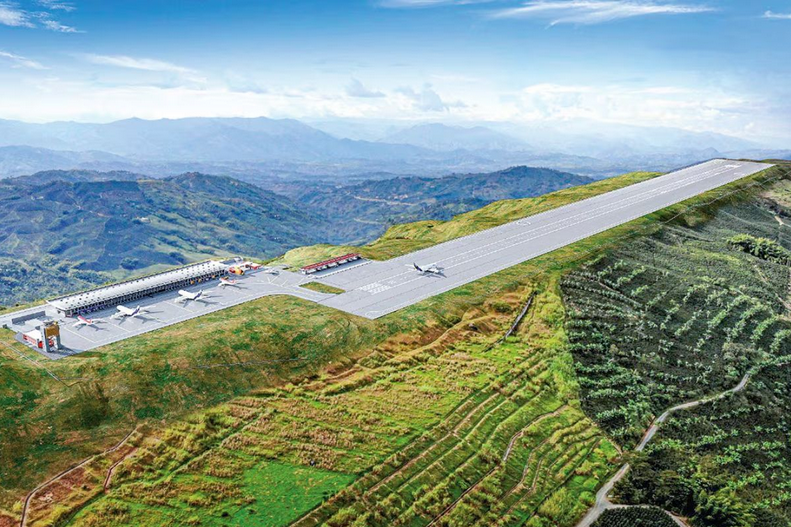
Aerocafe Airport
Rendering of Aerocafé Airport, now under construction in Palestina, Caldas. Image source: CPG Click Oil and Gas

Construction of Aerocafé Airport, in the municipality of Palestina in the south central region of the state of Caldas, part of Colombia’s coffee cultivating region known as the Coffee Triangle or Coffee Axis, is underway, The showcase infrastructure project is promoted as an engine for regional growth, anticipated to enable a 12 per cent increase in nature, adventure, cultural and gastronomic tourism. Exports including coffee, textiles and household appliances are envisaged. Yet Palestina residents in the affected area complain of uncertainty, displacement and disputes over compensation. In addition to economic concerns over resettlement the airport project has begun to impact on people’s local networks and sense of belonging. Authorities claim that the project complies with compensation and resettlement procedures. Construction of Aerocafé Airport, among the most complex and expensive in the history of the Caldas Department, is having major impacts on people occupying the area designated for the project. Land is being prepared for construction works and machinery moved in, directly affecting approximately 250 families living near the area earmarked for the runway and other structures. Entire communities will have to vacate their homes, rural property and small businesses. The Department of Caldas, Ministry of Transport and Civil Aeronautics of Colombia stated that affected residents should relocate to a planned neighbourhood providing equivalent or superior housing, with temporary compensation during the resettlement process. But this process necessitates environmental licenses, technical requirements and public hearings that are not yet completed.

These negative impacts on communities directly affected by construction are not what was promoted by the UK Government Prosperity Fund. In 2020 this scheme (a £25.5 million programme running from 2017 to 2022) provided USD1,265,000 for design studies for ‘Aerocafé, An Airport That Champions Economic Inclusion and Gender Equity’, claiming it would incorporate best practices exemplifying the principles of gender equity and social inclusion along with adherence to environmental standards. British Ambassador to Colombia, Colin Martin-Reynolds said, “This project will have a considerable impact on the economic development and livelihoods of communities in Caldas and the entire coffee producing region.” Manager of the Aeropuerto del Café Association, Amparo Sánchez Londoño, emphasised the strategic significance of the airport and foreign investment, saying, “thanks to this international cooperation, we have consultants with extensive experience in the airport sector, adding value to the design of the most important infrastructure project for the economic revival of the region.” Recent news on construction works raises serious concerns that Aerocafé Airport is failing to foster inclusive economic development for directly affected communities, or to support their livelihoods.

Plans for the Aerocafé Airport, originally named ‘Coffee Airport’, first emerged in 1977 but the project met with lengthy delays due to funding and administrative issues combined with engineering difficulties of constructing an airport on steeply sloping, unstable terrain. The site is on a plateau 1,600 metres above sea level which, following cut and grading works, could accommodate a runway more than 3 kilometres in length. In August 2021, during preparation of the site including grading (levelling the site), confirmation of sites for disposal of surplus materials and drainage works, the Civil Aeronautics of Colombia estimated that 5.8 million cubic metres of earth would need to be moved. In October 2024, 47 years after it was first mooted, the megaproject was revived when Aerocafé received a finance guarantee from the Colombian government, which meant that contracting for a further stage of construction works could commence. The investment for first phase of the project, with a 1,460 metre runway, taxiway, hangars, apron and a 6,000 square metre terminal with capacity for 1 million passengers per annum, is 828,423 million Colombian pesos (approximately USD197 million). The finance guarantee from the Ministry of Finance complemented funding from the Federal Government and Caldas State.

Zimbabwe: More than 7,000 people forcibly evicted from Willdale Farm

Forcible eviction of informal settlements from Willdale Farm, to make way for residential units, an industrial park and to support expansion of Charles Prince Airport, led to a humanitarian crisis. Over 7,000 people were left stranded by the roadside without shelter, food, water or sanitation.

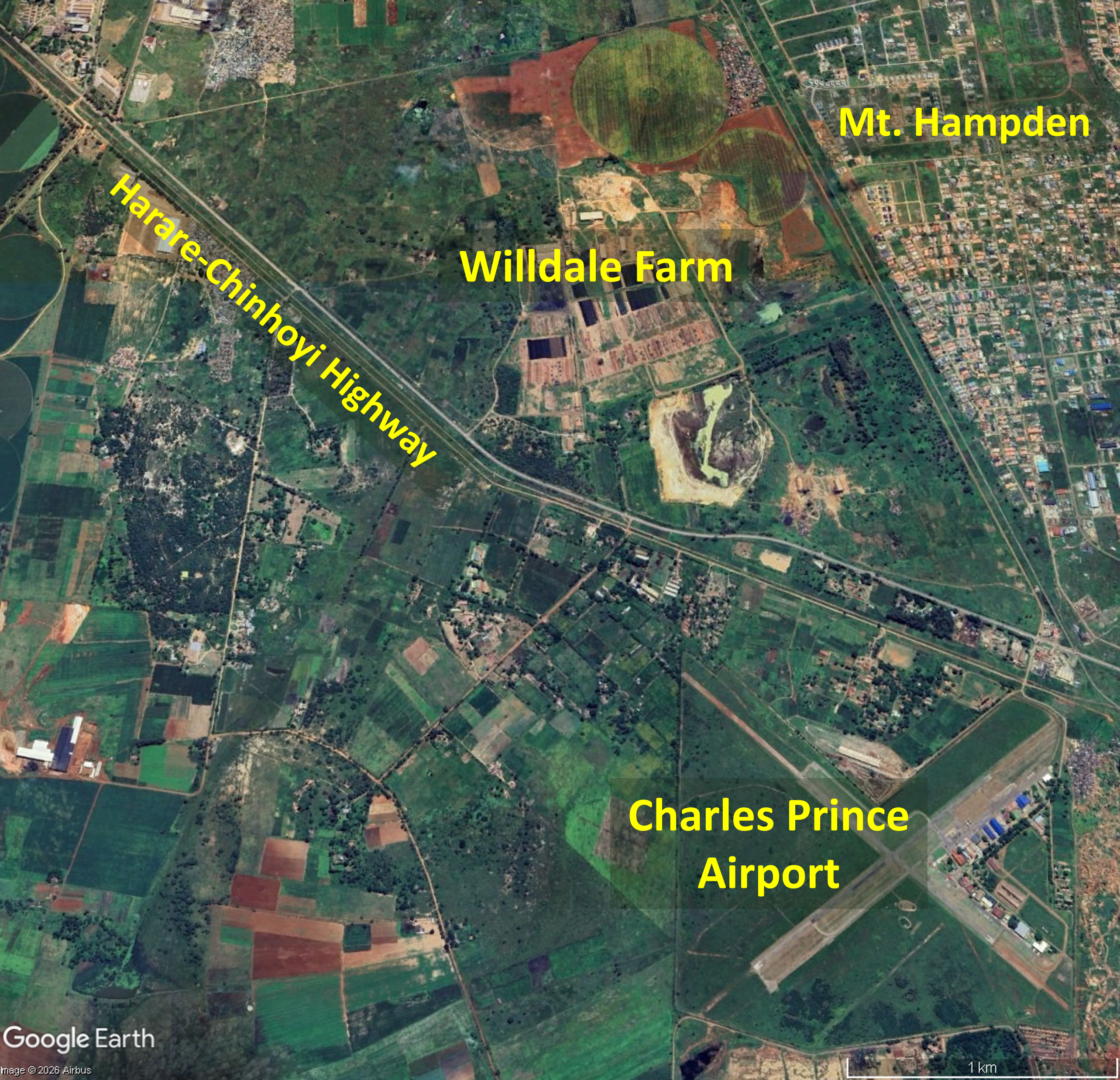
WIlldale Farm and Charles Prince Airport
Willdale Farm and Charles Prince Airport. Aerial imagery: 7th March 2025

In September 2025 more than 7,000 families residing on Willdale Farm, in the Mount Hampden area northwest of Harare, on land used for extracting clay for brick manifacturing, were served with eviction orders. Addressing the thousands of affected residents on 28th September Zimba East MP Kudakwashe Mananzva made reassurances that the government was committed to resettling all affected families and nobody would be rendered homeless. But people threatened with eviction complained that the landowner, brickmaking firm Willdale, was exerting pressure to force them to leave. On 29th November Zimbabwe Human Rights Association (ZimRights) reported that forced eviction had ’created an urgent protection crisis’. Evicted people had been left without shelter in heavy rains raising serious human rights concerns including rights to adequate housing and protection from inhumane treatment. On 2nd December New Zimbabwe reported that the ‘humanitarian crisis at Willdale Farm has deepened’; more than 7,000 residents had been evicted and were camped alongside the Harare-Chinhoyi highway to the south of Willdale Farm. The Department of Civil Protection acknowledged the scale of the eviction and said a temporary relocation site had been identified, about 14km northwest of Willdale Farm in Nyabira. State of the Nation reported widespread concerns over a ’humanitarian crisis’ affecting a vulnerable population including children and elderly people.

Zimbabwe Human Rights Commission (ZHRC) expressed serious concerns over the Willdale Farm mass eviction, flagging legal failings. On a 29th November site visit chairperson Jessie Majome saw hundreds of evicted people camped out along the road in the open air without water, sanitation or water. A 2nd December follow-up visit by the ZHRC secretariat confirmed that about 7,000 people including children, the elderly and disabled were still stranded. ZHRC said civil procedures had been violated, including the right to be heard, which might constitute a breach of constitutional rights pertaining to the right to a fair hearing and freedom from arbitrary eviction. ZHRC acknowledged efforts by the government to provide temporary alternative land in Nyabira but the relocation process was ‘extremely slow’, at this juncture nearly 8,000 people had been evicted but only 36 families had been relocated. A monitoring report by Zimbabwe Peace Project (ZPP) highlighted the Willdale Farm eviction, with families granted less than one hour to leave their homes before bulldozers arrived, as one of the most serious incidences of 123 human rights violations recorded in November 2025.

On 8th December Willdale announced that it had gained vacant possession of the 123.6314 hectares of land that had been occupied by third parties and the appointed contractor began mobilising equipment for construction of the project, an industrial park to support an emerging new city and expansion of Charles Prince Airport, located to the south of Willdale Farm and currently used by light aircraft and flights schools, into a regional hub for trade and commerce. An agreement for expansion and upgrade of Charles Prince Airport, was established between Zimbabwe and China during President Mnangagwa’s visit in 2024. Transport and Infrastructure Development Minister Felix Mhona highlighted the land and space for development around Charles Prince Airport, saying, “Once completed, the airport will serve as an international airport”, mentioning the airport’s proximity to the new Cyber City and new parliament building, located northeast of Willdale Farm. The Airports Company of Zimbabwe (ACZ) December 2025 announcement of airport infrastructure projects for the following five years highlighted upgrade of Charles Prince Airport, estimated to cost USD1 billion and supporting the government drive to establish new business and administrative hubs in the Mount Hampden area.

For more information including references for all source material, photos and videos see the case study on EJAtlas, the world’s largest, most comprehensive online database of social conflict around environmental issues – Willdale Farm mass eviction, Zimbabwe

Toulouse Airbus site expansion granted exemption from environmental law

Airbus has been granted permission to pave over 18 hectares of land for expansion of its Toulouse aircraft manufacturing site

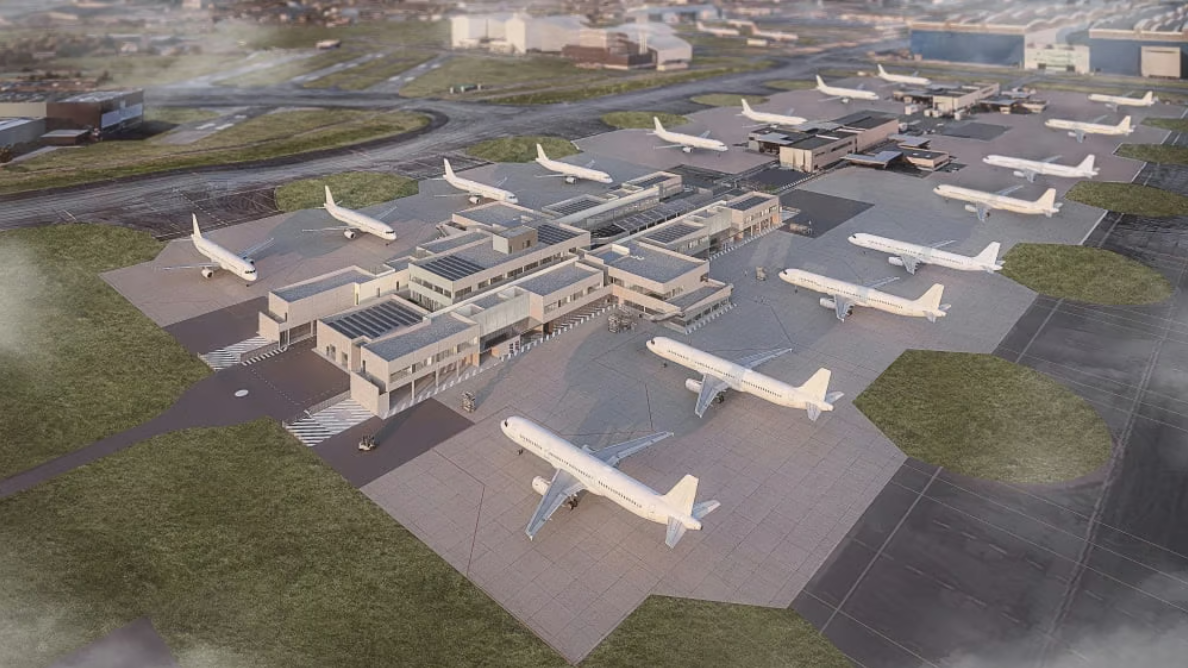
Artist’s rendering of 18 hectare expansion of Airbus aircraft manufacturing site Toulouse,
Artist’s rendering of 18 hectare expansion of Airbus aircraft manufacturing site in Toulouse. Image source: REC Architecture, La Tribune, 13/10/2025

Aircraft manufacturer Airbus’s main site, located next to Toulouse-Blagnac Airport in southern France, already covers 700 hectaes of land. In October 2025 Airbus announced that an additional 18 hectares of land will be developed to increase production of its A320 and A 321 aircraft. New storage hangars, fitting and painting halls and a new delivery centre will be constructed. This expansion would have been impossible without an exemption from the ‘net zero land take‘ provision of the Climate and Resilience Law, whereby metropolitan regions must half conversion of natural, agricultural and forest land for industrial infrastructure and housing between 2021 and 2031 in comparison to the previous decade. The Airbus expansion project benefits from permission for the state to grant exemptions for major projects designated as of significant public interest. In 2024 Airbus was granted permission to develop 54 hectares of natural, agricultural and forest areas by 2031.

There was some criticism of the government support and preferential treatment for the Airbus plant expansion. President of Friends of the Earth Midi-Pyrenees, Jean Olivier, disagreed with the claim that the project served the public interest, saying that, in addition to paving over more land, manufacturing of more planes was heading in the wrong direction and warred of increased nuisance for local residents. He also pointed out cessation of activities at a number of industrial sites in the region, suggesting the alternative of reusing these brownfield sites rather than developing greenfield sites. Haute-Garonne Green Party MP Christine Arrighi said reindustrialisation must not disregard environmental concerns and called for a halt to weakening environmental laws in the name of benefitting the economy and creating employment. At the time of the announcement, expansion works had already started at the Colomiers, Cornebarrieu and Lagardère areas of the Airbus Toulouse site. Airbus is also expanding its aircraft manufacturing sites in Germany, the USA and China.