Land clearance and consutruction of Gia Binh Airport, on the largest airport site in North Vietnam. is underway. Since approval of the project the projected passenger capacity has risen to 50 million per year by 2050. A VIP terminal is scheduled for completion in time for APEC 27.

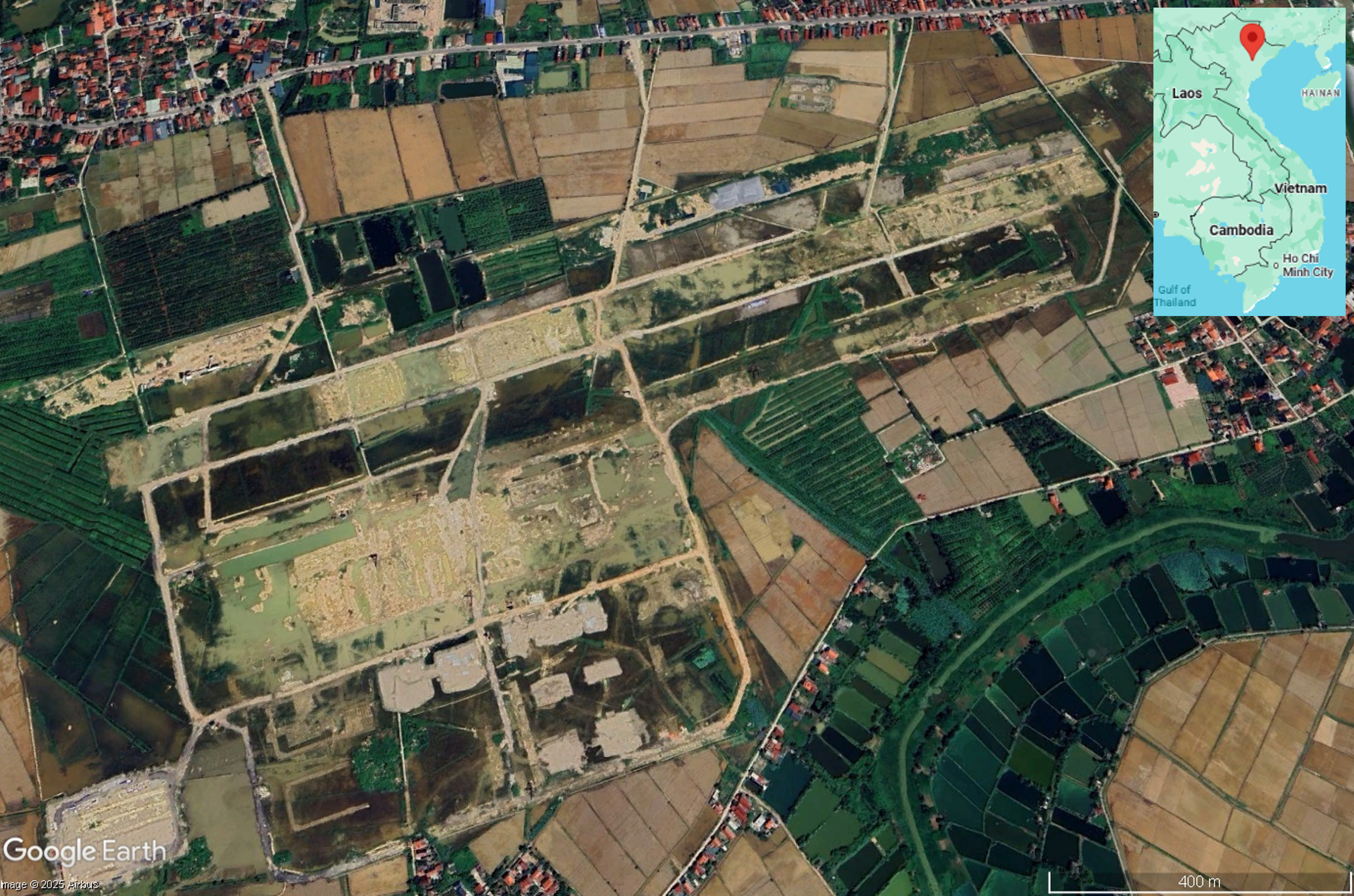
A major new airport in Gia Binh, about 40 kilometres east of Hanoi in a rural area of Vietnam’s Bac Ninh province, was approved by the Ministry of Transport in February 2025, with capacity for 1 million passengers annually by 2030, rising to 3 million by 2050. By April the planned capacity had been adjusted upwards to 5 million passengers annually by 2030 rising to 15 million by 2050. In July the size of the airport project was scaled upwards again, to handle 30 million passengers per year by 2030 then reaching 50 million by 2050. Since publication of the original plan the projected cargo volume had more than doubled, from 250,000 tons annually by 2030 growing to 1 million tons by 2050 to 1.6 million tons by 2030 growing to 2.5 million tons by 2050. With its site enlarged nearly fivefold, from an initial 408.5 hectares to 1,960 hectares, Gia Binh Airport is now set to be northern Vietnam’s largest airport, bigger than Noi Bai Airport and Tan Son Nhat Airport, exceeded only by the 5,000 hectare site of Long Thanh Airport in the southern Dong Nai province.
In August the government approved special mechanisms fast tracking investment and construction processes for the airport, related works, land clearance and resettlement, exempting projects from construction permit requirements and approving conversion of rice crop land. About 920 hectares of rice fields yielding two crops per year will be converted for the airport. Land allocated for the Gia Binh Airport site comprises about 1,184.78 hectares of agricultural land, 415 hectares of non-agricultural land, 159.4 hectares of residential land and 124.8 hectares of land utilized for defence and security purposes. Land acquisition will affect approximately 7,100 households and individuals and 118 organizations. About 5,800 households and individuals will have to relocate and resettle. The number of graves that will be moved is estimated at 18,800 but this does not include unidentified graves. Development of Gia Binh Airport is triggering one of the largest land clearances in recent history.
Schools and hospitals along with infrastructure such as irrigation systems, canals, pumping stations and power transmission lines will also have to be removed to make way for the airport and rebuilt elsewhere. About 25 historical and cultural sites must also be relocated as part of land clearance for the airport. By mid-November initial groundworks for construction of the airport and development of supporting infrastrucure were underway. Heavy machinery was operating continuously to level the airport site and barriers and signs restricted access to construction zones. The provincial government had paid more than VND1,990 trillion (USD81 million) in compensation to 4,045 households in the Gia Binh, Nhan Thang and Luong Tai communes, accelerating clearance of more than 436 hectares of land. Clearance of agricultural plots of land was scheduled to be finished by 30th November with resettlement areas due for completion by 15th December.
Gia Binh Airport will accommodate large, wide-bodied aircraft including the Boeing 777 and Airbus A330 and plans specify four runways upon completion by 2050. The investment requirement is estimated at VND 196.37 trillion (USD7.5 billion). As well as becoming a major aviation hub the airport project will open up land surrounding it for development including hotels, airport-adjacent hospitality, and airport city projects. The Ministry of Construction had considered expanding Noi Bai Airport southwards, but this would have necessitated relocation of large communities and incur high land clearance costs. With larger land reserves and more space for development than Noi Bai Airport, the government expects Gia Binh Airport to accelerate growth of industry, logistics, e-commerce and tourism.
In addition to dual-use function as a civil and military facility with a strategic role in national defence Gia Binh Airport is designed to support major diplomatic events, in particular Vietnam’s hosting of the 2027 Asia-Pacific Economic Cooperation inter-governmental forum, APEC 2027. Elite APEC officials will be among the first passengers to arrive at Gia Binh Airport; a ‘soft opening‘ in time for APEC 2027 is planned, with one runway operational along with the air traffic control tower and a VIP terminal. Many key APEC 2027 events, most notably the annual Leaders’ Summit, will take place on Phu Quoc, Vietnam’s largest island located near the south coast of Cambodia, which is rapidly developing as a luxury tourism destination. Fast-paced expansion of Phu Quoc Airport to support APEC 27 Leaders’ Week is underway. One of the high-priority projects is a VIP terminal to welcome heads of state and high-ranking delegations to the APEC 27 leaders’ meeting. Longer term plans for Phu Quoc Airport expansion aim to increase passenger capacity from the current 4 million to 50 million by 2050.


 antiaero.org