Concerns over Bhogapuram aerotropolis plan

This article was written by advocate Jogi Naidu KV Allu. It is an insightful and informative summary of key concerns over the planned aerotropolis at Bhogapuram, in the district of Vizianagaram, Andhra Pradesh. GAAM is very grateful for his contribution:

Proposed Green Field Airport in 15000 acres of ‘agriculture land’ at Bhogapuram, Vizianagaram District, Andhra Pradesh, India.

1. The project would wipe out approximately 10,000 families property, livelihood causing huge displacement.

2. The distance between the proposed Project and existing Visakhapatnam Airport is less than 25 nautical miles and is against all established norms. There should be a minimum of 150 nautical miles distance between any two airports.

3. The project would effect environment and cause ecological imbalance in the area. “Champavathi River” runs in the area.

4. The project directly effects fishermen villages who depend on both the agriculture holdings and also on the sea. Their life cycles are directly related to location. Displacing them would only nullify their fundamental rights under the constitution of India.

5. Right to property could be deprived only by authority of Law and the relevant Law for land Acquisition is the Right to Fair Compensation and Transparency in Land Acquisition, Rehabilitation and Resettlement Act, 2013. BUT the Government of Andhra Pradesh is adopting a novel unconstitutional method “Land Pooling” to avoid the implementation of 2013 Act. In other words, the Government is trying to take land without spending a single rupee.

6. There was or is NO DEMAND made by anyone from any quarter for the proposed airport at Bhogapuram.

7. The real requirement for an airport is between Viziawada and Nellore. Whereas, the Government is unnecessarily proposing airport in a region where there are five air strips in a distance of 300 KM range.

8. The existing Visakhapatnam Airport is operating at below 50% of its capacity and could take air traffic for another Twenty years. Moreover, Government has invested more than Rs.200 crores for its expansion and there is scope for further expansion with additional runway and new terminal.

9. The Government of India may think of establishing a New Airport between existing Visakhapatnam Airport and Bubaneswar Airport in Odisha. 10. The requirement of 15000 acres of Land for Green Field Airport itself stinks of interests and motives beyond establishing a mere airport. All concerned with good governance, environment, human rights and constitutional propriety should closely examine the developments of this proposed Green Field Airport at Bhogapuram.

A.K.V.JOGI NAIDU ADVOCATE

The map below includes the fertile farmland area where the aerotropolis is planned. An article in the Times of India states that the government plans to acquire land from the following villages: A Ravivalasa, Gudepuvalasa, Chepalakancheru, Kouluwada, Tudem, Basavapalli, Mujeru, Chakivalasa, Kongavanipalem, and part of Bhogapuram village. I assume ‘Mujeru’ is misspelled and actually the village of Munjeru. Amatam Ravivalasa, Gudepuvalasa, Munjeru, Chakivalasa, Kongavanipalem can be seen on the map.

Vizianagaram farmers resist land acquisition for greenfield airport

On 10th April 7,000 farmers protested against land acquisition for a ‘greenfield airport’ (on an undeveloped site) in the Vizianagaram district, near the town of Bhogapuram, on the northern coast of Andhra Pradesh. Farmers are concerned that the airport will deprive them of their lands and livelihood. The video below shows news footage of the protest. It is in the Andhra Pradesh language, Telugu, but the visuals are revealing. After 45 seconds of captions there are crowd scenes along with speakers, and is it is worth watching to get an impression of the scale and spirit of the demonstration.

The land that the government intends to acquire, a full 60 square kilometres, constitutes more than half of the 105 square kilometres of farmland in Bhogapuram. In early April it was reported that opposition to land acquisition was mounting. People from 16 villages were gearing up for a major protest and planning to blockade a major road, the NH-16 arterial highway between Chennai and Kolkata, even though they were informed by police that anyone participating in the roadblock would be arrested. An all-party meeting of villagers also decided to prevent officials from entering their villages. Senior officials had already tried to enter the village of Chakivalasa but the residents forced them to retreat. They chanted slogans like ‘don’t want airport’ and ‘go back’ and demanded improvements to vital amenities including water, housing and roads.

On 10th April farmers protested outside government offices demanding cancellation of the airport project. The number of demonstrators – 7,000 – far exceeded the 3-4,000 that had been anticipated. Several political parties supported the protesters, who were adamant that they will not give up their fertile farmland. The protest was peaceful. Demonstrators defied the police arrest threat over the roadblock plans, bringing traffic on the NH-16 highway to a halt for over an hour.

Villagers, dependent on agriculture for their livelihood, from their land which would be lost if the airport project goes ahead, accused the district administration of failing to inform them of the detail of the airport plans, including how much land would be taken from each of the villages. They are concerned that they may be forced to give up their land, and that the prices offered to farmers would be low, as has already been witnessed in nearby districts in the region where the government is attempting to acquire farmland for a new capital city for Andhra Pradesh. Karottu Satyam, president of the Bhogapuram mandal (administrative district) told reporters that ‘The government is literally pushing us onto the roads’.

The area of land the Andhra Pradesh state government intends to acquire for the airport project is vast: 60 square kilometres. The Times of India reported that the plan is actually for an aerotropolis, an airport surrounded by commercial development. Government sources stated that the 60 square kilometre site would be divided into three sections: 20 square kilometres to be set aside for the airport, 20 square kilometres for servicing aircraft i.e. an MRO (Maintenance, Repair and Overhaul) facility and an aviation academy and 20 square kilometres would be given back to the farmers as ‘developed plots’. An area of 20 square kilometres for the airport itself is even larger than the world’s busiest passenger airport, Atlanta Airport in Georgia, US, which handed more than 96 million passengers in 2014 and covers just over 15 square kilometres of land. 20 square kilometres is far more than would be required for an MRO and aviation academy, so no doubt considerable commercial development such as retail, tourism, residential and industrial facilities are planned.

The 20 square kilometres that would be given back to the farmers would be under a system called ‘land pooling’. This entails acquiring land for development by pooling parcels of land from a number of landowners. Developers then receive a large portion of the land for further real estate development. The remainder is divided into plots which are allocated to landowners, possibly with the addition of compensation for loss of agricultural income. Ajay Jain, State Energy and Infrastructure Secretary attempted to assure farmers that they would benefit from the airport project, recognizing that farmers who gave up their land for Hyderabad Airport were ‘short-changed’ because the price of the land ‘skyrocketed’ shortly after it was acquired.

But it is understandable that attempts at assuring farmers facing loss of their land for the aerotropolis are being met with scepticism. The land pooling system has already been used for acquisition of enormous tracts of fertile agricultural land, 120 square kilometres, for a planned new Andhra Pradesh capital city. The Deccan Herald described land pooling for the new city as a ‘reign of terror over the villagers/landowners’ belying government insistence that completion of the land acquisition process has been smooth and voluntary. Once farmers have signed legal documents the Capital Region Development Authority (CRDA) can take possession of the land, develop it, sell it and raise loans by mortgaging it. Evidence that the new city plans are a pretext for a land grab, primarily aimed at benefiting real estate developers, is compounded by the fact that none of the necessary clearances for the new city, such as social and environmental impact assessments, have been complied with, casting serious doubts over the feasibility of the enormously ambitious scheme.

There have been major protests against the land pooling process. On a recent visit to Rayapudi village in the Guntur district Medha Patkar, co-founder of the National Alliance of People’s Movements (NAPM), described land pooling as ‘land fooling‘, a ‘corporate conspiracy meant to grab the farmers’ land and deprive them of their livelihood’. People face removal from land they had lived on for many generations, and it will have a ‘genocidal’ effect on the rural economy. Farmers she had met with in several villages told her that they had been forced to sign consent forms for handing over land, which they were offered a mere ‘pittance’ for. Some farmers were left deprived of their only source of income. Patkar said that the CRDA land acquisition procedure is an illegal infringement of people’s rights and retired Indian Administrative Service (IAS) officer MG Devasahayam dubbed the CRDA the ‘Capital Real Estate Development Agency’.

Already, the real estate boom predicted by critics of the airport project is reported in Bhogapuram. Real estate developers are flocking to the area as the price of land has escalated at least fourfold.

Industry insight into airport-owned land

Industry websites are often enlightening regarding the workings of airport-centric commercial development (often referred to as an ‘aerotropolis’). This article in business website AreaDevelopment is a case in point. Entitled ‘Open for Business: Airports as Real Estate Developer and Strategic Partner‘ the article emphasizes the scale of airport land ownership and its role in airport income generation, seeing opportunities for business from airports as they ‘control large swathes of prime real estate’.

Airports used to be situated on the periphery of cities. Now hotels, shopping malls, tourist facilities such as casinos, offices and other business premises cluster around airports. The article explains that the majority of airports aim to attract non-aviation businesses to locate on ‘the lands and properties they control’ and that this provides a stream of ‘non-aeronautical revenue’. Many airports generate more non-aeronautical revenue than they receive in fees charged to airlines for landing and terminal services. Non-aeronautical revenue is used for airport maintenance and expansion. Thus a symbiotic relationship is established between growth of the airport and growth of the non-aviation commercial activity surrounding it. Many airport estates are so expansive that they even encompass ‘natural features like streams, beaches, and other conservation areas on their vast lands’. Undeveloped areas of natural beauty are additional assets for the airport, which can be served up as ‘attractions’ for visitors and the local community, while the airport and airport linked businesses continue with the main business of concreting over the majority of green space at their disposal for various industrial and commercial purposes.

Airport-owned land aims to host particular types of businesses – transnational firms which operate globally, import or export goods/components, require just-in-time delivery of goods/components and with staff frequently flying to and from business premises. All these are characteristics of aviation dependency. Reliance on air services is designed into the airport centric development.

The article describes the relationship between airports and surrounding development as ‘industrial ecology’. Airport centric development is indeed ‘ecology’ in the sense that there is an interdependence. But it is the very opposite of the ‘ecology’ of natural systems. Use of airport-owned land for aviation dependent business is a driver for economic growth built on profligate resource consumption, pollution, destruction of nature through building on green space and fossil fuel dependent long distance transportation. Businesses are selected as tenants on airport land on the basis that they will maximise the throughput of passengers and/or cargo. Locally based firms aiming to source inputs from nearby, to target local markets and/or transport goods using surface transport – minimizing fossil fuel use in transportation, with consequent reduction in greenhouse gases emissions – won’t get a look in.

The article is also enlightening regarding governance of the land in question, gushing enthusiastically about the high degree of autonomy that airports have over the land that they own. It makes an important distinction: airport land that is state owned is ‘not under the jurisdiction of local authorities’. And whether state owned or privatized, the airport has a high degree of self-governance, acting like a mini-state. The article enthuses over airport estates’ relative freedom from democratic control by the host community, stating that the land in question is ‘unfettered by local planning restrictions’.

Airport centric developments are evolving a dual role, combining the authority of the state (minus the the accountability that is ensured by democratic input) with the profit motive driving a corporation. As the article phrases it airports are ‘turning themselves into real estate developers, landlords and astute local authorities’. Commercial development on airport-owned land is a fast growing mechanism for state capitalism.

Investment and incentives for Cairo Airport City

The Egyptian government is encouraging investment in Cairo Airport City, a plan for an investment zone around the capital city’s airport. This article ‘Airport City project to cement Egypt as a major aviation hub in Africa and the Middle East’ is quite enlightening. It is from the WorldFolio News website, which states that it ‘provides intelligence about the economies with the highest growth potential in the world, with a focus on understanding them from within’. There are interviews with ‘key’ (i.e. most powerful) government officials and senior business executives.

H.E. Hossam Kamal, Minister of Civil Aviation is interviewed about Cairo Airport City, explaining that it will cover 10 million square metres of land (i.e. 10 square kilometres, a large development site, but actually small compared to the world’s most gigantic airport cities – Kuala Lumpur Airport owns 100 square kilometres of land and Dubai’s new airport, Al Maktoum, has been allocated a full 140 square kilometres). Anyway, the Cairo Airport City plan is the usual aerotropolis strategy: use the land around the airport for commercial and industrial activities in order to maximise revenue from non-aviation activities.

The zones planned for the aerotropolis are typical: goods handling and logistics areas linked with the airport’s cargo facilities; aviation training; hotels and restaurants to capture revenue from passengers (along with anamusement park to squeeze some revenue out of the captive audience of bored transit passengers). The solar panels planned for Cairo Airport City are not an unusual feature for an aerotropolis. Solar energy will reduce the airport city’s fuel bill but they are just a green garnish; as a whole the commercial and industrial development will lead to a massive increase in greenhouse gas emissions as it is designed to be aviation dependent, feeding airport growth.

The article makes the standard claims about supposed economic benefits to the region i.e. job creation and revenues. The latter must be weighed against incentives (subsidies such as tax breaks) which are granted to investors. Incentives are not specified but H.E. Hossam Kamal states that the marketing plan ‘significantly takes into  account offering many incentives and facilities to attract investors’.

No surprise that Cairo Airport City is linked with major surface transport infrastructure projects: there is plan for a rail link between the aerotropolis development, Ain Sokhna Port and an investment zone near the Suez Canal where, according to Kamal ‘certainly there will be a need to establish airports at the region’. Which shows that the infrastructure development will trigger more infrastructure development.

The interview ends with an outline of the incentives (i.e. subsidies) that Egypt’s Ministry of Aviation offers to international airlines. It’s quite an insight into the high level of government support for the aviation and tourism industries. International airlines are given reduced landing and waiting fees for operating at airports in ‘touristic cities’. In fact there is a 100% exemption from these fees at Luxor, Aswan, Abu Simbel and Assiut airports, for airlines using these airports as a base.

The Ministry of Aviation also pays towards the services provided to passengers at Egyptian airports: $20 per passenger on international, regular and charter flights and $4 per passenger on domestic routes. Ministers have also intervened to exempt certain airports from loading bridge fees and fire services, and duties have been reduced on aircraft weighing more than 200 tons.

Basically, the Egyptian government is falling over backwards to facilitate aviation growth.

Forests and lakes destroyed for Istanbul’s 3rd airport

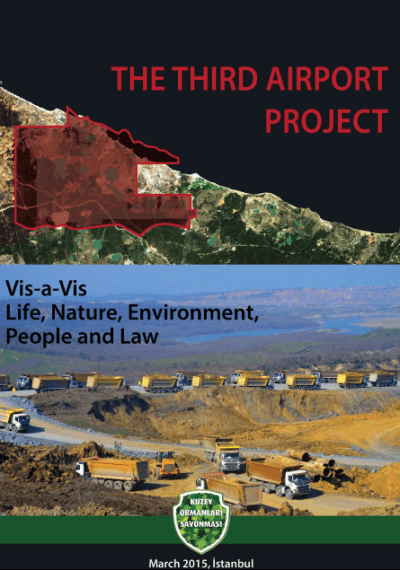
Kuzey Ormanları Savunması​ (the ‘North Forest Defence’) which campaigns to protect the forests to the north of Istanbul, has made an English language version of a shocking video. It documents the destruction of forests for the city’s third airport. Its ecocide: piles of felled trees; a long line of earth moving trucks nose to tail along the highway; bulldozers gouging away at the earth; forests, lakes and meadows destroyed. A sheep farmer explains that there is nowhere for him to tend his animals once the construction site is fenced off and fears dreadful consequences of the loss of the forest, it attracts rainfall that the city depends upon. The forest protectors want the world to know what is happening here. People sharing this video in English on social media are urged to use the hashtag #‎ResistAgainstInstanbul3rdAirport‬

The 3rd Airport Project in İstanbul Against Life, Nature, Environment, Humanity and Law from Kuzey Ormanları Savunması

The third airport is linked with other forest destroying megaprojects – a third bridge over the Bosphorus, a motorway and a canal linking the Black Sea with the Sea of Marmara. On 26th March Kuzey Ormanları Savunması​ held a press conference during which architect Mücella Yapıcı warned of irreversible ecological damage from the airport and other megaprojects, and announced that several business chambers, including the Chamber of Architects and the Chamber of Engineers, have united to open a court case relating to two Environmental Impact Reports in court. Both reports, prepared for investors, emphasised serious ecological destruction, with Yapıcı stating ‘This is the massacre of Istanbul. We cannot just sit here silently and allow this’.

At the press conference, Kuzey Ormanları Savunması​ presented its latest report. Entitled ‘Life, Nature, Environment, Humanity and the Law against the Third Airport Project‘ (article in Turkish) it explains that the megaprojects – the bridge, highway, canal and airport – are interconnected and designed to feed each others’ growth. The report also reveals that the new airport is not just an airport; it is a plan for an aerotropolis (a city built around an airport), on a site of over 76 square kilometres. Even if the new airport reaches its stated goal of 150 million passengers per year (which would make it the world’s busiest airport), the land area far exceeds that which would be required for aeronautical operations. Currently, Atlanta Airport in the US is the world’s busiest passenger airport, handling 95 million passengers per year, covering a site of 16.25 square kilometres.

The aerotropolis plan is designed to trigger development on land surrounding it including business, cultural and sports complexes, sprawling over the last remaining pristine natural areas of the area. Negative environmental impacts from felling of forests include loss of climate regulation through oxygen production and carbon sequestration. There are serious concerns over the concreting over of lakes which is a threat to Istanbul’s water supply and the loss of habitat hosting an abundance of wildlife such as wolves, insects and at least 160 species of birds.

Andal aerotropolis set for takeoff

A new airport built on a greenfield site in Andal, Bengal is due to start operations this month. It proclaims itself to be ‘India’s first airport-city project’. Partha Ghosh, Managing Director of the develop of the project, Bengal Aerotropolis Pvt Ltd (BAPL) is reported to be ‘bullish’ about the new airport’s prospects for attracting low cost airlines – and this will be helped by tax breaks offered by the West Bengal government. But even with this subsidy the airport does not expect to sufficient earnings from airline parking and landing fees. The article states that ‘the profitability of the project clearly hinges on the city-side development’ and the airport anticipates earning revenue from real estate, from residential, commercial and industrial development on land owned by the airport. Read the full article in the Hindu Businesses Line: Greenfield private airport set for takeoff

.

Aerotropolis: serving global business

Aerotropolis guru Dr. John Kasarda has written an in-depth article for Sodexo, one of the world’s largest firms. Entitled ‘Aerotropolis: Airports as the new city center‘ it is informative on how the aerotropolis serves the interests of aviation oriented global businesses. Airports serve as corporate headquarters and, apparently, the business space at some major airports, such as Paris Charles de Gaulle, is larger than the city’s central business districts. The article also indicates the scale and extent of aerotropolis developments worldwide: ‘Airport city and aerotropolis development is gaining substantial traction, multiplying rapidly on a global scale…. I’ve identified over 80 airport cities and broader aerotropolises (airport-centered urban economic regions) around the world that are either already operational or in early stages of development.’

Real estate firm predicts growth around Hyderabad and Bengaluru airports

In India, a real estate firm, Vestian Global Workplace Services, predicts growth in real estate in aerotropolis zones around two of the country’s main airports – Hyderabad and Bengaluru (Bangalore). The firm notes that hotel and MRO (Maintenance, Repair, and Overhaul of aircraft) facilities is already developing, further growth is expected on greenfield (undeveloped) land surrounding the airports. The article also states that real estate ‘activity in the government-promoted economic hubs is gaining momentum’, an indication of the government’s support for aerotropolis style development. Full article: Hyderabad, Bengaluru aerotropolis poised for take-off, says Vestian

Taoyuan campaigners’ ‘Lost Bear’ sculpture on dispay in Miaoli

Plans for an aerotropolis surrounding Taoyuan Airport, in Taiwan, involve forcible land expropriation that threatens to displace 46,000 people. Resistance against the megaproject involves innovative artwork – most notably an Alternative Land Art Festival in December 2014, on part of the farmland that the government wants to acquire for the project. The focal point of the festival was a Lost Bear sculpture standing a full 8 metres high. The Lost Bear is going on display to the south of Taoyuan, in Miaoli County. You can read an article about this, Anti-Aerotropolis ‘Lost Bear’ to go on display in Miaoli, in the Taipei Times.