Indigenous communities are protesting the expansion of Suriname’s international airport. The airport has obtained title to the neighbouring, indigenous land, and wants to expell most of the population of the Arawak villages Hollandse Kamp and Witsanti. Indigenous people reject the airport’s claim that they are the trespassers. They also protest against the airport’s dumping of untreated sewage into waterways that run through the two neigbouing Arawak villages.
Despite 500+ years of resistance, Indigenous people in Suriname are still not recognised as land owners. Suriname law doesn’t recognise collective land ownership at all. The state owns all land which is not individually owned. The government recently transfered ownership of the two indigenous villages to the state-owned International Airport of Suriname, without any consultation with the indigenous people who have lived there for generations.
For more information, contact http://www.vids.sr/
Press conference of chiefs, Hollandse Kamp, Suriname, 16 October 2015
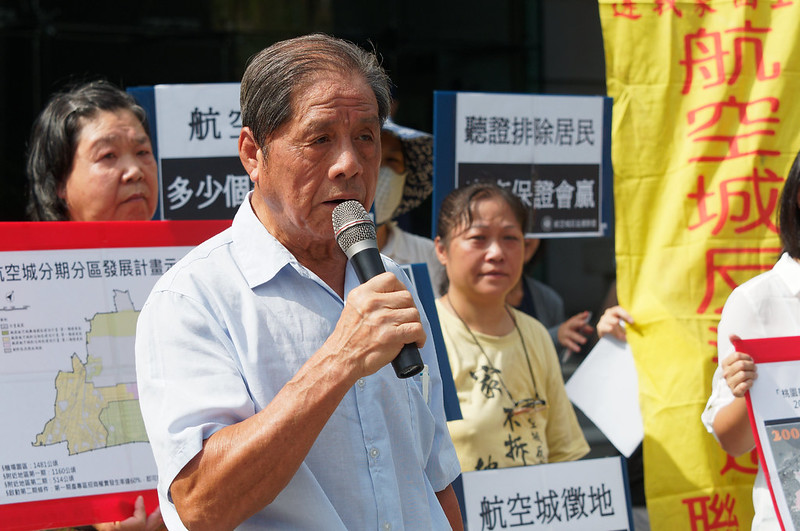
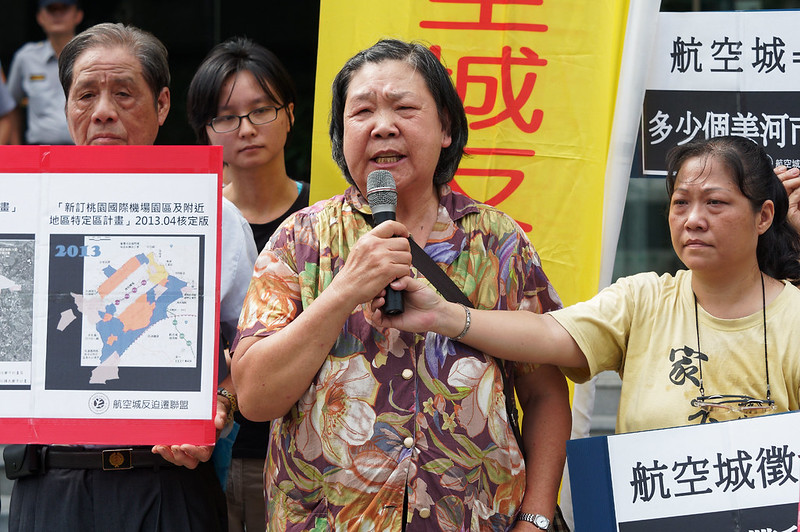
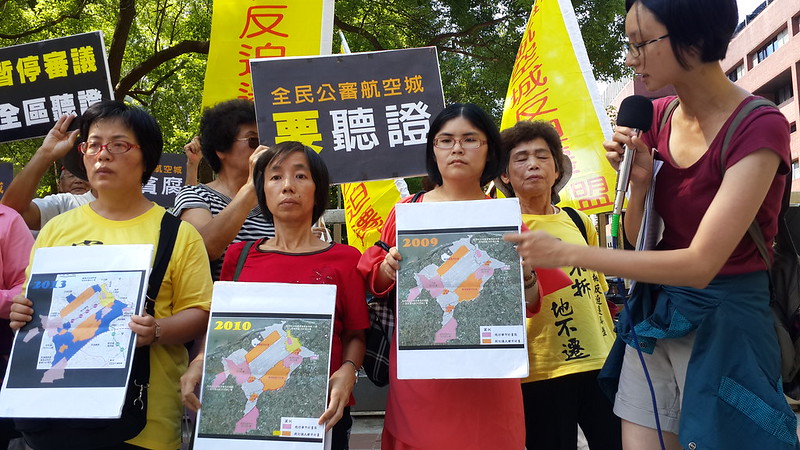
The long struggle for justice for affected people facing displacement for Taoyuan Aerotropolis continues. Planned land expropriation for Taoyuan Aerotropolis would be the largest in the history of Taiwan, taking up 4,700 hectares of land, mostly consisting of prime agricultural land, about 3,200 hectares of this land would be expropriated and 46,000 people face eviction from their homes and farmland.
On 30th September, residents from the group Alliance Against Aerotropolis Forced Evictions protested at the Ministry of Transportation and Communications over their concerns that some people will be excluded from upcoming hearings regarding the Taoyuan Aerotropolis project, submitting petitions requesting permission that they be included. The first phase of Taoyuan Aerotropolis is a third runway at the airport, the necessity of which the protesters said must be reconsidered, and development immediately surrounding it. The second phase is development over a wider area. Owners of property scheduled to be expropriated for the project’s second phase have not been invited to attend. Alliance spokesperson Wang Pao-hsuan argued that they should be able to attend as their property is included in government plans and will be forbidden from building on their land if the project is approved.
Environmental Jurists Association director Thomas Chan said that plans for the aerotropolis should ‘start from scratch’ in the light of a new ruling on from the Council of Grand Justice, which found that land should only be expropriated for infrastructure projects. This is pertinent to the planned Taoyuan Aerotropolis, which includes industrial and business parks, plus residential districts.
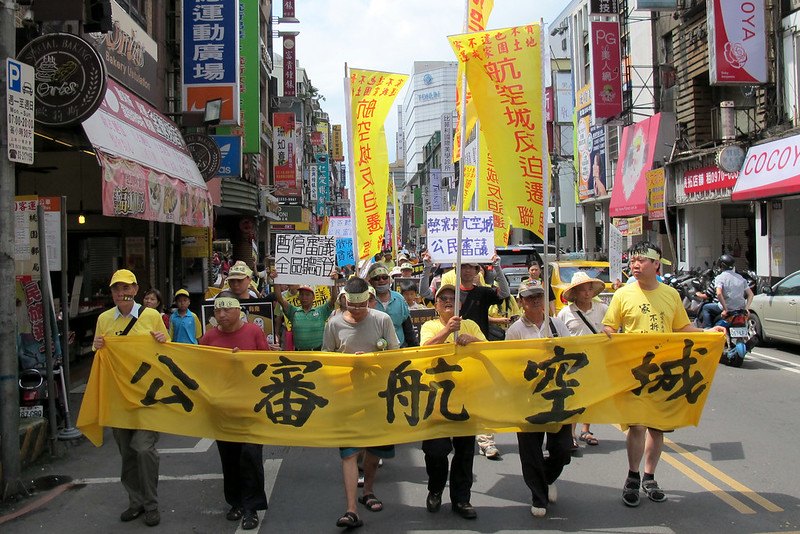
The 30th September demonstration is one of many protests against forcible land expropriation for the aerotropolis. On 11th March 2015, 300 people gathered outside government buildings in Taipei, capital city of Taiwan, demanding formal hearings . Photo by Coulloud, Creative Commons License
As with so many of the endless protests by people facing eviction for Taoyuan Aerotropolis, the demonstrators met with a heavy police presence.
TourismWatch, a quarterly newsletter that provides reports and background information about tourism in developing countries, has an article about aerotropolis developments in the September issue:
The September issue of the newsletter also contains articles about resource use in tourism, peak oil, climate justice, and the United Nations adopting new Sustainable Development Goals (SDGs).
‘Aerotropolis’ projects – commercial development around airports including facilities targeted at tourists such as hotels, retail, catering, entertainment and cultural centres – are proliferating around the world. These airport-centric developments are central to the growth of the tourism industry. In a press release to mark World Tourism Day (which has been celebrated on 27th September since 1980) the World Tourism Organization (UNWTO), the United Nations agency responsible for the promotion of tourism, calls for further growth: World Tourism Day: Celebrating the billion opportunities brought about by the tourism sector. UNWTO advocates that we “work together to maximize the immense potential of tourism to drive inclusive economic growth, protect the environment and promote sustainable development and a life of dignity for all.”
In response to UNWTO’s press release the Tourism Advocacy and Action Forum (TAAF), a founder member of the Global Anti-Aerotropolis Movement (GAAM), has released a statement, which draws attention to the sharp contrast between tourism’s benefits for the privileged, for whom the world is ever more easily accessible, and the plight of ‘irregular tourists’, people fleeing from war, poverty and persecution. Militarization of the world’s borders is infringing the rights of refugees and migrants. TAAF also criticizes UNWTO for hailing tourism a “transformative force” bringing livelihood opportunities and helping to alleviate poverty, failing to recognise that tourism can result in displacement and impoverishment, especially for people in developing countries. TAAF urges the UNWTO to “stop acting like a PR agency for the travel and tourism industry and genuinely work for the common good of humanity as deemed appropriate for a UN body”.
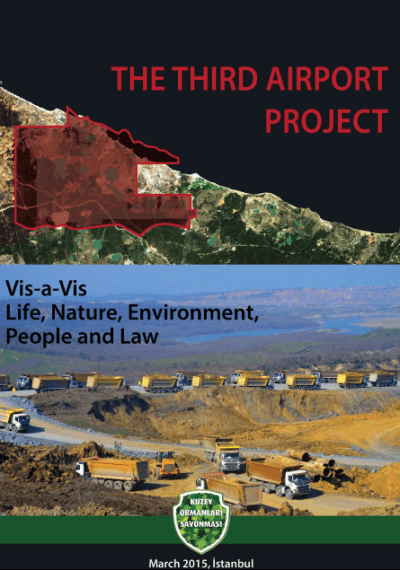
In March, Kuzey Ormanları Savunması (the ‘North Forest Defence’) which campaigns to protect the forests to the north of Istanbul from industrialization and urbanization, published a 100 page comprehensive report into Istanbul’s third airport, currently under construction. Entitled The Third Airport Project: Vis-a-Vis Life, Nature, Environment, People and Law, this report has been translated into English. It exposes the ecological destruction of the project, and examines the drive for economic growth and corporate profits that is the real reason it is being so relentlessly pursued by the government and firms that stand to benefit.
The site is gigantic, over 76 square kilometres. About 80 per cent of this area is forested, the remainder consists of 70 large and small lakes, meadows, farmland and coastline. All are being destroyed as airport construction progresses.
The reason for the gigantic site is that the plan is not for an airport. Land is being expropriated for an ‘aerotropolis’, an airport surrounded by commercial development that is designed to be aviation dependent and support growth of the airport.
Istanbul’s last large area of green space is being sacrificed for a vast urbanisation incorporating the world’s biggest duty-free shopping centre, hotels, a convention centre, sports centre, business space, a clinic and other facilities. Ostensibly, the land is allocated for an airport with the incredibly ambitious goal of handling 90 million passengers annually, ultimately becoming the world’s busiest airport with 150 million passengers passing through.
But even if the airport does indeed grow to handle this number of passengers, an eventuality regarded as unlikely within the aviation industry as well as by its critics, there will be plenty of space for commercial activity. North Forest Defence estimates the area surplus to requirements for aeronautical activities at 57 square kilometres. This is illustrated by comparison with the world’s busiest passenger airport, Atlanta in the USA, which, with a a far smaller land area of 1,625 hectares, handles about 95 million passengers per year.
Preparation of the site for construction commenced on approval of an Environmental Impact Analysis (EIA) that North Forest Defence’s work exposes as utterly inadequate, full of serious omissions and trivialising the impacts of the project. Lakes are described as ‘ponds’, the number of species at risk is under-reported and the bizarre claim is made that, of the 2.5 million trees earmarked for felling, over 1.8 million would be moved to another place, a mass replanting that is technically impossible. The reality is that the habitat of animal and plant species is being obliterated. Endangered bird species whose habitat is imperilled include the greater spotted eagle and the pygmy cormorant. Istanbul’s northern forests are one of the world’s major bird migration routes with hundreds of thousands flying over every spring and autumn. This means that the airport will endanger human life as well as birds, as there will be a considerably higher flight safety risk from bird strikes – collisions between birds and aircraft that can cause fatal air accidents.
Istanbul’s third airport has proceeded in the face of vigorous opposition from a broad coalition of environmental, community and civil organisations, plus professional associations of engineers, architects, scientists and economists. There have been endless campaign meetings and protests, in the centre of Istanbul and in villages affected by the project. The two photos below are of the protest to mark the groundbreaking ceremony for the airport, on 7th June 2014. A slideshow with more photos of this lively protest can be viewed here.
Protest against Istanbul’s third airport, 7th June 2014. Photo: MURAT DELIKLITAS/ISTANBUL-DHAForest defending protesters meet with a wall of riot police, 7th June 2014
North Forest Defence’s report is also a powerful critique of the financing of the airport, and the economic implications. The tender to construct the airport and operate it for 25 years, the biggest in the history of Turkey, was awarded to a consortium of five firms, all with close ties to the government. These firms stand to profit from operating the airport, regardless of the actual level of traffic, because of a state guarantee of liabilities that may be incurred. The consortium’s economic benefit from the airport is also assured because of revenue guarantee of €6.3 billion over 12 years, from a fee levied on the projected 342 million international passengers over this period. There is a precedent for state payment to airport operators when the projected number of passengers fail to materialise; €27 million has been paid to reimburse the operator of three of Turkeys’ airports to compensate for a shortfall. Treasury guarantees mean that the economic risks of the project fall onto citizens.
Every Turkish citizen will incur debt due to the cost of the project, which has already escalated from $16 billion to $20 billion. The airport project is part of a construction and real estate speculation frenzy that serves as Turkey’s main economic stimulus, keeping up a flow of ‘hot money’ – international capital seeking short term profits from interest rate differences and anticipated shifts in currency exchange rates – that buoys up capital markets and keeps the plates spinning.
The campaign to stop construction of Istanbul’s third airport is bolstered by an extraordinary visual record of the ecological destruction that is underway – photographs and videos. It is highly unusual for a megaproject to be documented in this way and it is extremely effective in raising the alarm over the scale and severity of the ecocide that is happening. The site is crawling with hundreds of trucks excavating and dumping earth, the level of infill required to raise and level the site is estimated at 2.5 billion square metres, and compacting the soil is on the swampy site is proving problematic.
Trucks in the Istanbul third airport excavation area, the number of trucks in the project area is expected escalate from 1,200 to 2,000
A video shows destruction of forests and meadows and filled in lakes, swathes of bare earth being worked by bulldozers, and piles of felled trees. There is nowhere left for the wild animals or for farmers to tend their sheep.
Video of storks, one of the 300 species of birds whose habitat is being destroyed for Istanbul’s third airport, flying around bewildered and traumatised in the immediate aftermath of their habitat being bulldozed.
This video, published in May 2015, shows the impact of airport construction on the coastal village of Yenikoy. It begins with a farmer explaining the ‘airport city’ plans, shows the farmland that is at risk as bulldozers move ever closer, then reveals the destruction of forest, lakes, farmland and coastline that is already underway.
Istanbul’s third airport is integrated with other ecologically destructive megaprojects – a multi-lane third bridge over the Bosphorus Strait and a canal running alongside it. Highways to provide surface access mean the loss of yet more green space. All these projects open up the virgin forests for further plunder and feed each others growth. Campaigners have stepped up their efforts to tackle these megaprojects as a package. North Forest Defence has joined forces with Istanbul Kent Suvanmasi (Istanbul City Defence) and on 5th July 2015 a new campaign was launched. The slogan is: ‘Stop the Killer Projects! Be the Breath of Istanbul‘. The forests north of Istanbul are depicted as the lungs of the city, providing oxygen for people and all life to breathe. As well as resisting the megaprojects the campaign is about envisioning and creating a future city which lives in harmony with nature rather than destroying it, taking forward the optimism that concludes North Forest Defence’s report into the third airport, the conviction that ‘it is in our hands to write another story’.
5th July 2015 – campaign meeting, ‘Stop the Killer Projects! Be the Breath of Istanbul!’. Photo: North Forest DefenceA banner is unfurled from the top of a building, it reads: ‘Stop the killer mega projects, defend 250 million trees, be the breath of Istanbul’: Photo: North Forest Defence“Stop the Killer Projects! Be the Breath Of Istanbul!” campaign ribbon, slogan translates as ‘Be the Breath’. Photo: North Forest Defence
In northern England, Leeds City Council plans to release 36.2 hectares of land to enable expansion of Leeds Bradford Airport, supporting its goal of doubling passenger numbers to 7.1 million by 2030. The land is currently designated as ‘greenbelt’ – green space surrounding urban areas that is protected from development, in order to ensure than urban dwellers have access to countryside and prevent urban sprawl. Adjacent to the airport terminal, the land in question is currently used for farming. In addition to an increase in terminal capacity to accommodate more passengers the land would be used for commercial development to support the growth of Leeds Bradford Airport – an ‘airport village’ consisting of a hotel, restaurants and shops, an air freight park and an ‘air innovation park’.
On 15th July opponents to Leeds Bradford Airport’s plans to concrete over greenbelt land gathered to protest outside the Leeds City Council Executive Board meeting which discussed the plans for a few minutes. As documented in the minutes of the meeting, attendees emphasized the Council’s continued support for expansion of the airport. The only note of caution was an assurance that consultation with ‘all relevant parties’ would be widespread and thorough.
Protest against allocation of greenbelt land for commercial development to support growth of Leeds Bradford Airport, 15th July 2015
The report proposing allocating the 36.2 hectares of greenbelt land to Leeds Bradford Airport had already been discussed at the Development Plan Panel on 26th June 2015. Its a lengthy document – 176 pages long. On page 5, the issue that land at the airport is already allocated for ’employment’ so therefore available for development, with most of it remaining under occupied, is raised. Airport supporters’ response to this point is that the scale of land allocation proposed will make it an attractive location, and it will be supported by promotion and marketing internationally to prospective tenants. Bizarrely, the supposed solution to vacant business space is supposedly to provide even larger space, and the established business space should have received more promotion and marketing support to reduce the risk of it languishing unoccupied.
This map shows the greenbelt land, currently used for farming, that Leeds City Council wishes to release for commercial development to support expansion of Leeds Bradford Airport – the area within the red line
It is not as if there is a shortage of business space in Leeds or Bradford. Both cities have plenty of vacant business premises, already constructed or on land with planning permission for industrial/warehouse development. An industry website lists 157 industrial properties available to rent in Leeds. The largest is a new development, Leeds Distribution Park, adjacent to Junction 47 of the M1 Motorway, with planning permission for industrial/warehouse development up to a maximum single footprint of 750,000 sq ft (17 acres). The website lists 40 industrial properties available to rent in Bradford. The largest is Bronte Business Park, boasting 16 acres of development land allocated for employment use.
Leeds Bradford Airport, and its supporters at Leeds City Council, aims to support commercial development on greenbelt land with more than just promotion and marketing. They are angling for ‘Mini-Enterprise Zone’ status, as stated on the the document submitted to the Development Plan Panel, see page 13. This is already in place elsewhere in England, including at Manchester and Newquay airports. Designation as an ‘Enterprise Zone’ is a subsidy, as tenants are gifted a Business Rate tax exemption of up to £275,000 per eligible business. This tax break is unfair and unwarranted preferential treatment for tenants that are fortunate to be in the Enterprise Zone. In the case of airports, space in the Enterprise Zone is granted to businesses that are aviation dependent, thus maximizing use of the airport’s passenger and/or cargo facilities and facilitating airport growth.
Businesses which do locate in the Enterprise Zone may not even create jobs, as firms will be incentivized to relocate from other premises in order to take advantage of the tax break. The argument that the airport-linked commercial development will boost the economy for neighbouring communities and the wider region, which the proponents of the project are most insistent about, is flawed. The shops, restaurant and hotel that are planned would result in air passengers spending more of their time, and money, on airport land, instead of stimulating economic activity in Leeds Bradford Airport’s host community.
Another aspect of the rationale for commercial development on green space is to strengthen the case for more ‘surface access’ to Leeds Bradford Airport. This means construction of another road link, a dual carriageway from the A65 in Rawdon to the A658. It would not come cheap and taxpayers would have to foot the bill. It is anticipated that public sector funding will be confirmed for the new link road. The route of this road plan is not revealed. Figure 13 in the report discussed by the Development Plan Panel entitled ‘Indicative Alignment of New LBIA Road Link’ is not actually included in the report, it is ‘TBC’, left blank. Already, Rawdon Greenbelt Action Group is campaigning against the link road; they are concerned that enormous swathes of greenbelt land will be damaged or lost altogether, along with the special landscape character of the area.
Leeds Bradford Airport’s ‘airport city’ plans are a smaller scale version of aerotropolis development that is already underway across the Pennine hills, at Manchester Airport. This is opposed by the Stop Expansion at Manchester Airport campaign group. There is also a Facebook page. Airport-linked business premises is being constructed on land formerly designated as ‘greenbelt’ and, under the guise of alleviating traffic congestion, construction of a link road, costing £290 million in public funds, has commenced. Calling the road a ‘relief road’ does not disguise the fact that it is designed to increase traffic to and from the airport. Most recently, hundreds of residents of High Lane village in Stockport, on the route of the new road, turned up to an exhibition to express their concerns over increased air pollution, noise and vibration from heavy vehicles.
There is strong opposition to aerotropolis development on green space, and associated road infrastructure, at both Leeds Bradford and Manchester airports. Linking up these campaigns will strengthen them.
The Ecologist website has published an article outlining some of the key aerotropolis developments worldwide, and the ecological, social and economic problems caused by these destructive megaprojects.
Governments and corporations are driving a global wave of ecologically disastrous airport-centered mega-projects each destroying as much of 100 sq.km of farmland and forests – sucking water, resources and economic activity from surrounding areas, excluding host communities and locking in high-carbon infrastructure for decades to come.
The aerotropolis is a disastrous model of development. Those working for social, economic and environmental justice must unite in opposing the fast-tracked planning and construction that is taking place around the world.
This article was written by advocate Jogi Naidu KV Allu. It is an insightful and informative summary of key concerns over the planned aerotropolis at Bhogapuram, in the district of Vizianagaram, Andhra Pradesh. GAAM is very grateful for his contribution:
Proposed Green Field Airport in 15000 acres of ‘agriculture land’ at Bhogapuram, Vizianagaram District, Andhra Pradesh, India.
1. The project would wipe out approximately 10,000 families property, livelihood causing huge displacement.
2. The distance between the proposed Project and existing Visakhapatnam Airport is less than 25 nautical miles and is against all established norms. There should be a minimum of 150 nautical miles distance between any two airports.
3. The project would effect environment and cause ecological imbalance in the area. “Champavathi River” runs in the area.
4. The project directly effects fishermen villages who depend on both the agriculture holdings and also on the sea. Their life cycles are directly related to location. Displacing them would only nullify their fundamental rights under the constitution of India.
5. Right to property could be deprived only by authority of Law and the relevant Law for land Acquisition is the Right to Fair Compensation and Transparency in Land Acquisition, Rehabilitation and Resettlement Act, 2013. BUT the Government of Andhra Pradesh is adopting a novel unconstitutional method “Land Pooling” to avoid the implementation of 2013 Act. In other words, the Government is trying to take land without spending a single rupee.
6. There was or is NO DEMAND made by anyone from any quarter for the proposed airport at Bhogapuram.
7. The real requirement for an airport is between Viziawada and Nellore. Whereas, the Government is unnecessarily proposing airport in a region where there are five air strips in a distance of 300 KM range.
8. The existing Visakhapatnam Airport is operating at below 50% of its capacity and could take air traffic for another Twenty years. Moreover, Government has invested more than Rs.200 crores for its expansion and there is scope for further expansion with additional runway and new terminal.
9. The Government of India may think of establishing a New Airport between existing Visakhapatnam Airport and Bubaneswar Airport in Odisha. 10. The requirement of 15000 acres of Land for Green Field Airport itself stinks of interests and motives beyond establishing a mere airport. All concerned with good governance, environment, human rights and constitutional propriety should closely examine the developments of this proposed Green Field Airport at Bhogapuram.
A.K.V.JOGI NAIDU ADVOCATE
The map below includes the fertile farmland area where the aerotropolis is planned. An article in the Times of India states that the government plans to acquire land from the following villages: A Ravivalasa, Gudepuvalasa, Chepalakancheru, Kouluwada, Tudem, Basavapalli, Mujeru, Chakivalasa, Kongavanipalem, and part of Bhogapuram village. I assume ‘Mujeru’ is misspelled and actually the village of Munjeru. Amatam Ravivalasa, Gudepuvalasa, Munjeru, Chakivalasa, Kongavanipalem can be seen on the map.
On 10th April 7,000 farmers protested against land acquisition for a ‘greenfield airport’ (on an undeveloped site) in the Vizianagaram district, near the town of Bhogapuram, on the northern coast of Andhra Pradesh. Farmers are concerned that the airport will deprive them of their lands and livelihood. The video below shows news footage of the protest. It is in the Andhra Pradesh language, Telugu, but the visuals are revealing. After 45 seconds of captions there are crowd scenes along with speakers, and is it is worth watching to get an impression of the scale and spirit of the demonstration.
The land that the government intends to acquire, a full 60 square kilometres, constitutes more than half of the 105 square kilometres of farmland in Bhogapuram. In early April it was reported that opposition to land acquisition was mounting. People from 16 villages were gearing up for a major protest and planning to blockade a major road, the NH-16 arterial highway between Chennai and Kolkata, even though they were informed by police that anyone participating in the roadblock would be arrested. An all-party meeting of villagers also decided to prevent officials from entering their villages. Senior officials had already tried to enter the village of Chakivalasa but the residents forced them to retreat. They chanted slogans like ‘don’t want airport’ and ‘go back’ and demanded improvements to vital amenities including water, housing and roads.
On 10th April farmers protested outside government offices demanding cancellation of the airport project. The number of demonstrators – 7,000 – far exceeded the 3-4,000 that had been anticipated. Several political parties supported the protesters, who were adamant that they will not give up their fertile farmland. The protest was peaceful. Demonstrators defied the police arrest threat over the roadblock plans, bringing traffic on the NH-16 highway to a halt for over an hour.
Villagers, dependent on agriculture for their livelihood, from their land which would be lost if the airport project goes ahead, accused the district administration of failing to inform them of the detail of the airport plans, including how much land would be taken from each of the villages. They are concerned that they may be forced to give up their land, and that the prices offered to farmers would be low, as has already been witnessed in nearby districts in the region where the government is attempting to acquire farmland for a new capital city for Andhra Pradesh. Karottu Satyam, president of the Bhogapuram mandal (administrative district) told reporters that ‘The government is literally pushing us onto the roads’.
The area of land the Andhra Pradesh state government intends to acquire for the airport project is vast: 60 square kilometres. The Times of India reported that the plan is actually for an aerotropolis, an airport surrounded by commercial development. Government sources stated that the 60 square kilometre site would be divided into three sections: 20 square kilometres to be set aside for the airport, 20 square kilometres for servicing aircraft i.e. an MRO (Maintenance, Repair and Overhaul) facility and an aviation academy and 20 square kilometres would be given back to the farmers as ‘developed plots’. An area of 20 square kilometres for the airport itself is even larger than the world’s busiest passenger airport, Atlanta Airport in Georgia, US, which handed more than 96 million passengers in 2014 and covers just over 15 square kilometres of land. 20 square kilometres is far more than would be required for an MRO and aviation academy, so no doubt considerable commercial development such as retail, tourism, residential and industrial facilities are planned.
The 20 square kilometres that would be given back to the farmers would be under a system called ‘land pooling’. This entails acquiring land for development by pooling parcels of land from a number of landowners. Developers then receive a large portion of the land for further real estate development. The remainder is divided into plots which are allocated to landowners, possibly with the addition of compensation for loss of agricultural income. Ajay Jain, State Energy and Infrastructure Secretary attempted to assure farmers that they would benefit from the airport project, recognizing that farmers who gave up their land for Hyderabad Airport were ‘short-changed’ because the price of the land ‘skyrocketed’ shortly after it was acquired.
But it is understandable that attempts at assuring farmers facing loss of their land for the aerotropolis are being met with scepticism. The land pooling system has already been used for acquisition of enormous tracts of fertile agricultural land, 120 square kilometres, for a planned new Andhra Pradesh capital city. The Deccan Herald described land pooling for the new city as a ‘reign of terror over the villagers/landowners’ belying government insistence that completion of the land acquisition process has been smooth and voluntary. Once farmers have signed legal documents the Capital Region Development Authority (CRDA) can take possession of the land, develop it, sell it and raise loans by mortgaging it. Evidence that the new city plans are a pretext for a land grab, primarily aimed at benefiting real estate developers, is compounded by the fact that none of the necessary clearances for the new city, such as social and environmental impact assessments, have been complied with, casting serious doubts over the feasibility of the enormously ambitious scheme.
There have been major protests against the land pooling process. On a recent visit to Rayapudi village in the Guntur district Medha Patkar, co-founder of the National Alliance of People’s Movements (NAPM), described land pooling as ‘land fooling‘, a ‘corporate conspiracy meant to grab the farmers’ land and deprive them of their livelihood’. People face removal from land they had lived on for many generations, and it will have a ‘genocidal’ effect on the rural economy. Farmers she had met with in several villages told her that they had been forced to sign consent forms for handing over land, which they were offered a mere ‘pittance’ for. Some farmers were left deprived of their only source of income. Patkar said that the CRDA land acquisition procedure is an illegal infringement of people’s rights and retired Indian Administrative Service (IAS) officer MG Devasahayam dubbed the CRDA the ‘Capital Real Estate Development Agency’.
Already, the real estate boom predicted by critics of the airport project is reported in Bhogapuram. Real estate developers are flocking to the area as the price of land has escalated at least fourfold.
Industry websites are often enlightening regarding the workings of airport-centric commercial development (often referred to as an ‘aerotropolis’). This article in business website AreaDevelopment is a case in point. Entitled ‘Open for Business: Airports as Real Estate Developer and Strategic Partner‘ the article emphasizes the scale of airport land ownership and its role in airport income generation, seeing opportunities for business from airports as they ‘control large swathes of prime real estate’.
Airports used to be situated on the periphery of cities. Now hotels, shopping malls, tourist facilities such as casinos, offices and other business premises cluster around airports. The article explains that the majority of airports aim to attract non-aviation businesses to locate on ‘the lands and properties they control’ and that this provides a stream of ‘non-aeronautical revenue’. Many airports generate more non-aeronautical revenue than they receive in fees charged to airlines for landing and terminal services. Non-aeronautical revenue is used for airport maintenance and expansion. Thus a symbiotic relationship is established between growth of the airport and growth of the non-aviation commercial activity surrounding it. Many airport estates are so expansive that they even encompass ‘natural features like streams, beaches, and other conservation areas on their vast lands’. Undeveloped areas of natural beauty are additional assets for the airport, which can be served up as ‘attractions’ for visitors and the local community, while the airport and airport linked businesses continue with the main business of concreting over the majority of green space at their disposal for various industrial and commercial purposes.
Airport-owned land aims to host particular types of businesses – transnational firms which operate globally, import or export goods/components, require just-in-time delivery of goods/components and with staff frequently flying to and from business premises. All these are characteristics of aviation dependency. Reliance on air services is designed into the airport centric development.
The article describes the relationship between airports and surrounding development as ‘industrial ecology’. Airport centric development is indeed ‘ecology’ in the sense that there is an interdependence. But it is the very opposite of the ‘ecology’ of natural systems. Use of airport-owned land for aviation dependent business is a driver for economic growth built on profligate resource consumption, pollution, destruction of nature through building on green space and fossil fuel dependent long distance transportation. Businesses are selected as tenants on airport land on the basis that they will maximise the throughput of passengers and/or cargo. Locally based firms aiming to source inputs from nearby, to target local markets and/or transport goods using surface transport – minimizing fossil fuel use in transportation, with consequent reduction in greenhouse gases emissions – won’t get a look in.
The article is also enlightening regarding governance of the land in question, gushing enthusiastically about the high degree of autonomy that airports have over the land that they own. It makes an important distinction: airport land that is state owned is ‘not under the jurisdiction of local authorities’. And whether state owned or privatized, the airport has a high degree of self-governance, acting like a mini-state. The article enthuses over airport estates’ relative freedom from democratic control by the host community, stating that the land in question is ‘unfettered by local planning restrictions’.
Airport centric developments are evolving a dual role, combining the authority of the state (minus the the accountability that is ensured by democratic input) with the profit motive driving a corporation. As the article phrases it airports are ‘turning themselves into real estate developers, landlords and astute local authorities’. Commercial development on airport-owned land is a fast growing mechanism for state capitalism.