South Africa: Vaal Aerotropolis could take up more than 12,000 hectares of farmland

The Vaal Aerotropolis site encompasses a large area of farmland. Two runways, two terminals, an Airport City, solar farm and ‘vast agri-zones’ for air exports of agricultural produce and live animals are planned. Project partners view designation as, or inclusion within, a special economic zone (SEZ) as essential for attracting investors.
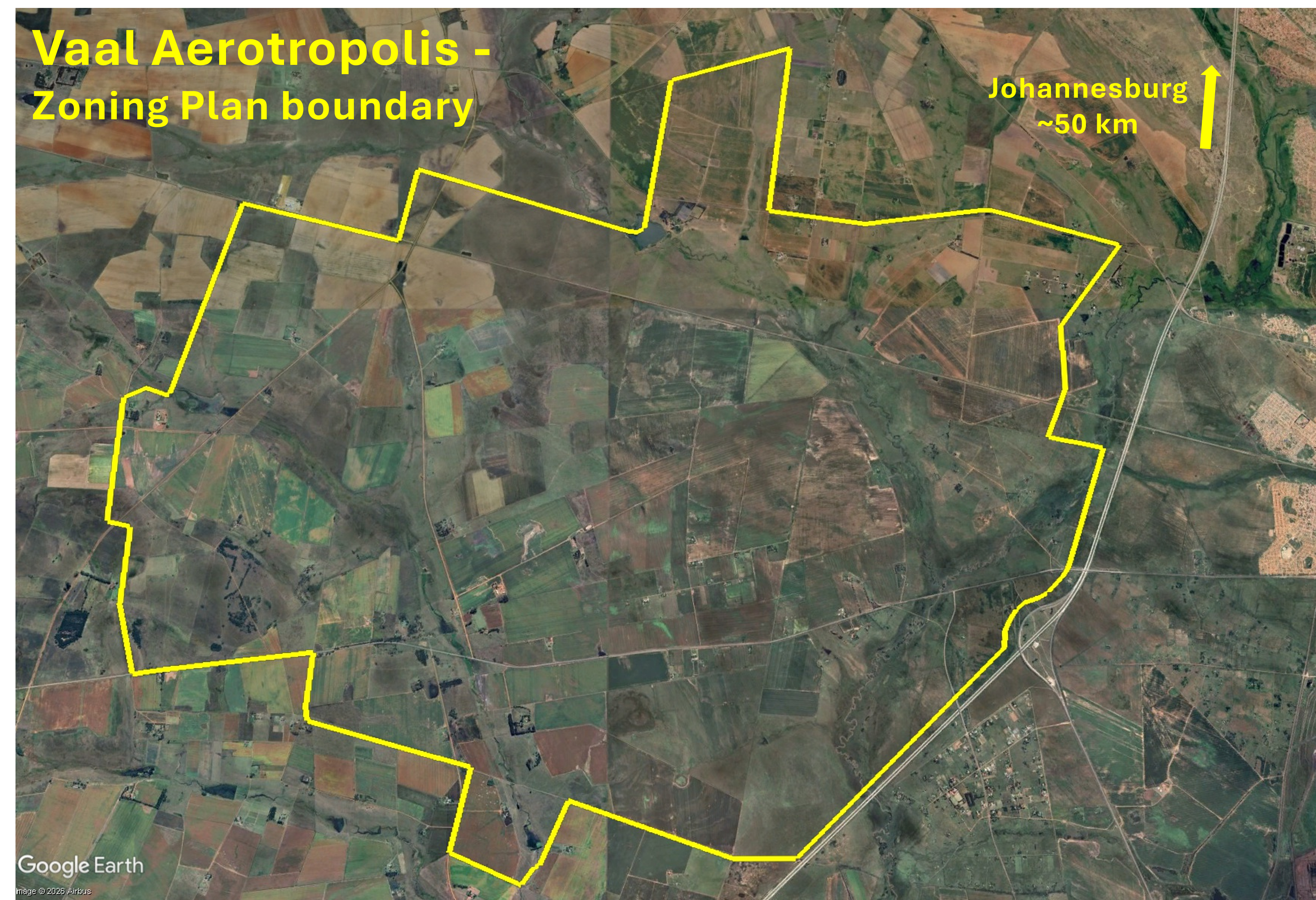
Vaal Aerotropolis - Zoning Plan boundary, 24th Jan 2026
The Vaal Aerotropolis site is predominantly farmland and adjacent to the N1 highway. This graphic overlays the Zoning Plan boundary of a 11,400 hectare site shown in the Vaal Aerotropolis Local Spatial Development Framework, page 35, onto aerial imagery dated 24/01/2026.

A multi-decade aerotropolis project

In April 2026, South Africa’s Department of Trade, Industry and Competition (dtic) announced public consultations, allowing comments and input from the local community, on designation of the Vaal Special Economic Zone (SEZ). Led by the Gauteng Growth and Development Agency (GGDA) the initiative includes a smart city and a new international airport, all to be supported by a ‘new “aerotropolis” – an industry term referring to an economic zone built around a major airport’. It was stated that the airport will be ‘supported by an extensive road network’ including direct access to the N1 highway, which is to the west of the site, so only a 50-minute journey from central Johannesburg. Nearly three years previously, in May 2023 Citibank South Africa, a subsidiary of US-based financial holding company Citigroup Inc., announced its investment in a ‘multi-decade aerotropolis project’ in the Vaal area, pledging R1.375 billion (USD84 million) having already applied for rezoning of the proposed development area into a special economic zone (SEZ). At an event held with dtic, Citibank SA’s Chief Country Officer Peter Taylor addressed the media, saying, “This is a massive infrastructure project. The timing of the airport itself will depend on a few things: the zoning, the licensing, the authority for the port etc. But a lot of work has gone into this. A lot of those [things] are being finalised. We are making an application for a an SEZ (special economic zone), which will encompass this area that the airport will be built in.”

Vaal AeroZone

Citibank SA is a major investor in Vaal AeroZone, the developer of Vaal Aerotropolis. Other partners in the Public Private Partnership (PPP) are the dtic, Gauteng Provincial Government, Sedibeng District Municipality, Emfuleni Local Municipality, PAPE Funds and Vaal Aerotropolis Design. The text at the top of the website home page reads like advertising for a particularly high-end VIP terminal: ‘VAAL AEROTROPOLIS: Pioneering a Sustainable Future for Travel and Innovation. Experience the future of luxury travel and innovation, where seamless connectivity meets sustainable opulence, shaping a world of refined possibilities.’ Yet in spite of the projected high passenger numbers, an initial capacity of 7.2 million per year (significantly higher than King Shaka Airport, the country’s third busiest airport handling just over 5.6 million passengers in 2025-26), the emphasis of the Vaal Airport project is on air cargo, ‘Vaal Aerotropolis will be the only airport in Gauteng where integrated air cargo services are designed and planned as a priority’, with initial capacity to handle 150,000 tonnes per year. Small blocks of text about development of a trade and logistics hub are packed with hype and superlatives: ‘VAAL AEROZONE: SHAPING THE FUTURE OF GLOBAL TRADE, Driving innovation, investment, and sustainable growth in the Sedibeng District’, ‘VAAL AEROTROPOLIS: A GATEWAY TO GLOBAL TRADE, Transforming the Sedibeng District into a world-class trade and logistics hub’. ‘A catalyst for economic transformation’. Green claims are prominent in the ‘AFRICA’S PREMIER GREEN AEROTROPOLIS’ and ‘CUTTING EDGE GREEN AIRPORT CITY’ sections. A timeline begins with inception of the project in 2020 and extends through to Phase 3 development commencing in 2068. A ‘GLIMPSE INTO THE FUTURE’ gallery consists of three computer generated graphics of generic airport buildings.

A video manifestation

The AI generated voiceover of a promotional video, Vaal Aerotropolis: A Gateway to Global Trade. published on 18th November 2024, refers to the components of the project – Airport, Airport City, Agri Zone, Trade Zone and Solar Farm – as if they already exist or are inevitable; the word ‘will’ occurs eleven times. Graphics show development of Vaal Aerotropolis in three phases. The project, with two terminals, two runways, supported by the existing road and rail network along with future upgrades and interchanges, is called ‘a gateway to the continent’, ‘a lush aviation oasis’. A ‘great passenger experience’ is promised and ‘Vaal Airport City, one of the first purpose-built aviation cities in Africa’ sounds like a high-end development, with ‘fully serviced premium offices, retail, hospitality, medical and leisure spaces in an urban, minimum 4-star green rating’. But the envisaged facilities for passengers are dwarfed by plans for a 1,000-hectare solar farm and ‘vast agri-zones’ for ‘production of agricultural products amenable for transport by air.’ Enormous volumes of air exports of farm produce are anticipated, ‘This hi-tech agri-cluster is the largest climate controlled growing area on the continent, an integrated perishable supply chain’ (perishable air cargo is produce requiring a temperature-controlled cold-chain such as fruit, vegetables, meat, fish and flowers). Apparently, herds of livestock will be boarding flights, departing from ‘the first live animal holding area for transport by air in South Africa’.
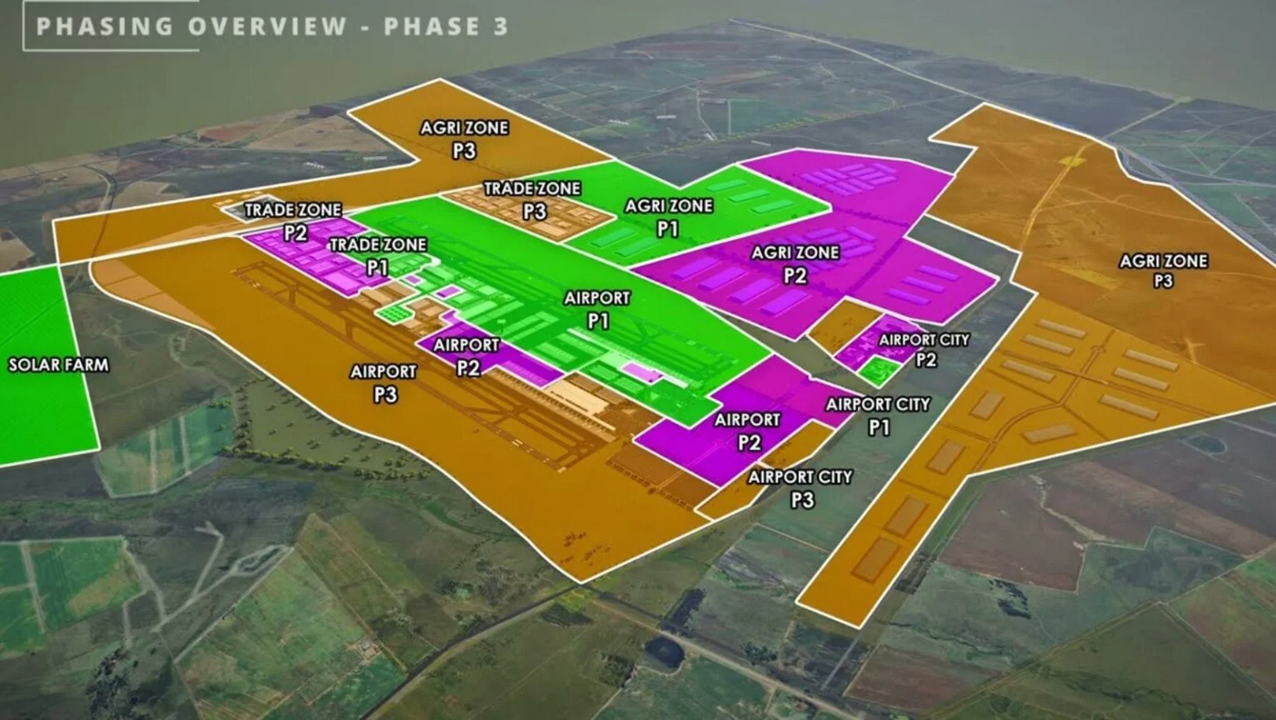
Map of phases 1,2 and 3 of Vaal Aerotropolis
November 2024 map of phases 1, 2 and 3 of Vaal Aerotropolis. Graphic from video: Vaal Aerotropolis: A Gateway to Global Trade. Vaal AeroZone, 18/11/2024

Up to R200 billion investment, ‘pie in the sky insanity’

In December 2024, after delivering the Medium-Term Budget Policy Statement speech in which the grandiose Vaal Aerotropolis scheme was not even mentioned, Gauteng Member of the Executive Council (MEC) of Finance and Economic Development, Lebogang Maile, told SABC News, “We’ve got a new airport coming in Sedibeng which will see, I think, investment of anything between R20bn and R200bn from the private sector. In fact, it’s about R200bn, and we will be working with DTIC [Department of Trade, Industry and Competition] investing in bulk for that project”. This statement met with scepticism in a Moneyweb article ridiculing the project as ‘pie-in-the-sky insanity‘, deeming the maximum cost estimate of R200bn (USD 12 billion) ‘impossible’ when construction of King Shaka Airport in 2007-2009 had cost R6.8 billion, equivalent to R17 billion in 2024. The aim to handle 27 million passengers per year seems unrealistic; it is not clear who this vast capacity might serve with the entire population of Sedibeng amounting to just over 1 million people. The projected level of demand looks improbable as Gauteng has several underutilised airports. A notable example is Lanseria Airport, northwest of Johannesburg, which has capacity for about 4.5 million passenger per year, but was, at this juncture, only used by one commercial carrier, Flysafair, operating up to nine daily flights. The cost estimate for major expansion plans for OR Tambo Airport, including a a new passenger terminal and phase one of a new cargo terminal accommodating 650,000 tonnes of cargo per year, was estimated at R21 billion, a fraction of the possible R200 billion figure for Vaal Aerotropolis. And there is already a programme to establish another aerotropolis a mere 70km away, next to OR Tambo Airport in Ekurhuleni.

Infrastructural instability

Sedibeng’s crumbling infrastructure, leading to widespread failures in provision of basic services, casts further doubts on the feasibility of the vast, technologically advanced Vaal Aerotropolis. Major highways, including the N1 adjacent to the project site, are ‘decent’ but the wider road network is ageing. Potholes are ‘ubiquitous’. Waste management is poor leaving the landscape littered with ‘festering rubbish dumps’. The electricity supply is unstable. The situation is particularly serious iin Emfuleni, making provision of the requisite ‘infrastructural backbone’ for an aerotropolis seem like a ‘flight of fancy’. If it is constructed there is considerable risk of it becoming a ‘very large, very expensive white elephant’. The vision of handling 45 million passengers per year upon completion seems fantastical when compared to the 21 million handled by OR Tambo, South Africa’s largest and busiest airport. Community members attending a Vaal SEZ engagement held In Vereeniging town hall on 15th April 2026 raised concerns over Emfuleni’s dilapidated infrastructure, including unreliable water and electricity supplies, and how this undermines the credibility of a drive to attract investors to the municipality. The April 2026 cancellation of the licence for Vereeniging Airport, just 17 kilometres east of the Vaal Aerotropolis site, is further evidence of infrastructural collapse in the area. Maintenance of dilapidated fencing did not take place despite allocation of more than R100,000 (USD6,000) for the purpose, allowing uncontrolled access to the premises which placed the fuel farm at risk. Animals roamed freely on the site, sewage was leaking between buildings and the runway approach lights were stolen.

A ‘zone of comfort for investors’

The July 2025 Vaal Aerotropolis Local Spatial Development Framework (LSDF) report, was prepared by AeroZone for the Sedibeng and Emfuleni authorities to ‘allow them to plan and budget, in order to obtain approval and proceed with the project’. Great importance is attached to Vaal Aerotropolis being designated as a SEZ, or included in an existing SEZ, in order to benefit from a supportive planning framework, development rights, infrastructure provision and a range of incentives. Zoning is viewed as vital to attract investors, ‘It is important to entrench the zoning rights as early as possible in order to create a zone of comfort for investors. The LSDF will create this comfort.’ Most of the site is owned by Vaal Aerotropolis developer AeroZone, ~4,000 hectares directly and ~1,200 through lease of publicly owned land. A small area of the site is privately owned. The area encompassed by the Zoning Plan boundary is 11,400 hectares, but the eventual site could be even larger as the ‘total envisaged site area is approximately 12,125 ha in extent’. The majority of the site within the Zoning Plan consists of land that has been farmed since the early 1900s, it is ‘mostly cultivated fields with a few patches of open grassland vegetation’. Streams run through the site and there are small areas of trees, shrubs, and wetlands. The LSDF acknowledges that the ‘environmental attributes once provided by the commercial agricultural activities will be lost’. Potential exports of agricultural produce are estimated at 11,000-15,000 tons by 2032, 15,000-20,000 tons by 2037 and 25,000-30,000 tons by 2042. No numbers are given for live animal exports but it appears facilities for this could be substantial, ‘The Vaal Aerotropolis location is ideally suited to provide enough space for holding areas for various animals.’

The future of Vaal Aerotropolis is uncertain, depending upon extent to which the plans are realised, what materialises on the site and the level of utilisation. Whatever actually happens, the combination of the large site, road and rail network access, backing from several government bodies, substantial private investment and likely SEZ zoning make the Vaal Aerotropolis site a significant asset and a locus and instrument of power for project partners.

Amazon expands e-commerce footprint

Amazon’s expansion of its e-commerce logistics network, giant distribution and fulfilment centres, continues during the Covid-19 pandemic. Several new facilities are airport-adjacent and many are supported by tax breaks.

Online buying has surged during the Covid-19 pandemic. Confinement of American citizens to their homes under ‘shelter in place’ orders and closure of shops selling non-essential goods have been a gift to e-commerce firms with extensive home delivery networks. E-commerce spending in the US surged by 78% in May, with Amazon, Target and Walmart reporting soaring online sales. Amazon, expanding its market share to nearly 40% of all online sales, has been the biggest winner. The first week of July 2020 marked the twelfth straight week of over 60% year-on-year growth of customer spending on Amazon. And Amazon is consolidating its distribution dominance by adding to its existing large facilities at airports, strategically located in proximity to fulfilment centres (warehouses for receiving and processing orders). A fleet of trucks, estimated to number over 20,000, delivers products and packages to urban centres.

Amazon Prime Air (32247381627)

Amazon Prime Air Boeing 767-300F, Nathan Coats from Seattle, WA, United States of America / CC BY-SA

Amazon’s surface shipping network is supported by Amazon Air (formerly known as Amazon Prime Air), a wholly owned subsidiary of the retail, e-commerce and logistics giant. Growth of Amazon Air is accelerating in 2020 and is a cornerstone of Amazon’s drive to challenge the dominance of FedEx, UPS and the United States Postal Service (USPS) in the overnight and 2-day home delivery market. Amazon’s fleet of cargo aircraft is anticipated to grow from 42 at present to 70 by 2021. A fleet of this size would place Amazon Air, its route network almost entirely within North America, among the world’s largest cargo airlines.

Amazon ‘super hub’ at CVG

A massive new air hub at Cincinnati/Northern Kentucky Airport (CVG) appears to be the lynchpin of Amazon’s expansion of domestic deliveries across the US. The new facility is expected to handle 200 flights per day, becoming Amazon Air’s ‘super hub’. Construction has caused problems for neighbouring homes and business premises. For more than a year vibrations from blasting works during construction caused damage to buildings along with uncontrolled dust and noise. Two affected residents filed a complaint seeking to allow residents living within 1 mile of the site to file a class action lawsuit against the contractors building the air hub. A construction worker, Loren Shoemake, was killed in a accident on the site. $40 million in state and local tax incentives and an additional $5 million from CVG Airport were given to Amazon to develop the air cargo hub at CVG and the State of Kentucky built a new interchange on the Interstate-275 highway to serve the development.

Nearly $3 billion tax breaks and counting

Amazon’s growth is partly due to its agressive stragetegy for getting tax breaks. Amazon Tracker, created by Good Jobs First, a non-profit organisation focusing on government and corporate accountability, tallies tax breaks and other subsidies given to Amazon for warehouses, other distribution network facilities and data centers. At the time of writing the total amounted to $2,982,000,000. Amazon facilites at airports benefitting from subsidies include hubs at Lakeland in Polk County, Florida and Will Rogers World Airport, Oklahoma, and distribution centres at Charlotte Douglas Airport in North Carolina and Romulus, Michigan.

Charlotte City Council approved $13.4 million in incentives to Amazon to bring an Amazon facility to Charlotte Douglas Airport. Opening in September 2019, the distribution centre has a footprint of 855,000 square feet, about the size of 15 football pitches. An identically sized Amazon fulfilment centre, on 84 acres of land in Romulus, north of Detroit Metropolitan Airport, was granted a $5 million state subsidy from the Michigan Strategic Fund in 2017. In addition $13.5 million of Michigan tax dollars was allocated for infrastructure around the site. The director of the Detroit Regional Aerotropolis Development Corporation said Amazon would attract other transportation and logistics firms to vacant property near the airport. Efforts to develop 6,000 acres of land within Detroit Regional Aerotropolis began in 2007 but never took off.

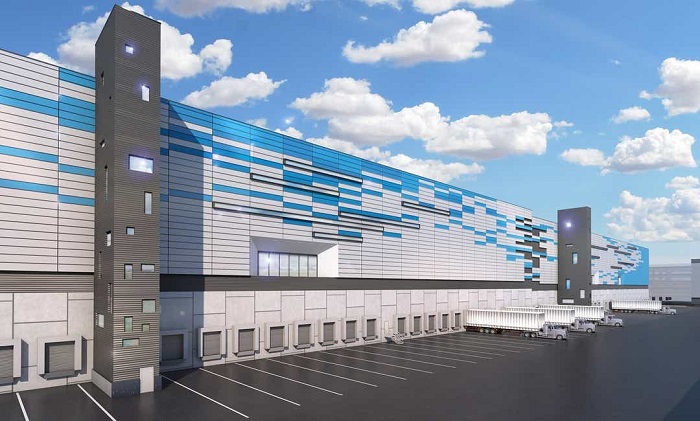
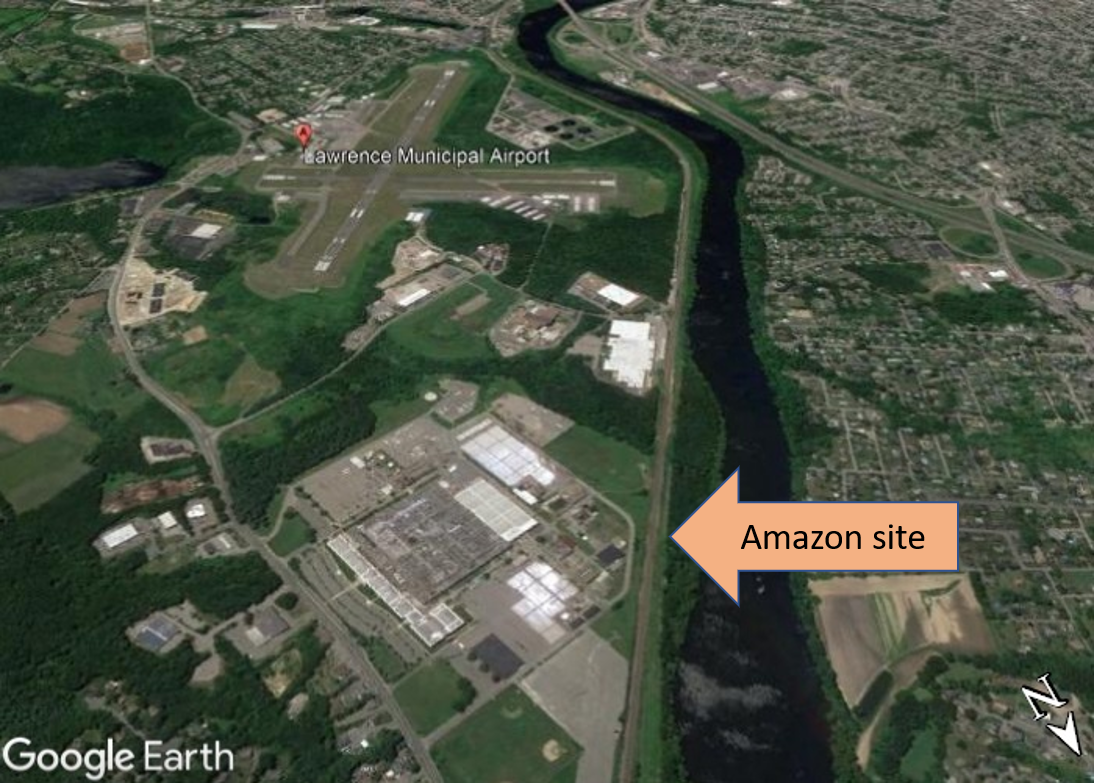
During 2020 Amazon has continued expansion of its surface shipping network, constructing and leasing massive warehouses across the US, in several instances supported by tax breaks and state funding for associated road infrastructure. In June 2020 the town of North Andover, Massachusetts, approved an estimated $27 million in tax incentives to Amazon for a massive 3.8 million square feet, five-storey high distribution centre. A tax increment finance agreement will reduce Amazon’s property tax bill for a decade. The amount is almost equal to the combined total of tax breaks previously granted to the company for other facilities in Massachusetts in the past few years: $16 million in state and local tax incentives for a large distribution centre in Fall River, an estimated $3.5 million for a sortation centre in Stoughton and up to $10 million in property tax breaks from the city of Boston for new offices in the Seaport District. The 110 acre North Andover site, formerly an industrial complex, is adjacent to Lawrence Municipal Airport with easy access to two interstate highways, the I-495 partial beltway around Boston and the I-93 arterial road extending from southwest Boston to St. Johnsbury, Vermont.

Site of new Amazon distribution centre in North Andover, Massachusetts

Over in Ohio construction of an Amazon fulfilment centre with a 2.8 million square feet footprint in Rossford, Wood County, was nearing completion by the end of June 2020. Interior works on robotics and HVAC (heating, ventilation and air conditioning) were underway and the scope of the project had expanded; 300 parking spaces for tractor-trailers in initial designs had increased to 719. Also in Ohio, state funding for a road project in Etna Township, Licking County is related to an Amazon building. One of the biggest speculative developments in the country, the footprint is reportedly 1.2 million square feet. The 15th June 2020 meeting of the Ohio Controlling Board approved release of $800,000 in support of the Amazon project, to extend a road “needed for basic access to the facility.” The 85 jobs that will be created by the road project come at the expense of a hefty subsidy: $9,411 per job. State largesse for Amazon was the polar opposite of swingeing $850,000 cuts to the nearby Southwest Licking School District, part of statewide budget cuts announced in May.

Map showing site of Amazon speculative building in Etna Township and road funded by Ohio Controlling Board. Source: Newark Advocate, 11th June 2020

More Amazon facilities in California

Imminent opening of a large new Amazon distribution centre at Meadows Field Airport in Kern County, California – a four floor facility with a footprint measuring 640,000 square feet – was announced in June 2020. Kern County agreed to give Amazon $3 million in local tax rebates in 2018, a subsidy package that would award the company annual refunds of approximately $275,000 for more than a decade.

Speculation that Amazon is developing a western hub at San Bernardino Airport was confimed on 8th May 2020 when the tenant of a major new air cargo facility was announced and the project named Amazon Air Regional Air Hub. Up until this point the tenant of what had previously been called the Eastgate Air Cargo Facility had not been disclosed. Amazon has already built 14 giant fulfilment centres in the San Bernardino and Riverside communities, known as the Inland Empire and one of the biggest hubs for goods warehousing and distribution in the US. High levels of air pollution from logistics traffic is compounded by geography; the area sits in a valley between two mountain ranges, forming a bowl trapping pollutants and emissions drift inland from Los Angeles. Several studies link poor air quality to health problems.

Eastgate Air Cargo Facility site plan
Eastgate Air Cargo Facility site plan showing distribution and office building, aircraft parking areas, dock doors, parking and operational support areas. Source: Environmental Science Associates, Inc., July 2019

More air cargo flights at San Bernardino Airport will bring more trucks, more traffic and more pollution. Specifications for the air cargo facility include two new driveways into the site with two new bridges crossing the City Creek Bypass Channel. Hundreds of local residents attended meetings to raise concerns over pollution from air cargo flights at the new San Bernardino Airport facililty and the projected 1,568 diesel-fuelled truck trips per day. A coalition of residents, community organisations, labour unions and churches united under the San Bernardino Airport Communities banner to push for good jobs during construction and operation and protection from air pollution, noise and road traffic impacts.

Two local community groups in Sonoma, Northern California, called for public input on a proposal to lease a vast warehouse to Amazon for its North Bay delivery hub project, questioning whether the turning the space into a major regional delivery centre violates the terms of the permit for the building. The property is zoned for light manufacturing, research and development, warehousing and distribution or retail/office use. Norman Gilroy of Mobilize Sonoma and Kathy Pons of the Valley of the Moon Alliance raised concerns that operation of a major regional delivery centre will increase intensity of the building’s use, without planning review or public comment, enquiring about the number of vehicles that will enter and leave the building on a typical day. The facility is anticipated to open in the autumn. In June 2020 neighbouring residents, concerned when they noticed a large crane at work, alerted county officials. An inspector verified that no permit for the work existed, leading to issuance of a ‘stop work’ order and a fine.

Houston, Florida, New York, Connecticut

Construction of a massive Amazon warehouse just southwest of Houston began in June 2020. The new fulfilment centre, on a 93.5 acre site, will have an 855,000 square feet footprint. Amazon built its first facility in the area, in north Houston, a few years ago, receiving a 10-year tax break from Harris County that was expected to save the company $180,000 annually. Elsewhere in the Houston area Amazon also has a fulfilment centre in Brookshire and a sorting facility near George Bush Intercontinental Airport. In central Florida the aforementioned Amazon air cargo hub at Lakeland Linder Airport is taking shape, a 300,000 square foot, three storey building taking up 47 acres of airport land. Then in July Amazon secured approval to build what might be its largest distribution facility in South Florida, near the Homestead Air Reserve Base in south Miami-Dade.

Site of new Amazon distribution centre in Miami-Dade

In New York, work on Amazon’s 450,000 square foot last mile facility in Bloomfield, Staten Island was deemed essential construction during the Covid-19 pandemic. Amazon already has a facility in Staten Island, an 855,000 square foot distribution centre opened on the West Shore in 2017. On 23rd June Amazon inked an agreement to lease space for an even bigger facility in Queens. A disused containerboard factory will be demolished and replaced with a massive 1 million square foot four-storey warehouse which will be the largest in New York City. Simultaneously, steel girders were being erected for an Amazon distribution centre in Clay, a town in Onondaga, a northern suburb of Syracuse. Upon completion, scheduled for autumn 2021 in time for Christmas deliveries, the five-storey, 3.8 million square foot facility will, in term of floorspace, be one of the largest in the world. Jobs will be created, but mainly for robots. Employing just 1,000 people it will be one of Amazon’s most automated sites. Little remains of the golf course that previously occupied the site, for 73 years. Onondaga County Industrial Development Agency approved $70.8 million in tax breaks for this Amazon distribution centre project.

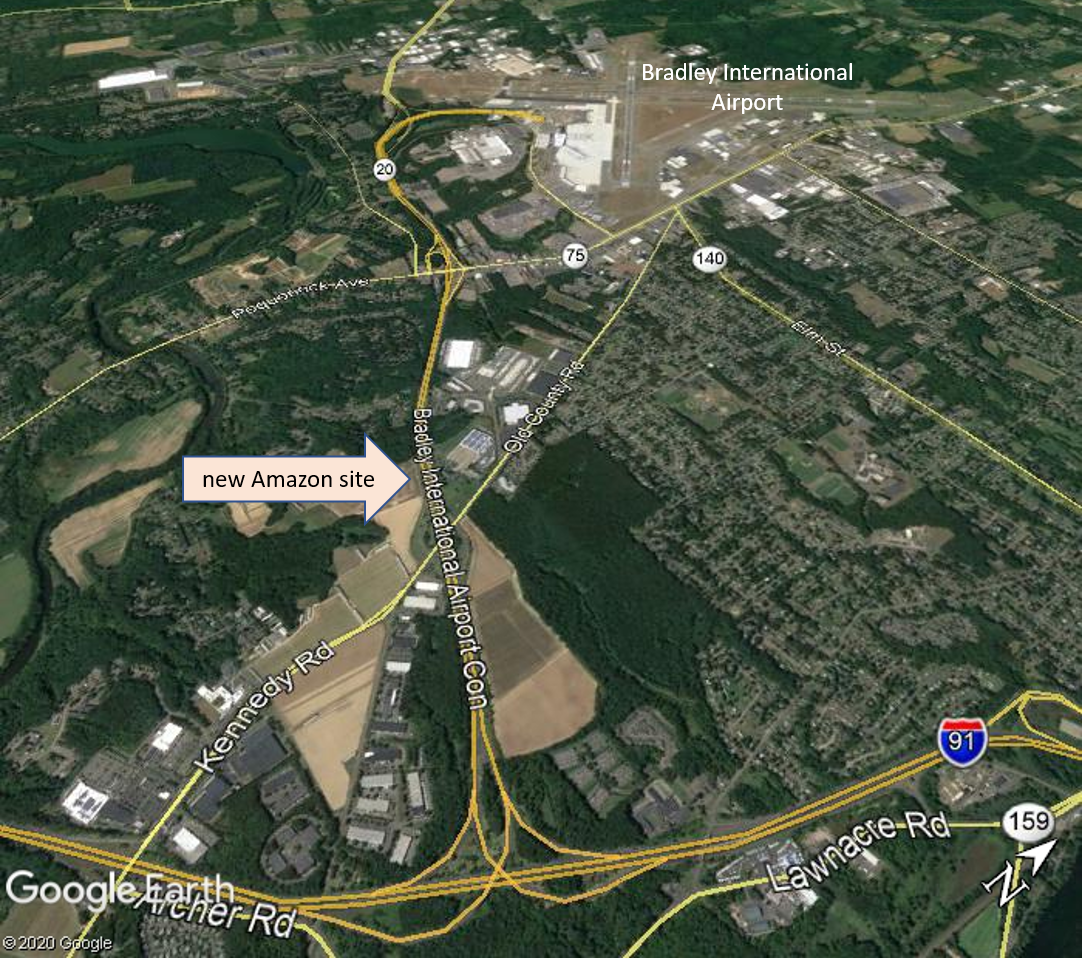
On 26th May 2020 a second Amazon warehouse/distribution centre in Windsor, Connecticut received local land use approvals. The 147 acre hub will be built on former tobacco farmland. Amazon, aiming to start construction in the third quarter of 2020, sought multi-year tax breaks for the development. Windsor’s economic development commission obliged, recommending approval of a seven-year 100% cent tax abatement. The site is on the Bradley Airport Connector highway connecting Bradley Airport with Interstate-91, the major north–south transportation corridor in central Connecticut.

Map showing site of new Amazon warehouse in Windsor, Connecticut, next to Bradley International Airport and connector highway

The tax breaks for the new Amazon facility, approved by Windor town council, were more modest than had been suggested: a three-year 50% abatement of real property taxes plus a 50% reduction in building permit fees. Amazon is projected to net savings of $8.78 million from the deal. Good Jobs First expressed its opinion on granting tax incentives to Amazon in a tweet:

Chicago distribution hubs reawaken 3rd airport plans

On 22nd June Amazon decided to open two distribution centres in the south suburbs of Chicago, in Matteson and Markham, each measuring 855,000 square feet and anticipated to employ 1,000 people. The low employment density ratio is partly due to automation; the facilities will use ‘the newest generation of Amazon robots’ to pick, pack and ship goods. Several officials said Amazons’ decision to locate the warehouses in Matteson and Markham strengthened the case for proceeding with the long proposed south suburban airport in Peotone, as an air cargo hub. The new Amazon facilities are within a few miles of the airport project site. Government funding for road construction linking to the airport site is already allocated: more than $205 million from the Rebuild Illinois infrastructure plan for construction of Interstate 57 (I-57) related to the airport property. David Greising, president and Chief Executive of the Better Government Association, wrote that area would be better served with road and bridge upgrades serving rail and trucking routes than by ‘sinking $205 million into an “airport to nowhere” off I-57 toward Peotone’.

A third major Chicago region airport, on farmland in Peotone, has been proposed since the 1980s. Illinois Department of Transportation started buying land surrounding the site in 2002, amassing 5,000 acres of the proposed 6,000 acres for the ‘inaugural footprint’ for the airport. Farmer Judy Ogalla, who owns land in the proposed airport site where she grows corn, soybeans and wheat, said “We have great soil…It doesn’t have any sense to pave over that when we have an airport in Gary.” Kevin Brubaker of the Environmental Law and Policy Center said construction of the airport would destroy 1,200 acres of flood plains and 180 acres of wetlands. Opposition to Peotone airport has been sustained by Shut This Airport Nightmare Down, a group composed of environmentalists, farmers and other residents.

Amazon’s cloud cluster, data centres housed in another set of ubiquitous grey warehouses, casts an ever heavier earthly footprint. Already Amazon operates more than 50 data centres in Loudoun County, Northern Virginia, the largest single concentration of corporate data centres on the planet. Amazon seeks to expand this by building a massive, 2.5 million square feet, data centre campus south of Dulles Airport. This is one of five potential Amazon data centre projects being developed as the cloud cluster becomes a ‘cloud corridor’. Amazon and its development partners have been land banking, buying parcels of land for future development, adjcacent to Dulles Airport. Some Loudoun County community members are critical of data centre design and location. Over 100 data centres lining major roads dominate the visual landscape and lead to tensions over noise in residential neighbourhoods.