DR Congo: Evictions and demolitions for Mbuji-Mayi Airport rehabilitation and expansion

About 800 houses were demolished to make way for rehabilitation and expansion of Mbuji-Mayi Airport. Many affected people said compensation did not match the real value of their land plots.

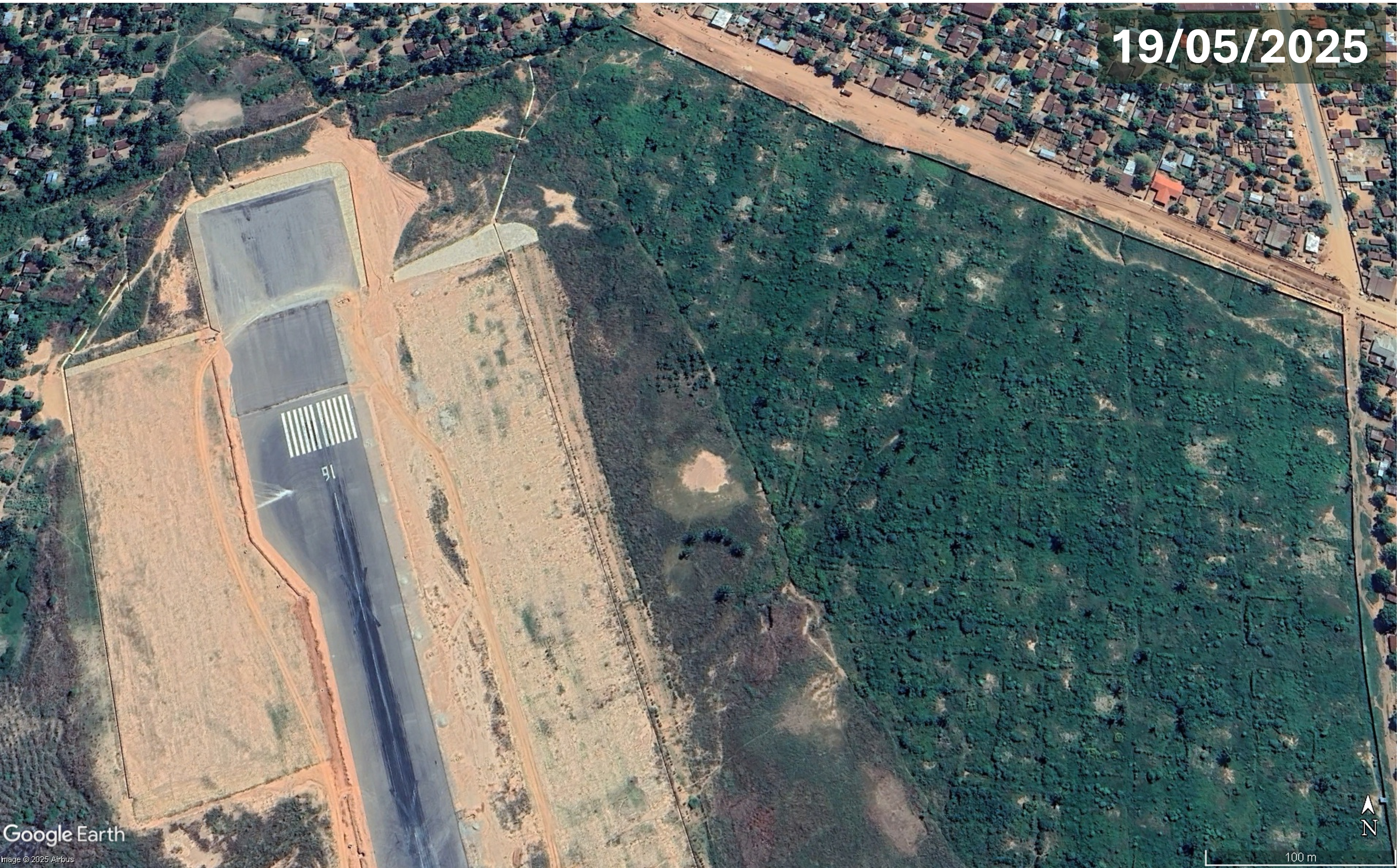
Aerial imagery of Mbuji-Mayi Airport, 17th June 2023Aerial imagery of Mbuji-Mayi Airport, 19th May 2025
Aerial imagery shows changes to the northern section of Mbuji-Mayi Airport between June 2023 and May 2025. In addition to runway works, roads have been widened and buildings next to the airport demolished and replaced with fast-growing vegetation.

Rehabilitation of Mbuji-Mayi Airport, located in the northeast of the city of Mbuji-Mayi, the capital of the Kasai-Oriental Province in south central DR Congo, is part of the Priority Air Safety Project – Phase 2 (PPSA 2) project financed by the African Development Bank (AfDB). Project components include runway extension, construction of aircraft parking aprons, control tower and works to improve aviation safety. AfDB’s 2018 Summary Environmental and Social Management Plans (ESMP) noted that the project area consists of neighbourhoods situated near the airport with dwellings and agricultural plots on the site; some activities including runway extension were postponed to enable studies and mobilisation of funding for involuntary resettlement. In February 2021 the mayor of Mbuji-Mayi set up a commission to identify all affected people who would be evicted, then in March he made reassurances that state obligations for the eviction of people who had built and rented houses would be followed.

Bulldozing of unauthorised buildings around Mbuji-Mayi Airport began on 7th November 2022. The airport project necessitated displacement of approximately 800 households but compensation of affected people was suspended in October 2023 because the census was inadequate and the process had not been accepted by all the residents with some continuing to resist. People whose land was expropriated began receiving compensation cheques on 13th October yet some voiced concerns about finding a new site, the compensation amount and demanded more transparency and guarantees regarding their property rights.

On 21st October 2023 residents whose land was expropriated for the airport project demonstrated in the street denouncing insufficient compensation, burning tyres at two road junctions before police attempted, unsuccessfully, to disperse them. An emergency meeting failed to reach an agreement satisfactory to plot owners who were given a 15-day ultimatum to relocate after receipt of compensation. In February 2024, as works at Mbuji-Mayi Airport were underway, owners of nearly 800 houses on the site were given two weeks’ notice to dismantle their homes. Occupants maintained that the compensation offer did not match the value of their assets.

On 17th July 2024 the mayor of Mbuji-Mayi announced imminent demolition of houses built on the airport site, in the name of expropriation for public purposes. Plot owners had been given tokens for replacement land on the outskirts of Mbuji-Mayi but had not vacated or demolished their houses; 800 families still contested expropriation due to lack of recognition of the market value of their plots. A delegation of residents living around the airport requested protection and support from the provincial authority and respect for expropriation law as recognised in the constitution.

Early on the morning of 29th October 2024 demolition of houses east of Mbuji-Mayi Airport, between Zaire and Dodoma avenues, began. Heavy machinery was escorted by police, as owners of the buildings demanded compensation matching the real value of their property. All their efforts, including marches, sit-in protest and suicide threats, had not dissuaded the government from expropriating the land plots. On the instructions of the president of DRC, Félix Tshisekedi, Minister of Social Affairs, Humanitarian Action and Solidarity, Nathalie Aziza Munana, visited Mbuji-Mayi on 10th November to investigate the demolition of 800 houses near the airport, collect information about evictions and meet with victims and civil society organisations. Minister of Justice, Constant Mutamba, said he had been contacted by several citizens who had not yet received the compensation they were promised, raising suspicions of misappropriation of funds allocated for this purpose.

For more information including references for all source material and photos see the case study on EJAtlas, the world’s largest, most comprehensive online database of social conflict around environmental issues – Mbuji-Mayi Airport rehabilitation, DRC

Vietnam: Clearing rice fields and relocating thousands of households for Gia Binh Airport

Land clearance and consutruction of Gia Binh Airport, on the largest airport site in North Vietnam. is underway. Since approval of the project the projected passenger capacity has risen to 50 million per year by 2050. A VIP terminal is scheduled for completion in time for APEC 27.

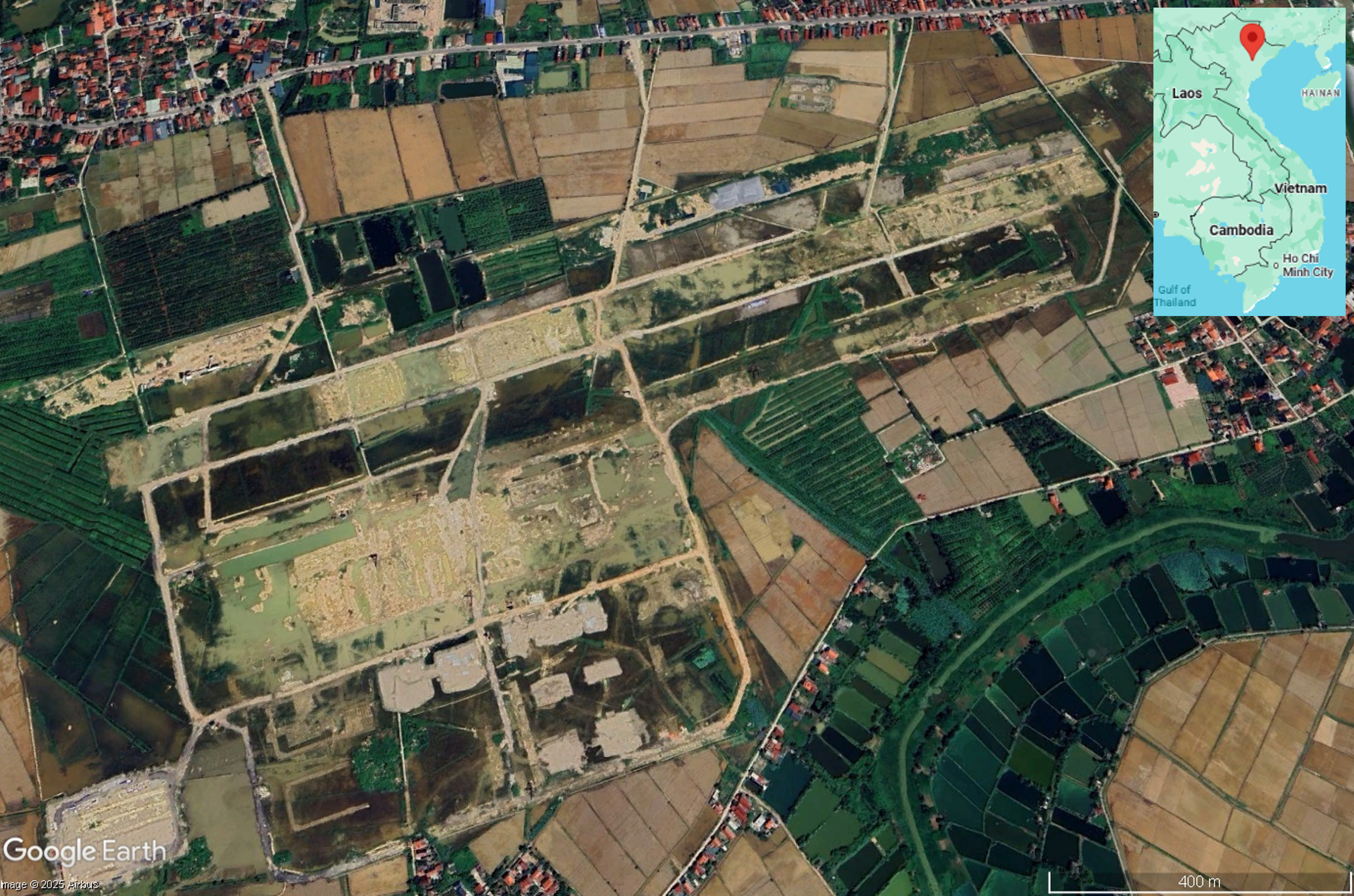
Aerial image of Gia Binh Airport site, 26/04/3024Aerial image of Gia Binh Airport site, 17/07/2025
Aerial imagery of Gia Binh Airport site. The image on the left shows the site on 26/04/2024 before construction works began. The image on the right, dated 17/07/2025, shows land cleared for runways and other airport infrastructure.

A major new airport in Gia Binh, about 40 kilometres east of Hanoi in a rural area of Vietnam’s Bac Ninh province, was approved by the Ministry of Transport in February 2025, with capacity for 1 million passengers annually by 2030, rising to 3 million by 2050. By April the planned capacity had been adjusted upwards to 5 million passengers annually by 2030 rising to 15 million by 2050. In July the size of the airport project was scaled upwards again, to handle 30 million passengers per year by 2030 then reaching 50 million by 2050. Since publication of the original plan the projected cargo volume had more than doubled, from 250,000 tons annually by 2030 growing to 1 million tons by 2050 to 1.6 million tons by 2030 growing to 2.5 million tons by 2050. With its site enlarged nearly fivefold, from an initial 408.5 hectares to 1,960 hectares, Gia Binh Airport is now set to be northern Vietnam’s largest airport, bigger than Noi Bai Airport and Tan Son Nhat Airport, exceeded only by the 5,000 hectare site of Long Thanh Airport in the southern Dong Nai province.

In August the government approved special mechanisms fast tracking investment and construction processes for the airport, related works, land clearance and resettlement, exempting projects from construction permit requirements and approving conversion of rice crop land. About 920 hectares of rice fields yielding two crops per year will be converted for the airport. Land allocated for the Gia Binh Airport site comprises about 1,184.78 hectares of agricultural land, 415 hectares of non-agricultural land, 159.4 hectares of residential land and 124.8 hectares of land utilized for defence and security purposes. Land acquisition will affect approximately 7,100 households and individuals and 118 organizations. About 5,800 households and individuals will have to relocate and resettle. The number of graves that will be moved is estimated at 18,800 but this does not include unidentified graves. Development of Gia Binh Airport is triggering one of the largest land clearances in recent history.

Schools and hospitals along with infrastructure such as irrigation systems, canals, pumping stations and power transmission lines will also have to be removed to make way for the airport and rebuilt elsewhere. About 25 historical and cultural sites must also be relocated as part of land clearance for the airport. By mid-November initial groundworks for construction of the airport and development of supporting infrastrucure were underway. Heavy machinery was operating continuously to level the airport site and barriers and signs restricted access to construction zones. The provincial government had paid more than VND1,990 trillion (USD81 million) in compensation to 4,045 households in the Gia Binh, Nhan Thang and Luong Tai communes, accelerating clearance of more than 436 hectares of land. Clearance of agricultural plots of land was scheduled to be finished by 30th November with resettlement areas due for completion by 15th December.

Gia Binh Airport will accommodate large, wide-bodied aircraft including the Boeing 777 and Airbus A330 and plans specify four runways upon completion by 2050. The investment requirement is estimated at VND 196.37 trillion (USD7.5 billion). As well as becoming a major aviation hub the airport project will open up land surrounding it for development including hotels, airport-adjacent hospitality, and airport city projects. The Ministry of Construction had considered expanding Noi Bai Airport southwards, but this would have necessitated relocation of large communities and incur high land clearance costs. With larger land reserves and more space for development than Noi Bai Airport, the government expects Gia Binh Airport to accelerate growth of industry, logistics, e-commerce and tourism.

In addition to dual-use function as a civil and military facility with a strategic role in national defence Gia Binh Airport is designed to support major diplomatic events, in particular Vietnam’s hosting of the 2027 Asia-Pacific Economic Cooperation inter-governmental forum, APEC 2027. Elite APEC officials will be among the first passengers to arrive at Gia Binh Airport; a ‘soft opening‘ in time for APEC 2027 is planned, with one runway operational along with the air traffic control tower and a VIP terminal. Many key APEC 2027 events, most notably the annual Leaders’ Summit, will take place on Phu Quoc, Vietnam’s largest island located near the south coast of Cambodia, which is rapidly developing as a luxury tourism destination. Fast-paced expansion of Phu Quoc Airport to support APEC 27 Leaders’ Week is underway. One of the high-priority projects is a VIP terminal to welcome heads of state and high-ranking delegations to the APEC 27 leaders’ meeting. Longer term plans for Phu Quoc Airport expansion aim to increase passenger capacity from the current 4 million to 50 million by 2050.