DR Congo: Evictions and demolitions for Mbuji-Mayi Airport rehabilitation and expansion

About 800 houses were demolished to make way for rehabilitation and expansion of Mbuji-Mayi Airport. Many affected people said compensation did not match the real value of their land plots.

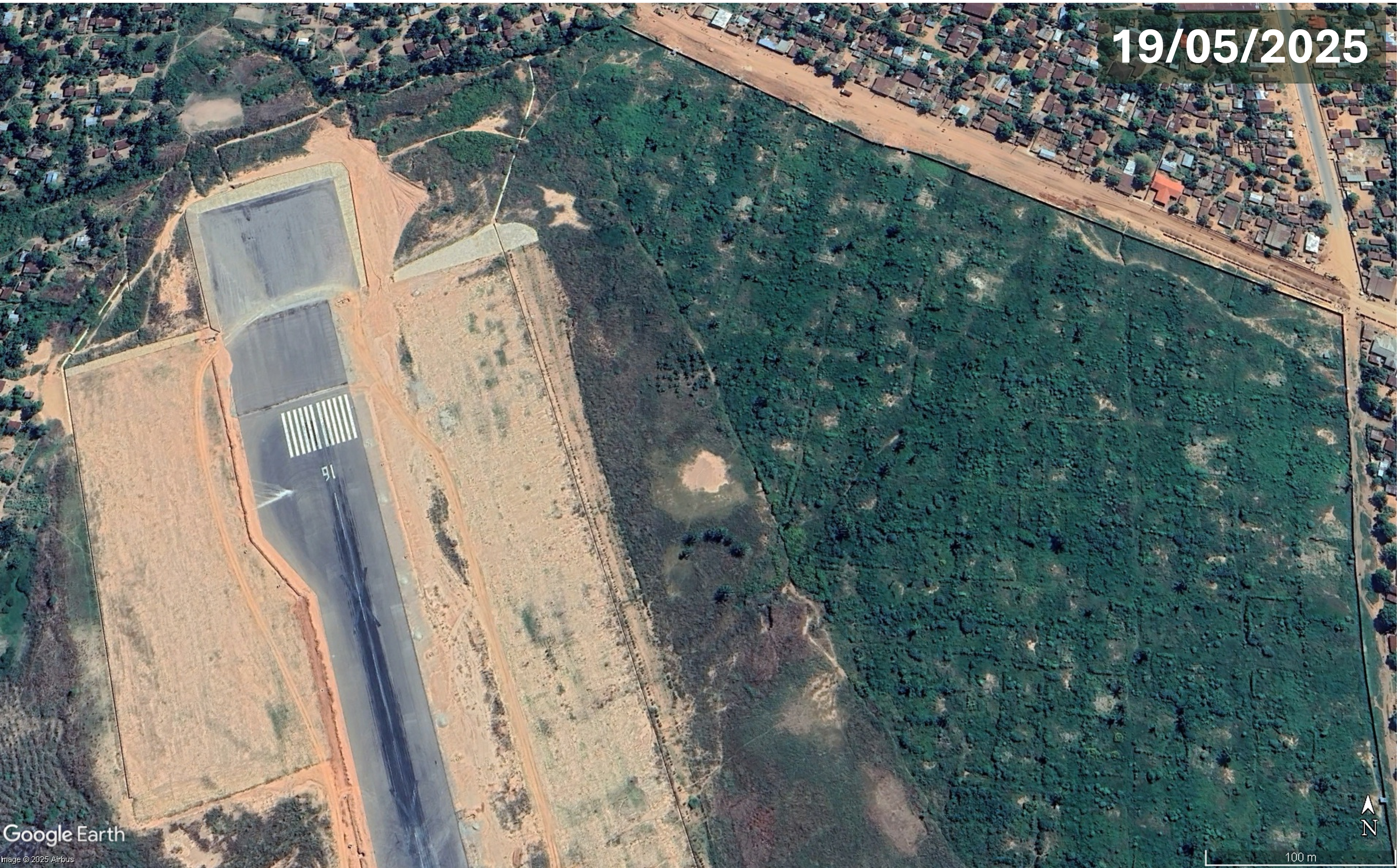
Aerial imagery of Mbuji-Mayi Airport, 17th June 2023Aerial imagery of Mbuji-Mayi Airport, 19th May 2025
Aerial imagery shows changes to the northern section of Mbuji-Mayi Airport between June 2023 and May 2025. In addition to runway works, roads have been widened and buildings next to the airport demolished and replaced with fast-growing vegetation.

Rehabilitation of Mbuji-Mayi Airport, located in the northeast of the city of Mbuji-Mayi, the capital of the Kasai-Oriental Province in south central DR Congo, is part of the Priority Air Safety Project – Phase 2 (PPSA 2) project financed by the African Development Bank (AfDB). Project components include runway extension, construction of aircraft parking aprons, control tower and works to improve aviation safety. AfDB’s 2018 Summary Environmental and Social Management Plans (ESMP) noted that the project area consists of neighbourhoods situated near the airport with dwellings and agricultural plots on the site; some activities including runway extension were postponed to enable studies and mobilisation of funding for involuntary resettlement. In February 2021 the mayor of Mbuji-Mayi set up a commission to identify all affected people who would be evicted, then in March he made reassurances that state obligations for the eviction of people who had built and rented houses would be followed.

Bulldozing of unauthorised buildings around Mbuji-Mayi Airport began on 7th November 2022. The airport project necessitated displacement of approximately 800 households but compensation of affected people was suspended in October 2023 because the census was inadequate and the process had not been accepted by all the residents with some continuing to resist. People whose land was expropriated began receiving compensation cheques on 13th October yet some voiced concerns about finding a new site, the compensation amount and demanded more transparency and guarantees regarding their property rights.

On 21st October 2023 residents whose land was expropriated for the airport project demonstrated in the street denouncing insufficient compensation, burning tyres at two road junctions before police attempted, unsuccessfully, to disperse them. An emergency meeting failed to reach an agreement satisfactory to plot owners who were given a 15-day ultimatum to relocate after receipt of compensation. In February 2024, as works at Mbuji-Mayi Airport were underway, owners of nearly 800 houses on the site were given two weeks’ notice to dismantle their homes. Occupants maintained that the compensation offer did not match the value of their assets.

On 17th July 2024 the mayor of Mbuji-Mayi announced imminent demolition of houses built on the airport site, in the name of expropriation for public purposes. Plot owners had been given tokens for replacement land on the outskirts of Mbuji-Mayi but had not vacated or demolished their houses; 800 families still contested expropriation due to lack of recognition of the market value of their plots. A delegation of residents living around the airport requested protection and support from the provincial authority and respect for expropriation law as recognised in the constitution.

Early on the morning of 29th October 2024 demolition of houses east of Mbuji-Mayi Airport, between Zaire and Dodoma avenues, began. Heavy machinery was escorted by police, as owners of the buildings demanded compensation matching the real value of their property. All their efforts, including marches, sit-in protest and suicide threats, had not dissuaded the government from expropriating the land plots. On the instructions of the president of DRC, Félix Tshisekedi, Minister of Social Affairs, Humanitarian Action and Solidarity, Nathalie Aziza Munana, visited Mbuji-Mayi on 10th November to investigate the demolition of 800 houses near the airport, collect information about evictions and meet with victims and civil society organisations. Minister of Justice, Constant Mutamba, said he had been contacted by several citizens who had not yet received the compensation they were promised, raising suspicions of misappropriation of funds allocated for this purpose.

For more information including references for all source material and photos see the case study on EJAtlas, the world’s largest, most comprehensive online database of social conflict around environmental issues – Mbuji-Mayi Airport rehabilitation, DRC

Houses demolished for Muhammadu Buhari International Airport expansion, Nigeria

Hundreds of people were displaced by a demolition exercise to make way for expansion of Muhammadu Buhari International Airport

On 30th January 2025 a number of residents of Shuwari 5 ward in Maiduguri, near the Muhammadu Buhari International Airport runway, reported that the Borno State Government was demolishing their houses. A bulldozer destroyed houses while residents retrieved essential household items. People whose houses were still standing but had been marked for demolition worked to remove roofs from their houses. One resident said people had received only three days’ notice before their homes were demolished and appealed to the Borno State Governor to provide compensation or alternative shelter for affected residents as they had no other place to go to.

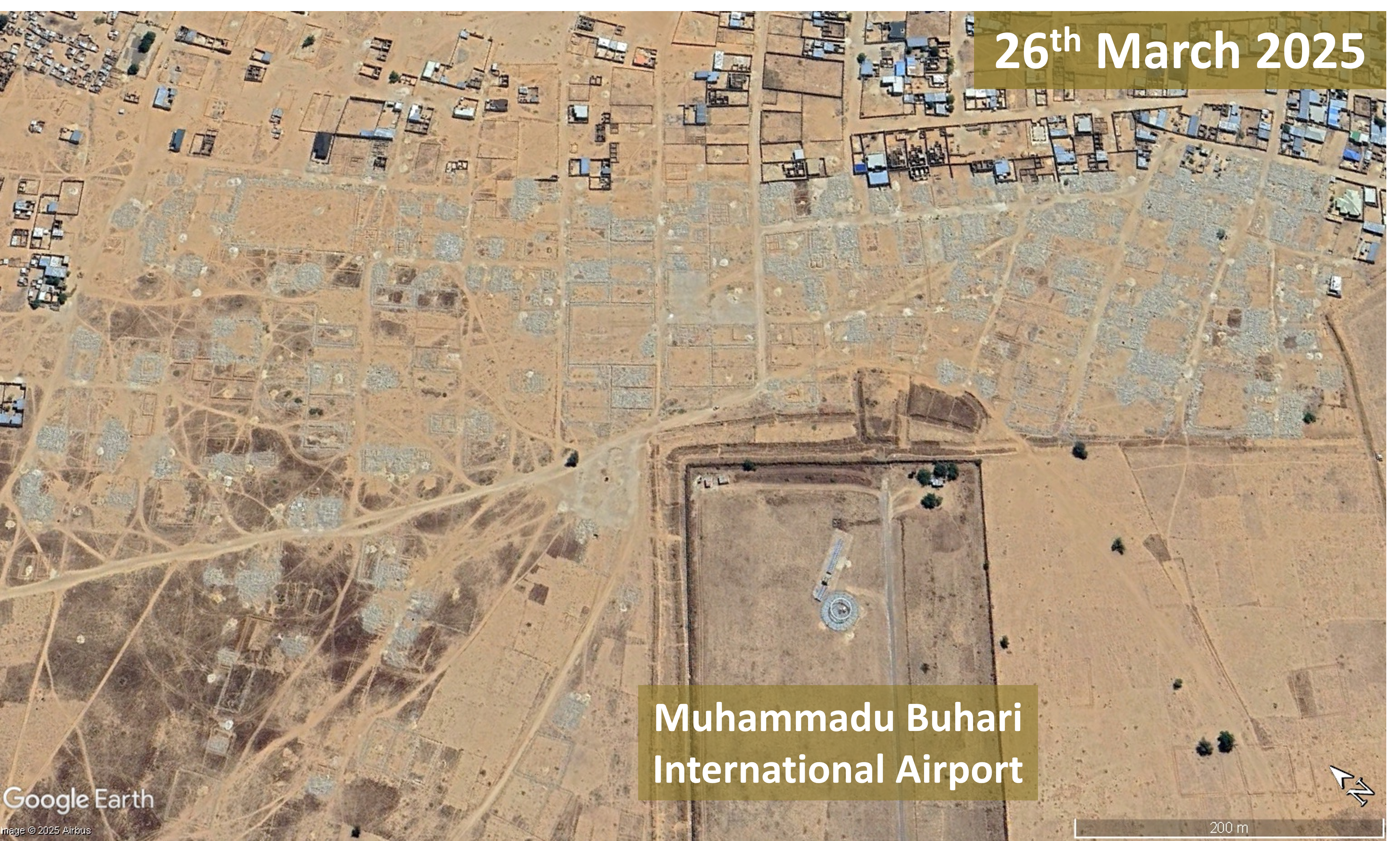
Aerial mage -Muhammadu Buhari International Airport runway, 14th July 2024
Aerial imagery of the Shuwari 5 area near the end of Muhammadu Buhari International Airport runway before and after the demolition exercise beginning on 30th January 2025 shows buildings reduced to rubble.

On a visit to Borno State in October 2024 Minister of Aviation and Aerospace Development, Festus Keyamo, had announced that Muhammadu Buhari Airport had been upgraded to international status and would commence operation as an international airport from 1st January 2025. The General Manager of Borno State Urban Planning Development Board, Liman Mustapha, said the purpose of the demolition exercise beginning on 30th January 2025 was to secure land for upgrade of the airport. He also said there would be no compensation for affected house owners and that residents had been informed that their occupation of the land was illegal in 2020 and since then authorities had attempted, unsuccessfully, to stop construction of houses on the land.

The demolition exercise targeted the area up to 500 metres from the airport fence, beginning with the area within 200 metres. Adamu Matankolo, Acting Regional Manager of the airport, said upgrade of the airport to international status by the federal government necessitated its expansion. He said, “We sympathise with the people who don’t want to obey this order. We have our plan and out plan is that the area slated for demolition is a buffer zone.”

Premium Times reported that more than 100 houses were demolished and many of the affected people had occupied the area for over 10 years having been displaced by the Boko Haram insurgency. The IDPs (Internally Displaced Persons) thought their resettlement was permanent until the state government demolished their houses. An IDP and single mother of three children said residents received a notice from the Borno State Geographical Information Service (BOGIS) just a few hours before the demolition exercise began.

Many people criticised the State government’s handling of the demolition exercise on social media, in the context of the Borno state’s socio-economic problems caused by the Boko Haram insurgency and a recent flood impacting 40% of the city of Maiduguri. Commenting anonymously a Maiduguri-based lawyer gave a detailed statement on the government’s obligations regarding compensation, concluding: “Thus, if a house is built on government land without approval, the owner is generally not entitled to compensation. However, if the government initially allowed of overlooked the development, there is scope for negotiation or legal redress.”

HumAngle, a media platform focussed on conflict, humanitarian, and development issues in Africa, reported that the demolition had displaced hundreds of people. One of them, a widow raising four children who had lived in Shuwari 5 for 17 years, said the government only notified people about the demolition two days before bulldozers arrived, not even giving enough time for gathering belongings. She said at least three affected people had died of shock and more than 20 had fallen ill due to trauma.

Liman Gana, head of Borno State Building Planning Authority, said 306 structures had been demolished, including 64 fully occupied houses, 42 incomplete structures and 17 incomplete buildings. A Federal Airports Authority of Nigeria (FAAN) official gave technical and safety reasons for the demolition exercise, saying structures built too close to the runway posed safety risks. Many displaced residents insisted that they were not informed of these risks before they bought or built their homes and said resettlement should have been planned and implemented before the demolitions took place.

For more information, including references for source material, see the case study on EJAtlas, the world’s largest, most comprehensive online database of social conflict around environmental issues – Demolition of houses for Muhammadu Buhari International Airport expansion, Nigeria

Demolition of Nuwalege homes for Presidential Air Fleet expansion

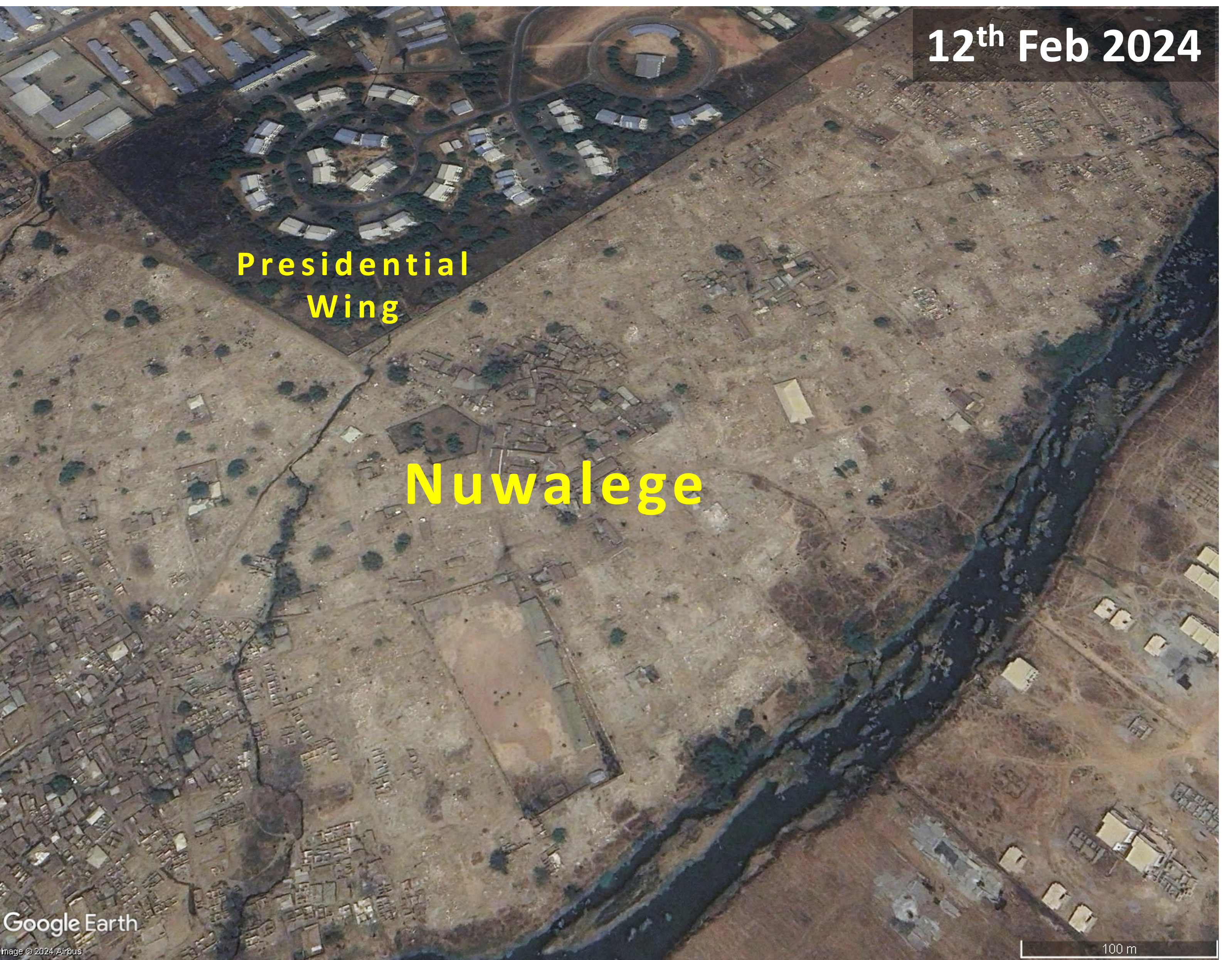
On the morning of 15th January 2024 dozens of police and soldiers stood guard as over 200 homes in the Nuwalege community, a settlement in a rural area adjacent to the Presidential Wing of Nnamdi Azikiwe International Airport (the main airport of Abuja, capital city of the Federal Capital Territory of Nigeria) were demolished to make way for expansion of the Presidential Air Fleet (PAF). Police fired teargas to disperse residents and they were prevented from entering their homes. Officials threatened to seize people’ phones and one person who took photos of the demolition was manhandled. Some Nuwalege residents including community leaders said that the demolition happened without warning.

Satellite imagery shows Nuwalege homes demolished for expansion of the Presidential Air Fleet. The image on the left is from 2nd May 2023, the most recent Google Earth imagery before the demolition exercise. On the right is an image from 12th February 2024, nearly a month after the demolition began.

Demolition of more than 200 houses in the Nuwalege community had been ordered by the Federal Capital Territory Administration (FCTA) on 18th December 2023 and a thorough investigation of compensation for affected people, involving the FCTA, the Department of Resettlement and Compensation and the Nigerian Air Force (NAF), was promised. Peter Obi, Labour Party candidate in the 2023 presidential election, spoke out against the planned demolition in a statement on his X account: “I am again pained that we are embarking on such an inconsiderate project at this critical time when the country is going through such hardship…We cannot continue to encourage those who have kept us suffering to enjoy a luxurious lifestyle far beyond our legitimate means…I therefore, advise that we have a rethink, and, most importantly, ensure that our fellow Nigerians are not rendered homeless for the sake of an unproductive presidential fleet.” He also argued that instead of expanding the Presidential Air Fleet the government should explore ways of reducing or getting rid of it to reduce costs.

Seven months after the demolition, in August 2024, The Punch reported that Nuwalege landowners who were forcibly ejected following demolition of their homes were still calling for compensation. Residents denied Department of Development Control claim that the structures belonging to indigenous people had been left intact, saying that no houses had been spared from demolition and the Director of the Department of Development Control’s claim that they had been given a two-month notice period before the demolition took place. Many displaced residents had been forced to seek shelter in nearby communities including Zamani, Sauka, Giri, Iddo and Gwagwalada.

Resource Centre for Human Rights and Civic Education (CHRICED) issued a statement expressing dismay at widespread destruction of indigenous settlements in the FCT on 1st September 2024, making specific reference to the forcible demolition of over 200 homes in Nuwalege. Urging the government to engage in dialogue with affected residents CHRICED Executive Director Ibrahim M. Zikirullahi said, “The demolition reportedly executed by the Federal Capital Development Authority (FCDA) to accommodate the luxurious lifestyle of the presidency demonstrates gross irresponsibility and insensitivity to the plight of the Abuja natives. This prioritization of luxury and expansion for a select few over the basic rights and needs of ordinary citizens is an affront to democratic values and the principles of social justice.”

Works in the demolished area have not commenced but on 1st November 2024 a N9.8bn (USD5.9m) contract for rehabilitation of facilities in the Presidential Wing was awarded to Nigerian construction firm Julius Berger. Executive Secretary of the Federal Capital Development Authority (FCDA) said the project – including rehabilitation of the link road, access road to the presidential kitchen, hangar housing presidential aircraft and holding centre for visiting presidents – would take six months. A number of civil society organisations condemned the contract. Peluola Adewwale, National Secretary of the Democratic Socialist Movement, said, ”The N9.8bn presidential wing rehabilitation contract is a misplacement of priority, frivolous and insensitive.” The Committee for the Defence of Human Rights (CDHR) described the Presidential Wing rehabilitation as an ‘unnecessary project’. CDHR chairman in Osun State, Emmanuel Olowu, said, “the Tinubu’s government prioritises a luxurious lifestyle against the welfare of the people.”

For more information including references for all source material see the case study on EJAtlas, the world’s largest, most comprehensive online database of social conflict around environmental issues – Nuwalege homes demolished for Presidential Air Fleet expansion, Nigeria.

Demolition of +300 houses on Kasompe Airstrip land

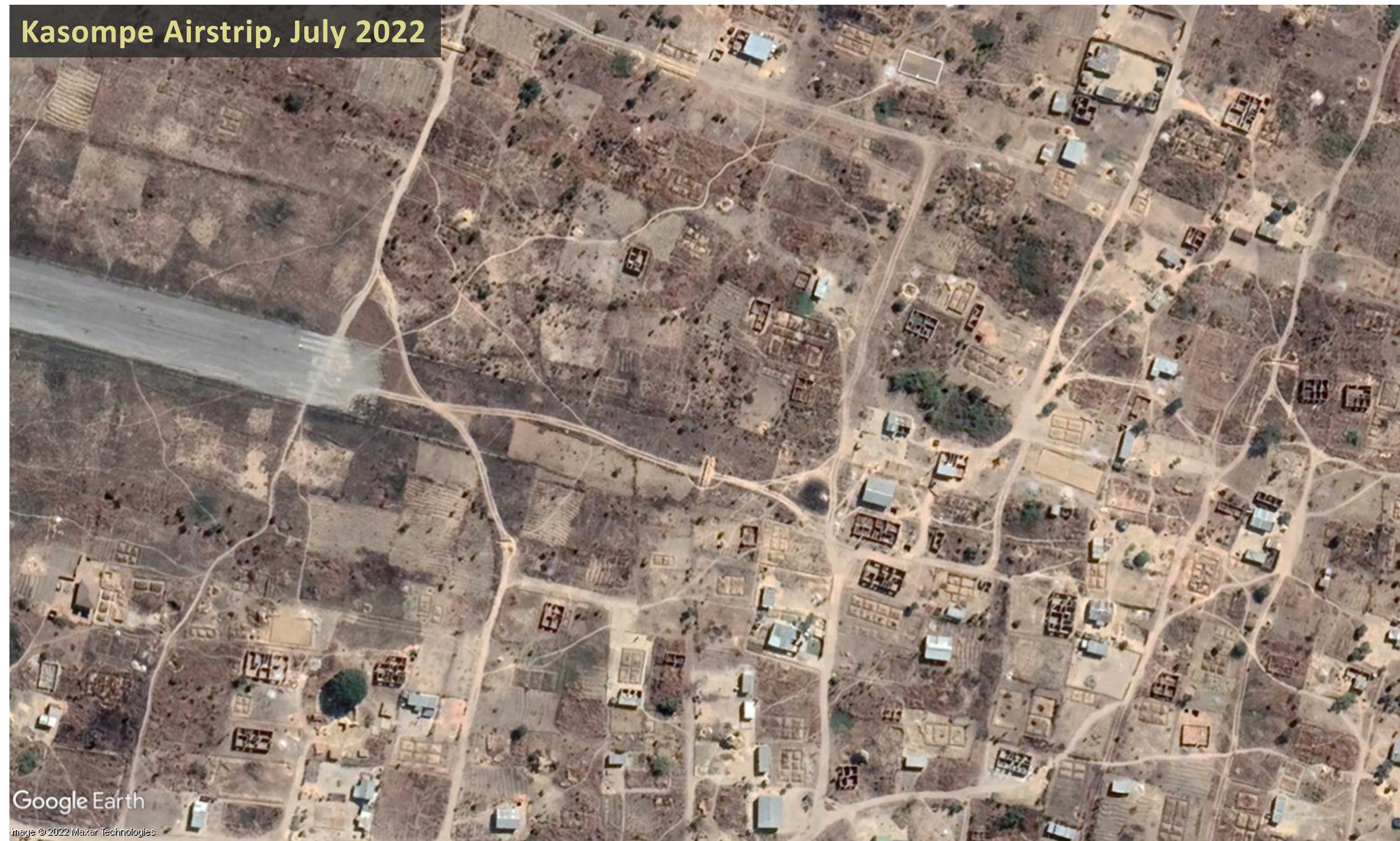
On 20th August 2022, beginning at 2am, more than 300 houses built on land surrounding Kasompe Airstrip were demolished by officers from Chingola Municipal Council and the Zambia Police Service. The Council stated it had not allocated the land in question and the buildings had been erected without planning permission. Residents appealed to the government to find them alternative land and some of them attempted to resist the demolition, burning tyres and breaking the windows of bulldozers. A video of the demolition shows houses in plots of land with gardens and trees being bulldozed, as displaced people looked on.

Completed houses as well as houses still under construction were demolished. A number of residents retaliated against destruction of their homes, setting fire to two properties – a guesthouse and servants’ quarters – owned by Johnson Kang’ombe, Mayor of Chingola, whom they accused him of selling them plots of land at Kasombe Airstrip. Two suspects thought to be involved in the arson were apprehended and detained. A group of women protested chanting slogans including “The Mayor must go”. One evicted woman said that her aunt whose home was also demolished had collapsed with suspected high blood pressure.

In the aftermath of the demolitions the only help given to displaced residents was food aid and space in a camping site, provided by the Chingola District Disaster Management and Mitigation Unit (DMMU). On 29th August it was reported that Chingola District Commissioner Raphael Chimupi had said that DMMU had given relief food items to 95 out of 98 families whose houses had been demolished. Chingola Member of Parliament Chipoka Mulenga visited affected residents and promised to help them, saying “I will do everything in my power to help resolve this issue, it is saddening to see a lot of houses demolished, which has left many families in the cold.” Mulenga said the government would provide alternative land to the victims of the demolition of 345 houses, but as of 27th September 2022 some people were still stranded with nowhere to relocate to.

Satellite imagery of an area at the eastern end of the Kasompe Airstrip runway, dated 26th July and 8th September, shows some of the buildings which were destroyed on 20th August 2022. Slide the bar between the images below to compare the area before and after the demolitions.

The land conflict, inustice and human rights violations related to Kasompe Airstrip is documented on EJAtlas, the world’s largest, most comprehensive online database of social conflict around environmental issues. Kasompe Airstrip is located on the eastern outskirts of the city of Chingola, in the Copperbelt Province, a mineral rich area that is the main copper mining region in Zambia. President of the Equity and Economic Party, Chilufya Tayali, said information had surfaced indicating that the demolition of the houses was not driven by the purported illegality of allocation on plots of land but by foreign interests in a mine near Kasompe Airstrip. Aerotropolis-type plans were mentioned in 2019 when the then Mayor of Chingola, Titus Tembo, said Chingola aims to become a city with Kasompe Airstrip being part of this agenda.

The Zambia Air Force (ZAF) denied allegations that it has influenced or pressured Chingola Municipal Council to demolish the houses on Kasompe Airstrip land. ZAF Director Public Relations Lieutenant Colonel Helen Chota said rumours were incorrect and that none of the other ZAF airstrips had been encroached. Yet the day after the demolitions, on 21st August 2022, it was reported that ZAF Commander Lieutenant Colon Barry had alerted citizens to more house demolitions across the country, saying houses and other structures built within 500 metres of airport infrastructure would be demolished and that building civilian structures on or near airports is a threat to national security.