Canada: The campaign to preserve Technoparc Montreal wetlands

An alliance of community and environmental organizations, led by TechnoparcOiseaux, works to protect the highly biodiverse Technoparc Montréal wetlands, north of Montreal-Trudeau Airport, from development. There is widespread support for conferring protected status to the welands through inclusion in a national urban park.
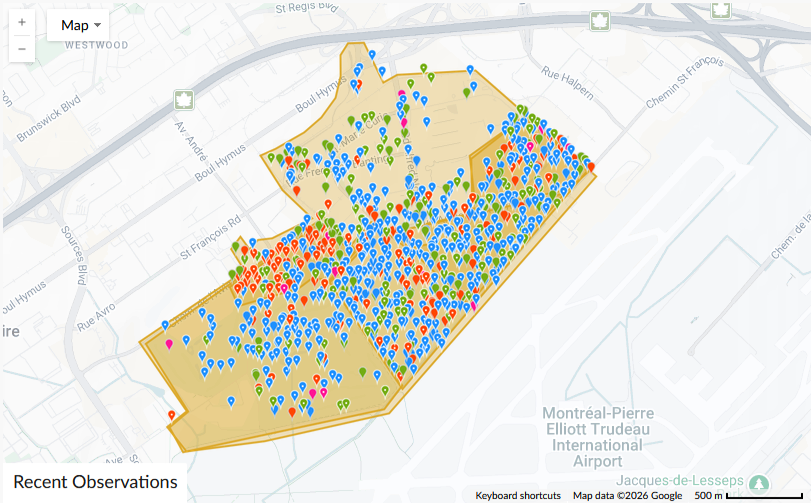
Observations map, Technoparc Wetlands
Map of citizen observations of plant and animal wildlife species at Technoparc Montréal wetlands near Montreal-Trudeau Airport. Image source: iNaturalist

Technoparc Montreal, a high-tech industrial park near Montreal-Trudeau International Airport, is situated in the most biodiverse wetlands on Montreal Island, known as the Technoparc wetlands. Many citizens’ observations of plant and animal species are recorded on the Technoparc:Montreal Wetlands section of the iNaturalist crowdsourced identification system. By March 2026, 17,929 observations of 1,302 species by 549 observers had been recorded. But there is a long history of encroaching development which has been opposed at every stage. In July 2016 conservationists urged Technoparc to reconsider development of Eco Campus Hubert Reeves, for cleantech startup companies, on an area of the wetlands containing a marsh hosting a wide variety of birds; 160 species had been spotted. Bird Protection Quebec said development on the Technoparc wetlands, ‘an oasis in the heart of Montreal’, posed threats to uniquely biodiverse wetlands and woodlands, with the number of bird species among the highest in the Montreal region and including 19 categorized as threatened. Les Amis du Parc Meadowbrook passed a resolution, endorsed by Green Coalition and Sauvons la Falaise, calling on authorities to impose an immediate moratorium on Technoparc Montreal expansion and to consolidate undeveloped areas into a protected wildlife refuge. Extension of a road into the wetlands continued despite the presence of a few least bitterns, a small species of heron thought to be at risk in the Montreal area, leading members of the Green Coalition, Sauvons la Falaise and the Green Party to hold a news conference at the site.

In March 2018 Joel Coutu, leading birders on regular walks in the wetlands drew attention to Red-shouldered hawks, merlins and other birds of prey, indicating a richly biodiverse environment and mammals including coyotes, foxes, beavers rabbits and skunks. Bird enthusiasts and environmental groups intensified pressure to preserve the wetlands in August 2018 with a petition demanding a halt to works on sensitive areas in and around the Technoparc and to protect the sites as a ‘Sources Nature Park’ conservation area attracting over 68,000 signatures. Bird species nesting on the site that activists were concerned about included four at-risk species: Least Bittern, Wood Thrush, Eastern Wood-Pewee and Barn Swallow. Tree cutting for a Réseau express métropolitain (REM) light metro station at the Technoparc began in September 2018. TechnoparcOiseaux, Trainsparence and Montreal Climate Coalition had led a legal attempt to halt the project, appealing a previous lawsuit demanding a halt to the works that had been thrown out, but the provincial government had passed a special law enabling its construction. Matthew Chapman, president of Montreal Climate Coalition, said, “The biggest project in the last half century went forward in a very undemocratic way” and that it would facilitate development eroding the area’s remaining green space. The previous month, environmentalists had noted the irony of Eco-Campus Hubert Reeves being named after a renowned ecologist and astrophysicist, as preparation of the site included removing 3,000 trees for extension of a road anout 500 meters into natural space.

In September 2021, while Covid-19 restrictions were in place, dozens of local residents gathered near the Technoparc in a demonstration organized by TechnoparcOiseaux, protesting a proposed 15,000 square meter facility for production of surgical masks on part of the wetlands called Monarch Field. Efforts to expand the Des Sources Nature Park to include the Technoparc wetlands received a setback in February 2025 when Aéroports de Montréal (ADM), operator of Montreal-Trudeau Airport, stated concerns over bird strikes in the aftermath of a 29th December 2024 air crash in South Korea in which 179 people died. Air accident investigations had concluded that bird strikes were a factor and ADM stated, “It is inconceivable to ask an airport authority to assign a nature park use to such a large land located so close to the airfield and runways, as it would increase the presence of wildlife on site.” Katherine Collin of TechnoparcOiseaux rejected this argument saying, “We believe that ADM is overstating the dangers posed by the bird population here”. John Gradek, an aviation expert, said ADM was being too cautious as it can deploy technology such as blank cannons, along with falconry, to control birdlife around the airport.

ADM said it planned to develop a “decarbonization support center” on part of the land, Lot 20, in the following 10-20 years, claiming that any development of the site would protect areas that are of high ecological value and safeguard endangered species. Its 2023-2043 master plan includes solar panels, storage for ‘fuels of the future’ and other development on the site and the adjoining Dorval golf course. TechnoparcOiseaux’s Katherine Collin said, “What we see is worse than we imagined. Development is planned over vital habitat for endangered and threatened species, there are no buffer zones planned around current conservation areas, there will be a massive loss of green space – 130 hectares.” At ADM’s May 2025 annual public meeting president and director general, Yves Beauchamp, said the primary concern was passenger safety, “So a park of this expanse, near the runways, is not compatible with the safety goals we have. So will we change our opinions? No.” Yet hopes that the federal government might select the lands north of Montreal-Trudeau Airport as a national urban park, conferring protected status on 200 hectares of green space, were raised by a letter from the minister responsible for Parks Canada, Steven Guilbeault, stating, “The federal government is open to creating a national park on those lands”. A letter to Transport Minister Steven MacKinnon from Communauté métropolitaine de Montréal (CMM) executive director Massimo Iezzoni and Montreal’s executive committee chai Émilie Thuillier stated, “Few subjects enjoy such unanimous support within the CMM as the importance of protecting the natural areas around Montreal-Trudeau International Airport” and pointed out that the CMM represents 82 municipalities and 4.3 million people, nearly 50 per cent of the population of Quebec’s population.

For more information including references for all source material, photos and videos see the case study on EJAtlas, the world’s largest, most comprehensive online database of social conflict around environmental issues – Technoparc Montreal wetlands, Quebec, Canada

New Phnom Penh Airport land dispute enters fifth year

Disputes over land acquisition for New Phnom Penh Airport date back to 2018 when 2,600 hectares, in the Kandal Province, were allocated for the project. With an estimated cost of US$1.5 billion the development was described as one of the world’s largest airports by land area with an adjoining ‘Airport City’. The site is predominantly agricultural land and villagers were shocked by sudden news of the airport and the prospect of losing homes, land and livelihoods from farming and fishing. A series of protests between February and June 2018 involved hundreds of people, representing about 2,000 families, complaining of low compensation offers, intimidation during negotiations over land and encroachment onto communally held wetlands. By December 2019 foundations for the airport were being laid.

Protest continued into 2020. In June the Kandal Stung district governor said 2,000 plots of land were affected by airport construction and in August villagers from the Kandal and Takeo provinces whose farmland fell within the planned site petitioned the Prime Minister requesting a bigger payout from the airport developer. By May 2021 construction of New Phnom Penh Airport was reported to be 40% complete, with the terminal hall, airfield and 100 metre high control tower already in place. A State Secretariat of Aviation (SSCA) spokesperson said, “We are aware that the pandemic has disrupted many projects and the economy, but the construction of the airport in Kandal Province and other airport projects in the country have been on schedule.” The map below, dated 17th July 2021, shows satellite imagery of part of the airport site and communes impacted by land acquisition including Ampov Prey, Boeng Khyang and Kandork.

New Phnom Penh Airport construction site, satellite imagery 17th July 2021

The land dispute escalated on 14th May 2021 when approximately 200 people who said their rice crops had been destroyed set up a protest camp blocking a road to the construction site. They set up tents and a few days later several of them surrounded a bulldozer and demanded proper compensation for their land and crops. Residents were still blocking bulldozers from clearing farmland in July and authorities warned journalists against covering the land dispute. On 7th September about 50 villagers attempted to block National Road 2 in protest against development of New Phnom Penh Airport. They were confronted by about 100 security officers but the standoff remained non-violent. Then police set up roadblocks to prevent villagers from inspecting land they had been displaced from. A representative of Kampong Talong village (shown to the south of the map) said villagers were being prevented from seeing land that had been seized for airport construction. They had ceased cultivating the land three years ago but economic hardship, due to business shutdowns during the Covid pandemic, had driven them to start farming it again as they had been left without other ways to survive.

On 12th September 2021 a ‘clash’ between about 100 protesters and about 400 police left 13 officers and an unknown number of protesters injured. Kandal provincial police dispersed the protests with teargas and about 30 people were arrested and detained. Nine of the arrested people were accused of violence – specifically being in possession of sticks stones and slingshots, hurling gasoline and burning tyres. In February 2022 a dozen excavators were digging up rice fields and wetland in Boeng Khyang and dozens of police and military officials were dispatched to ensure implementation of authorities’ instructions to carry out the works. The nine protesters charged with violence were acquitted in November 2022. At this time the number of villagers impacted by land acquisition increased; about 200 people demanded to know whether they would be joining the 300 families already being displaced for the airport. Numbers were sprayed in red paint on dozens of houses alongside the 94 canal, located about 5km from the airport site. Then in January 2023 residents affected by the airport development said company workers had instructed them to dismantle sheds housing animals, causing anxiety that their land might be cleared. Representatives of 460 families living around the airport project had requested land titles the previous month but received no response.

For more information about the airport land dispute see the case write-up on EJAtlas, the world’s largest, most comprehensive online database of socio-economic conflict related to environmental issues: New Phnom Aiport and Airport City, Kandal Province, Cambodia

Opposition to acquisition of farmland for airport in Parandur

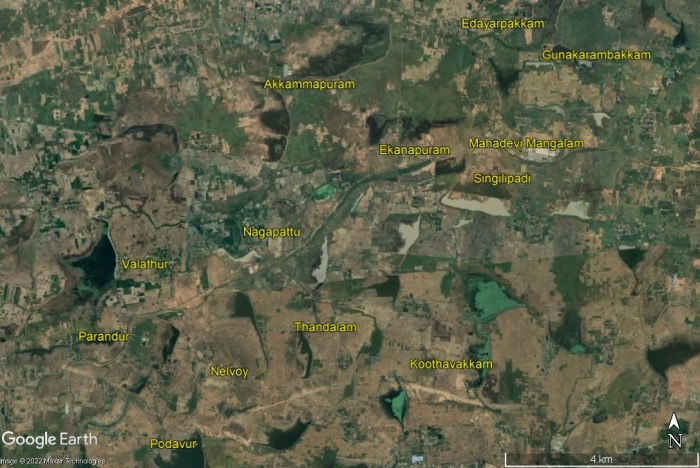
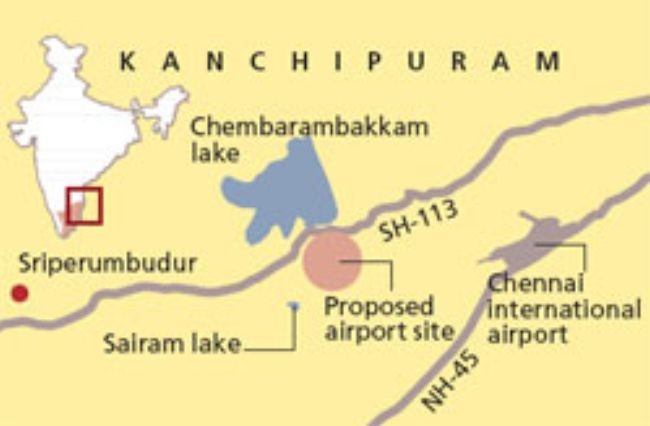
Thousands of farmers and residents have urged the Tamil Nadu state government and Central government of India not to implement a proposed second Chennai airport in Parandur that would destroy their agrarian activities and livelihoods. Parandur is an agricultural area in the Kanchipuram district and the State government plans to acquire land in 12 villages for the airport project. The proposed site in Purandur is approximately 57 kilometres eastwards of the existing Chennai Airport and to the north of the Chennai-Bangalore national highway which is being constructed in stages. Below is a slideshow of a map of the proposed airport site and Google Earth satellite imagery showing several of the villages that might be impacted by land acquisition.

  • map of proposed airport in Parandur
  • Villages the may be impacted by land acquisition for airport in Parandur

A Times of India article states that the 12 villages from which land for the airport will be acquired are: Parandur, Valathur, Nelvoy, Thandalam, Polavur (Podavur), Madapuram, Ekanapuram, Akkammapuram, Singilipadi, Mahadevi Mangalam, Gunakarambakkam and Edayarpakkam. Other villages to be impacted by land acquisition are listed in other sources referenced in this blogpost, namely Nagapattu, Koothavakkam, Uthyarpakkam and OM Mangalam.

Concerns over acquisition of farmland and environmental issues

On 1st August Union Minister of State for Civil Aviation Vijay Kumar Singh announced that the Parandur site has been finalised after consultation with the Tamil Nadu government. Some Purandar residents demanded suitable replacement land and employment from the government in return for acquiring their land; others said that acquisition of their agricultural land will render them jobless as it is the only work they have known. Some villagers have spoken to media outlets about reluctance to give up their land and uncertainty over provision of compensation:

Ramasamy, from Ekanpuram village, said “A huge tract of our agricultural land would come under this project. We don’t want to lose our agricultural land for this project because farming is our sole source of livelihood.”

Jayakumar, a farmer from Singilipadi, said, “We have been living here for generations. We didn’t know that the airport is coming up here. No one has informed us. If the government suddenly takes away our homes and land, what would we do? Even if they provide compensation, we don’t know what that would be. I am shocked.”

Rajendran, a resident of Thandalam, said, “We are ready to give up land if needed. But we need assurance from the government about good compensation and employment.

Selvaraj from Parandur village said, “We’ve been here in the village for the last 50 years. As per the map released by the government, 5 villages would be destroyed for constructing a new airport. Even if the government gave us compensation for our land, we don’t know what to do for a living, since we know only farming. All of us are shocked by this decision and are planning for a big protest soon. Even last month, the district collector assured us that the airport would not be constructed in Parandur.”

Nachiyappan, a farmer from Koothavakkam, said, ”We are living by farming and if the government acquires our land what will we do for a living? I have small children and want to educate them and am the sole breadwinner for the family. The government will make all sweet talking, but in reality, nothing will happen and we will be the losers. We will protest strongly against this project that will destroy our livelihood as well as the flora and fauna of the area.”

A postgraduate in Economics from Koothavakkam, R. Bindu, said, “Around 800 houses would be demolished in the area and the agrarian economy will be totally destroyed. There are many people in this village who don’t have the patta or the legal rights of the land and they will be totally on the streets.”

Many villagers are employed by the Mahatma Gandhi National Rural Employment Guarantee Scheme (MNREGS) and are concerned that their livelihoods could be destroyed along with the agricultural fields.

An environmental expert pointed out several hydrological problems that might arise from construction of the airport, from decreased recharge of groundwater to deterioration of water quality and possible flooding during the monsoon. The 4,791-acre site is dotted with water bodies and a large proportion, 2,605 acres, is wetlands. A large number of migratory bird species, especially from eastern Europe, visit the site. Some of the birds fly south to Vedanthangal which would pose a bird strike risk to air traffic. Building a stable structure on wetlands would be challenging. Parandur has a lake where migrant birds – tufted ducks, flamingos and common pochards – are frequently spotted.

An airport on a 4,791-acre site, with a huge aerocity

The proposal is for the new airport, with two runways, to have capacity to handle 100 million passengers annually, almost five times higher than the capacity of the existing Chennai Airport, at 22 million passengers per year. Capacity at Chennai Airport is being increased to 35 million in a seven-year expansion project. The runways at the airport in Purandar would be larger than at Chennai Airport, enabling it to handle larger aircraft carrying more than 600 passengers. Tamil Nadu chief minister Muthuvel Karunanidhi Stalin said the initial estimated cost of the proposed airport is Rs20,000 Crore, more than USD2.5 billion. Details of the break-up of this sum, and the funding route, have yet to be made public.

A Times of India article states that ‘The plan is to develop a huge aero city with facilities for maintenance and repairs, aviation ancillary units, and commercial establishments’. Confederation of Indian Industry (CII) Tamil Nadu Chapter chairman Satyakam Arya has pushed for an aerocity around the new airport, which in addition to aviation related facilities could have a convention centre for global conferences and exhibitions. Shankar Vanavarayar, vice-chairman of CII Tamil Nadu, said the state may introduce special schemes and incentives for industries in order to spur industrialization from Chennai towards Parandur.

The proposed site for the Parandur airport, 4,791 acres (1,939 hectares), is certainly large enough to allocate a significant portion of the site for non-aviation facilities. It is larger than the world’s largest airport, Hartsfield Jackson in Atlanta USA, which, with five parallel runways and a site of 1,902 hectares, handled more than 110.5 million passengers in 2019, before traffic reduced worldwide due to the response to Covid-19. In addition to the 4,791-acre site a further 200 acres of land is required for construction of two airstrips, for which the process of surveys and land acquisition is likely to start soon.

Difficulties acquiring thousands of acres for the airport

Land availability has been the main hurdle stalling the second Chennai airport project since it was first mooted, in 1998. Many attempts at large-scale land acquisition failed until authorities zeroed in on Parandur and an article in The Hindu provides a timeline. In November 2000 a ‘futuristic terminal’ was anticipated on a 3,000-acre site likely to be at Porur in west Meenambakkam, north of the existing Chennai Airport. In May 2007 the then Chief Minister of Tamil Nadu, Muthuvel Karunanidhi, said that 4,820 acres would be acquired for the airport in Sriperumbudur. In 2016 the proposed greenfield airport, still planned in the vicinity of Sriperumbudur, was mired in land procurement problems. Union Minister of State for Civil Aviation Jayant Sinha said the thousands of acres required for the new airport were difficult to procure.

In January 2022 the Airports Authority of India (AAI) began to study four potential alternative sites identified by the State government: Pannur, Parandur, Padalam and Thiruporur. Subsequently this list was narrowed down to Pannur and Parandur. On 1st August 2022 Minister of State for Civil Aviation Vijay Kumar Singh said the Tamil Nadu government had shortlisted Parandur as the site for development of a second Chennai airport. The State government will now submit a proposal to the Ministry of Civil Aviation for ‘grant of site clearance’ for the finalised site. The State is also set to begin preparation of a detailed project report. Land acquisition is likely to begin once the State receives approval from the Centre. State government officials have confirmed they will conduct sittings in all affected villages allowing people to express their views to officials.

2010 protest against land acquisition in Sriperumbudur

The article with the project timeline in The Hindu does not mention that the 2007 identification of land for the airport in Sriperumbudur triggered mass protest by villagers resisting land acquisition. In 2010 Moverment against SEZs in Tamil Nadu reported that a 6,921-acre (2,800-hectare) site in Sriperumbudur, located eastward of Parandur and just 30 kilometres from Chennai’s existing airport, had been earmarked for a greenfield airport. The proposed land acquisition for the new airport threatened to displace 2,800 families, about 37,000 people, from 20 villages. Village representatives opposed the airport project and were not interested in compensation from the government. They said agriculture was viable in the proposed site where they cultivated rice paddies, mangos, jasmine trees and vegetables. The site also containing 77 lakes, 120 ponds and 10,000 trees which would be felled. Six village panchayats – Thirumanaikuppam, Vadamangalam, Vayalur, Thirupandiyur, Kottaiyur and Kiloy – passed resolutions opposing land acquisition in a gram sabha meeting.

Proposed site for secodn Chennai airport in Sriperumbudur
Proposed site for a 2nd Chennai airport in Sriperumbudur, triggering mass protest in August 2010. Image: Down to Earth, 15/09/2010

Villagers drove away officials sent to survey the land on at least three occasions. On 12 August 2010, 3,000 people from 26 villages demonstrated against the project. Police attacked them with a lathi (baton) charge. Villagers who went to meet the District Officer and attempted to present a petition were beaten and around 20 of them had to be admitted to hospital. A jet fuel pipeline to Chennai Airport, routed through Sriperumbudur, seemingly hardwired the area for development of a new airport. Inaugurating the fuel pipeline in 2009 Praful Patel, Minister of State for Civil Aviation from 2004 to 2011, said, “This (pipeline) also passes through Sriperumbudur where another airport is planned. Once it comes up, the pipeline will be extremely useful.”