Zimbabwe: More than 7,000 people forcibly evicted from Willdale Farm

Forcible eviction of informal settlements from Willdale Farm, to make way for residential units, an industrial park and to support expansion of Charles Prince Airport, led to a humanitarian crisis. Over 7,000 people were left stranded by the roadside without shelter, food, water or sanitation.
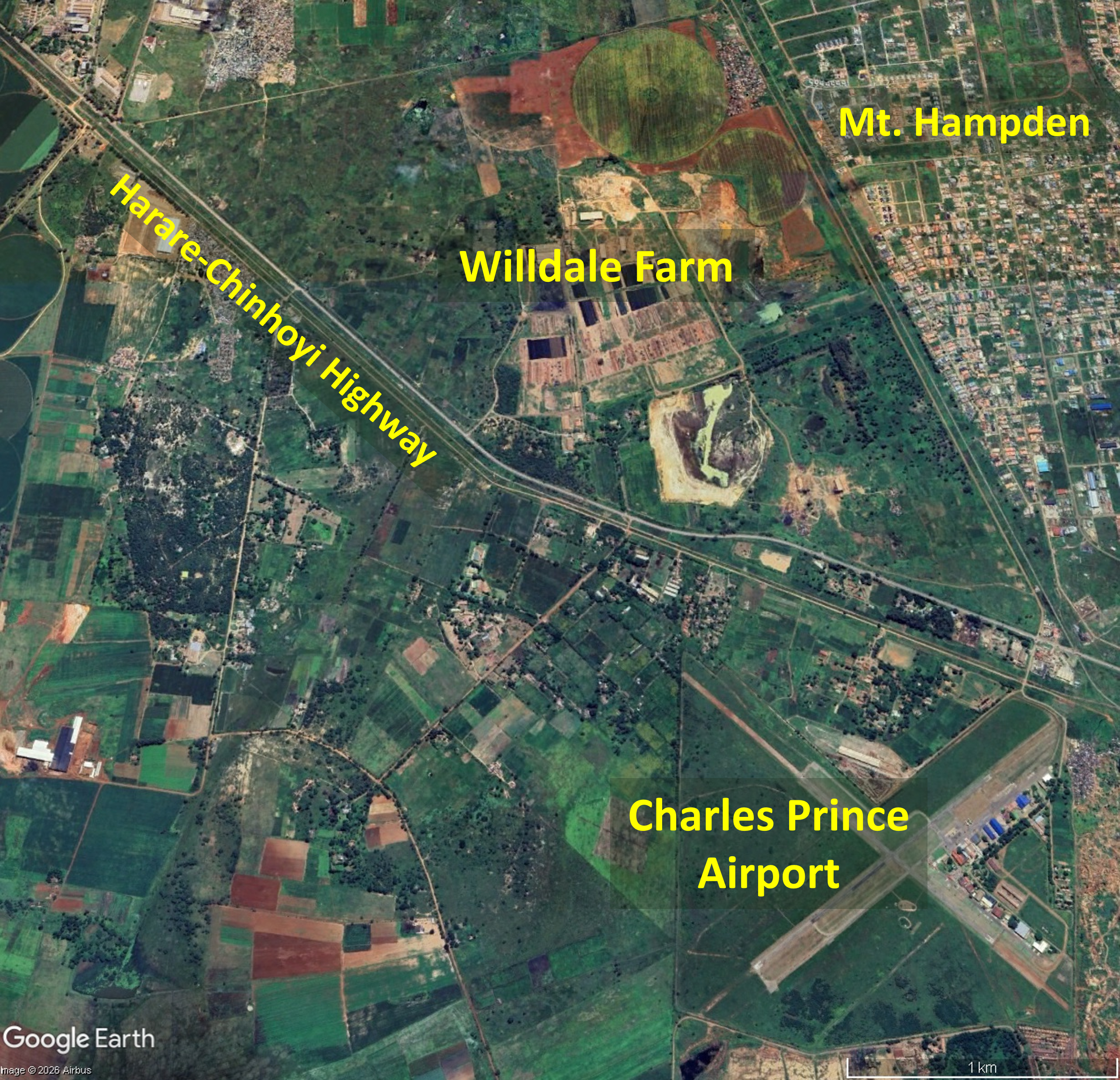
WIlldale Farm and Charles Prince Airport
Willdale Farm and Charles Prince Airport. Aerial imagery: 7th March 2025

In September 2025 more than 7,000 families residing on Willdale Farm, in the Mount Hampden area northwest of Harare, on land used for extracting clay for brick manifacturing, were served with eviction orders. Addressing the thousands of affected residents on 28th September Zimba East MP Kudakwashe Mananzva made reassurances that the government was committed to resettling all affected families and nobody would be rendered homeless. But people threatened with eviction complained that the landowner, brickmaking firm Willdale, was exerting pressure to force them to leave. On 29th November Zimbabwe Human Rights Association (ZimRights) reported that forced eviction had ’created an urgent protection crisis’. Evicted people had been left without shelter in heavy rains raising serious human rights concerns including rights to adequate housing and protection from inhumane treatment. On 2nd December New Zimbabwe reported that the ‘humanitarian crisis at Willdale Farm has deepened’; more than 7,000 residents had been evicted and were camped alongside the Harare-Chinhoyi highway to the south of Willdale Farm. The Department of Civil Protection acknowledged the scale of the eviction and said a temporary relocation site had been identified, about 14km northwest of Willdale Farm in Nyabira. State of the Nation reported widespread concerns over a ’humanitarian crisis’ affecting a vulnerable population including children and elderly people.

Zimbabwe Human Rights Commission (ZHRC) expressed serious concerns over the Willdale Farm mass eviction, flagging legal failings. On a 29th November site visit chairperson Jessie Majome saw hundreds of evicted people camped out along the road in the open air without water, sanitation or water. A 2nd December follow-up visit by the ZHRC secretariat confirmed that about 7,000 people including children, the elderly and disabled were still stranded. ZHRC said civil procedures had been violated, including the right to be heard, which might constitute a breach of constitutional rights pertaining to the right to a fair hearing and freedom from arbitrary eviction. ZHRC acknowledged efforts by the government to provide temporary alternative land in Nyabira but the relocation process was ‘extremely slow’, at this juncture nearly 8,000 people had been evicted but only 36 families had been relocated. A monitoring report by Zimbabwe Peace Project (ZPP) highlighted the Willdale Farm eviction, with families granted less than one hour to leave their homes before bulldozers arrived, as one of the most serious incidences of 123 human rights violations recorded in November 2025.

On 8th December Willdale announced that it had gained vacant possession of the 123.6314 hectares of land that had been occupied by third parties and the appointed contractor began mobilising equipment for construction of the project, an industrial park to support an emerging new city and expansion of Charles Prince Airport, located to the south of Willdale Farm and currently used by light aircraft and flights schools, into a regional hub for trade and commerce. An agreement for expansion and upgrade of Charles Prince Airport, was established between Zimbabwe and China during President Mnangagwa’s visit in 2024. Transport and Infrastructure Development Minister Felix Mhona highlighted the land and space for development around Charles Prince Airport, saying, “Once completed, the airport will serve as an international airport”, mentioning the airport’s proximity to the new Cyber City and new parliament building, located northeast of Willdale Farm. The Airports Company of Zimbabwe (ACZ) December 2025 announcement of airport infrastructure projects for the following five years highlighted upgrade of Charles Prince Airport, estimated to cost USD1 billion and supporting the government drive to establish new business and administrative hubs in the Mount Hampden area.

For more information including references for all source material, photos and videos see the case study on EJAtlas, the world’s largest, most comprehensive online database of social conflict around environmental issues – Willdale Farm mass eviction, Zimbabwe

Puerto Rico: Resisting Esencia, a luxury tourism and residential development with a private airport

Many local and diaspora organisations are opposing Esencia, a luxury tourism and residential megaproject with a private airport, in Cabo Rojo. The development has been granted generous tax credits and would require vast volumes of water.

In May 2024 two real estate firms, Reuben Brothers and Three Rules Capital, filed a master plan for Esencia, a USD2billion development in Boquerón Bay, Cabo Rojo on the west coast of Puerto Rico. Anchored by international hotel operators Mandarin Oriental Hotel Group, Aman Group and Rosewood Hotels and Resorts and containing up to 500 luxury hotel rooms and 900 tourist residences the complex would have a private airport. The Esencia website says the new ‘residential and hospitality community’ will have 3 miles (4.8km) of ‘pristine beachfront’. Plans also included two golf courses, spa, wellnesses centre, health clubs, equestrian centre, hiking and biking trails and a school.

Project Esencia proposed plan
The proposed Esencia plan, with sea views and a private airport, includes luxury hotels and residences and two golf courses. Image source: Reuben Brothers

The Esencia project was granted more than USD497 million in tax credits and in August 2024 four new tax exemptions of between 90 and 100 per cent were approved. A new decree granting 100 per cent fuel tax exemption for tourism-related activities was criticised for incentivising high levels of fossil fuel usage. Comité por la Verdadera Esencia del Suroeste sent statements to multimedia platform Marea Ecologista concerning the proximity of the project site to protected ecologically sensitive areas providing habitats for endangered birds such as the Puerto Rican nightjar. Responding to the absence of public hearings on permits and boundary demarcation for the Esencia project a town hall was convened by local community, environmental and cultural groups on 28th September 2024 where further detail of Esencia project components, including shopping malls and renovation of an airstrip to accommodate small aircraft, was shared.

The land within the site is rural and falls under two classifications. One category is rural land protected because of its ecological importance as it is located between two nature reserves and serves as a corridor for many species and also for its recreational value. The second category is rural land where there is more flexibility regarding development and in recent years mechanisms to evade compliance with the land use plan have been deployed such as declaring projects to be strategic or of critical importance. The project area contains at least 24 archaeological sites from the colonial and pre-colonial eras, many of which have not yet been explored.

On the first day of public hearings in March 2025 Cabo Rojo’s streets were filled with protesters holding posters and banners, many declaring ‘No to Esencia’ and calling the project an enclave for a small number of billionaires. The hall was not big enough to accommodate all the people opposing the project so many watched the proceedings on a screen in a tent outside. Puerto Rican groups opposing the project joined forces under the slogans ‘Defend Cabo Rojo’ and ‘No to Esencia’. The anti-Esencia movement gained support from Puerto Rican diaspora and pro-independence organisations, amplifying locals’ calls for cancellation of the project and holding protests throughout New York. For example, protesters occupied the lobby of the Mandarin Oriental Hotel and unfurled banners in the luxurious Columbus Circle shopping mall.

Officials said the project’s environmental impact statement (EIS) did not address the impacts on infrastructure and ecosystems and lacked hydrological studies. Esencia would place additional strain on water supplies, consuming more than 1.25 million gallons per day, a volume equal to more than a third of current consumption in the Cabo Rojo Municipality. This is a low estimate as it does not include the project proposal’s two golf courses which would increase the volume of water consumed per day to 2 million gallons. The development would require extraction from aquifers or connection to the existing drinking water system but neither of these options are feasible. Local fishers expressed concerns over the risk of damage to oyster beds and disruption of freshwater and saltwater flows that are essential to the health of the estuarine environment.

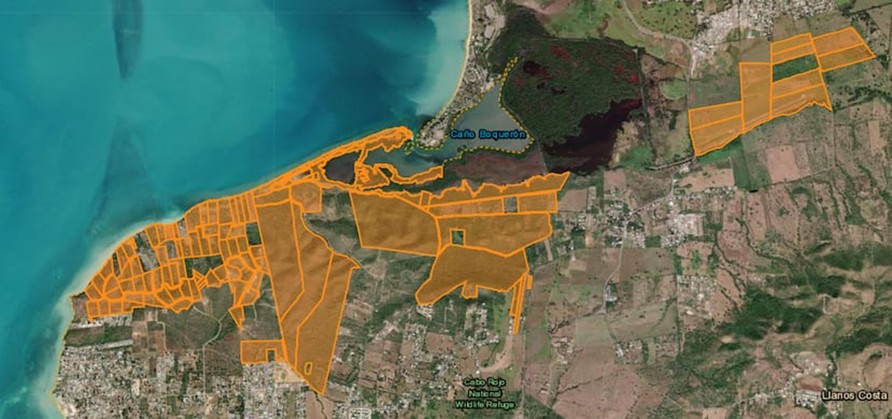
Properties in Cabo Rojo purchased for Esencia
Many of the properties purchased for the Esencia project are shown in orange, agricultural land purchased in August 2025 is shown to the right. El Nuevo Día, 20/09/2025

By September 2025 project investors had spent approximately USD147 million on properties for Esencia and were on track to acquire the target of 809 hectares of land. Recent land parcel purchases were part of the Reserva Agrícola del Valle de Lajas (Lajas Valley Agricultural Reserve) and an airstrip. On 12th September the Department of Natural and Environmental Resources (DNRA) published a 29-page report firmly reiterating its opposition to the Esencia project and concluding that the plans did not comply with environmental laws. Significant findings included fragmentation of habitats hosting endangered bird species, severe impacts on Catesbaea melanocarpa, a rare, endangered lily and threats to the habitat of Anolis poncensis, a rare lizard species. The project’s so-called ‘ecological corridors’ lacked the connectivity of existing ecosystems and golf courses, artificial ponds and landscaping claimed to be mitigations would be part of the project’s negative impacts.

For more information including references for all source material and photos see the case study on EJAtlas, the world’s largest, most comprehensive online database of social conflict around environmental issues – Esencia project, Puerto Rico

By 3rd November 2025 a petition – STOP THE LUXURY MEGAPROJECT “ESENCIA” IN CABO ROJO, PUERTO RICO NOW – calling on the Puerto Rican government and its agencies to stop the permit granting process, protect the land, study submitted material and conduct a transparent investigation prioritizing affected communities and experts, had attracted 36,327 signatures: Detengan ahora el megaproyecto de lujo “Esencia” en Cabo Rojo, Puerto Rico (STOP THE LUXURY MEGAPROJECT “ESENCIA” IN CABO ROJO, PUERTO RICO NOW)