Hundreds of people were displaced by a demolition exercise to make way for expansion of Muhammadu Buhari International Airport
On 30th January 2025 a number of residents of Shuwari 5 ward in Maiduguri, near the Muhammadu Buhari International Airport runway, reported that the Borno State Government was demolishing their houses. A bulldozer destroyed houses while residents retrieved essential household items. People whose houses were still standing but had been marked for demolition worked to remove roofs from their houses. One resident said people had received only three days’ notice before their homes were demolished and appealed to the Borno State Governor to provide compensation or alternative shelter for affected residents as they had no other place to go to.

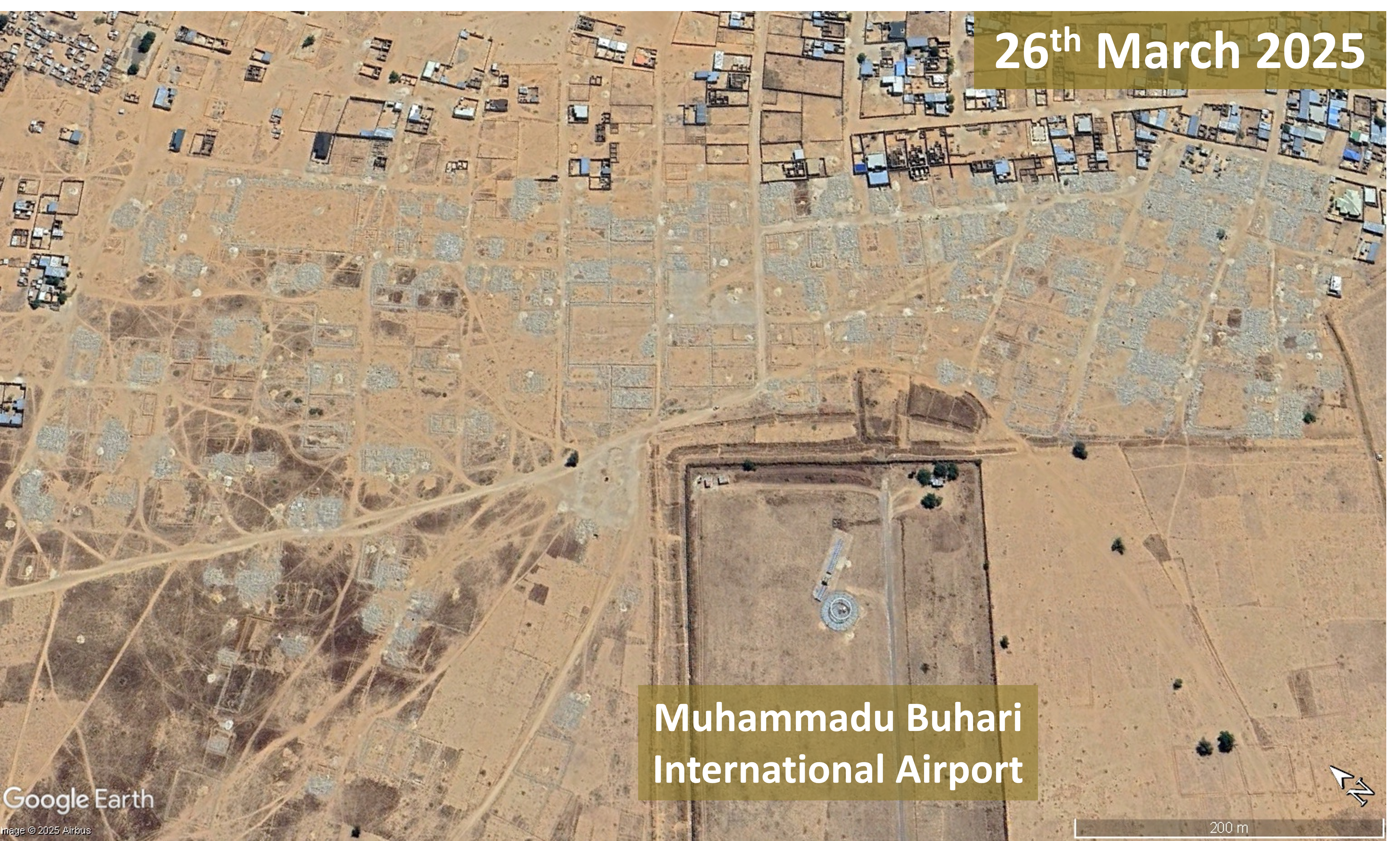
On a visit to Borno State in October 2024 Minister of Aviation and Aerospace Development, Festus Keyamo, had announced that Muhammadu Buhari Airport had been upgraded to international status and would commence operation as an international airport from 1st January 2025. The General Manager of Borno State Urban Planning Development Board, Liman Mustapha, said the purpose of the demolition exercise beginning on 30th January 2025 was to secure land for upgrade of the airport. He also said there would be no compensation for affected house owners and that residents had been informed that their occupation of the land was illegal in 2020 and since then authorities had attempted, unsuccessfully, to stop construction of houses on the land.
The demolition exercise targeted the area up to 500 metres from the airport fence, beginning with the area within 200 metres. Adamu Matankolo, Acting Regional Manager of the airport, said upgrade of the airport to international status by the federal government necessitated its expansion. He said, “We sympathise with the people who don’t want to obey this order. We have our plan and out plan is that the area slated for demolition is a buffer zone.”
Premium Times reported that more than 100 houses were demolished and many of the affected people had occupied the area for over 10 years having been displaced by the Boko Haram insurgency. The IDPs (Internally Displaced Persons) thought their resettlement was permanent until the state government demolished their houses. An IDP and single mother of three children said residents received a notice from the Borno State Geographical Information Service (BOGIS) just a few hours before the demolition exercise began.
Many people criticised the State government’s handling of the demolition exercise on social media, in the context of the Borno state’s socio-economic problems caused by the Boko Haram insurgency and a recent flood impacting 40% of the city of Maiduguri. Commenting anonymously a Maiduguri-based lawyer gave a detailed statement on the government’s obligations regarding compensation, concluding: “Thus, if a house is built on government land without approval, the owner is generally not entitled to compensation. However, if the government initially allowed of overlooked the development, there is scope for negotiation or legal redress.”
HumAngle, a media platform focussed on conflict, humanitarian, and development issues in Africa, reported that the demolition had displaced hundreds of people. One of them, a widow raising four children who had lived in Shuwari 5 for 17 years, said the government only notified people about the demolition two days before bulldozers arrived, not even giving enough time for gathering belongings. She said at least three affected people had died of shock and more than 20 had fallen ill due to trauma.
Liman Gana, head of Borno State Building Planning Authority, said 306 structures had been demolished, including 64 fully occupied houses, 42 incomplete structures and 17 incomplete buildings. A Federal Airports Authority of Nigeria (FAAN) official gave technical and safety reasons for the demolition exercise, saying structures built too close to the runway posed safety risks. Many displaced residents insisted that they were not informed of these risks before they bought or built their homes and said resettlement should have been planned and implemented before the demolitions took place.
For more information, including references for source material, see the case study on EJAtlas, the world’s largest, most comprehensive online database of social conflict around environmental issues – Demolition of houses for Muhammadu Buhari International Airport expansion, Nigeria
 antiaero.org