Landholders of San Salvador Atenco, Mexico, successfully resisted plans to build a mega-airport on farmlands in 2001. In 2006, the government punished the community with a brutal police raid. The propject was revived, even larger than before, in 2014. Resistance continues, and UK based Dorset Chiapas Solidarity is urging people to write to the two UK firms that have been contracted as the airport’s architect and engineering consultant.
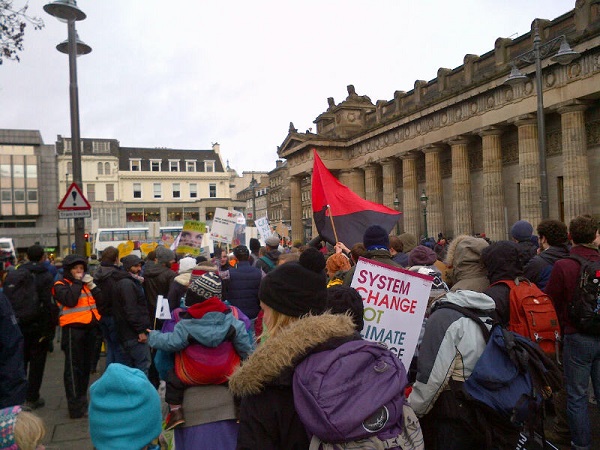
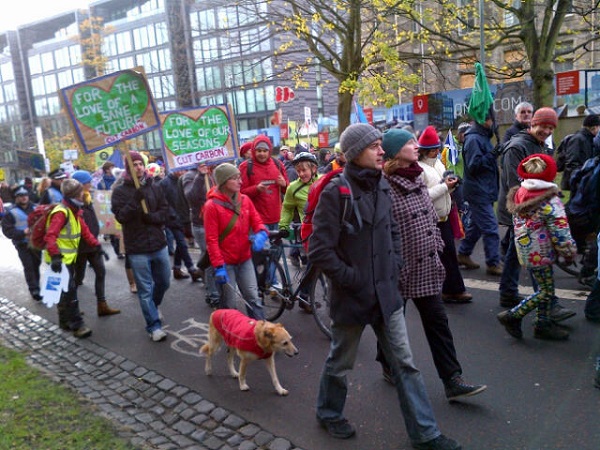
Leaflet distributed at the Climate Change March in Edinburgh
Defending their lands and opposing the new airport in Mexico City
On the front line of Blockadia, resisting climate change
Solidarity with the people of San Salvador Atenco
British companies are involved
Take action!
In her book THIS CHANGES EVERYTHING – CAPITALISM VS THE CLIMATE, Naomi Klein writes of the central importance of Blockadia. She describes how round the globe local people are taking direct action to resist extreme extractive industries and mega-projects which cause great damage to the environment and contribute significantly to climate change. One such struggle is happening now in Mexico.
In 2001, the indigenous common landholders of San Salvador Atenco were successful in their fight against the building of a new airport in Mexico City on their ancestral farm lands. The Peoples Front in Defence of the Land (FPDT) became emblematic for their highly symbolic machetes…
The second issue of GAAM Aerotropolis Update has been published. It looks at a total of 46 aerotropolis developments, in all regions of the world, with major land allocation for greenfield projects (on undeveloped land). Maps created for GAAM show the land area for three major aerotropolis projects:
plans for KZN (KwaZulu-Natal) Aerotropolis, around King Shaka Airport in South Africa, span over 200 square kilometres
plans for Long Thanh aerotropolis, in Vietnam, covers 50 square kilometres, requiring relocation of 15,000 people, and that’s just for phase one
the Atlanta Aerotropolis Alliance highlights an area of 418 square kilometres, predominantly urban and suburban land with areas of woodland
At the other end of the scale, the smallest aerotropolis developments cover a few hectares, but still raise concerns of loss of ecosystems and preferential treatment for firms, such as tax breaks. The Update covers just a fraction of what is happening worldwide. Material is already being compiled for Issue 3. If you missed Issue 1 it is available on the GAAM Aerotropolis Update page.
There are a lot of internet videos promoting aerotropolis projects – here is one that is critical. ‘Parasitic Urbanization: The Transformation of Istanbul’, a talk by Cihan Uzunçarşılı Baysal
The presentation highlights Istanbul’s airport, currently under construction, and other mega infrastructure projects in the region, which are symptomatic of the phenomenon of “planetary urbanisation”. What is happening with this wave of urban development is not new cities, it is not settlements that are contained within boundaries. A new type of urbanisation is extending its influence over the entire surface of the earth, even encroaching into the atmosphere and into the oceans and underground. A key characteristic of this new wave of urbanisation is that it is “parasitic” – it depends on nutrition from its host – sucking in water and other resources from a large hinterland area.
Baysal describes Istanbul’s third airport as an “ecocide” project. Forest is being felled and lakes filled, on a massive scale, and not just for an airport; land is being prepared for an ‘aerotropolis’ extending over a much larger area. An aerotropolis is the opposite of traditional airports, built to serve an established city. An aerotropolis is an airport-centric development, commercial development around an airport that is designed to serve aviation growth.
The talk explains that Istanbul’s third airport is one of the largest of no less than 43 megaprojects underway and planned in the region – most notably a third Bridge across the Bosphorus Strait and a canal alongside it. There is no democratic process whatsoever for deciding to embark on the megaprojects; they are imposed by the government and the firms awarded contracts. Citizens simply do now know what “insane” scheme is going to be announced next.
Campaigners against the Istanbul megaprojects make use of satellite images to reveal the reality of the ecological destruction. These images reflect a global phenomenon. They are examples of the 21st century iconic image of urbanisation, an aerial photograph of excavated and bulldozed area of land, a site being prepared for construction, an image of destruction that is similar to the tar sands in Alberta. This is a marked contrast with the exciting iconic image of 20th century urbanisation: the skyscraper.
Ecologically destructive urban development in Istanbul also exacts a human cost. People are being displaced for the airport and other megaprojects – forced out of their homes by eminent domain, then dumped in new settlements on the periphery, far away from their livelihoods and social life in Istanbul, having to undertake long commutes for work and leisure.
The underlying agenda for the orgy of construction is opening up land for plunder, turning it into a financial and speculative asset, which facilitates the accumulation of capital. The megaprojects are in the process of “privatising and commercialising each and every urban space” and must be halted.



 antiaero.org